Before vaping at a café, station, beach, workplace, or airport, how do you know if it is legally prohibited? Where Is Vaping Prohibited in Australia? The answer depends on both the location and the jurisdiction. Council rules, property policies, and temporary event restrictions can also create extra vape-free areas.
A place may seem open and unrestricted but still fall within a regulated boundary. Building entrances, playgrounds, transport stops, and outdoor dining areas, for example, may have buffer zones. Check the exact site rather than assuming that vaping is allowed in every outdoor space.
1. Where Is Vaping Prohibited in Australia?
Every state and territory applies significant smoke-free protections to vaping. As a general rule, you cannot vape anywhere the relevant legislation treats e-cigarette use as smoking. The details vary, though, including legal definitions, covered locations, boundary distances, exemptions, and enforcement methods.
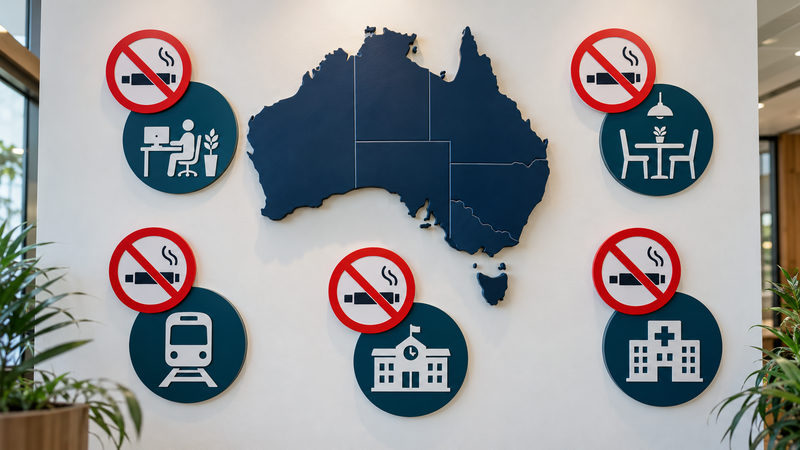
No single nationwide rule prohibits vaping in every Australian public space. Instead, legality depends on the jurisdiction, type of location, displayed signs, local laws, and property policy. One beach might prohibit vaping only between the patrol flags, while another council may make the entire beach vape-free.
Federal and local responsibilities
Federal law governs several national matters involving vaping products, including importation, domestic manufacture, commercial supply, advertising, aviation safety, and some Commonwealth property. State and territory laws, meanwhile, regulate most smoke-free public places and vehicles carrying children.
Transport operators, airport managers, councils, universities, and government agencies may introduce further restrictions. Venue owners can also prohibit vaping across their properties. So, a rule may still apply even if general smoke-free legislation does not cover that exact location.
Nicotine content usually has no bearing on whether a location restriction applies. Many laws focus on the device, aerosol, or act of vaping rather than nicotine itself. A device labelled nicotine-free may therefore still be prohibited in a smoke-free area.
Lawful possession or pharmacy access does not give anyone the right to vape wherever they choose. A prescription does not override location restrictions either. The safest approach is simple: if smoking is prohibited, assume vaping may be prohibited too unless official guidance says otherwise.
2. Indoor Venues, Hospitality Businesses and Workplaces
Enclosed public places are generally smoke-free and vape-free throughout Australia. This commonly includes shopping centres, cinemas, libraries, galleries, community halls, and indoor recreation facilities. Shared corridors, toilets, lifts, foyers, and other enclosed common areas are usually covered as well.

The same rule generally applies to indoor hospitality areas. Do not vape inside restaurants, cafés, pubs, clubs, bars, nightclubs, or food courts. Even a spacious room with open doors may still meet the legal definition of an enclosed area.
Outdoor food and drink areas
Outdoor hospitality rules need a closer look because jurisdictions define covered areas differently. Some ban vaping throughout outdoor dining spaces. Others tie the restriction to food-service times, seating layouts, licensed areas, or separation barriers.
A courtyard, for example, may become vape-free whenever meals are available. A separate drinking area could operate under different conditions. Buffer zones may also push the dining restriction beyond the tables and chairs themselves.
- Check whether food is being served or offered for consumption.
- Look for boundaries separating dining and designated smoking areas.
- Follow venue signs even when the area appears legally open.
- Ask staff before vaping in any hospitality courtyard or terrace.
Workplaces and private premises
Smoke-free legislation commonly covers indoor workplaces and offices. Work health and safety duties may also require employers to manage exposure to vaping aerosol. Employers can go further by adopting policies that cover entrances, grounds, balconies, vehicles, and off-site work activities.
Hotels and serviced apartments often combine legal restrictions with their own house rules. Shared hallways, lobbies, restaurants, and other enclosed public areas usually face the clearest legal limits. Rules for individual rooms and balconies may instead depend on booking conditions, fire regulations, strata requirements, or management policies.
At rental properties, lease terms, building rules, and body-corporate policies may all come into play. Tenants should not assume that vaping is permitted on a private balcony. Aerosol drifting into neighbouring homes or common property can also lead to complaints and tenancy disputes.
Even a designated smoking area may not permit vaping. An operator might allow tobacco smoking while excluding electronic devices for safety or policy reasons. Read the sign carefully, or ask staff before using a vape.
3. Transport, Airports and Vehicles Carrying Children
Vaping is generally prohibited inside public and commercial passenger transport, including trains, buses, trams, ferries, taxis, and other passenger vehicles. Operator conditions also usually ban vaping in rideshare vehicles, even where legislation uses different terminology for transport services.

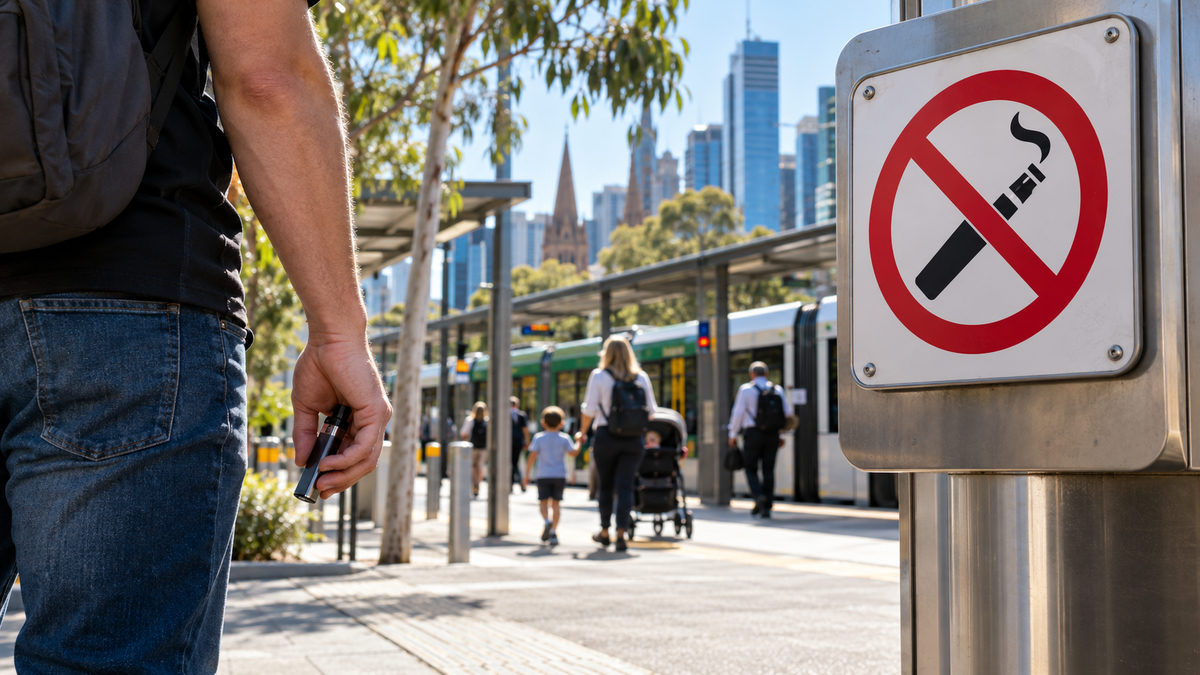
The restriction often reaches beyond the vehicle. Platforms, stations, shelters, bus stops, ferry terminals, taxi ranks, and transport interchanges may be vape-free too. The amount of property covered and any required boundary distance vary by jurisdiction.
Airports and aircraft
Vaping is generally prohibited inside airport terminals and on aircraft. Airlines also ban its use during flights, including inside aircraft toilets. Outdoors, vaping is usually limited to areas specifically authorised by the airport operator.
Do not take it for granted that every airport smoking area allows vaping. Fire controls, terminal rules, and airline policies can each impose separate conditions. If the permitted area is unclear, follow the signs and ask airport staff.
Possessing a device and using it are separate matters. Security screening, spare-battery packaging, device storage, and carriage aboard an aircraft are subject to aviation safety rules. International destinations may also prohibit the importation or possession of vaping products, even if an Australian airport allows them to be carried.
Cars and commercial vehicles
Australian jurisdictions prohibit smoking or vaping in vehicles when protected children are present. The relevant age threshold and legal wording are not uniform. Some laws cover children under 16, while others extend protection to anyone under 17 or 18.
The rule can apply whether the vehicle is moving or parked. Opening a window makes no difference. Drivers and passengers should avoid vaping whenever a child is in the vehicle.
Other restrictions may apply even when no child is present. Employers, fleet operators, taxi companies, rideshare platforms, and rental businesses can make their vehicles completely vape-free. Breaching those rules may result in cleaning charges, workplace discipline, or account consequences without any public-place infringement.
4. Schools, Hospitals, Playgrounds and Outdoor Public Areas
Education settings receive strong protection across Australia. Vaping restrictions commonly apply to school buildings and grounds, childcare centres, preschools, and early-learning facilities. Several jurisdictions also set specific distances around entrances, exits, grounds, or property boundaries.
That means a footpath outside a school may still sit inside a regulated zone. Waiting near a childcare entrance could do the same. Follow boundary signs rather than estimating the restricted area from the fence line.
Healthcare and recreation sites
Hospitals and healthcare facilities commonly prohibit vaping indoors. Many extend the ban across their grounds or within set distances of entrances and boundaries. Aged-care providers may also enforce comprehensive policies covering rooms, courtyards, gardens, and vehicles.
Many places used by children and families are covered as well. These can include playgrounds, public swimming pools, recreation centres, skate parks, and organised junior sporting events. Some jurisdictions, for example, apply a 10-metre zone around playground equipment or junior sporting activity.
Stadiums, sporting grounds, festivals, concerts, markets, and ticketed events can be governed by several layers of rules. Legislation might cover part of the site, with a council lease or organiser policy covering the rest. Ticket conditions and temporary signs can therefore make an entire event precinct vape-free.
Beaches, parks, and council areas
Australia does not have one nationwide vaping rule covering every beach, park, reserve, and walking trail. Some laws apply to patrolled swimming areas or the space between lifesaving flags. Councils may also declare entire beaches, parks, pedestrian malls, or public squares smoke-free and vape-free.
Councils can introduce restrictions through local laws, formal declarations, leases, permits, or site-management policies. The rules may change as soon as you cross a municipal boundary. Temporary restrictions can also appear during festivals, sporting competitions, and community events.
- Keep away from entrances, exits, and ventilation intakes.
- Avoid playgrounds, childcare boundaries, and junior sporting areas.
- Stay clear of food-service zones, queues, and crowded spaces.
- Check beach, park, reserve, and event signage before vaping.
Distance requirements are not consistent across Australia. A four-metre rule from one jurisdiction should never be used as a guide in another. If no marker identifies the boundary, move farther away and ask the site controller for guidance.
5. Vaping Laws by State and Territory
All eight jurisdictions regulate vaping through their smoke-free frameworks, but their legislation, terminology, outdoor restrictions, and child-protection thresholds differ. The table below offers a practical comparison rather than a complete account of every exemption.
| Jurisdiction | Legal coverage and principal source | Important location rules |
|---|---|---|
| New South Wales | E-cigarette use falls under the Smoke-free Environment Act 2000. NSW Health provides current smoke-free guidance. | Restrictions cover enclosed public places, outdoor dining, public transport stops, pools, and spectator areas during organised sport. They also cover areas within four metres of public-building entrances and ten metres of playground equipment. Vaping in a vehicle with a child under 16 is prohibited. |
| Victoria | The Tobacco Act 1987 expressly covers e-cigarette use. The Victorian Department of Health explains smoke-free and vape-free areas. | Coverage includes enclosed workplaces, outdoor dining, transport platforms, shelters, schools, childcare grounds, and certain entrance zones. Ten-metre restrictions apply around specified recreational areas. Patrolled beaches carry special restrictions near lifesaving flags. |
| Queensland | The Tobacco and Other Smoking Products Act 1998 covers vapes, including nicotine-free products. Queensland Health publishes location guidance. | Broad restrictions cover indoor and outdoor no-smoking areas, hospitality settings, transport facilities, healthcare grounds, schools, playgrounds, and sporting locations. Queensland also uses several entrance and boundary zones. Vehicle restrictions protect children under the applicable statutory age. |
| Western Australia | The Tobacco and Other Products Control Act 2006 and regulations cover vaping. The WA Department of Health states that smoke-free places are also vape-free. | Restrictions include enclosed public places, workplaces, public transport, outdoor eating areas, playground zones, and patrolled beach areas. Rules also address entrances and air-conditioning intakes. Vaping in a vehicle with a child under 17 is prohibited. |
| South Australia | The Tobacco and E-Cigarette Products Act 1997 expressly regulates e-cigarettes. SA Health and current regulations provide detailed guidance. | Coverage includes enclosed workplaces, public places, outdoor dining, education sites, hospitals, pools, playgrounds, sporting facilities, and prescribed public areas. Several outdoor laws use boundaries rather than entrances alone. Readers should check commencement dates for newer aged-care restrictions. |
| Tasmania | The Public Health Act 1997 treats vaping as smoking for smoke-free controls. Tasmania’s Department of Health administers tobacco-control guidance. | Restrictions cover enclosed public places, workplaces, transport areas, outdoor dining, playgrounds, sporting venues, and declared streets or malls. Guidance identifies three-metre entrance zones and ten-metre air-intake zones in relevant settings. Site declarations can extend coverage. |
| Australian Capital Territory | The Smoke-Free Public Places Act 2003 covers smoke-free public locations. The ACT Government and Access Canberra provide compliance information. | Restrictions include enclosed public places, outdoor eating and drinking areas, government schools, health facilities, stadiums, and underage events. Vaping is prohibited at interchanges and within five metres of specified transport stops. Cars carrying children under 16 are covered. |
| Northern Territory | The Tobacco Control Act 2002 extends consumption restrictions to e-cigarettes. NT Health explains the legislation and government smoke-free policy. | Rules cover enclosed workplaces, enclosed public areas, transport, hospitality premises, and regulated outdoor eating or drinking areas. Licensed premises can involve specific conditions or exceptions. Government health facilities and vehicles may face broader policy restrictions. |
Differences that matter in practice
Buffer zones vary considerably. NSW applies a four-metre rule at many public-building entrances, while relevant Tasmanian guidance specifies three metres. Other laws use distances of five, ten, or more metres for particular sites and activities.
Outdoor hospitality rules vary too. Some jurisdictions ban vaping throughout outdoor eating and drinking areas. Others distinguish between spaces used for food service and drinking, or permit tightly controlled designated areas at licensed premises.
Protected ages in vehicles are not consistent. Nor is the coverage given to healthcare grounds, school boundaries, beaches, pools, and sporting areas. Exemptions, terminology, proof requirements, penalties, and authorised enforcement officers also differ.
Check the current health department guidance and legislation register for the relevant jurisdiction. Transport authority, airport, council, and venue pages may contain additional site-specific requirements. Give direct official guidance priority over summaries, social posts, or rules remembered from another state.
6. Fines, Enforcement and Private Vape-Free Policies
Vaping in a prohibited area can result in an infringement notice or prosecution. The amount depends on the jurisdiction, offence, location, and method of enforcement. Penalty units and fixed infringement amounts can change, so publishers should confirm them immediately before publication.
There is no single nationwide fine for unlawful vaping in public. An offence for individual use may carry a different consequence from refusing a direction given by an authorised person. Repeated behaviour or related offences can lead to further penalties.
Responsibilities of businesses and operators
Occupiers, employers, licensees, and venue operators may have separate legal responsibilities. Depending on the jurisdiction, they might need to display signs, remove ashtrays, or take reasonable steps to stop prohibited conduct. The maximum penalties they face may be higher than those imposed on an individual user.
Health inspectors, authorised council officers, transport officers, police, and other appointed officials may all take part in enforcement. Who has responsibility depends on the law and the location. Transport conditions may also allow a person to be removed or excluded without a health-law prosecution.
- Businesses may direct a person to stop vaping or leave.
- Employers may apply workplace disciplinary procedures.
- Landlords or strata managers may enforce lease and building rules.
- Event organisers may cancel entry or remove a patron.
- Transport operators may refuse travel under their conditions.
Private rules can go further
A lawful private policy can go beyond the minimum statutory restriction. Employers, landlords, councils, schools, universities, hotels, and event organisers often adopt wider vape-free policies. In other words, “not expressly prohibited by this law” does not automatically mean “permitted on this property.”
Breaking a private rule may lead to removal, refused service, workplace discipline, tenancy consequences, or loss of access. These outcomes are possible even where no public-place vaping fine applies. Ignoring a direction to leave could also create a separate legal issue.
A nicotine-free device is not a reliable exception. Where legislation defines the device or behaviour as vaping, enforcement may apply regardless of what the liquid is said to contain. Focus on the location rule, not the product label.
7. How to Check Whether Vaping Is Allowed
Begin with the signs around the site. Check for no-smoking, no-vaping, entry-condition, boundary, and temporary event notices. Look near doors, fences, tables, shelters, ticket gates, and information boards too.
If the rule is still unclear, ask whoever is responsible for the property. That may be venue staff, an employer, a property manager, or a transport representative. At an airport or festival, speak to airport staff or the event organiser before using the device.
Never assume a designated smoking area also allows vaping. Look for wording that specifically mentions electronic cigarettes or vaping. If a sign refers only to smoking, ask staff—legislation or property policy may still cover both.
A quick checking process
- Read all permanent and temporary signs at the location.
- Check current state or territory health department guidance.
- Review legislation when the exact legal boundary matters.
- Check council rules, transport conditions, or airport maps.
- Ask the venue or property controller for confirmation.
- Use only an area clearly identified as permitted.
Pay immediate attention to on-site restrictions when they differ from general online guidance. Follow the stricter displayed direction, then seek clarification from the relevant authority. Remember, a venue policy can lawfully cover more space than legislation requires.
Visitors should avoid vaping near entrances, children, food, queues, crowds, and sensitive facilities. Keep away from air intakes and regulated boundaries as well. A few extra metres can prevent exposure, complaints, and an accidental infringement.
Article maintenance note: Regularly review all official source references, boundary rules, exemptions, and penalty information. Transport, council, airport, and venue policies also need periodic checks. New rules may take effect before outdated summaries disappear from search results.
Legal information disclaimer: This guide offers general information, not legal advice. Regulations and local policies can change. Official government sources, current legislation, and site-specific directions always take precedence.
Conclusion
Vaping is not banned in every Australian public place, but it is commonly prohibited in smoke-free indoor settings and many regulated outdoor locations. Exact boundaries, child-age thresholds, exemptions, penalties, and enforcement arrangements vary across the eight jurisdictions.
Councils, employers, transport operators, landlords, and venue controllers can impose stricter policies. An outdoor area that appears open may still be vape-free. Nicotine-free products and prescriptions generally do not override these location controls.
Before vaping, check current government guidance and all signs at the site. Ask the property controller if you are unsure, and use only an area clearly confirmed as permitted. Above all, never assume that a rule from one state, airport, council, or venue applies somewhere else.