
A vaping product can appear on an official list without undergoing an individual regulatory assessment. So, what is the TGA Notified Vape List? It is a record of therapeutic vaping goods whose sponsors have declared that they comply with the applicable minimum requirements. Being listed, however, does not mean the TGA has approved, tested, or recommended the product.
It is easy to mistake notification for registration, proven safety, or guaranteed legal supply. Health professionals and sponsors may also misunderstand what an entry actually permits. To understand the list properly, you need to look beyond the product name or notification number. Federal, local, professional, and clinical rules still determine whether the product can be supplied.
1. What Is the TGA Notified Vape List?
Definition and purpose
The TGA Notified Vape List is an official searchable record maintained by the Therapeutic Goods Administration. It covers therapeutic vaping goods intended for smoking cessation or the management of nicotine dependence. Australian sponsors notify the TGA that the listed goods meet the relevant minimum requirements. Substances, devices, accessories, kits, and packs can all appear on the list.

This framework does not support recreational vaping or establish a general consumer market. Its purpose is to identify goods that may qualify for lawful importation, manufacture, prescribing, or pharmacy supply. Even then, additional legal conditions apply to each activity. A listing by itself does not authorise every transaction involving the product.
Suppose a pharmacist finds a named pod with a stated nicotine concentration on the list. That result can help verify the sponsor’s notification details, but it is only one part of the process. The pharmacist must still consider the patient, the access pathway, local law, and professional obligations. The pharmacy must also obtain the product through a lawful supply chain.
The list gives consumers, pharmacists, prescribers, regulators, wholesalers, importers, and manufacturers a way to see which goods sponsors have notified. It also provides a public reference for checking product descriptions and sponsor information. What it does not do is rank products, compare performance, or recommend one brand over another.
What notification means
An Australian sponsor submits a formal sponsor notice for a specific vaping good. In doing so, the sponsor declares that the product complies with the standards and conditions relevant to its category. The sponsor also confirms that its permitted purposes relate to smoking cessation or nicotine-dependence management. Separate product variants may need separate notices.
Notification is based on a declaration from the sponsor, not a TGA pre-market evaluation. Put simply, the sponsor supplies the required information and takes responsibility for its accuracy. The TGA then publishes information associated with the notice. Publication does not turn that declaration into an independent assessment.
The live list changes as sponsors submit, withdraw, replace, or update notices. The TGA may also cease a notice in circumstances permitted by law. As a result, saved spreadsheets, screenshots, and supplier catalogues can quickly become outdated. Always check the current TGA Notified Vape List.
2. Notified Does Not Mean TGA Approved or ARTG Registered
Notification versus approval and registration
Most notified therapeutic vaping goods are unapproved therapeutic goods. They are not listed in the Australian Register of Therapeutic Goods, commonly known as the ARTG. The notified list works through a different regulatory mechanism. An entry should therefore never be described automatically as ARTG registered or included.
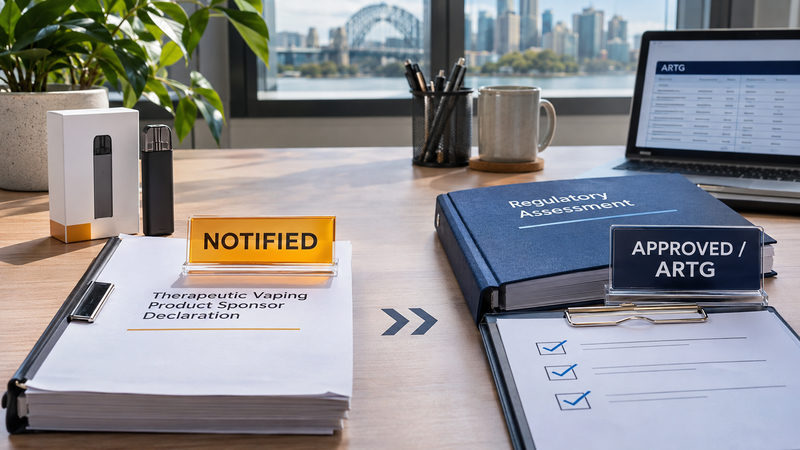
ARTG inclusion or registration follows a separate pathway under therapeutic-goods legislation, with assessment requirements that depend on the product and its regulatory classification. Notification, by comparison, records a sponsor’s declaration about compliance with applicable vaping requirements. Calling an ordinary notified product a “TGA approved vape” can seriously misrepresent its status.
Appearing on the list does not show that the TGA assessed the product for quality, safety, or efficacy. In the case of devices, it does not demonstrate an individual TGA assessment of performance either. The TGA specifically distinguishes notified goods from approved goods on the ARTG. That is a fundamental difference, not a technical footnote.
The published details generally come from information provided during the sponsor-notification process. Publication is not an endorsement of the sponsor, manufacturer, brand, flavour, device, or therapeutic value. Nor does it show that the product is suitable for a particular patient. A pharmacist or prescriber must assess that separately.
Correctly interpreting common marketing terms
Words such as “notified,” “compliant,” “legal,” “registered,” and “approved” do not mean the same thing. A notified product has an associated sponsor notice. A compliance claim, meanwhile, concerns whether the relevant requirements have actually been met. Registration, inclusion, and regulatory approval are separate legal concepts with their own pathways.
The phrase “legal vape” makes Australia’s rules sound simpler than they are. Lawful supply may depend on the product, supplier, patient, nicotine concentration, and clinical pathway. State or territory requirements can also affect access. Both the product’s status and the relevant rules must be valid at the time of supply.
Take a listed liquid containing 30 mg/mL of nicotine. Its presence on the list does not let an adult buy it without a prescription. That concentration is above the 20 mg/mL threshold for pharmacist-only supply without a prescription. The patient would need an appropriate prescription and would still have to meet every other access requirement.
This comparison separates three concepts that are often confused:
- Notification: A sponsor declares that a specific therapeutic vaping good complies with applicable minimum requirements.
- ARTG inclusion or registration: A product enters Australia’s formal register through a separate regulatory pathway.
- Regulatory approval: The regulator makes an approval decision following the assessment required for that pathway.
Sponsors should not present notification as evidence of TGA approval. Health professionals likewise should not treat a listing as proof of therapeutic benefit. Promotional claims must also comply with Australia’s strict controls on vaping advertising. Clear, accurate wording helps prevent patients from making decisions based on a status the product does not have.
3. Which Therapeutic Vaping Goods Appear on the List?
Product categories covered
The list covers several categories under the therapeutic-vaping framework. Vaping substances include liquids or other substances designed for use with a vaping device, whether they contain nicotine or not. Their notified therapeutic purpose, however, must relate to smoking cessation or nicotine-dependence management.
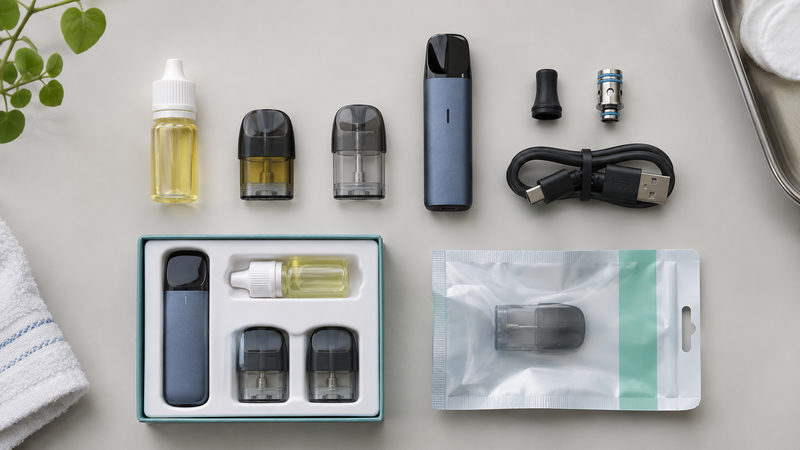
Substance accessories are used to hold or deliver a vaping substance. Prefilled cartridges, capsules, and pods are common examples. A device accessory, on the other hand, may be an empty refillable pod or another device-related item. This distinction matters because substances and device components can be subject to different standards.
A complete device contains the elements required to operate as a therapeutic vaping device. Device components and accessories may also have separate entries when notification requirements apply. The list can include therapeutic vaping kits and therapeutic vaping packs as well. These terms refer to particular combinations, not every bundle a seller might put together.
A therapeutic vaping kit generally combines substances or substance accessories without a therapeutic vaping device. A therapeutic vaping pack includes a combination involving a device or device accessory. Individual goods within the pack may still need their own notices. Check each entry rather than assuming one pack notice covers every possible configuration.
Nicotine-free goods may appear if they fall within the therapeutic framework. The live list might, for example, include a zero-nicotine pod intended to support smoking cessation. But zero nicotine alone does not bring an ordinary retail vape into the therapeutic system. Purpose, category, notification, supply route, and compliance still matter.
The list gives no legitimacy to recreational or illicit retail vapes. Vape shops, tobacconists, convenience stores, and general retailers cannot point to it as justification for consumer sales. Australia restricts the sale of vaping goods to pharmacies for therapeutic purposes. The list does not recreate a wider commercial vaping market.
Standards declared by sponsors
TGO 110 sets minimum requirements for relevant unapproved therapeutic vaping goods. It covers substances, substance accessories, kits, packs, and specified contents within those combinations. The requirements deal with general provisions, ingredients, containers, labelling, and packaging. They also regulate composition and permitted product characteristics.
The requirements may address ingredient restrictions, nicotine concentration, flavour, container design, and product information. Packaging must meet the relevant pharmaceutical presentation rules. Only restricted flavours, including mint, menthol, and tobacco, may fit within the current framework. Sponsors need to consult the operative standard rather than depend on an older summary.
Therapeutic vaping devices and device accessories are subject to device-related requirements. Depending on the pathway, they may be governed by the Medical Device Standards Order or applicable Essential Principles. These rules cover matters connected with device safety and performance. Even so, notification does not mean the TGA individually tested the device.
The exact requirements differ for substances, filled pods, empty pods, devices, kits, and packs. Standards and regulatory guidance may also change. Before importing, manufacturing, varying, or supplying a good, sponsors should review the latest TGA instructions. A change to the flavour, concentration, container, device characteristics, or product name may require a new notice.
Crucially, it is the sponsor who makes the declaration in the sponsor notice. The TGA does not take over the sponsor’s continuing compliance duties. Sponsors must keep suitable records and monitor their goods after supply. They must also deal appropriately with defects, adverse events, regulatory requests, and changes to standards.
4. How to Search and Interpret the TGA Notified Vape List
Step-by-step search process
Begin with the current list provided through the official TGA Vaping Hub. Search-engine snippets, retailer pages, and downloaded copies may be out of date. Check that you are looking at the live TGA page, which also states when the information was last updated.
- Enter the complete product or brand name shown on the packaging.
- Try the supplier or Australian sponsor name if the first search returns nothing.
- Filter or compare the product type, nicotine strength, flavour, volume, or notification number.
- Check alternate spellings, spacing, abbreviations, and product names used on older packaging.
- Match every relevant field before treating the result as the same product.
Separate concentrations, flavours, volumes, pods, and device components may each have their own entries. A 10 mg/mL mint pod, for example, does not cover a 20 mg/mL version. One listed device may not cover the model that replaces it either. Never assume a single result represents an entire brand family.
If your search produces no result, see whether the product has a different formal name. Searching by sponsor can also help because the branding may differ from the notified description. Check withdrawn and ceased notices too. A product that once appeared on the list may no longer have current notified status.
Understanding each listing
A typical substance entry shows the product type, product name, and sponsor or supplier. It may also give the nicotine base equivalent in mg/mL, nicotine form, flavour, and volume. Every notice has a notification number as well. Together, these details help distinguish products that may otherwise look almost identical.
The nicotine form may be described as salt, freebase, or another form supplied through the notification. Nicotine base equivalent makes it easier to compare concentrations between products. Still, users need to read the full entry and product information. A shortened brand claim may leave out details needed to identify the product correctly.
Some fields may be blank or marked as inapplicable. Devices, charging units, batteries, empty accessories, kits, and packs do not necessarily contain a vaping substance. Nicotine strength, flavour, form, or volume may therefore have no relevant value. A blank field does not automatically mean the notice is defective.
The notification number identifies a particular sponsor notice. Pharmacists, sponsors, wholesalers, and regulators may refer to it when checking records or discussing an entry. It is not, however, an ARTG number. Neither its presence nor its format proves ARTG registration or regulatory approval.
Using results for different purposes
Consumers can use the list to challenge vague statements on packaging or in supplier materials. They can compare the precise name, concentration, flavour, volume, and sponsor, then take any questions to a participating pharmacy. A search result is useful for verification, but it is not a personal product recommendation.
Consumers might ask whether the pharmacy participates and whether the exact variant is still available. They can also ask which access pathway applies to their age and the nicotine concentration they require. Other quitting options and potential side effects are worth discussing too. A pharmacist may conclude that a different treatment is more suitable.
Pharmacists and prescribers can refer to the list during product checks and clinical conversations. It can help identify a sponsor-notified good and tell similar variants apart. But it cannot replace professional guidance, dispensing controls, patient assessment, or checks of local law. Clinical responsibility stays with the treating professional.
Sponsors should check the published information for accuracy after submitting a notice. If something is wrong, they should use the appropriate TGA channel to request a product-specific correction or ask a question. A product change may require an entirely new notice rather than a simple correction. Publication does not resolve every compliance responsibility.
Inclusion also does not guarantee pharmacy stock, sponsor supply, or continued availability. The list provides no assurance about price, affordability, pharmacy participation, or suitability for a patient. A sponsor may stop distributing a product even while it remains listed. Questions about availability are usually best directed to the listed sponsor or a participating pharmacy.
5. When Can a Notified Vape Be Legally Supplied?
Pharmacy supply and prescription rules
Patients obtain therapeutic vaping goods through participating Australian pharmacies. Vape shops, tobacconists, convenience stores, and general retailers cannot lawfully sell consumer vapes. Pharmacies are not obliged to stock therapeutic vaping products either. Each pharmacy can choose whether to offer this clinical service.
Pharmacies generally need to source and supply goods that appear on the notified list or are otherwise included in the ARTG. They must also meet the conditions of the relevant federal access pathway. State or territory laws, professional standards, and clinical duties still apply. A notified entry covers just one part of this broader framework.
Adults aged 18 or older may access eligible nicotine vapes containing no more than 20 mg/mL without a prescription. This depends on local law and whether the pharmacist participates. The pharmacist must complete the required consultation and verify the person’s age by checking identification. Any supply must be for smoking cessation or nicotine-dependence management.
A prescription is required for products containing more than 20 mg/mL of nicotine. The patient will normally obtain it from an authorised medical or nurse practitioner. Every therapeutic vape supplied to a patient under 18 also requires a prescription. Other professional, access-pathway, and jurisdictional requirements may apply.
Anyone seeking supply should confirm the current rules first. A participating pharmacist, qualified prescriber, or relevant health authority can explain what applies. Requirements are not necessarily identical across states and territories. They may also change as legislation, scheduling decisions, and professional guidance evolve.
Why list inclusion is not a supply guarantee
Being listed does not make a product available to everyone automatically. The pharmacist must decide whether supply is clinically appropriate under the relevant pathway. A customer cannot simply provide a notification number and demand the product. This is a genuine health consultation, not a routine retail transaction.
Before considering an unapproved vape, pharmacists may discuss approved first-line treatments for smoking cessation. They should also look at nicotine dependence, previous quit attempts, dosage, and treatment goals. Medical conditions, pregnancy, interactions, contraindications, and the risk of adverse effects can all affect the decision. A patient with complex needs may need referral to a prescriber.
Lawful supply does not allow unrestricted promotion. Australia generally bans public advertising and promotion of vaping goods unless a specific authorisation applies. Some limited communications are permitted in defined healthcare and supply-chain settings. Even then, strict rules govern their content, audience, and presentation.
A pharmacist may, for example, give product information directly to a patient during treatment. That does not permit public promotion on social media or the use of product testimonials. Nor can the notified list be used as promotional evidence that one product is superior. Sponsors and suppliers must assess every communication against the current advertising rules.
6. Withdrawn Products, Safety Limits, and Reliable Next Steps
Withdrawn and ceased notifications
A withdrawn notice is not the same as a ceased notice. A sponsor may choose to withdraw its notice, perhaps because it has stopped supplying the product or changed it. A ceased notification, by contrast, results from the TGA exercising its regulatory powers. The cause and the party responsible are different.
The TGA may decide that a notified product should no longer be supplied. This may happen if the good fails to meet an applicable standard or if its supply compromises public health and safety. Once a good has been ceased, old records do not preserve its ordinary notified status.
Check the TGA website’s separate information on withdrawn or ceased sponsor notices. Compare the product name, sponsor, status, date, and notification number. It is also wise to inspect the live notified list rather than depending on a single source. An old screenshot or notification number cannot prove current status.
A product can disappear from the market without the TGA ceasing its notification. A sponsor might stop importing a device or discontinue a pod, for instance. A participating pharmacy may simply decide not to stock it. Regulatory status and commercial availability are separate issues.
Health risks and patient discussions
Notification does not make vaping free from risk. Nor does it show that a product is right for a particular person. Nicotine can cause and sustain dependence, while dosing mistakes or high exposure may lead to unpleasant or dangerous effects.
Vaping substances can be poisonous if swallowed, spilled, or handled incorrectly. Concentrated liquids and filled pods pose a particular risk to children and pets. Devices and batteries may also overheat, fail, leak, or cause injury. Users should follow the supplied instructions and report suspected product faults promptly.
There is still uncertainty about the long-term effects of vaping. Some users may experience coughing, throat irritation, nausea, dizziness, headaches, or other adverse effects. Patients should raise these symptoms with a pharmacist or prescriber. Severe or urgent symptoms need immediate medical attention.
Keep liquids, pods, devices, batteries, chargers, and accessories securely out of reach of children and pets. Leave them in their original packaging and follow the disposal instructions. Do not use damaged batteries, incompatible chargers, or unauthorised product modifications. Safe handling remains essential, even for a product on the notified list.
A practical clinical discussion might include these questions:
- Which approved first-line treatments should I try before an unapproved therapeutic vape?
- What are my treatment goals, and how will we measure progress?
- Which nicotine concentration and dosing approach fit my dependence?
- What side effects or warning signs require medical advice?
- Could this treatment interact with my medicines or health conditions?
- How do pregnancy or breastfeeding affect the available options?
- What is my plan to reduce nicotine use and eventually stop vaping?
Where to obtain current guidance
Consumers and health professionals should start with the TGA Vaping Hub and the live notified list. From there, they can speak with participating pharmacists, qualified prescribers, and state or territory health authorities. These sources can explain current access requirements and address clinical responsibilities that a database entry cannot.
Sponsors need to follow current TGA guidance on sponsor notices and relevant product standards. They should also review the requirements for importation, manufacturing, advertising, record-keeping, and post-market compliance. Each obligation may apply independently of notification. Complex situations may call for professional legal or regulatory advice.
For current stock, pricing, or details about a specific product, contact the listed sponsor or a participating pharmacy. The TGA provides regulatory information, not personalised product recommendations. It also cannot guarantee that a sponsor continues to supply an item. Availability must be checked through the lawful supply chain.
Conclusion
The TGA Notified Vape List records sponsor-notified therapeutic vaping goods intended for smoking cessation or nicotine-dependence management. Notification is not TGA approval or ARTG inclusion. It reflects a compliance declaration by the sponsor, not an individual TGA assessment. A listing therefore does not prove safety, effectiveness, device performance, or suitability.
A listed product may still require a prescription, a consultation, and checks under local law. Its appearance cannot guarantee stock, affordability, permission to advertise, or lawful supply in every situation. Clinical decisions should take established cessation options and the individual patient’s health needs into account. A notification number is no substitute for that conversation.
Use the official TGA Vaping Hub to check the live list and any withdrawn or ceased notices. Then speak with a participating pharmacist or qualified prescriber about product eligibility and suitable support for smoking cessation. Confirm any state or territory rules that could affect access as well. Current official information is far more reliable than an old screenshot or a marketing claim.