

What if quitting smoking had less to do with willpower and more to do with being prepared? Learning How to Create a Personal Quit Smoking Plan gives you practical ways to respond before tough moments hit. The plan can be shaped around your routines, triggers, health needs, and the reasons that matter most to you.
General advice can fall apart during withdrawal, a stressful evening, or pressure from other people. A personal plan gives you something specific to do when motivation feels far away. It can also help you get back on track quickly if you smoke after your quit date.
1. How to Create a Personal Quit Smoking Plan
Turn your decision into written actions
Putting your plan in writing makes quitting feel real and manageable. A broad promise becomes a series of small, clearly timed actions. Before cravings intensify, you can gather supplies, contact supporters, and arrange treatment.

Writing things down also creates accountability because every commitment is there in front of you. Just as importantly, it exposes gaps that early enthusiasm can hide. You may have chosen a quit date, for example, but still have no plan for stressful meetings or evenings with friends who smoke.
Your plan needs to be personal, not perfect. Choose strategies that work with your schedule, budget, medical needs, and living situation. Someone who works nights may need very different support from a person caring for young children.
Complete your quit-plan template
Copy these prompts into a notebook or your phone, then fill in each line as you work through the guide. Keep the completed plan where you will see it, perhaps on your refrigerator, calendar, or home screen.
- My quit date: ____________________
- My three strongest reasons: ____________________
- My main smoking triggers: ____________________
- My planned responses: ____________________
- My craving supplies: ____________________
- My treatment choice: ____________________
- My healthcare consultation date: ____________________
- My support people: ____________________
- My counseling or quitline resource: ____________________
- My first reward: ____________________
- If I smoke once, I will: ____________________
Above all, write down reasons with real emotional weight. “Improve my health” may feel too vague in the middle of a craving. “Climb the playground steps without stopping” paints a much clearer, more motivating picture.
Read through your plan every morning during the first few weeks. If a response does not work in real life, change it. Replacing a weak strategy is good problem-solving, not a sign of failure.
2. Select a Quit Date and Prepare Your Environment
Choose a date you can prepare for
Pick a quit date soon enough to keep your momentum going. Choosing a day within the next two weeks often leaves enough time to prepare without giving delay a chance to take over. Try to avoid dates already packed with unusual stress, travel, or major celebrations.
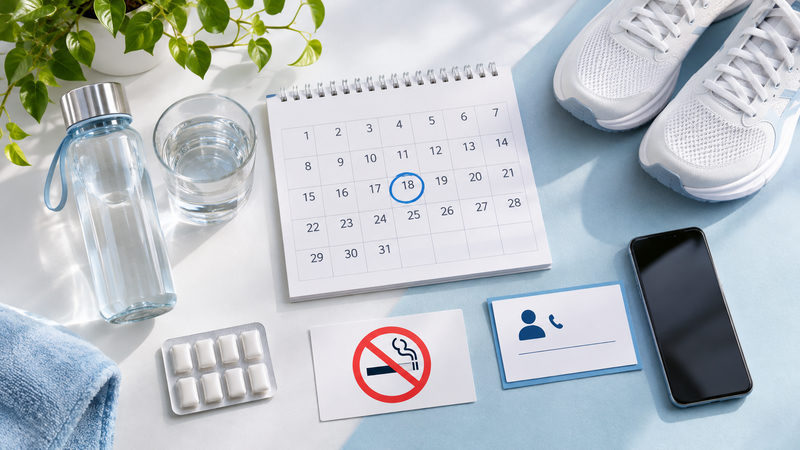
Think about how your smoking changes through the week. Monday might work well if your workplace enforces strong smoke-free rules. If work pressure is your biggest trigger, though, Saturday may be the better choice.
Tell the people who matter exactly when you are quitting. “I am quitting next Thursday” carries more weight than “I should quit soon.” Put the date on your calendar, then schedule your preparation tasks before it arrives.
Create smoke-free surroundings
Clear cigarettes, tobacco, lighters, matches, and ashtrays out of your home, vehicle, bags, and workplace. Wash any clothing, bedding, and curtains that smell of smoke. Clean your car too, and change the spots where you normally smoke.
Skip the emergency pack. Easy access can turn a passing craving into an automatic choice. In its place, keep water, sugar-free gum, crunchy snacks, toothpicks, or a stress ball close at hand.
- Ask household members not to smoke around you.
- Request smoke-free visits and car journeys.
- Prepare simple meals for your first few days.
- Arrange childcare before counseling or medical appointments.
- Limit alcohol if it strongly triggers smoking.
- Save support numbers in your phone.
Practice a short answer for anyone who offers you a cigarette. A simple “No thanks, I quit” is enough; you do not owe anyone a lengthy explanation. Having the words ready can make social pressure easier to handle.
3. Map Smoking Triggers and Plan Your Responses
Find the pattern behind each cigarette
Smoking often gets tied to particular emotions, people, places, and routines. For three ordinary days before quitting, track every cigarette. Note the time, location, activity, mood, and craving strength on a scale from one to ten.

You may find that nicotine is only part of the pattern. Someone who smokes 15 cigarettes, for instance, might light eight of them during predictable transitions. Driving, finishing a meal, taking a break, and making a phone call can all become powerful cues.
Anger, boredom, loneliness, excitement, and anxiety may act as emotional triggers. Social triggers can include certain friends, alcohol, parties, or shared breaks at work. Even coffee, an ashtray, or the smell of smoke may serve as a physical cue.
- Routine triggers: coffee, meals, driving, work breaks, or bedtime.
- Emotional triggers: stress, frustration, sadness, boredom, or celebration.
- Social triggers: smoking friends, parties, bars, or workplace groups.
- Environmental triggers: balconies, vehicles, entrances, or visible tobacco products.
- Body triggers: tiredness, hunger, alcohol use, or nicotine withdrawal.
Write specific if-then responses
An if-then plan pairs a familiar trigger with an action you can take immediately. The format is straightforward: “If this happens, then I will do that.” It saves you from having to make a fresh decision while an urge is demanding your attention.
You could write, “If I crave a cigarette after lunch, then I will brush my teeth and walk.” Another response might be, “If friends smoke outside, then I will remain inside and message my supporter.” Keep every action simple enough to begin right away.
- If coffee triggers me, then I will drink tea in another chair.
- If driving triggers me, then I will play a podcast and chew gum.
- If stress rises, then I will take ten slow breaths before responding.
- If someone offers a cigarette, then I will use my prepared refusal.
- If boredom appears, then I will complete a five-minute task.
- If alcohol weakens my decision, then I will choose a nonalcoholic drink.
One replacement will not work in every setting. Give yourself two backup responses for your strongest triggers. If you cannot walk during a meeting, for example, slow breathing or cold water may be a practical alternative.
Try these actions before your quit date. A little rehearsal makes them feel more familiar when cravings show up. It also helps you spot any awkward or unrealistic strategies while there is still time to adjust them.
4. Manage Nicotine Cravings, Withdrawal, and Treatment
Know what withdrawal may feel like
Nicotine withdrawal may bring cravings, irritability, restlessness, anxiety, low mood, sleep problems, hunger, and trouble concentrating. Some people also experience headaches, fatigue, coughing, or constipation. The symptoms—and how strongly they are felt—vary considerably from person to person.
Symptoms often start within hours of the final cigarette. They commonly feel most intense during the first three days and the first week. For most people, that intensity declines during the first month, although some symptoms may last longer.
A craving can feel urgent, but it will not stay at peak strength forever. Focus on riding out the wave in front of you rather than imagining an entire smoke-free lifetime. Begin one of your planned actions immediately, then reassess after several minutes.
Use a rapid craving routine
Build a short routine you can use almost anywhere. You might delay your response, breathe slowly, drink water, and switch activities. Moving into a smoke-free place can also break the cue before it decides your next move.
- Delay: Commit to waiting while the urge changes.
- Breathe: Take ten slow breaths with longer exhalations.
- Drink: Sip cold water and notice each swallow.
- Move: Walk, stretch, or climb stairs for several minutes.
- Distract: Call someone, shower, play a game, or tidy one area.
- Remind: Read your reasons and recall what smoking would cost.
During early withdrawal, protect your sleep and eat at regular times. Cut back on caffeine if it makes anxiety or restlessness worse. Gentle activity may lift your mood as well, while giving your hands and mind something else to do.
Discuss proven treatment options
Medication can ease cravings and withdrawal, while behavioral support helps you build coping skills. Combining counseling with medication generally provides stronger support than using either one alone. The right choice should reflect your health history and personal preferences.
Nicotine replacement comes in several forms, including patches, gum, lozenges, inhalers, and nasal sprays. Patches deliver nicotine steadily, while shorter-acting products can help with sudden cravings. Some adults use both types, though choosing and using them correctly matters.
Prescription choices include varenicline and sustained-release bupropion. Each medicine has its own instructions, precautions, and possible side effects. A healthcare professional can discuss the benefits and help you choose an appropriate option.
This guide is not a substitute for individualized medical advice. Ask a professional for guidance if you are pregnant, breastfeeding, under 18, or living with significant medical or mental health conditions. Be sure to mention other medicines you use and any reactions you have had in the past.
Do not leave treatment research until quit day. Some options need to be started earlier or require a prescription. Schedule your consultation and collect any supplies before your chosen date.
5. Build Counseling, Quitline, and Social Support
Create a team with different roles
Support works best when people know how they can help. One friend might take emergency calls, while a family member keeps the house smoke-free. A colleague could walk with you during the breaks when you used to smoke.
Professional counseling gives you space to examine triggers, rehearse coping skills, and revise parts of your plan that are not working. It may be available individually, in groups, over the phone, or through digital programs. Choose a format you can stick with.
Quitlines may provide coaching, planning help, and details about services in your area. In the United States, free support is available at 1-800-QUIT-NOW. If you live elsewhere, ask a healthcare provider or public health service about a national or regional quitline.
Tell supporters exactly what helps
People can care about you and still give advice that is not helpful. Tell them what you need before withdrawal starts. Ask for encouragement, patience, distraction, or practical assistance—not lectures.
- Invite me to walk when I become restless.
- Celebrate my effort without repeatedly testing me.
- Do not smoke or leave cigarettes near me.
- Listen briefly when I describe a craving.
- Help me contact professional support after a difficult day.
- Avoid criticism if I make a mistake.
Support should never feel like surveillance. A daily message asking, “How can I help today?” may be genuinely encouraging. Constant questions, searches of your belongings, or suspicious comments can increase both stress and secrecy.
Let supporters know that withdrawal can cause irritability. That does not excuse harmful behavior, but knowing what to expect can prevent unnecessary misunderstandings. Agree on a pause signal for moments when either person needs some space.
6. Track Progress, Savings, and Smoke-Free Benefits
Make improvement visible
Tracking each day turns effort you cannot see into evidence you can. Record your smoke-free days, cravings handled, treatment use, mood, sleep, and physical changes. Note which responses helped too, so you can build on what works.
You can track savings with one simple calculation. Divide the price of a pack by the number of cigarettes it contains, then multiply that amount by how many cigarettes you previously smoked each day. As an example, ten daily cigarettes from a $10 pack equal about $5 saved per day.
Over 30 days, that example adds up to roughly $150. Put the money in a separate account or envelope. Watching it grow provides a tangible reward that one cigarette cannot match.
- Count smoke-free days and weeks.
- Record cravings you successfully managed.
- Notice easier breathing during ordinary activities.
- Track changes in taste, smell, coughing, and energy.
- Calculate money saved each day.
- Write one thing you feel proud of nightly.
Use rewards that reinforce your reasons
Choose rewards for reaching one day, three days, one week, and one month. Some can be free—a favorite film or a quiet afternoon, for example. As the savings grow, you might spend them on a meal, hobby item, family outing, or fitness goal.
Keep your rewards separate from tobacco and other strong triggers. Celebrate what you did, not just the final result. Calling a supporter during an intense craving deserves recognition because you practiced a skill you can use again.
7. Recover From a Lapse and Follow Your Quit Roadmap
Respond quickly to one cigarette
A lapse is a single cigarette or a brief period of smoking after you quit. Returning to regular smoking means falling back into your previous pattern. One cigarette does not wipe out every smoke-free day, nor does it mean you must give up the attempt.
Interrupt the lapse as soon as you recognize it. Throw away the cigarettes that remain and step out of the situation that triggered you. Then call a supporter and look at what happened without attacking yourself.
Ask useful questions instead of looking for someone to blame. Identify the place, emotion, people, thoughts, and access that came before the cigarette. Strengthen the response that was missing, then restart at once or choose a restart point in the near future.
- What happened during the hour before I smoked?
- Which trigger did my plan miss?
- Did I use my treatment as directed?
- Which support could I contact sooner next time?
- What obstacle should I remove today?
- What will I do if the same situation returns?
If lapses keep happening, your treatment or support may need to change. Instead of struggling alone, contact a healthcare professional, counselor, or quitline. Even repeated attempts can reveal valuable information about what you need to quit successfully.
Follow your first-month roadmap
On the first day, clear away tobacco, follow your treatment plan, and stay away from your strongest triggers. Eat regularly, keep craving supplies with you, and reach out to one supporter. At bedtime, write down every urge you managed.
During the first week, simplify your schedule whenever you can. Practice your if-then responses, attend counseling, and check the treatment instructions again. After your first several smoke-free days, reward the effort you have made.
During the first month, ease back into challenging situations carefully. Keep tracking your savings, improve weak responses, and continue using professional support. Be ready for surprise cravings; familiar cues may return even after physical symptoms have eased.
When the month ends, review your entire plan. Keep the strategies that helped and replace those that repeatedly let you down. Then set your next milestone and choose a reward that feels meaningful.
Conclusion
A strong quit plan brings together a firm date, personal responses to triggers, withdrawal management, treatment, supportive people, and visible signs of progress. It also makes room for a kind, practical response to setbacks. Preparation will not eliminate every hard moment, but it can give you a useful next step when one arrives.
Complete your written quit-plan template today, then choose one source of support. If you need help selecting or safely using cessation medication, schedule a healthcare consultation as well. One practical step now could mark the start of a lasting smoke-free life.