
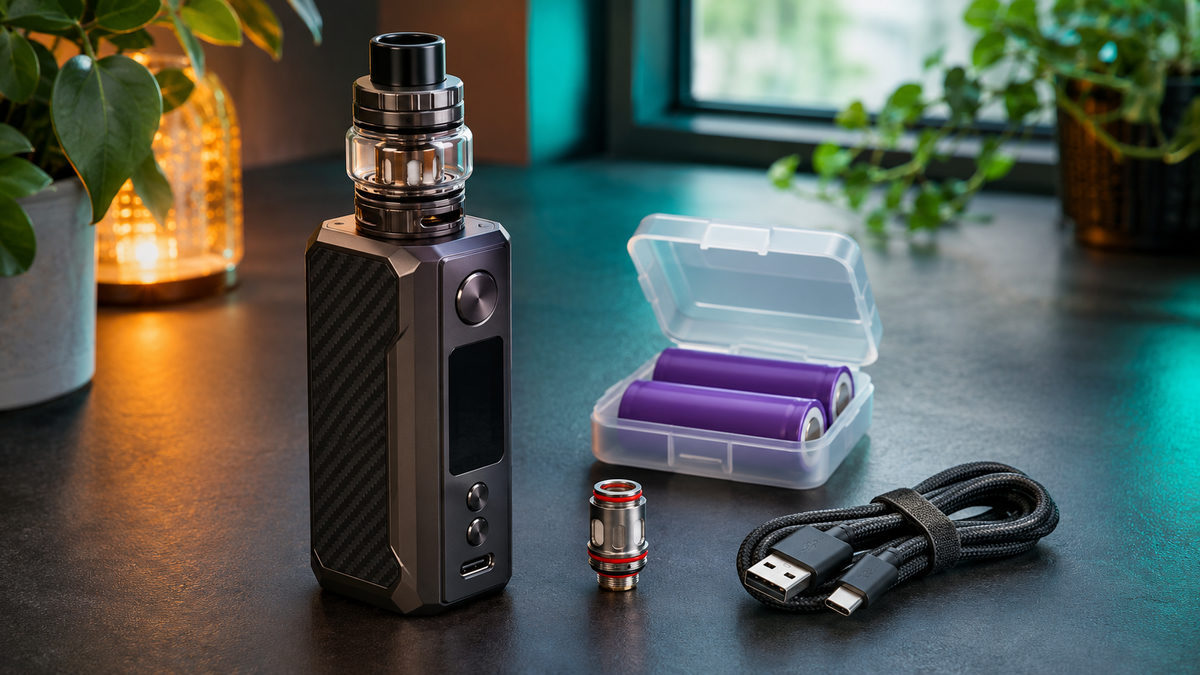
What is a vape mod, and why does it offer more controls than a basic vape pen? These devices provide adjustable power, replaceable parts, and plenty of room for customization. For a first-time user, though, unfamiliar batteries, tanks, coils, and settings can feel overwhelming.
Adults who are new to vaping may find wattage, resistance, compatibility, and maintenance confusing at first. A mod can also resemble a pod device even though the two work quite differently. This guide breaks down those differences and explains the safety essentials every adult user should know.
1. What Is a Vape Mod and Why Is It Called a Mod?
A vape mod is a reusable device that delivers electrical power to a coil inside an attached tank or atomizer. As the coil heats up, it turns the e-liquid surrounding its wick into an inhalable aerosol. The mod is essentially the power and control center; it does not usually hold the liquid itself.
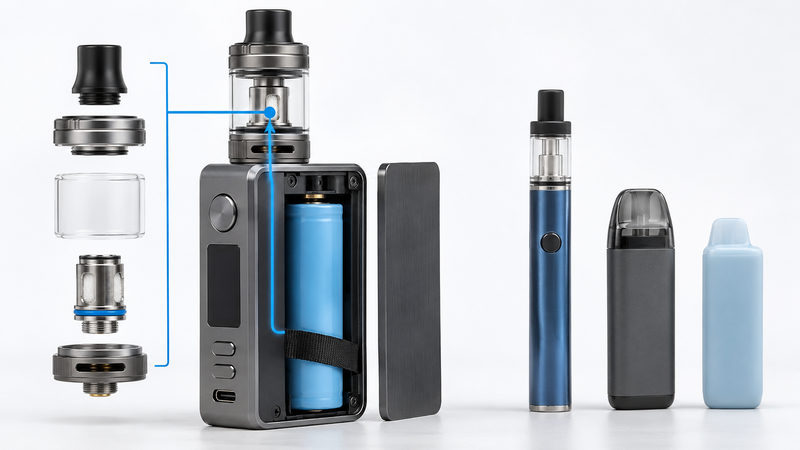
The vape mod meaning makes more sense when you know where the device came from. Early enthusiasts modified flashlights, battery tubes, and other pieces of hardware to get more power or extend battery life. The term mod was simply short for modified device.
Today’s commercial mods bear little resemblance to those improvised products. Manufacturers now build complete devices with dedicated controls, battery compartments, screens, and protective electronics. Reputable regulated mods also monitor factors such as temperature, resistance, voltage, and operating time.
What counts as a regular vape?
“Regular vape” is not a precise technical term. Depending on who is speaking, it might refer to a disposable, vape pen, pod system, starter kit, or mod. It is better to ask about the actual device category than rely on such a broad label.
A starter kit is not a single type of device either. The label simply means that the package contains several items needed to get started, such as a device, tank, and coil. Stores may sell mod kits, pod kits, and vape pen kits under the same starter-kit description.
Most importantly, vaping is not risk-free. These products are meant only for adults who meet the legal-age requirements where they live. Even nicotine-free e-liquid can expose users to aerosol chemicals, heated flavorings, and fine particles.
Anyone who does not currently use nicotine should not start vaping. People who want to stop smoking or vaping can seek advice from a qualified healthcare professional. Medical support may provide options that are better suited to their individual needs.
2. How Does a Vape Mod Work? Parts and Power Explained
Press the fire button and a quick electrical sequence begins. The battery sends power through the mod and its connection to the coil. The coil then heats the saturated wick, turning the surrounding e-liquid into an aerosol.
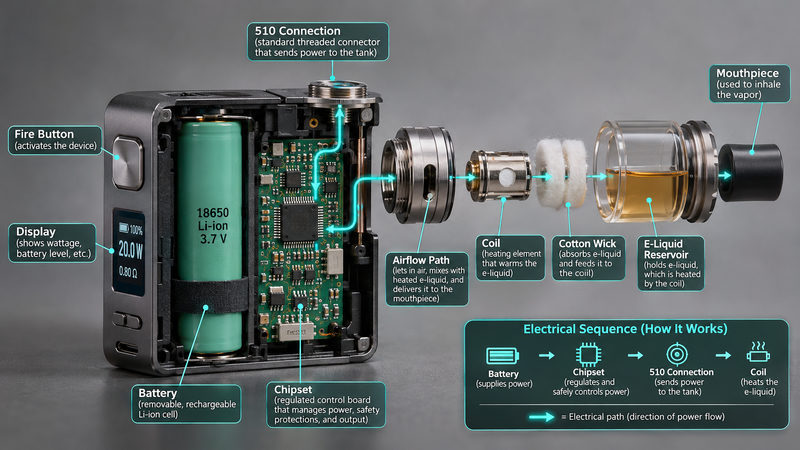
The mod body houses the controls and power system. A regulated model typically includes a chipset, display, firing button, adjustment buttons, battery compartment, and protective circuitry. The chipset manages power delivery and watches for conditions that could signal unsafe operation.
Parts inside the tank
The tank sits on top of the mod and holds e-liquid in a reservoir. Inside it, an atomizer coil surrounds or touches an absorbent wick, usually made from cotton. Airflow openings direct air around the hot coil as the user inhales.
The chimney carries aerosol from the coil chamber to the mouthpiece. Adjustable airflow also changes how tight or open the draw feels. More airflow often cools the coil and works better at higher power, while less airflow produces a tighter draw.
- Tank: Holds e-liquid and contains the atomizing components.
- Coil: Converts electrical energy into heat.
- Wick: Draws e-liquid toward the heating wire.
- Airflow control: Changes air volume and draw resistance.
- Chimney and mouthpiece: Direct aerosol toward the user.
Batteries, connections, and controls
Mods may use internal batteries or removable lithium-ion cells. Battery capacity helps determine expected operating time, while current capability affects how safely the battery can deliver power. A high-capacity battery is not automatically appropriate for every high-power device.
Many mods and tanks connect through threading known as a 510 connection. But just because a tank screws onto a mod does not mean the two are electrically or physically suitable. Resistance support, required power, tank diameter, and manufacturer instructions all matter.
Variable wattage allows the user to choose how much power reaches the coil. Variable voltage provides similar control by adjusting voltage instead. Some advanced devices also include temperature control, preheat settings, power curves, and other specialized firing modes.
Temperature control only works properly with compatible coil materials and accurate settings. Beginners should read the instructions for both the mod and the coil before enabling it. Choose the wrong mode, and performance may suffer or the coil may be damaged.
Resistance and sub-ohm vaping
Coil resistance is measured in ohms and is usually shown with the symbol Ω. At a given voltage, lower resistance generally allows more current to flow. Modern regulated devices manage their output through chipsets, however, so users should still follow the range printed on the coil.
A sub-ohm coil has a resistance below 1.0 ohm. Compared with higher-resistance coils, these coils commonly use more power, consume more e-liquid, and produce more aerosol. They may also drain batteries more quickly and need wider airflow.
Imagine that a coil has a recommended range of 40 to 55 watts. A cautious user might start at 40 watts and raise the power gradually. There is no single correct wattage that works for every coil.
3. Types of Vape Mods: Regulated, Mechanical, and Squonk
Regulated box mods are probably the most recognizable style. Their box-shaped bodies usually leave room for a display, control buttons, and one or more batteries. An electronic chipset regulates the output and provides important operating protections.

Common protections include limits for firing duration, excessive temperature, low voltage, and short circuits. Some devices can also detect unsupported resistance or batteries installed incorrectly. These safeguards reduce risk, but only when the device is operated and maintained properly.
Tube and squonk mods
Tube mods use cylindrical bodies instead of rectangular cases. Some contain regulated electronics; others have a direct mechanical design. You cannot tell what features or safety systems a device has from its shape alone.
A squonk mod has a refillable bottle built into its body. Squeezing the bottle pushes e-liquid through a hollow connection and into a compatible bottom-fed atomizer. When the bottle is released, it may draw excess liquid back into the container.
Squonk systems reduce the need to drip e-liquid manually onto a rebuildable atomizer. That convenience comes with extra parts, seals, and cleaning needs. A beginner does not need a squonk system to have a functional, adjustable vaping setup.
Why mechanical mods require advanced knowledge
A mechanical mod sends battery power directly to the atomizer without a protective regulating chipset. It typically has no adjustable wattage, screen, resistance alerts, or electronic cutoff protections. A short circuit or build error can therefore put extreme stress on the battery.
Regulated mods allow users to adjust the output and display warnings when certain faults are detected. Mechanical devices, by contrast, depend heavily on the user’s calculations and inspections. Their output also shifts as the battery voltage drops.
Mechanical mods are not suitable for inexperienced users. Safe operation calls for advanced knowledge of Ohm’s law, battery current limits, coil building, short detection, and cell condition. Users must also understand voltage drop, resistance measurement, and battery specifications.
A mistake with resistance or battery limits can lead to severe overheating, venting, fire, or injury. Beginners should choose an authentic regulated device with clear instructions. A mechanical device should never be treated as a shortcut to producing more vapor.
4. Vape Mod vs Pod System, Vape Pen, and Disposable
Pod systems are designed around compact size and straightforward operation. They generally use small replaceable or refillable pods rather than separate tanks. Mods, on the other hand, tend to offer wider power ranges, larger batteries, stronger output, and more replaceable components.
Many pod devices activate automatically when the user inhales and need very little adjustment. Their smaller batteries and restricted airflow may not appeal to someone who wants longer runtime or extensive customization. Mods take more upkeep, but they give users greater control over tanks, coils, and power.
Mods compared with pens and disposables
Vape pens usually have slim, cylindrical bodies and simple controls. They tend to offer less adjustability and smaller tanks than full-sized mods. For users who care more about portability than detailed settings, a pen may feel easier to approach.
Disposable vapes come prefilled and generally need no coil replacements or tank cleaning. Once the liquid or battery runs out, however, the entire unit becomes waste. Reusable mods still need coils and batteries over time, but the main device and tank remain in use.
Disposables favor convenience; mods favor control. A mod user can replace a worn coil, change the tank, adjust the airflow, and select a suitable wattage. With a disposable, repairs and meaningful adjustments usually are not possible.
Advantages and disadvantages
A vape mod offers several practical advantages. Users can choose from different tanks, coil styles, battery arrangements, and power levels. Because many parts are replaceable, the complete setup may also remain useful for longer.
- Wide power and airflow adjustment options
- Replaceable tanks, coils, and mouthpieces
- Larger battery capacities on many models
- Greater vapor output when used appropriately
- More repairable components than sealed devices
- Internal or removable battery options
All those options bring extra responsibility. Mods may feel bulky and complicated, and the initial purchase can be expensive. Higher-power coils can also use a substantial amount of e-liquid and need more frequent charging.
- A steeper learning curve for new users
- Regular coil, tank, and contact maintenance
- More settings that users can configure incorrectly
- Higher initial costs for suitable equipment
- Greater e-liquid use at high power
- Additional risks from mishandled removable batteries
An adult who already understands basic vaping equipment may appreciate a mod’s flexibility and replaceable parts. Someone who wants a compact device with minimal adjustment might be happier with a regulated pod system or pen. The right choice comes down to experience, willingness to perform maintenance, and practical needs.
5. How to Choose and Use a Vape Mod Safely
Beginners should look first for a regulated mod with clear controls and documented protections. Check its power range, physical size, tank capacity, display readability, and availability of replacement parts. It is also worth confirming that local retailers regularly carry the correct coils.
Internal batteries simplify cell selection and usually charge through a manufacturer-approved connection. Removable batteries can be replaced and may help extend the device’s usable life. They also demand careful purchasing, inspection, charging, storage, and transport.
Confirm tank compatibility
First, check that both devices use a suitable 510 connection. Then confirm that the mod supports the coil’s resistance and required wattage range. The tank should also fit without overhanging the device or blocking its controls.
Do not overlook airflow. A high-power tank needs adequate ventilation and clear space around its intake slots. Above all, follow the guidance from both manufacturers instead of assuming that every 510 tank will work with every mod.
Set up the tank correctly
- Inspect the mod, tank, seals, coil, and connection for damage or contamination.
- Install the exact coil model recommended for the tank.
- Add several drops of e-liquid to exposed cotton openings when instructions permit.
- Assemble the tank carefully and fill it through the correct port.
- Wait for the manufacturer’s suggested saturation time before firing.
- Attach the tank securely without overtightening it.
- Confirm the coil resistance, firing mode, airflow, and starting wattage.
Priming allows the wick to absorb enough liquid before it is heated. If the cotton is not fully saturated, it can burn and produce a harsh taste. A new coil may appear ready on the outside while remaining partly dry at its center.
Follow the wattage range printed on the coil or its packaging. Begin near the lower end and raise the power in small steps if necessary. Universal recommendations are not reliable because coil design, resistance, airflow, and liquid composition all vary.
Handle and charge batteries safely
Always use the charging method specified by the device manufacturer. If an external charger is required, select a reputable model made for the correct lithium-ion cell type. Keep the charging equipment on a stable, nonflammable surface and check it regularly.
Inspect removable cells each time before installing them. Do not use any battery that is dented, wet, leaking, overheating, or visibly damaged. If the insulating wrap or top ring is damaged, replace the cell or have it professionally rewrapped.
Loose cells belong in protective battery cases. Coins or keys can bridge exposed battery terminals and cause a dangerous short circuit. Never carry unprotected cells in pockets, bags, glove compartments, or storage drawers.
Multi-battery mods require matched cells that were bought and used together. Their brand, model, capacity, age, and charge state should remain identical. Never pair a new cell with an older one or combine cells from separate sets.
Purchase authentic devices, batteries, chargers, coils, and e-liquids from responsible sellers. Counterfeit products may have misleading labels or use inconsistent materials. Before buying or using vaping equipment, check the local rules for age and products.
Keep devices, batteries, and e-liquid out of reach of children and pets. Nicotine-containing liquid can cause poisoning if swallowed, inhaled, splashed in the eyes, or absorbed through the skin. If an exposure occurs, promptly contact the appropriate local medical or poison service.
6. Vape Mod Maintenance, Troubleshooting, and Safety Checklist
Regular maintenance keeps a mod working consistently. Empty and clean the tank as directed, and allow the appropriate parts to dry completely. Wipe the 510 contact, check the airflow openings, and keep the battery compartment both clean and dry.
When practical, store the device upright and away from extreme temperatures. Switch it off or lock its controls before transport. Never leave a mod in a hot vehicle or near heaters, open flames, or direct sunlight.
When to replace a coil
How long a coil lasts depends on power, liquid composition, frequency of use, and inhalation habits. Replace it when the flavor turns burnt, vapor becomes weak, or performance noticeably falls off. Ongoing leaks or dark discoloration can also point to a worn or damaged coil.
No fixed replacement schedule works for everyone. Sweet liquids, for example, may create residue more quickly than simpler formulations. Use performance to judge the coil’s condition while continuing to follow the manufacturer’s guidance.
Leaks, burnt taste, and weak vapor
If a tank leaks, inspect the seals, glass, coil installation, and threaded components. Make sure the liquid went into the correct filling port and keep the tank reasonably upright. A very thin liquid may also leak through a coil intended for thicker formulations.
A burnt taste usually means the wick is dry or damaged. Check the liquid level, saturation, coil age, wattage, and airflow. Rapid, repeated firing can also leave too little time for the wick to absorb more liquid between draws.
Weak vapor may come from a low battery, restricted airflow, a worn coil, or an unsuitable power setting. Check the electrical contacts and make sure the tank is seated properly. If warnings appear or the device becomes unusually hot, stop making adjustments.
Respond to warnings instead of bypassing them
Stop using any mod that becomes unusually hot. Move it away from flammable materials, but avoid unnecessarily touching an overheating battery. When it is safe to do so, follow the manufacturer’s emergency guidance and seek professional help if fire or injury is a threat.
A short-circuit warning, resistance error, or failure to fire calls for a careful inspection. Look for liquid around the contacts, a loose coil, damaged insulators, or unsupported resistance. Never bypass protective features just to force the device to work.
If the problem remains after basic checks, stop using the setup. Contact the retailer or manufacturer, or speak with a qualified vape technician where lawful. Do not take apart sealed batteries or electronic circuits without the proper training.
Lifespan and common beginner mistakes
Coils are consumable and must be replaced regularly. Rechargeable batteries gradually lose capacity as they age and accumulate charging cycles. A well-maintained mod body may last considerably longer, depending on its construction, how it is handled, and whether it is exposed to moisture.
New users often ruin coils by firing them before the wick is fully saturated. Other common mistakes include exceeding the printed wattage range and overtightening the tank. Too much tightening can damage the threads, seals, or spring-loaded connection pin.
- Failing to prime a new coil before use
- Operating above the coil’s recommended power range
- Overtightening the tank or coil
- Using dented cells or damaged battery wraps
- Mixing batteries within a paired set
- Ignoring heat, warning messages, or resistance changes
- Carrying loose batteries beside metal objects
- Buying counterfeit or unidentified products
Vape mod safety checklist
- Use an authentic regulated mod appropriate for your experience.
- Read the instructions for the mod, tank, coil, and charger.
- Confirm resistance, wattage, diameter, and connection compatibility.
- Prime every new coil and begin near its lowest recommended wattage.
- Inspect removable batteries and wraps before each use.
- Keep matched battery sets together throughout their working lives.
- Use protective cases whenever transporting loose cells.
- Stop immediately after unusual heat, odors, warnings, or physical damage.
- Clean the tank, airflow openings, contacts, and battery compartment regularly.
- Keep equipment and e-liquid away from children and pets.
Conclusion
A vape mod is a customizable power unit used with a compatible tank and coil. Regulated mods may offer wider power control, longer battery life, and replaceable components. Those advantages come with responsibilities: correct setup, routine maintenance, compatibility checks, and safe battery handling.
Mechanical mods require advanced technical knowledge and are not appropriate for beginners. No vaping product is risk-free, including one filled with nicotine-free e-liquid. Adults who do not already vape should not view a mod as a harmless hobby product.
Before making a purchase, compare authentic regulated kits sold by responsible retailers. Check local age and product rules, and read every manufacturer instruction. Use the safety checklist to decide whether a mod truly suits your needs, knowledge, and comfort with maintenance.







