A vape can make it all the way to the warehouse and still fail because a single nicotine unit is wrong. So, what information should vape packaging contain? The answer goes well beyond a product name and warning. Each label must help buyers identify, use, store, trace, and safely discard the product.
Manufacturers face a tough design challenge. They have to fit detailed information onto small boxes, bottles, pods, and devices, while requirements vary by market and product category. This guide covers the information commonly required on packaging and provides a practical review process to follow before printing or distribution.
1. Why Vape Packaging Information Matters
Protecting consumers and supporting informed choices
Vape packaging serves as a product guide, safety notice, and identification record. It tells buyers what they are purchasing and whether nicotine is present. Clear instructions also help prevent mistakes during charging, refilling, storage, and disposal. With accurate details, consumers can more easily compare strengths, capacities, ingredients, and compatible components.

Consider a buyer who mistakes 20 mg/mL for 20% nicotine. The difference is dramatic, and unclear units can create serious risks. Likewise, a pod without compatibility details could damage a device or leak during use. Every important statement should therefore be specific, readable, and consistent.
Packaging is also essential during complaints, returns, and recalls. A retailer can use a batch code to quickly separate affected stock, while a consumer can quote the same code when reporting a leak or battery failure. Without traceability data, a business may have to withdraw much more inventory than the problem actually affects.
Understanding what determines the requirements
There is no universal vape label that works in every market. The requirements depend on the destination country, product category, nicotine status, and sales channel. Bottled liquids, for example, may be regulated differently from disposables, devices, pods, or replacement batteries. Online listings may also need to display warnings found on the physical package.
Some information is legally required; other details are optional. Mandatory content may include prescribed warnings, nicotine strength, responsible-party details, and net quantity. Voluntary additions might include authentication instructions, customer-support contacts, or a clearer compatibility chart. Used thoughtfully, these details improve usability and give buyers greater confidence.
Businesses also need to examine the complete packaging system. That may include the retail box, device label, bottle, insert, shipping carton, and online presentation. A compliant box cannot make up for conflicting information on the bottle or product page. Reviewers should treat every customer-facing surface as part of one connected record.
2. What Information Should Vape Packaging Contain?
Product identity and package contents
The package should identify the product clearly, without making buyers decode vague branding. Include the product name, brand, flavor or variant, and relevant classification. State whether the item is an e-liquid, prefilled pod, disposable vape, refillable device, or replacement component. Avoid names that hide what the product actually is.
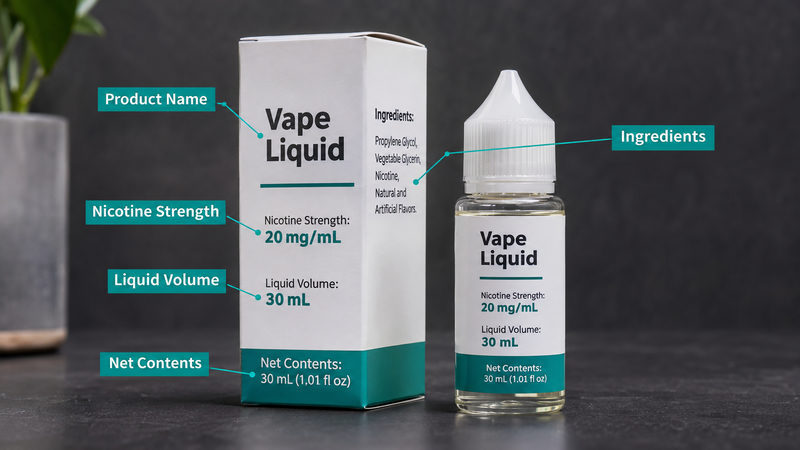
Be precise about what the customer receives. A pod package might state that it contains two prefilled pods, each holding 2 mL. A device kit could list one device, one tank, two coils, and one charging cable. Clear contents reduce confusion and help retailers confirm that sealed packages are complete.
Net quantity must appear in units accepted by the destination market. Bottled liquids usually use milliliters, while pod packages may show both the number of units and the liquid volume. Devices may also need to state tank capacity, battery capacity, or another relevant measurement. Whatever the measure, it should describe the actual product—not an unverified maximum.
Nicotine declarations and consistency
Make it clear whether the product contains nicotine. If it does, declare the concentration using units accepted by law. Common formats include mg/mL, percentage, or total nicotine content, but one format will not necessarily satisfy the rules in every country.
Percentage conversions need special care. In many simple liquid formulations, 2% broadly corresponds to 20 mg/mL. Even so, presentation requirements and testing methods may affect which declaration is permitted. A qualified reviewer should verify both the calculation and the required label format.
Terms such as “strong,” “extra,” or “level five” are too vague without an exact concentration. They may help customers tell variants apart, but they cannot replace measurable information. Unclear strength labels invite selection errors and can also create conflicts between different sales materials.
The stated strength must match everywhere. Check the retail box, primary container, insert, barcode record, invoice description, and online listing. A bottle labeled 10 mg/mL, for example, must not be advertised online as 1.8%. The declaration should also agree with formulation records and verified laboratory results.
Ingredients, allergens, and product claims
List e-liquid ingredients in the order and terminology required by the destination market. A typical formulation may contain propylene glycol, vegetable glycerin, flavorings, and nicotine. Local rules may require certain allergens or sensitizing substances to be listed separately. Reviewers should also check whether ingredient quantities or categories must be disclosed.
Flavor names should reflect the formulation accurately without making the package look too much like food. “Strawberry flavor,” for instance, should not suggest that the liquid contains fresh fruit. Ingredient information also needs to stay legible after opening and normal handling. Tiny type, curved labels, and glossy finishes can all make that harder.
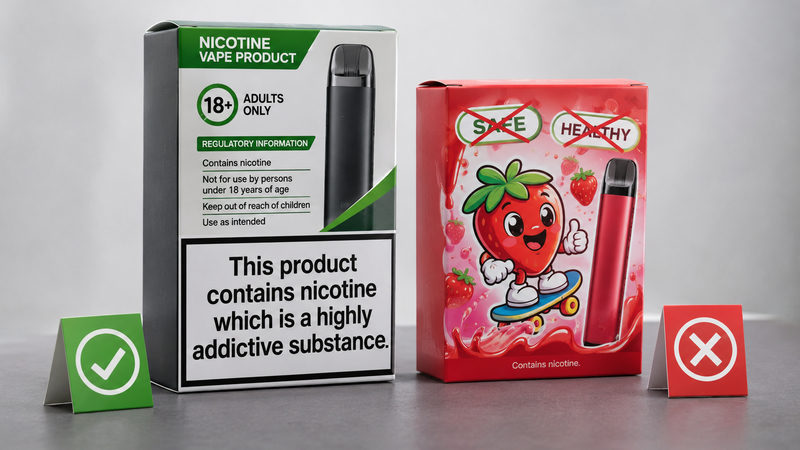
Avoid unsupported claims such as “safe,” “healthy,” “harmless,” or “detoxifying.” Do not claim that a product is approved for smoking cessation unless that claim has lawful authorization. Phrases such as “chemical-free” are also inaccurate, since every liquid is made of chemicals. Keep all claims truthful, supportable, and permitted in the intended market.
3. Health Warnings, Age Restrictions, and Marketing Rules
Prescribed warnings require exact reproduction
Nicotine warnings often come with exact legal specifications. The rules may dictate the wording, font size, position, contrast, borders, and percentage of the package covered. Designers should never shorten or rephrase a prescribed statement. Even a well-meaning edit can turn an otherwise accurate label into a noncompliant one.
Relevant European markets may apply requirements derived from the Tobacco Products Directive together with national measures. These can cover nicotine warnings, leaflet content, container capacity, and child-resistant features. In the United States, products may fall under FDA tobacco-product requirements, with federal, state, and local obligations applying at the same time.
Always verify the current rules for every sales destination. A warning accepted in one country may be rejected in another, and language requirements can vary even within the same region. Never copy wording from a competitor’s package without first confirming its legal basis.
Warnings for vulnerable people and accidental exposure
Age restrictions should appear wherever local law requires them. Some markets mandate a specific age statement; others control age through the sales process. Required wording may also refer to children, pregnant people, breastfeeding people, or individuals with certain medical conditions. When authorities prescribe the language, reproduce it exactly.
Nicotine exposure can happen through swallowing, skin contact, or eye contact. Packaging may therefore need warnings about addiction and accidental poisoning, along with instructions to keep the product away from children and pets. Depending on local rules, first-aid directions or poison-information contacts may also be required.
- Do not swallow the liquid or place it in food.
- Avoid contact with skin, eyes, and contaminated clothing.
- Keep the product locked away from children and pets.
- Seek appropriate medical advice after significant exposure.
These statements should reflect the product and its genuine hazards. A refill bottle, for example, creates different exposure risks from a sealed device. Instructions must not conflict with mandatory warning language, so reviewers should assess the package and insert as a pair.
Marketing presentation and restricted claims
Many markets restrict packaging designed to appeal strongly to children. Cartoons, toys, youth-oriented characters, celebrities, and playful lifestyle imagery may all cause problems. Packages that resemble juice boxes, sweets, or confectionery can also increase the risk of accidental ingestion. Even adults may mistake a familiar food-style container for something it is not.
Promotional copy deserves the same scrutiny as safety information. Environmental claims need reliable evidence and should clearly explain their scope. Comparative-risk statements may likewise require specific proof or regulatory permission. Review every slogan, badge, icon, and side-panel statement before the product is released.
4. Responsible-Party Details and Product Traceability
Identifying the accountable business
The package should name the business legally responsible in the sales market. Depending on local rules, that may be the manufacturer, importer, distributor, or an authorized local representative. Use the correct legal name, not an informal brand nickname, and make sure the organization accepts responsibility for that particular product.
A physical postal address may be compulsory, especially for an importer or locally responsible party. Some markets also require a telephone number, email address, website, or country of origin. A website by itself may not satisfy an address requirement, so reviewers should confirm which contact details must be printed on the package.
Accurate contact information helps consumers and authorities report defects without delay. A customer might need assistance after a battery overheats, while a regulator may request formulation, notification, or test records. Current details save valuable time during an urgent investigation.
Codes, dates, and recall readiness
Batch or lot codes connect each package to manufacturing and quality records. Serial numbers can narrow identification to an individual device, while manufacturing dates help with inventory rotation and defect investigations. All of these details should remain legible for the product’s expected life.
Date-marking rules differ across jurisdictions and product categories. Even where they are not mandatory, best-before or expiration dates can be useful when ingredients, seals, or battery performance deteriorate. Flavors may change in storage, and batteries can lose capacity. Any shelf-life statement should be backed by suitable stability evidence.
Traceability proves its value when a defect is limited to one production run. Suppose 600 devices have a faulty component in a shipment of 20,000 units. A dependable lot code lets the business isolate those 600. Without one, a far wider recall may be necessary.
Digital and market-specific identifiers
Packaging may also display barcodes, unique identifiers, authentication codes, tax stamps, or registration numbers. The exact requirements depend on the product and its destination. Digital records can connect each identifier to formulation, supplier, testing, and distribution information, helping businesses answer questions quickly.
QR codes can take users to instructions, authenticity checks, or updated disposal advice. They usually complement mandatory physical information rather than replace it. Not every buyer has internet access, and linked pages can change. Core product details and required warnings should remain visible on the packaging itself.
5. Instructions, Safety Features, and Disposal Information
Clear instructions for normal use
Instructions must reflect how the product actually works. Explain how to open, assemble, activate, refill, charge, clean, and store it. Where relevant, show users how to replace pods or coils. Short numbered steps and straightforward diagrams can make misuse less likely.
A refillable device may need to be primed before its first use. Skip that step and the coil could overheat, producing an unpleasant burnt taste. An automatic disposable, by contrast, may require nothing more than removing the protective seals and inhaling. Never describe controls or features that the product does not have.
Compatibility information matters whenever components can be swapped. Identify suitable pods, coils, chargers, cables, and batteries, and explain unsafe combinations when confusion is likely. A vague instruction like “use the correct charger” may not give users enough practical guidance.
Exposure, battery, and fire warnings
E-liquid instructions should cover swallowing, leakage, and contact with the skin or eyes. Tell users what to do after accidental exposure, and warn them not to use leaking containers or damaged pods. They should know exactly when to stop using the product.
Battery-powered products bring extra hazards. Warnings should address overheating, short circuits, unsuitable chargers, damaged cells, and exposure to water. Users should not charge a device on a bed or near flammable materials. They should also stop using anything that swells, becomes unusually hot, or gives off an unusual smell.
- Use only compatible charging equipment and suitable electrical ratings.
- Do not puncture, crush, burn, or dismantle the battery.
- Keep exposed battery contacts away from keys and coins.
- Never use a wet, damaged, swollen, or leaking device.
Storage directions should address children, pets, heat, sunlight, moisture, and extreme temperatures. A parked car, for example, can become dangerously hot in sunny weather, increasing the risk of pressure, leakage, and battery problems. Where supported by testing or local rules, include clear temperature limits.
Physical safeguards and package integrity
Some markets require child-resistant closures, tamper evidence, or leak-prevention features. These safeguards are especially relevant to refill bottles and other accessible liquids. Still, child-resistant does not mean childproof. Every product must be stored securely.
Tamper-evident bands and seals help buyers spot packages that have already been opened. Other package-integrity features can limit leaks during shipping. Closures should be tested on the final filled container, since a cap that works on an empty prototype may perform differently after filling and transport.
Recycling and end-of-life handling
Electrical products may need battery markings, recycling symbols, or a crossed-out wheeled-bin symbol. Hazardous-material and transport information may apply in some situations as well. Local disposal instructions should tell consumers where they can return devices or batteries, since ordinary household waste may not be suitable.
Disposal guidance should be especially visible on disposable vapes. Each one combines liquid, electronics, and a battery in a compact item. Consumers should not put them into standard recycling unless local rules allow it. Clear e-waste directions can help prevent fires in collection vehicles and waste facilities.
6. Packaging Requirements by Vape Product Type
Liquids, pods, and disposable products
Bottled e-liquids generally place the greatest emphasis on ingredients, nicotine concentration, liquid volume, and exposure warnings. Closure safety and leak resistance matter too. Because bottle labels are small and curved, keeping the text readable can be difficult. An outer box does not necessarily remove the obligations that apply to the bottle itself.
Prefilled pods may need to state the volume per pod, nicotine strength, pod count, and compatibility information. Leakage precautions help users handle damaged pods safely. Packaging should also make similar-looking strengths and flavors easy to distinguish. Do not rely on color alone to communicate an important difference.
Disposable vape packaging may show a qualified puff estimate, liquid capacity, nicotine content, and battery details. It should explain how the product activates, whether it can be charged, and how to dispose of it. Puff counts vary with user behavior and testing conditions, so estimates should never be presented as guaranteed performance.
Devices and replacement components
Refillable devices often need to display tank capacity, electrical ratings, coil resistance, and assembly instructions. Battery safety and compatible charging information should also be easy to find. If a product uses removable cells, identify acceptable battery specifications so users have enough information to avoid unsafe combinations.
Replacement coils, tanks, batteries, and mouthpieces need precise compatibility details. Technical specifications may cover resistance ranges, materials, or maximum operating limits. Replacement batteries also require their own handling, transport, and disposal warnings. A component may be small, but its safety obligations can still be significant.
Assess combination kits one component at a time. A single label format rarely serves liquids, electronics, batteries, and accessories equally well. The solution may require information on the box, labels on individual components, and an instruction insert. Map each requirement to the surface where the user is most likely to need it.
7. Pre-Print Vape Label Compliance Checklist
Build the review around the intended market
Begin by confirming the destination country and relevant regulator. Next, identify the product classification, nicotine status, and sales channel. Determine whether local rules define the item as a tobacco product, consumer product, electrical device, or another category. Do not start with artwork copied from a different market.
Build a market-specific content matrix before the design moves too far. Record each required statement, symbol, language, unit, font size, placement rule, and packaging surface. Give every entry an owner and an evidence source. This makes omissions much easier to catch.
- Confirm the product name, classification, variant, and package contents.
- Verify nicotine presence, strength, units, volume, and ingredients.
- Insert every prescribed warning without changing its wording.
- Confirm responsible-party names, addresses, and contact details.
- Map batch codes, dates, barcodes, symbols, and digital identifiers.
- Review instructions, safeguards, storage, and disposal information.
Check consistency across every customer touchpoint
Compare the product name, nicotine strength, volume, ingredients, and warnings across every piece of material. That includes the container, box, insert, shipping carton, and online listing. Check responsible-party details against contracts and official registrations too. One outdated importer address can be enough to delay market entry.
Have translations reviewed by qualified native-language specialists familiar with regulated products. A literal translation can alter the meaning of warnings or technical instructions. Different languages also take up different amounts of space, so designers must test the translated artwork instead of assuming the original layout will still fit.
Test the finished production sample
A digital proof cannot reveal every physical issue. Examine text size, contrast, permanence, and readability on the finished production sample. Scan every barcode and test every QR code. Check that varnish, seams, curves, flaps, and seals do not hide important text.
Test closure performance, tamper evidence, and package integrity under realistic conditions. Where relevant, include filling, transport, storage, opening, and repeated use. Check whether labels begin to lift after contact with liquid, and make sure batch printing stays clear and durable.
Catch common failures before authorization
Common failures include incorrect nicotine units, missing warnings, and incomplete importer details. Reviewers also encounter hidden text, poor translations, unsupported claims, and inconsistent batch information. Several minor mistakes can have the same commercial effect as one major omission. A structured checklist helps catch them early.
Labeling errors can lead to customs detention, shipment delays, retailer rejection, or sales bans. More serious failures may result in recalls, fines, product seizure, and reputational harm. Another review costs little compared with reprinting thousands of packages, and early corrections help keep distribution on schedule.
Require documented approval from regulatory, legal, quality, and responsible-party stakeholders. Every reviewer should sign off on the final artwork and production specification. Later changes must go through a formal revision process. Otherwise, an approved warning could vanish when someone rearranges a panel to fit a new barcode.
Before manufacturing, importing, or selling, confirm the current e-cigarette packaging regulations with the relevant authority. A qualified compliance professional can help interpret requirements that overlap. Repeat the review whenever the formulation, supplier, component, branding, or market changes. Compliance continues throughout the product’s commercial life.
Conclusion
Compliant vape packaging brings together clear product identification, accurate nicotine details, ingredient disclosures, and prescribed health warnings. It also provides responsible-party information, traceability codes, safe-use instructions, and appropriate physical safeguards. Battery markings and disposal guidance help consumers handle electrical products responsibly. Above all, every statement must be readable, accurate, and consistent.
The exact obligations vary by product type and sales market. Use a jurisdiction-specific pre-print checklist for every version of the package, and obtain approval from the relevant regulator or a qualified compliance professional before production or distribution. That last check can prevent expensive delays, recalls, and avoidable safety failures.