

A vape labeled “5% nicotine” sounds straightforward. But what does that number actually measure? What does 5% nicotine mean? In most cases, it means the liquid contains about 50 milligrams of nicotine per milliliter. It does not tell you how much nicotine is in each puff or how much your body absorbs.
Three figures are often confused: concentration, total nicotine, and absorbed nicotine. Each one tells you something different about the product’s strength and your potential exposure. So, understanding the label takes more than reading a single percentage.
This guide breaks down those differences with clear calculations and realistic examples. It also compares common strengths, nicotine formulations, delivery factors, and key safety concerns.
1. What Does 5% Nicotine Mean on a Vape Label?
Converting 5% nicotine into mg/mL
On many vape labels, 5% nicotine works out to approximately 50 mg of nicotine per milliliter of e-liquid. Manufacturers typically show this concentration as either “5%” or “50 mg/mL.” In general, the two labels describe the same nominal strength.
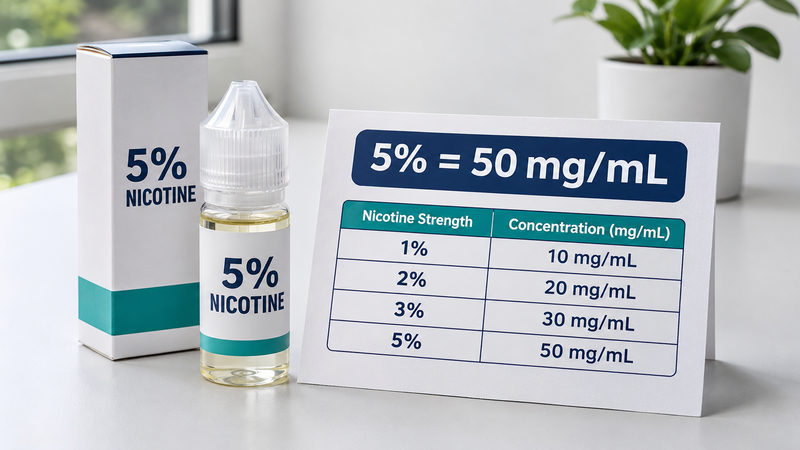
The calculation follows a common labeling convention: one percent nicotine equals approximately 10 mg/mL, making five percent approximately 50 mg/mL. Still, check the units stated by the manufacturer, since labeling practices can vary.
The key point? This percentage describes the concentration of the liquid. It does not mean that five percent of every aerosol cloud enters your bloodstream, nor does it show how much nicotine is contained in one puff.
Three measurements that mean different things
Think of concentrated fruit syrup in a bottle. The concentration tells you how strong the mixture is, while the bottle size tells you how much syrup is available. Nicotine concentration and total nicotine work in much the same way: they are connected, but they measure different things.
- Concentration: The nicotine strength of the liquid, usually shown as a percentage or mg/mL.
- Total nicotine: The concentration multiplied by the total liquid volume inside the product.
- Absorbed nicotine: The amount that ultimately enters the user’s bloodstream during use.
For example, two devices can both contain 5% nicotine. One may hold 2 mL, while the other holds 10 mL. The concentration is identical, but the larger device contains five times more nicotine in total.
Neither figure tells you exactly how much nicotine the body will absorb. Delivery depends on the device design, puffing pattern, formulation, and product efficiency. That is why two products with identical labels can feel different and lead to different levels of exposure.
Why location matters
Nicotine labels and permitted strengths differ from country to country. European Union rules, for example, limit many consumer e-liquids to 20 mg/mL. A 50 mg/mL product may therefore fall outside local requirements in that market.
Other regions may allow different concentrations, container sizes, or labeling formats. Before comparing products, check both the local regulations and the manufacturer’s stated units. A percentage by itself can hide meaningful differences in volume and formulation.
2. How Much Total Nicotine Is in a 5% Nicotine Vape?
The basic calculation
A 5% label tells you the nicotine concentration per milliliter, not the amount in the entire pod or disposable. To calculate total nicotine, you also need to know the e-liquid volume. Use this calculation:

E-liquid volume in mL × nicotine concentration in mg/mL = total nicotine in mg
For a 5% product, the approximate concentration is 50 mg/mL. A device containing 2 mL therefore holds about 100 mg of nicotine in its liquid. That is the amount contained in the product before accounting for aerosol losses or absorption.
Worked examples for common volumes
- 1 mL pod: 1 mL × 50 mg/mL = 50 mg total nicotine.
- 2 mL pod: 2 mL × 50 mg/mL = 100 mg total nicotine.
- 5 mL disposable: 5 mL × 50 mg/mL = 250 mg total nicotine.
- 10 mL disposable: 10 mL × 50 mg/mL = 500 mg total nicotine.
- 30 mL bottle: 30 mL × 50 mg/mL = 1,500 mg total nicotine.
These numbers describe the nicotine in the original liquid. They are not a single dose, and they do not show how much someone will absorb over the product’s lifetime. Some nicotine may remain in unused liquid, condensation, the coil, or discarded components.
A device also releases only a portion of its liquid with each puff, and the user absorbs only part of the nicotine carried in that aerosol. Put simply, “500 mg inside” does not mean that 500 mg enters the bloodstream.
Why advertised puff counts provide limited information
A disposable may advertise 5,000 puffs, but that claim cannot reliably tell you the nicotine dose in each puff. Puff length and intensity differ between laboratory tests and real-world use. Device performance can also change as the battery weakens and the liquid level falls.
Estimating delivery would require verified information about the liquid volume, formulation, aerosol output, and testing conditions. Even with those details, individual inhalation habits introduce uncertainty. Dividing the total nicotine by an advertised puff count gives only a rough theoretical estimate.
Consider the difference between a short mouth puff and a long, deep inhalation. They may produce very different amounts of aerosol. One person might take ten puffs an hour, while another uses the device almost continuously, resulting in very different daily exposure.
3. Is 5% Nicotine Strong? Comparing Common Vape Levels
Where 5% sits on the strength scale
Yes. Manufacturers and health professionals generally regard 5% nicotine as a high-strength concentration. It contains five times the nicotine concentration of a 1% liquid and ten times that of a 0.5% product.

- 0.5% nicotine: Approximately 5 mg/mL.
- 1% nicotine: Approximately 10 mg/mL.
- 2% nicotine: Approximately 20 mg/mL.
- 3% nicotine: Approximately 30 mg/mL.
- 5% nicotine: Approximately 50 mg/mL.
These comparisons refer only to the liquid’s concentration. Someone who frequently uses a lower-strength device may still have substantial exposure. On the other hand, occasional use of a higher concentration does not make the exact absorbed dose easy to predict.
A 5% product also exceeds the 20 mg/mL limit applied to many consumer products in the European Union. This helps explain why a product sold in one market may not legally appear in another. Regional context matters when you read the label.
Why equal concentrations can feel different
Two 5% products can deliver different throat sensations and amounts of nicotine. Device power, airflow, coil resistance, and aerosol output all affect how much liquid becomes aerosol. Flavor ingredients and the nicotine formulation can change the perceived harshness as well.
A small pod, for instance, may produce a modest amount of aerosol with each short puff. Another device could heat more liquid and generate a much larger aerosol volume. The same 50 mg/mL label does not guarantee the same delivery.
How a person vapes matters just as much. Longer puffs, deeper inhalation, and repeated sessions can raise exposure. A smoother sensation may also encourage more frequent use because the intake feels less noticeable.
Who should avoid starting
Adults who do not currently use nicotine should not start vaping. Nicotine can cause dependence, and vape aerosol may contain other potentially harmful substances. Children, teenagers, and pregnant people should avoid nicotine exposure altogether.
Adults who smoke cigarettes have several options when trying to quit. Vaping, however, is not harmless or recognized as an approved cessation treatment in every country. A healthcare professional can discuss established choices, including approved nicotine replacement medicines.
Partially switching may also leave someone exposed to cigarette smoke. Anyone considering harm reduction should speak with a qualified professional about stopping smoking completely. A general chart cannot determine the right nicotine strength for every person.
4. Nicotine Salts vs Freebase Nicotine at 5% Strength
What nicotine salts are
Many 5% disposable vapes and closed-pod products use nicotine salts. Manufacturers make these formulations by combining nicotine with an acid, such as benzoic acid. The process alters properties such as pH, stability, and sensory harshness.
Freebase nicotine has a different chemical form and has been used in e-liquids for many years. At higher concentrations, it often produces a stronger sensation in the throat. The exact experience still depends on the formulation, flavor, device, and the user’s sensitivity.
Nicotine salts can feel smoother at strengths that might make a freebase liquid uncomfortable to use. This can allow someone to inhale high-strength aerosol without intense irritation. A smoother sensation, though, does not mean the product contains less nicotine.
Common differences between the formulations
- Product formats: Salts commonly appear in compact pods and disposables, while freebase liquids often appear in refillable systems.
- Throat sensation: Salts may feel smoother, while freebase nicotine often feels sharper at comparable high concentrations.
- Concentration: Salt products frequently use higher strengths, although neither form has one universal range.
- Device compatibility: High-strength liquids usually suit lower-output devices, subject to the manufacturer’s instructions.
- Delivery: Formulation can influence nicotine absorption, but device design and puffing behavior also remain important.
These are general tendencies, not hard rules. Some freebase liquids come in low concentrations, and some salt products use modest strengths. Always check both the nicotine formulation and the stated mg/mL.
Smooth does not mean harmless
A softer feeling in the throat can disguise how concentrated a product really is. Someone may keep puffing simply because the aerosol feels mild. By the time discomfort appears, a substantial amount of nicotine may already have been consumed.
Nicotine salts still contain nicotine that can cause dependence. Like other nicotine formulations, they can contribute to cravings, tolerance, and withdrawal symptoms. Using an acid-based formulation does not remove the health concerns linked to inhaling aerosol.
The safest assumption is straightforward: 5% is a high strength, no matter how smooth it feels. Never judge nicotine content by throat sensation alone. Look at the percentage, mg/mL, volume, and manufacturer’s warnings together.
5. How 5% Nicotine Vaping Compares with Cigarettes
Why simple cigarette equivalents fail
Some online comparisons divide the total nicotine in a vape by an estimated amount from one cigarette. It seems convenient, but the calculation mixes up contained nicotine and absorbed nicotine. The result can seriously overstate or understate actual exposure.
A cigarette does not deliver every milligram of nicotine in its tobacco to the bloodstream. The same applies to a vape: not every milligram in the reservoir reaches the user. Comparing total content alone cannot produce a dependable cigarette equivalent.
Take a 2 mL vape at 5%. It contains about 100 mg of nicotine in the liquid, but calling that a fixed number of cigarettes ignores unused liquid and nicotine lost during aerosol production. It also leaves out how often, how deeply, and how efficiently someone inhales.
Contained, emitted, and absorbed nicotine
There are three stages between the product label and nicotine reaching the bloodstream. First, the liquid contains nicotine at a stated concentration. Then the device emits some of that nicotine in its aerosol.
Finally, the mouth and lungs absorb part of the emitted nicotine. Devices do not all convert liquid into aerosol with the same efficiency, and some aerosol escapes into the air or stays inside the mouthpiece.
- Nicotine contained: The amount present in the e-liquid before use.
- Nicotine emitted: The amount carried from the device within generated aerosol.
- Nicotine absorbed: The portion that enters the user’s body and bloodstream.
Laboratory equipment can measure each stage under controlled conditions. Everyday use rarely follows a fixed testing pattern, however. A label alone cannot predict the exact dose one person will absorb.
Factors that change nicotine delivery
Device power and coil design influence how much e-liquid is heated during a puff. Airflow can alter the aerosol’s temperature, density, and volume. Puff duration also has a major impact on how much aerosol the device produces.
- Device power and battery performance
- Coil resistance, condition, and design
- Airflow settings and aerosol output
- Puff length, strength, and frequency
- Mouth-to-lung or deeper inhalation styles
- Nicotine formulation and liquid composition
Repeated use makes the picture more complicated. A cigarette has an obvious endpoint; a vape may stay within reach all day. Small sessions can quickly turn into frequent, sustained nicotine intake.
Even a mild-feeling puff contributes to cumulative exposure. Someone taking two puffs every few minutes may use far more liquid than expected. Daily liquid consumption often provides more useful context than an advertised puff count.
6. Dependence, Excessive Intake, and Nicotine Safety
Dependence and changing use patterns
Nicotine affects the brain’s reward pathways and can lead to dependence. Repeated use of high-strength products may reinforce cravings and make quitting harder. The U.S. Food and Drug Administration’s nicotine guidance describes these addiction risks.
As tolerance develops, the same intake may feel less noticeable. Some users then puff more frequently or move to stronger products. Withdrawal may bring irritability, restlessness, poor concentration, anxiety, or intense cravings.
Small, discreet devices can also encourage automatic use during work, travel, or screen time. Without a natural stopping point, it is easy to lose track of sessions. Daily consumption may rise without the user making a conscious decision to increase it.
Common signs of excessive nicotine intake
Early symptoms are a signal to stop nicotine exposure and put the device aside. They may appear after heavy use, repeated sessions, accidental swallowing, or contact between the liquid and skin. Common warning signs include:
- Nausea or vomiting
- Dizziness or light-headedness
- Headache
- Sweating or clammy skin
- Shakiness or tremors
- Abdominal pain or discomfort
- Weakness or unusual fatigue
- A rapid or pounding heartbeat
These symptoms can have many causes, and their severity may change fast. Do not continue vaping just to see whether the feeling goes away. Stop the exposure and seek professional advice if the symptoms persist or concern you.
Severe warning signs
Serious nicotine poisoning needs urgent attention. After a significant accidental exposure, call local emergency services or a poison-control center. Get immediate help if any of these warning signs appear:
- Repeated or severe vomiting
- Confusion or extreme agitation
- Breathing difficulty
- Seizures
- Collapse or profound weakness
- Loss of consciousness
Do not induce vomiting unless a medical professional tells you to do so. Never give food or drinks to an unconscious person. Keep the product package nearby, as responders may need to know its concentration, ingredients, and volume.
If the liquid gets on the skin, remove contaminated clothing and wash the affected area with soap and water. If it reaches the eyes, rinse them gently with clean water. Contact local poison-control services afterward for advice specific to the exposure.
Choosing and reassessing nicotine strength
There is no single nicotine strength that suits every adult who already uses nicotine. Cravings and side effects can, however, signal that it is time to reassess. Frequent nausea, dizziness, headaches, or a racing heartbeat may point to excessive intake.
Persistent cravings may reflect dependence, inconsistent use, or a cessation approach that is not working well. Raising the strength without professional guidance can deepen dependence or make side effects worse. Talk through reduction plans with a healthcare professional or trained cessation adviser.
For several days, track how much liquid you use, how often you vape, when cravings appear, and any symptoms you notice. Record how long a pod lasts and when use becomes automatic. This information can help a professional suggest a safer, more structured cessation strategy.
Safe storage and handling
Liquid nicotine can harm children and pets if swallowed or absorbed through the skin. Even a small spill needs prompt attention. Store every device and refill securely after each use.
- Keep products locked away and out of children’s sight and reach.
- Use original, clearly labeled containers with child-resistant caps.
- Never transfer e-liquid into food, drink, or medicine containers.
- Avoid skin and eye contact when handling refill liquids.
- Clean spills promptly while keeping children and pets away.
- Dispose of batteries, pods, and liquid according to local requirements.
- Never leave devices inside hot cars or near heat and flames.
Nicotine sales rules, label requirements, and permitted strengths differ by location. Poison-control contact methods vary between countries too. Find your local emergency and poison-information resources before you ever need them.
Conclusion
A 5% nicotine label usually means approximately 50 mg/mL, a high nicotine concentration. Concentration alone, however, does not tell you the product’s total nicotine content. To estimate that figure, multiply 50 mg/mL by the volume of e-liquid.
Absorption is another matter. Device output, formulation, puff duration, inhalation style, and frequency all affect how much nicotine reaches the body. Never treat 5% as an exact dose per puff or a simple cigarette equivalent.
Before using any product, check both its nicotine concentration and e-liquid volume. Watch for signs of excessive intake, and keep every device stored securely. For help reducing nicotine use or choosing a proven cessation strategy, speak with a qualified healthcare professional.







