
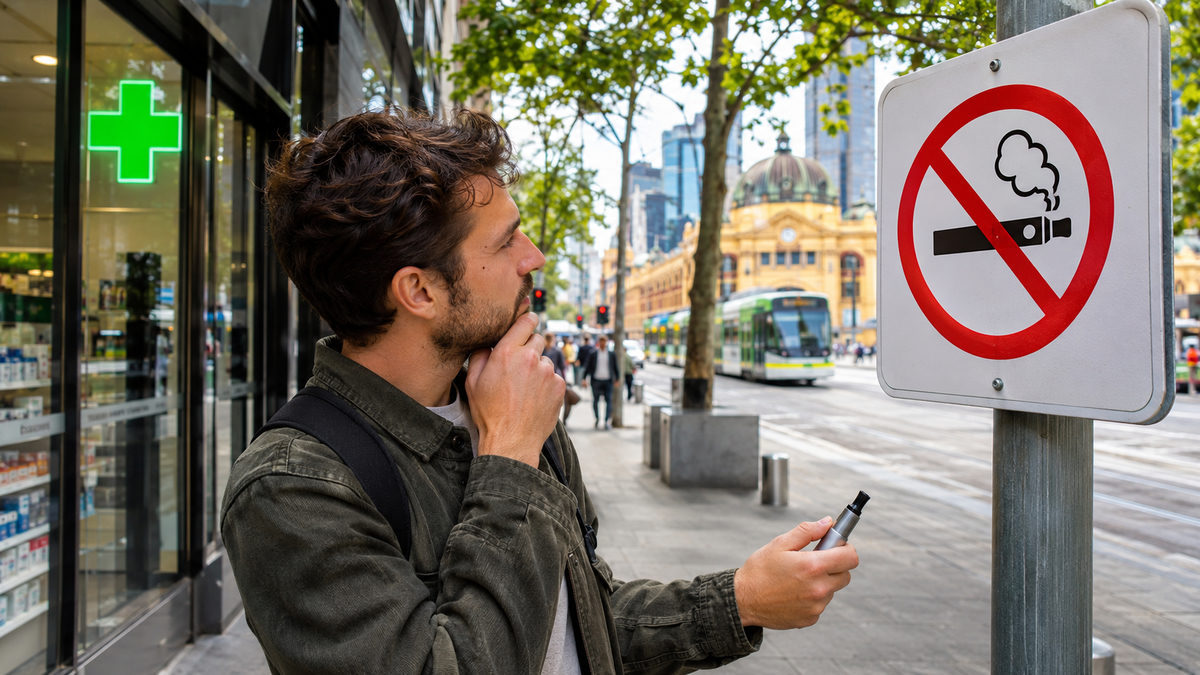
Can you take a vape through Melbourne, buy one at a pharmacy, or use it outside a café? Vaping Rules in Melbourne Explained may feel confusing because Commonwealth and Victorian laws overlap. The basic distinction is simpler: Australia allows tightly controlled therapeutic vaping but restricts ordinary retail sales and use in public places.
Residents, travellers, parents, and retailers all face several separate requirements. Federal law governs products, imports, advertising, and the national supply chain. Victoria, meanwhile, sets rules for matters such as supplying minors and the many places where vaping is banned.
This guide covers pharmacy access, age limits, product restrictions, travel allowances, enforcement, and support for quitting. Laws and administrative guidance can change, though. Before making an important decision, check with the relevant government agency or a qualified health professional.
1. Vaping Rules in Melbourne Explained: What Is Legal?
Vaping is not completely illegal in Melbourne. An adult can lawfully possess and use a compliant therapeutic vape in appropriate circumstances. That does not, however, give anyone an unrestricted right to buy, sell, import, advertise, or use vaping products wherever they choose.
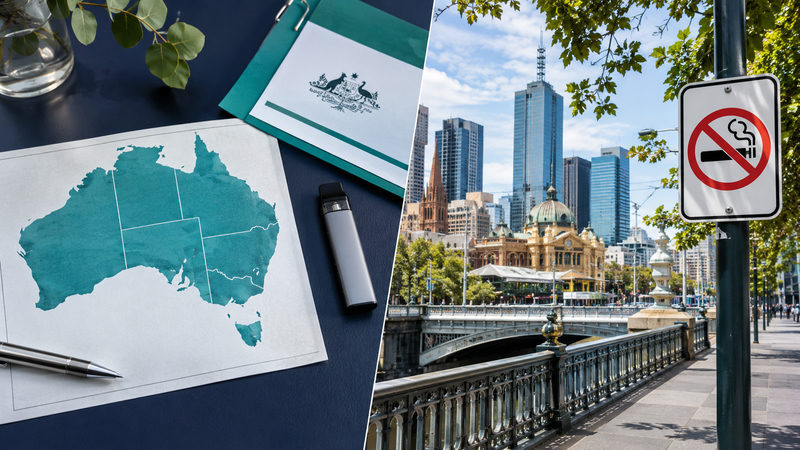
Commonwealth law governs most of Australia’s therapeutic vaping supply chain. It covers manufacturing, importation, commercial possession, advertising, supply, and sale. These controls apply broadly to devices, liquids, cartridges, capsules, pods, and related vaping goods.
Therapeutic access is the central principle
Legal access centres on smoking cessation and the management of nicotine dependence. Therapeutic vapes are treated as controlled health products, not everyday consumer goods. Being an adult does not mean someone can lawfully buy a brightly packaged disposable vape from a corner shop.
The rules also cover products advertised as nicotine-free. This stops sellers from sidestepping regulation with uncertain labels or claims that have not been verified. In practice, a non-pharmacy retailer cannot point to a “zero nicotine” sticker as justification for selling vaping goods.
Australia also excludes disposable vapes from ordinary therapeutic vaping pathways. Compliant therapeutic products generally use reusable devices with replaceable components. National standards also limit ingredients, packaging, flavours, nicotine strength, and other product features.
- Permitted purpose: Smoking cessation or management of nicotine dependence.
- Lawful supply: Participating pharmacies and limited authorised clinical pathways.
- Restricted products: Disposable, non-therapeutic, and non-compliant vaping goods.
- Restricted conduct: Unauthorised importing, advertising, commercial possession, supply, and retail sale.
Victoria adds local rules
Victoria’s Tobacco Act 1987 places vaping under many of the same restrictions as smoking. In particular, it prohibits supplying vaping goods to anyone under 18. It also regulates displays, advertising, and use in many workplaces and public locations.
These Victorian rules apply across Melbourne, from the central business district to surrounding municipalities. So, even if a product was obtained lawfully, using it in a particular place may still be illegal. Supply by a pharmacist does not override public transport, workplace, council, or private-property rules.
Crucially, lawful personal possession is different from lawful commercial possession. Carrying one compliant therapeutic vape for personal treatment is not equivalent to keeping cartons for resale. Enforcement agencies look at the product, quantity, intended purpose, source, and surrounding circumstances.
2. Buying Therapeutic Vapes from Melbourne Pharmacies
Vaping goods can enter the lawful market only through controlled therapeutic channels. That includes devices, liquids, pods, cartridges, and even products promoted as nicotine-free. For adults in Melbourne, participating registered pharmacies are the main lawful point of access.

Not every pharmacy has to stock therapeutic vaping products. Your nearest pharmacy may decide not to offer them. A quick call before visiting can save time and avoid confusion.
Access without a prescription
Adults aged 18 or older can ask a participating pharmacist about certain therapeutic nicotine vapes without showing a prescription. This route applies when the nicotine concentration is no more than 20 milligrams per millilitre. Supply is not automatic, though; it remains subject to the pharmacist’s professional assessment.
The pharmacist must verify the customer’s identity and age. They will also decide whether vaping is clinically appropriate for smoking cessation or managing nicotine dependence. The conversation may cover other options, earlier quit attempts, current nicotine use, medicines, and possible interactions.
Consider Mia, who is 32 and wants to stop smoking ten cigarettes a day. A pharmacist might discuss patches, gum, counselling, or an appropriate therapeutic vape. Mia cannot simply demand a particular product as if it were an ordinary retail purchase.
The pharmacist must also explain practical matters such as dose, frequency, treatment duration, and available quitting support. Without a prescription, the amount supplied cannot exceed what is reasonably needed for one month. That monthly quantity may be provided only once during the month.
When a prescription is required
Higher nicotine concentrations require a prescription from a medical practitioner or nurse practitioner. Specifically, a prescription is needed above 20 milligrams per millilitre. Products containing more than 50 milligrams per millilitre fall outside the permitted therapeutic vaping limit.
A prescription can also provide closer clinical supervision for someone with complex health needs. Still, it does not guarantee that every pharmacy will carry the prescribed product. Patients should check availability with both their prescriber and pharmacist.
Victorian pharmacies cannot supply vaping goods to anyone under 18. This applies even if a medical or nurse practitioner has written a prescription. Young people and their families should instead seek clinical advice about lawful treatment alternatives and quitting support suited to their needs.
Which sellers are prohibited?
Tobacconists, convenience stores, ordinary vape shops, and general retailers cannot legally sell vaping goods. The restriction also catches informal sellers using messaging applications, social media, markets, or private delivery services. Describing a product as “nicotine-free” does not create an exception.
- Tobacconists and tobacco retailers
- Convenience stores and service stations
- Ordinary vape shops and pop-up stalls
- Social-media and messaging-app sellers
- Unauthorised websites and delivery businesses
- Friends or individuals selling products privately
Overseas websites cannot lawfully send personal vape orders to Australian consumers either. The former personal importation route no longer offers that option. Even with a prescription, a consumer cannot authorise an overseas seller to mail vaping goods directly to Melbourne.
Product and pharmacy controls
Therapeutic vapes supplied by pharmacies must meet the relevant Commonwealth standards. Those standards restrict flavours, ingredients, packaging, presentation, and nicotine strength. Permitted flavours are generally limited to mint, menthol, and tobacco, rather than fruit or confectionery themes.
Pharmacy products also cannot look like colourful lifestyle merchandise designed for casual users. Under Victorian requirements, pharmacists must keep vaping goods out of public view. If you cannot see any on a shelf, that does not necessarily mean the pharmacy has none.
Even when supplied through a lawful pathway, therapeutic vaping goods are generally unapproved medicines. This means they have not received the same standard pre-market evaluation as registered medicines. A pharmacist or prescriber can explain the difference and discuss cessation treatments with stronger established evidence.
Do not assume that a product is lawful simply because it is sold from behind a counter. Check that it comes from a registered pharmacy and is being supplied for a therapeutic purpose. Keep the pharmacy labels, packaging, receipts, and prescriptions too; they may help establish lawful possession while travelling or during an inspection.
3. Where Can You Vape in Melbourne?
As a general rule, Victoria bans vaping wherever smoking is banned. Switching from a cigarette to a therapeutic vape does not grant permission to use it indoors. These restrictions protect others from smoke and vaping aerosol while maintaining smoke-free environments.
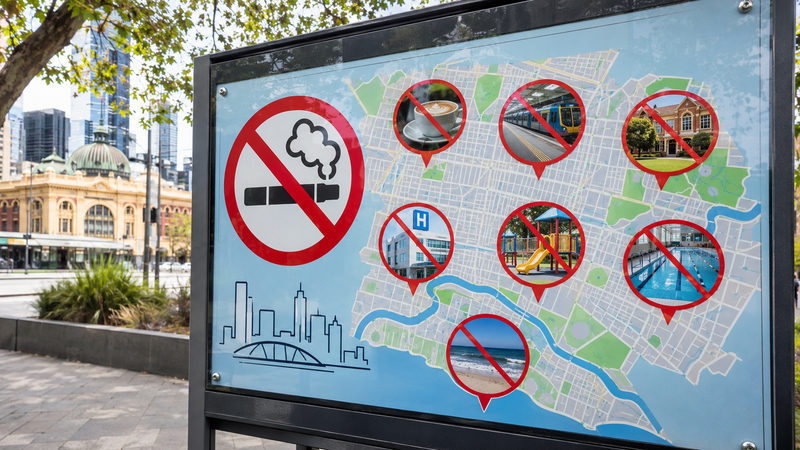
Enclosed workplaces must be free from both smoking and vaping. This includes many offices, shops, restaurants, warehouses, shared workspaces, and staff facilities. Employers can also introduce broader policies covering outdoor grounds, vehicles, entrances, and work-related events.
Dining, drinking, and entertainment areas
Vaping is banned in every outdoor dining area. You cannot, for example, vape beside a table while meals or snacks are being served. The same rule applies when the café table is on a footpath rather than inside the premises.
Restrictions also apply to outdoor drinking areas located near outdoor dining spaces. Vaping is prohibited if any part of the drinking area falls within four metres of an outdoor dining area. A wall at least 2.1 metres high may provide the separation required under the Victorian rule.
Venue operators may go further and ban vaping everywhere on their premises. A pub, for instance, can make its courtyard smoke-free even if legislation might otherwise permit vaping there. When in doubt, ask staff and follow the signs instead of assuming an unmarked corner is fine.
Public transport and surrounding facilities
Vaping is prohibited on Melbourne’s trains, trams, and buses. The ban extends to train stations, tram-stop platforms, tram shelters, and bus shelters. Having a lawful therapeutic product does not make it acceptable to use during the journey.
Airports have their own security, airline, and property requirements. Vaping aboard an aircraft is prohibited, and airport terminals generally allow it only in designated locations, if any. Airlines also usually require vaping devices and spare lithium batteries to be carried in cabin baggage under specific safety conditions.
Schools, healthcare sites, and public buildings
Vaping is banned on the grounds of childcare centres, kindergartens, preschools, primary schools, and secondary schools. The restriction reaches four metres beyond their entrances. Waiting outside a school gate with a vape could therefore still break the law.
The same four-metre restriction applies at entrances to public hospitals and registered community health centres. Certain Victorian Government buildings receive similar protection, including Parliament, courts, and police stations.
Children’s indoor play centres also have a four-metre entrance restriction. Individual hospitals and health services often ban vaping across their entire grounds as well. If signs impose a wider site rule than the statutory entrance zone, follow the broader restriction.
Recreation spaces and beaches
Families often come across vaping restrictions in recreation areas. Victoria prohibits vaping at playground equipment and skate parks, as well as within ten metres of them. The same distance applies around outdoor sporting venues during organised underage sporting events.
Every outdoor area within a public swimming pool complex is also smoke-free and vape-free. Patrolled beaches have a more targeted rule: vaping is banned between the lifesaving flags and within a 50-metre radius of each flag.
- Enclosed workplaces
- Outdoor dining areas
- Specified outdoor drinking areas near dining
- Public transport vehicles, stations, platforms, and shelters
- School and childcare grounds and protected entrances
- Protected hospital, health centre, and government-building entrances
- Playgrounds, skate parks, and specified junior sporting areas
- Public swimming pool complexes and protected beach zones
- Underage music and dance events
Local and private restrictions
Melbourne spans several council areas, so local controls are not always identical. Councils can create additional smoke-free or vape-free places through local rules and site-management decisions. Shopping centres, universities, stadiums, hotels, apartment buildings, and event organisers may set broader policies too.
A public square, for example, may have signs banning smoking and vaping across the whole precinct. A building manager might also prohibit vaping on balconies or in shared spaces. Posted signs and direct instructions still matter, even when no statewide distance rule appears to apply.
Unsure whether vaping is allowed? Move well clear of entrances, crowds, dining areas, children, and transport facilities. Distance by itself does not guarantee permission, so check venue signs, council information, and directions from authorised staff before using the device.
4. Travelling to Melbourne with a Vape
People arriving in Australia by aircraft or ship may qualify for a limited federal traveller exemption. The vaping goods must be for the traveller’s therapeutic use. They may also be intended for someone under the traveller’s care who is travelling with them.
The goods have to arrive in accompanied baggage. Travellers cannot use the exemption to mail supplies ahead or place an order with an overseas website. Unaccompanied parcels may be intercepted, seized, or become the subject of other enforcement action.
Federal quantity limits
Current limits apply to each eligible traveller. A person may bring no more than two vapes, 20 cartridges, capsules, or pods, and 200 millilitres of vape liquid. Cannabis products and other controlled medicines are subject to separate rules.
- Up to two vaping devices
- Up to 20 cartridges, capsules, or pods
- Up to 200 millilitres of vaping liquid
A prescription or doctor’s letter is not generally required solely to use this vaping-goods border exemption. Even so, supporting documents can make the therapeutic purpose clearer. Where available, carry original packaging, pharmacy labels, prescriptions, and a clinician’s letter.
Remember, this exemption deals with importation at the border. It does not displace Victoria’s rules on supplying minors or restrictions on where vaping is allowed. Nor does it permit a traveller to sell, advertise, commercially share, or distribute imported products.
Flying with devices and batteries
Airlines commonly ban the use or charging of vaping devices during flights. Lithium-battery safety rules also often require devices and spare batteries to travel in carry-on baggage, not checked luggage. Devices should be protected from accidental activation, while battery terminals should be secured against short circuits.
Airport security limits for liquids may affect what can be packed in cabin baggage. Airlines can also set conditions beyond general government requirements. Check the operating airline’s dangerous-goods policy before you pack.
The rules at your next destination may be very different from Australia’s. Some countries prohibit possession or importation altogether. A product carried lawfully into Melbourne could therefore create serious trouble on a later international trip.
Before leaving, check the latest guidance from Australian Border Force, the Therapeutic Goods Administration, airports, airlines, and authorities at the destination. Check again shortly before travelling, since border and aviation rules can change. Advice from a seller or an old travel forum is not enough.
5. Fines, Confiscation, Illegal Sales, and Reporting
The consequences depend on what happened, where it happened, the quantity involved, and which law applies. Vaping in a prohibited public place may lead to an infringement notice. Unlawful importing or commercial retail activity, however, can have far more serious consequences.
Authorised officers can investigate suspected breaches and request relevant information. Border officers may stop prohibited imports, while health regulators can inspect supply arrangements. Enforcement agencies may also seize vaping goods linked to unlawful importation, possession, supply, or sale.
Personal-use and commercial conduct differ
Someone vaping on a prohibited tram platform commits one kind of breach. A retailer holding hundreds of disposable vapes for sale presents a much larger commercial matter. Penalties can therefore range from an infringement issued to an individual to substantial civil or criminal proceedings.
Commercial quantities, repeat offending, advertising, concealment, and organised distribution can make a case more serious. Several laws may apply to the same operation. Commonwealth therapeutic goods and customs rules can work alongside Victorian tobacco, licensing, and public-health laws.
This guide does not list fixed fine amounts because penalty units and infringement values may change. Court outcomes also turn on the particular charge and circumstances. If exact financial exposure matters, consult the current legislation and official enforcement guidance.
Products bought from illegal sellers
A shopfront, receipt, or delivery service is no guarantee that a sale was legal. Illegal sellers may offer unlabelled liquids, disposable devices, or products containing uncertain ingredients. Claims on the packaging about nicotine content do not always match laboratory findings.
Consumers should never resell unwanted products on social media or give them to minors. Nicotine liquid should not be poured down household drains either, as this creates needless safety and environmental risks. Ask a pharmacist or local waste service how to dispose of it properly.
If officers confiscate goods, follow their written directions and retain every notice you receive. Do not obstruct an inspection or give false information. If an investigation, prosecution, or substantial seizure affects you or your business, seek independent legal advice promptly.
Reporting suspected illegal activity
Suspected illegal retail sales can be reported to the appropriate Victorian health or tobacco enforcement authority. Concerns about border imports may need to go to Australian Border Force. Suspected breaches involving therapeutic goods, advertising, or unlawful national supply may instead fall within the TGA’s remit.
- Record the business name and exact location.
- Note the date, time, and products offered.
- Save public advertisements or transaction records.
- Avoid confrontation or entering unsafe situations.
- Submit information through the relevant official reporting channel.
Councils may deal with complaints about vaping in specific local areas or council-managed facilities. Public Transport Victoria provides guidance on conduct across the transport network. If there is an immediate emergency, call emergency services rather than trying to investigate the matter yourself.
6. Official Guidance and Help to Quit Vaping
Government guidance is the best starting point for legal and practical questions. The TGA Vaping Hub covers therapeutic products, pharmacy supply, product standards, and national reforms. The Australian Department of Health and Aged Care also publishes broader health and policy information.
Australian Border Force explains prohibited imports and the traveller exemption. Victoria’s Department of Health publishes local guidance for pharmacies and retailers, along with information about age restrictions and vape-free places. Public Transport Victoria and the relevant Melbourne councils cover rules within their facilities and public spaces.
- Australian Department of Health and Aged Care
- Therapeutic Goods Administration Vaping Hub
- Australian Border Force
- Victoria’s Department of Health
- Public Transport Victoria
- The council responsible for the relevant Melbourne location
Therapeutic vaping is regulated as a tool for smoking cessation or managing nicotine dependence. It is not an unrestricted recreational product. And simply because a vape is legally available does not mean it is suitable for every person or every attempt to quit.
A doctor, nurse practitioner, or pharmacist can talk through nicotine replacement products, medicines, counselling, and behavioural support. Quitline can help people prepare for cravings, triggers, and setbacks. That support is available both to smokers moving away from cigarettes and to people who want to stop vaping.
Parents should seek professional support if a young person is using nicotine. A Victorian pharmacy cannot supply that young person with a therapeutic vape. Health professionals can, however, assess dependence, wellbeing, withdrawal symptoms, and lawful treatment options.
Conclusion
Vaping is not completely banned in Melbourne, but the lawful route is narrow. Legal products are limited to therapeutic supply through participating pharmacies or other specifically authorised clinical pathways. General retailers and overseas postal sellers cannot lawfully provide vaping goods directly to consumers.
Victorian pharmacies cannot supply anyone under 18, even if that person has a prescription. Disposable and non-therapeutic vapes are prohibited as well, while compliant pharmacy access for adults depends on clinical and product requirements. Lawful possession never means someone may vape in a restricted place.
Melbourne bans vaping in enclosed workplaces, transport facilities, outdoor dining areas, protected entrances, and many recreation spaces used by families. Travellers must also satisfy the rules for therapeutic purpose, accompanied baggage, and quantity limits. Getting a device through the border is not the same as having permission to use it anywhere.
Before obtaining a vape or travelling with one, check the latest guidance from the TGA, Australian Border Force, and Victorian Department of Health. Confirm any relevant airline, airport, council, and venue requirements as well. If you want to cut down or quit vaping, contact Quitline, a pharmacist, or another qualified health professional.







