A vape package can look like a puzzle, with bold warnings, tiny symbols, and unfamiliar numbers competing for attention. Understanding Vape Packaging Warnings turns those details into useful, practical information. Requirements vary across countries, regions, and product categories, though. And remember: a warning communicates risk; it never proves that a product is safe.
Parents, consumers, educators, retailers, and industry staff may all read the same label differently. A disposable vape also requires different instructions from bottled e-liquid or a rechargeable device. This guide breaks down the most common labels, safeguards, and warning signs. It offers general information, not medical or legal advice.
1. Understanding Vape Packaging Warnings and Their Purpose
Vape packaging warnings cover hazards, restrictions, storage, and handling through statements, symbols, and instructions. Regulators require some elements, while manufacturers may include others voluntarily. A package might address nicotine addiction, accidental poisoning, battery fires, age restrictions, or disposal. Together, these messages help people make informed choices before opening or using the product.
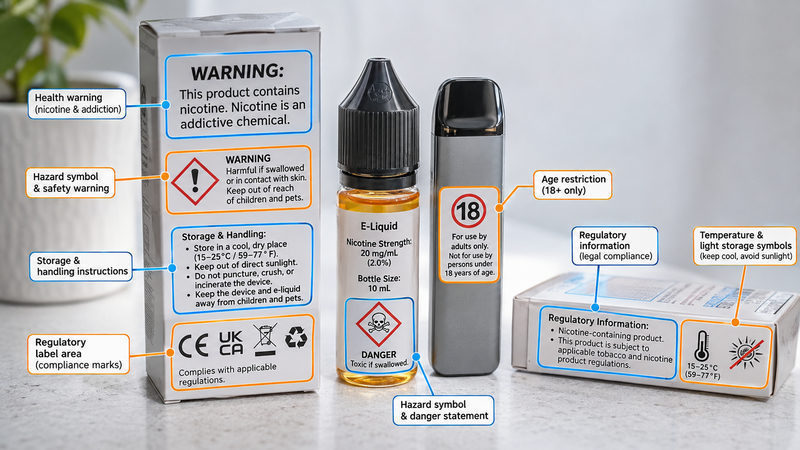
Required wording often has to meet exact rules governing size, location, contrast, and surrounding space. Regulators may, for example, require an addiction warning on a main display panel. The details can change across borders and product types. So a warning that complies with one market’s rules may fail to meet those of another.
Warnings communicate risk, not safety
A prominent warning does not mean regulators have declared the product safe. Usually, it highlights one significant hazard rather than every possible concern. Packaging space is limited, and scientific knowledge continues to develop. Consumers should also read any enclosed instructions and check guidance from local health authorities.
By the same token, a missing warning does not prove that a product contains no hazardous substance. Different local rules, incorrect labeling, or unlawful distribution could explain the omission. General phrases such as “use responsibly” also rarely replace legally prescribed language. Professional-looking artwork is no guarantee of compliance.
How different label elements work together
- Health statements explain addiction, exposure, or population-specific concerns.
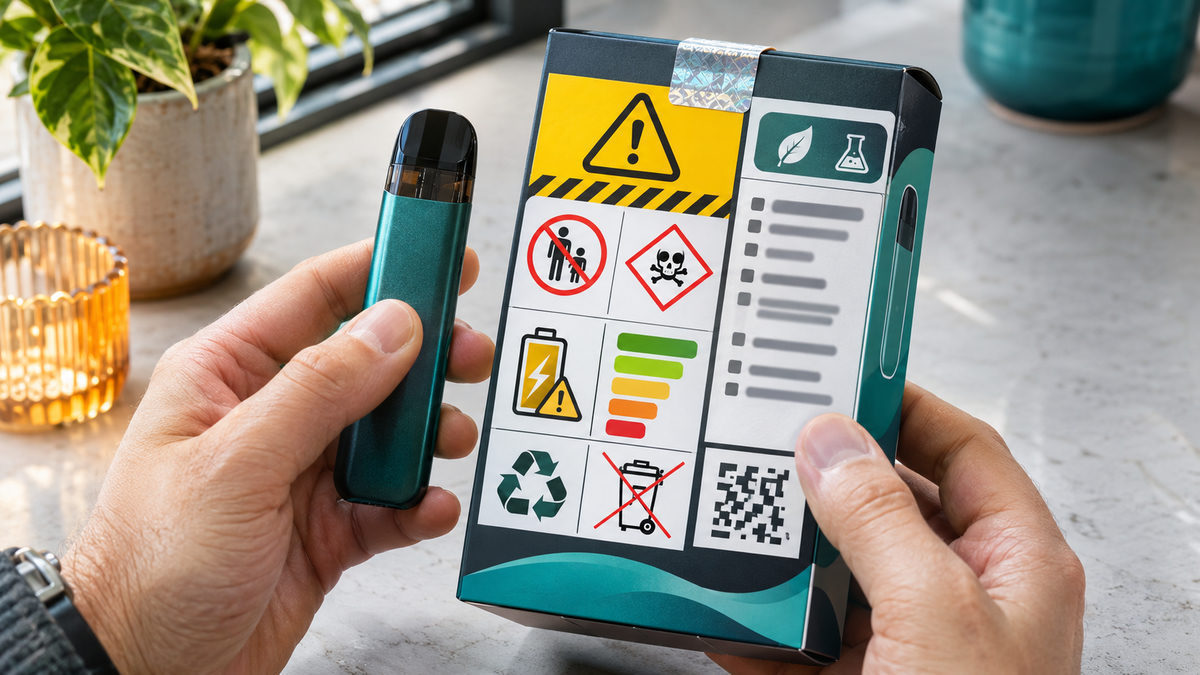
- Safety symbols highlight electrical, fire, recycling, and handling requirements.
- Product details identify ingredients, nicotine strength, volume, and device compatibility.
- Traceability fields connect the package with a producer, batch, or manufacturing record.
- Physical safeguards reveal opening, leakage, or tampering before use.
Look at these elements together rather than focusing on one impressive symbol. A batch code has little value if the manufacturer cannot explain it. Likewise, a child-resistant cap cannot prevent every accidental exposure. Effective packaging brings together clear information, suitable safeguards, and a traceable supply chain.
2. Nicotine Addiction Warnings and Strength Labels
Nicotine can cause dependence, which is why nicotine-containing products commonly carry a prominent addiction warning. Regulators often control the wording so that softer language cannot downplay the risk. Placement on a principal display panel also keeps decorative graphics from burying the message. The exact statement and format still vary by market.
In the United States, covered nicotine products commonly display a prescribed nicotine-addiction statement. European rules, meanwhile, have their own wording and presentation requirements. Official guidance from the U.S. Food and Drug Administration outlines federal warning expectations for covered tobacco products. Consumers and retailers should still check the national, state, provincial, or local requirements that apply to them.
Finding a nicotine claim
Check every panel—the front, back, base, and sides—for nicotine information. Look for terms such as “contains nicotine,” “nicotine-free,” and “zero nicotine,” as well as any numerical strength. Inspect removable sleeves, leaflets, and multipack boxes too. A flavor name, device color, or throat sensation is never reliable evidence of nicotine content.
A zero-nicotine statement is still a manufacturer’s claim unless credible testing backs it up. Mislabeling and cross-contamination can occur in poorly controlled supply chains. Anyone who must avoid nicotine should treat uncertain products with caution. A missing strength figure also warrants investigation before sale or use.
Interpreting common concentration formats
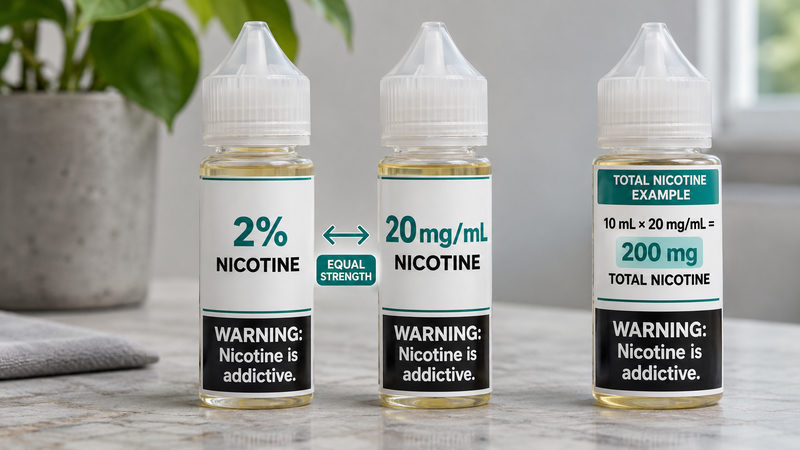
Labels often state nicotine concentration in milligrams per milliliter, written as mg/mL. For example, 20 mg/mL means that each milliliter contains 20 milligrams of nicotine. A percentage generally describes nicotine concentration by volume or mass, depending on the local convention. Do not compare percentages with mg/mL figures until you know how the producer calculated them.
One commonly used approximation treats 1% nicotine as roughly 10 mg/mL. Under that convention, a 2% label usually corresponds to about 20 mg/mL. Formulation methods and labeling rules can affect the precise relationship, however. When accuracy matters, rely on the manufacturer’s declared units and local regulatory definitions.
To calculate total nicotine, you need both the concentration and the liquid volume. For instance, 2 mL at 20 mg/mL contains 40 milligrams of nicotine in the liquid. That figure does not tell you how much a person will absorb. Device power, puffing behavior, formulation, and product performance all influence delivered exposure.
Nicotine salts, freebase nicotine, and dose claims
Some labels specify nicotine salts, while others mention freebase nicotine. These are formulation terms, not automatic measures of safety. Two products with the same labeled strength may still feel quite different in use. Acidity, aerosol production, and device design can all shape the experience.
Packages may also state nicotine per pod, cartridge, unit, dose, or puff. “Per puff” figures are especially dependent on testing conditions and user behavior. Only compare products when the units and measurement methods match. Otherwise, the smaller-looking number may simply refer to a different quantity.
- Confirm whether the label explicitly claims nicotine content.
- Identify the unit, such as percent, mg/mL, or milligrams per unit.
- Check the liquid volume before estimating total nicotine.
- Do not confuse total content with absorbed dose.
- Investigate conflicting figures on the device, package, and leaflet.
3. Health, Poisoning, and Vulnerable-Population Warnings
Health notices may refer to addiction, irritation, adverse effects, or restrictions for certain users. No package, however, can capture every known or potential risk. Warning content usually reflects local law, available evidence, and the product’s intended market. If a label says nothing about a particular outcome, that does not mean the outcome is impossible.

E-liquid can pose a poisoning hazard if someone swallows it or experiences substantial exposure. Leaks and refilling can also bring the liquid into contact with skin or eyes. Severity may depend on nicotine concentration, the amount involved, body size, and response time. After accidental exposure, the package may direct users to seek urgent medical or poison-control advice.
Why child warnings matter
Young children may confuse colorful bottles or sweet-smelling liquids with food. Because their bodies are smaller, a given exposure may also be more serious. “Keep out of reach of children” is therefore a crucial safety instruction. Products belong in a locked location, not simply on a high table.
Child-resistant packaging can reduce access when it is closed correctly. But “child-resistant” does not mean “childproof.” A determined child may eventually open a container, particularly if it has already been damaged. Adults should replace the cap at once and secure spills, tissues, and used pods as well.
Young people and non-users
Age statements and youth warnings reflect both legal restrictions and health concerns. Nicotine can cause dependence, and repeated patterns of use may develop quickly among young people. Attractive packaging does nothing to reduce those concerns. Nor should anyone read an age mark as a recommended starting age.
Warnings may also discourage use among non-smokers and people who do not already consume nicotine. Avoiding initiation closes off a new route to dependence and exposure. Flavors, vitamins, or “natural” ingredients do not remove risk, and the package should never suggest otherwise. Retailers should challenge unsupported wellness or performance claims.
Pregnancy, breastfeeding, and medical conditions
Some labels advise against use during pregnancy or breastfeeding because nicotine can affect developing children. Exposure concerns may reach beyond the person using the product, too. Anyone who is pregnant, breastfeeding, or planning a pregnancy should seek qualified medical guidance. Packaging is not a substitute for an individual clinical assessment.
Manufacturers may refer to cardiovascular conditions, seizures, allergies, or sensitivity to particular ingredients. These lists vary and may be incomplete. People with relevant conditions should discuss nicotine and aerosol exposure with a healthcare professional. Bringing the package or ingredient list can help when seeking advice.
Responding to accidental exposure
- Stop using the product and move it away from children or animals.
- Follow the package’s first-aid directions when they are clear and appropriate.
- Contact local emergency services or a poison information service when exposure may be serious.
- Keep the container, ingredient list, strength, and batch details available.
- Do not induce vomiting unless a qualified professional specifically directs it.
After skin contact, remove contaminated clothing and follow appropriate washing instructions. Eye exposure generally calls for prompt rinsing and professional guidance. Symptoms vary from person to person, so do not wait for dramatic signs before acting. Urgent medical advice matters more than trying to interpret the label on your own.
4. Safety Features, Battery Alerts, and Disposal Symbols
Physical packaging can help limit leakage, accidental opening, tampering, and misuse. Common safeguards include sealed caps, breakable rings, shrink bands, blister packs, and protected mouthpieces. Some refill bottles also use narrow nozzles or controlled-flow systems. These designs reduce risk, but safe storage and careful handling are still essential.
A broken seal may point to prior opening, damage, or poor packaging. Packaging styles differ, though, so a missing feature alone does not prove counterfeiting. Compare the item with verified examples supplied through lawful channels. Retailers should set questionable stock aside while confirming where it came from.
Understanding battery and charging warnings
Rechargeable vapes usually contain lithium-ion batteries, which may overheat if damaged, misused, or charged incorrectly. Packages may warn against puncturing, crushing, extreme heat, water, and direct sunlight. Users should watch for swelling, unusual heat, odors, or damaged charging ports as well. If a device shows any of these warning signs, stop using it.
- Use the specified charging cable, adapter, and voltage.
- Charge on a stable, nonflammable surface away from bedding.
- Do not leave a charging device unattended for long periods.
- Never use a wet, swollen, leaking, or visibly damaged battery.
- Keep loose batteries away from coins, keys, and other metal objects.
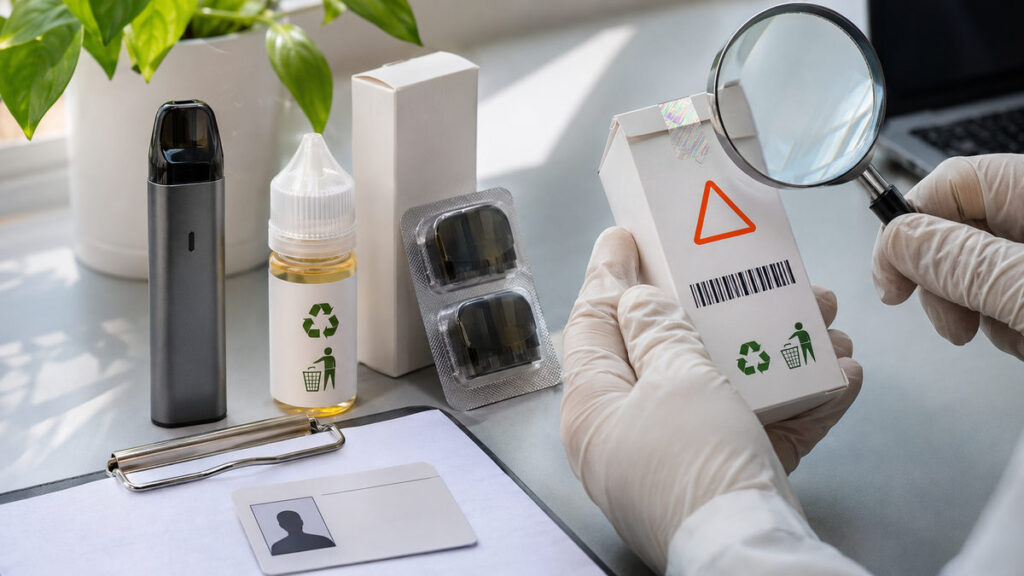
A crossed-out wheeled-bin symbol usually indicates that the device does not belong in ordinary household waste. Battery and recycling marks may also point to separate collection requirements. But a recycling triangle does not guarantee that local facilities will accept the item. Ask an authorized collection facility how it handles vapes, batteries, and residual e-liquid.
Disposing of complete devices and liquids
Disposable vapes contain electronics, a battery, and potentially nicotine residue. They may therefore need to go through an electronic-waste or hazardous-waste collection route. Do not crush, burn, puncture, or dismantle them unless an approved program specifically instructs you to do so. Unsafe handling can cause residual liquid to leak.
Do not pour unwanted e-liquid into sinks, toilets, soil, or storm drains either. Seal the container and follow local hazardous-waste guidance. Keep used pods and absorbent cleanup materials away from children and animals. When local disposal rules differ from generic symbols intended for another market, follow the local rules.
5. Ingredient, Traceability, and Product-Specific Labels
Useful packaging tells you what the product contains and who placed it on the market. Depending on local rules, it may list ingredients, liquid volume, nicotine content, and manufacturer contact details. A batch or lot code also connects the item to production records. That link can prove valuable during recalls, investigations, and quality complaints.
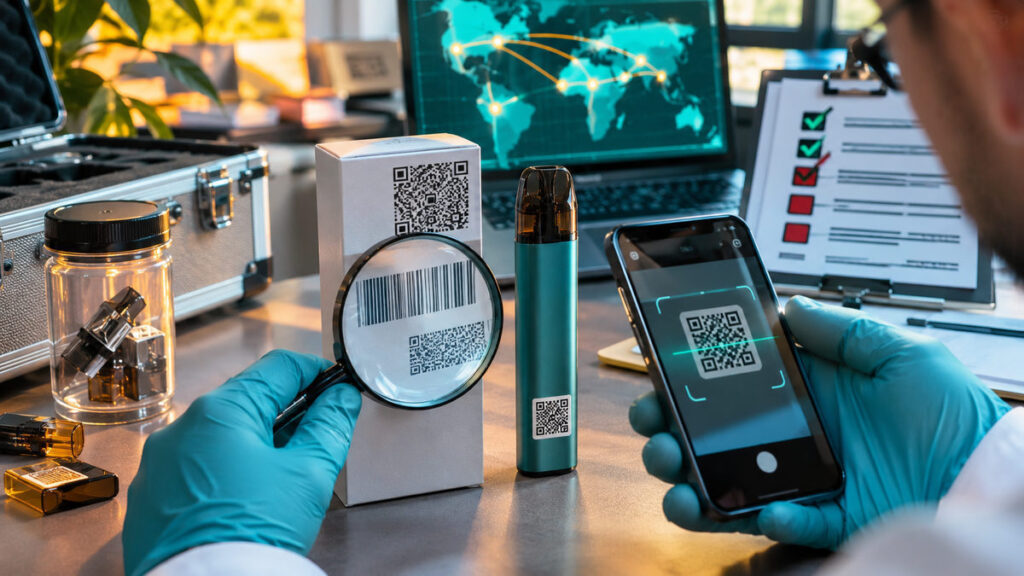
Check for a product name, model, flavor, quantity, and a country-specific responsible business. Look for manufacturing or expiry information where applicable, too. A barcode can support inventory management, but it does not prove authenticity by itself. Visible numbers and graphics are easy for counterfeiters to copy.
Labels for different product formats
- Disposable vapes: Check liquid capacity, nicotine strength, battery information, puff claims, charging status, and disposal directions.
- Refillable devices: Review tank compatibility, coil limits, power range, charging requirements, filling instructions, and leakage warnings.
- Pods and cartridges: Confirm device compatibility, unit count, liquid volume, nicotine level, and protective-seal condition.
- Bottled e-liquids: Check ingredients, concentration, bottle volume, child-resistant closure, batch code, and first-aid guidance.
Treat puff counts carefully because there is no universal puff duration. Laboratory tests may use fixed draw lengths that bear little resemblance to real behavior. A “5,000 puffs” claim therefore cannot guarantee a particular period of use. Without more information, it reveals nothing definite about nicotine delivery either.
Ingredient lists and flavor descriptions
Ingredient fields commonly name propylene glycol, vegetable glycerin, nicotine, and flavorings. The terms used and the level of disclosure vary by jurisdiction, however. A broad description such as “flavorings” may leave individual compounds unidentified. Anyone with allergies or sensitivities should request dependable information before using the product.
A flavor name describes the expected sensory character, not the full composition. Terms such as “ice,” “cool,” or “fresh” may suggest cooling ingredients without identifying them. Words like “organic,” “clean,” and “premium” do not establish lower risk, either. Keep promotional language separate from required factual information.
Using traceability information
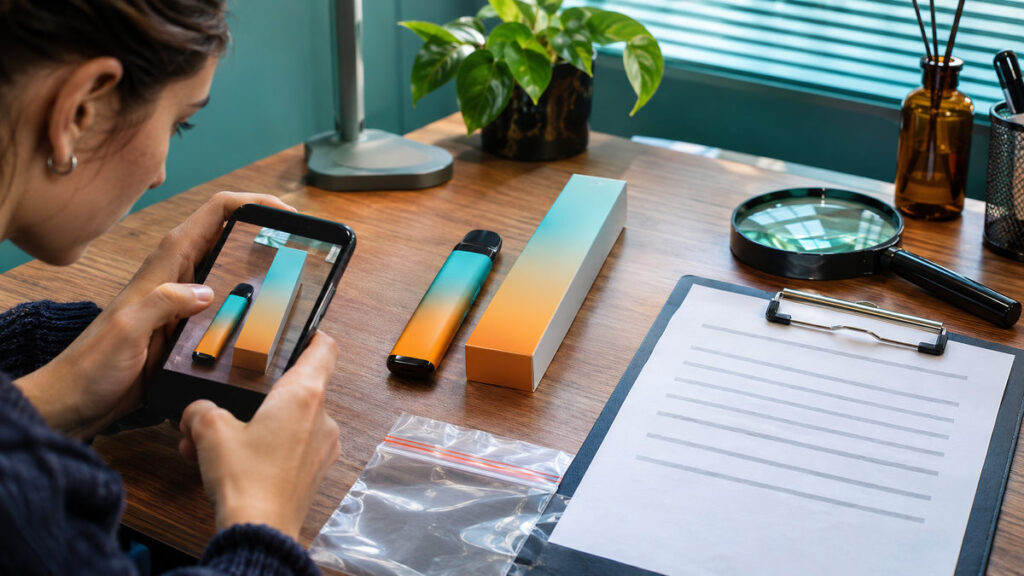
When reporting a problem, record the batch code and photograph the package. Include the seller, purchase date, product format, and defect you observed. Retailers should keep invoices and supplier records for the same reason. Good documentation helps responsible businesses investigate affected stock more efficiently.
Some products feature a verification code or another scannable security feature. Use only the manufacturer’s verified checking method. A code that sends you to an unfamiliar site may introduce a different risk. Repeated codes or failed verification deserve investigation, although neither is conclusive on its own.
6. How to Check Vape Packaging Before Sale or Use
A careful inspection takes just a few minutes, yet it can uncover meaningful problems. Begin before opening the package, since intact seals and presentation offer useful evidence. Compare every printed claim across the outer box, device, bottle, and leaflet. Any contradiction could signal poor quality control, mislabeling, or unauthorized distribution.
Practical packaging inspection checklist
- Confirm the seller: Prefer lawful, established suppliers that provide receipts and business contact information.
- Read the nicotine statement: Check whether the product claims nicotine content and uses a clear measurement unit.
- Compare all figures: Match strength, volume, model, flavor, and unit count across every component.
- Inspect required warnings: Look for appropriate language, prominence, contrast, and placement for your jurisdiction.
- Find age restrictions: Confirm that retail controls and packaging statements match local requirements.
- Check seals and closures: Reject unexplained leaks, broken rings, opened blisters, or damaged mouthpiece covers.
- Review battery instructions: Identify charging limits, damage warnings, storage conditions, and disposal directions.
- Locate traceability details: Find a batch code, responsible business, contact details, and other locally required fields.
- Examine print quality: Note spelling errors, distorted logos, inconsistent fonts, or labels covering earlier information.
- Check product compatibility: Confirm that pods, coils, chargers, and refill systems suit the intended device.
- Verify local authorization: Use official regulatory records when your jurisdiction provides a product database.
Warning signs that deserve investigation
Irregular packaging may suggest a counterfeit, mislabeled, or noncompliant product. Possible clues include impossible contact details, duplicated batch numbers, and conflicting nicotine strengths. Missing instructions, poorly attached labels, and suspicious verification pages also deserve attention. An unusually low price can add to the concern when other irregularities are present.
Still, no single clue proves that a product is counterfeit. A printing defect might be an ordinary manufacturing error, while polished packaging can conceal an unlawful product. Weigh physical observations alongside supplier records and official information. Avoid accusing staff without adequate evidence.
What consumers should do
Do not use a product that is leaking, damaged, swollen, or otherwise unexplained. Isolate it safely from heat, children, animals, and metal objects. Keep the receipt, package, and photographs while you contact the retailer or responsible business. If symptoms appear, seek medical help immediately instead of waiting for a commercial response.
Where local authorities accept product complaints, report specific facts rather than assumptions. Include the batch code, nicotine claim, seller, purchase date, and visible discrepancy. State whether the seal was intact as well. Clear evidence makes the resulting investigation far more useful.
What retailers should do
Retailers should inspect incoming stock before it reaches the shelves. Staff can compare invoices, product identifiers, warnings, and seals with approved purchasing records. Any questionable item should be separated from saleable inventory. The supplier can then be asked for traceability and compliance documentation.
Retail staff also need training on nicotine units, age restrictions, and battery hazards. Businesses should retain purchase records and act on relevant recall notices. Never alter, cover, or remove a required warning. Even an ordinary price sticker can cause problems if it hides essential information.
Rules change, and online marketplaces make it easy for products to cross borders. Packaging designed for another country may therefore fall short of local requirements. Consumers and sellers should consult the relevant health, consumer-protection, environmental, or tobacco-regulatory authority. Official local guidance always takes priority over a generalized checklist.
Conclusion
Vape packaging can tell you about nicotine content, addiction potential, poisoning hazards, battery risks, and storage needs. Symbols and traceability details may also help with disposal, recalls, and complaints. Yet both warning language and legal status vary by jurisdiction and product category. A required warning does not make a product risk-free, and neither does a nicotine-free claim.
Before purchasing, selling, or using a vape product, work through the packaging checklist carefully. Compare nicotine figures, inspect seals, locate batch details, and read the battery instructions. Then confirm the current requirements with your local health or tobacco-regulatory authority. If the packaging looks damaged or inconsistent, stop and investigate before going any further.