
What would you do if your vape suddenly became too hot to hold while charging? Understanding Vape Charging Safety helps you spot the danger before it turns into an emergency. A careful routine also protects the device, the surrounding area, and anyone nearby. This guide is intended for adults who already use rechargeable vape products.
A damaged cable or unsuitable adapter might look like a small inconvenience. It isn’t. Either can cause excess heat, unstable charging, or battery failure. Safe charging begins with compatible equipment and requires active supervision. You also need to recognize when it is safer to move away and call emergency services.
1. Understanding Vape Charging Safety and Lithium-Ion Risks
Why compact batteries require careful handling
Lithium-ion batteries pack considerable energy into a small cell. That high energy density is what makes portable vape devices possible. Yet the same stored energy can generate intense heat when something fails. A short circuit, crushed cell, or internal defect may set off a dangerous chain reaction.
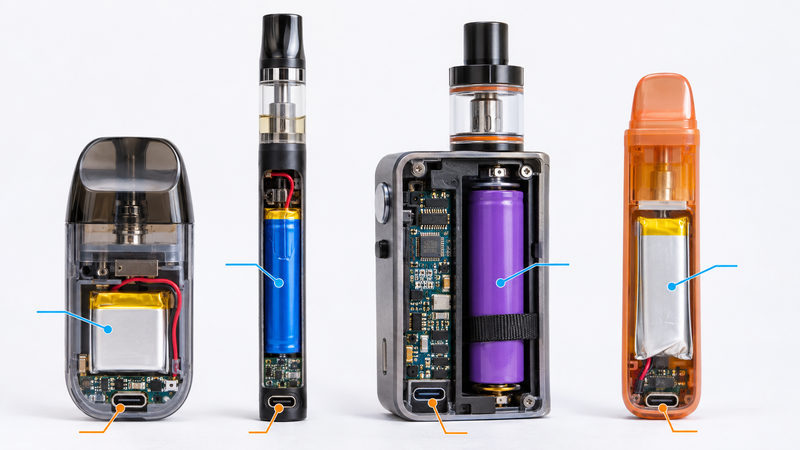
Thermal runaway begins when rising temperatures trigger chemical reactions that produce even more heat. The battery may then vent hot gases, ignite, or set nearby combustible materials on fire. Physical damage, manufacturing defects, incorrect charging, and extreme temperatures all raise the risk. Never ignore unusual heat, swelling, hissing, or a strong chemical odor.
Different devices have different charging needs
Devices with built-in batteries generally charge through a USB port and an internal charging circuit. Removable-cell mods may instead need an external charger and careful battery installation. Pod systems and vape pens differ widely in capacity, connector type, and supported charging rate. One cable or adapter will not necessarily suit every device.
Some disposable products have a charging port designed by the manufacturer. A disposable without that feature, however, must never be recharged or modified. Opening the casing can puncture the cell or cause a short circuit. Always handle each model according to its manual and original design.
What safety guidance can and cannot do
Good habits lower charging risks, but no routine can prevent every possible failure. Safe charging also does not make vaping harmless or remove its health concerns. This information is only for adults who already use vape products. Non-users should not start vaping simply because the charging process seems manageable.
2. How to Choose a Safe, Compatible Vape Charger
Start with the manufacturer’s specifications
Use the cable, adapter type, voltage, and current specified for your exact device. Check the manual, original packaging, or official instructions from the manufacturer. A connector may fit perfectly and still be electrically incompatible. Plug shape alone is never enough to confirm suitability.
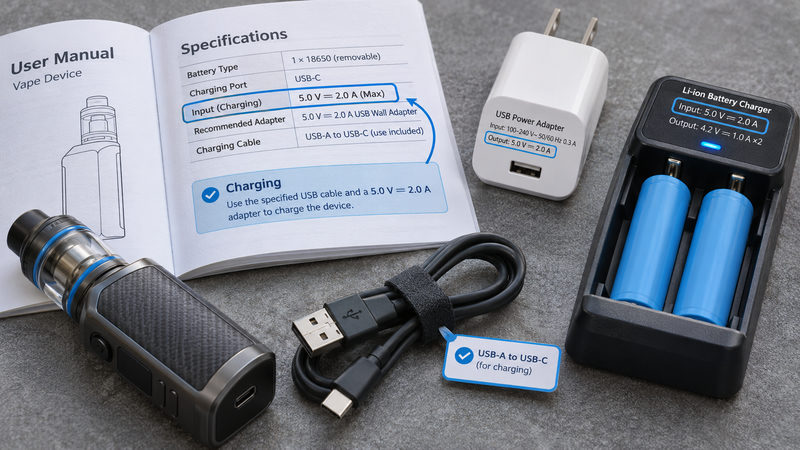
For example, two USB-C adapters can offer very different power levels and charging protocols. One might provide a basic five-volt output, while the other negotiates substantially higher power. An older or poorly designed vape may not safely handle every available mode. Manufacturer approval is far more dependable than guesswork.
Check every compatibility detail
Before plugging anything in, carefully compare the charger and device requirements. Check that the charging port gives the connector a firm, correct fit. With removable-cell chargers, confirm the supported chemistry, cell size, current, and polarity. The charger’s documentation should clearly identify every compatible battery type.
- Connector: Confirm the correct USB or proprietary plug type.
- Voltage: Match the device’s required input voltage exactly.
- Current: Follow the manufacturer’s supported charging current.
- Protocol: Confirm support for any required charging communication.
- Polarity: Install removable batteries according to marked positive and negative terminals.
Phone adapters and fast charging
A phone adapter is suitable only if its output matches the vape manufacturer’s requirements. Both products must also support a compatible charging protocol. Don’t assume a smart adapter will negotiate safely with every vape. Cheap or outdated charging circuits may respond unpredictably.
Unsupported fast charging can create extra heat and strain internal components. It may damage the charging circuit or reduce battery life. A high-output label doesn’t mean your device will charge better. Use fast charging only when the vape manufacturer explicitly approves it.
Reject questionable charging equipment
Avoid counterfeit, modified, improvised, or unbranded equipment with vague specifications. Replace any cable with frayed insulation, a bent plug, corrosion, or a loose connection. Damaged adapters can spark, disconnect repeatedly, or deliver unstable power. Saving a little on poor equipment may lead to a much bigger problem.
3. A Step-by-Step Routine for Charging a Vape Safely
Inspect everything before connecting power
Start with the device switched off whenever its instructions permit. Inspect the casing, port, cable, adapter, and removable battery. Watch for moisture, lint, corrosion, cracks, dents, swelling, or loose parts. If anything appears damaged or altered, stop there.
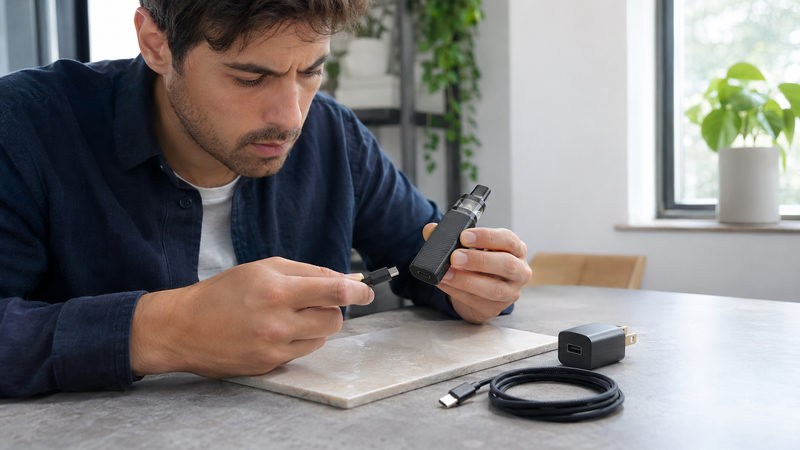
Make sure the port and connector are clean and dry. Never force a plug that feels misaligned or unusually tight. A loose connector is also a concern because it can create resistance and repeated electrical interruptions. Replace questionable equipment instead of trying to adjust it while power is flowing.
Choose a safer charging location
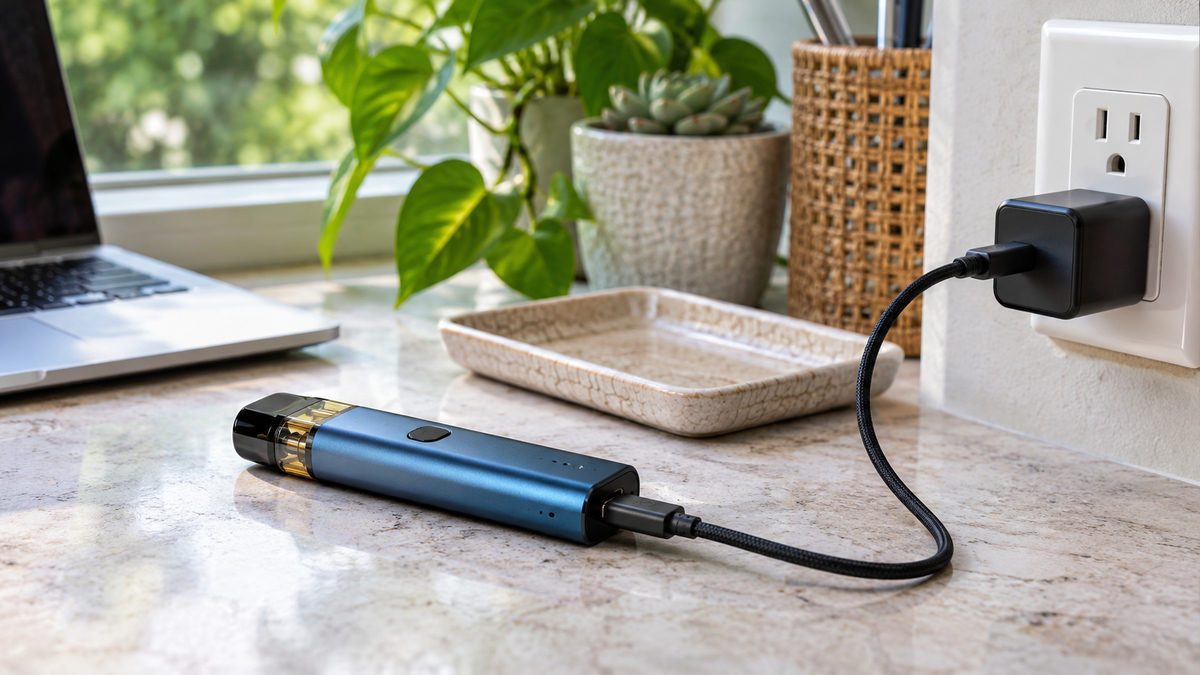
Set the vape on a clean, dry, flat, and stable surface. Ideally, use a nonflammable material such as ceramic tile or another location approved by the manufacturer. Keep the device away from direct sunlight, heaters, liquids, and cooking areas. Environmental heat only adds to the heat produced during charging.
Never charge on a bed, sofa, carpet, vehicle seat, or upholstered furniture. Clear away paper, clothing, curtains, and anything else that could burn. Soft materials trap heat and can conceal early warning signs. A clear space also makes the device easier to see and reach.
Stay nearby and monitor progress
Connect the approved cable and adapter gently, without excessive force. Check that the expected charging indicator appears. Stay nearby and periodically look for heat, odors, unusual sounds, or erratic lights. Once charging is complete, unplug the device as directed in the manual.
A functioning protection circuit can manage charging, but it cannot stop every failure. Avoid charging overnight or leaving the device unattended while you are away from home. Don’t leave a fully charged device connected for excessively long periods, either. Supervision gives you a chance to catch trouble before it becomes serious.
Use pass-through charging cautiously
Pass-through use means vaping while the device is still connected to power. Only do this if the manufacturer explicitly supports the feature. Even then, using and charging the device at once can generate more heat and put extra strain on the battery. Letting it charge undisturbed is usually safer.
A sensible charging routine takes only a minute to set up. Inspect the equipment, clear the space, and check the indicator. Then stay close enough to notice anything unusual. Together, these small steps provide several layers of protection during each charging session.
4. Charging Time, Light Indicators, and Overheating
Why charging time varies
No single charging time applies to every vape. The duration depends on battery capacity, remaining charge, charger output, and internal circuitry. An older battery may also charge differently from a healthy new cell. Very hot or cold conditions can affect performance as well.
For example, a partly charged pod may finish far sooner than an empty high-capacity device. Unusually slow charging, though, can point to a weak cable, dirty port, aging battery, or circuit fault. Compare the actual time with the manufacturer’s normal range. Don’t respond by leaving a questionable device plugged in indefinitely.
Interpret indicator lights correctly
Charging lights might stay steady, flash, change color, or turn off. Their meanings vary by device. A flashing red light may mean normal charging on one model and signal a fault on another. Check the manual rather than guessing what a pattern means.
Some mild warmth is possible as energy enters the battery. Rapid heating or a surface that becomes uncomfortable to touch is different and needs immediate attention. Disconnect the power if you can do so safely. Then put some distance between yourself and the device and watch for signs that the problem is worsening.
Recognize abnormal charging behavior
Protective circuitry lowers the risk of overcharging by limiting or stopping power under normal conditions. Those safeguards can still fail because of damage, defective equipment, manufacturing faults, or circuit problems. Repeated restarts or erratic lights may point to an unstable connection. A device that fails to stop charging is also a serious concern.
Disconnect the device if it becomes excessively hot or charges much more slowly than usual. Don’t keep reconnecting it just to see whether the issue goes away. Start by inspecting or replacing the approved cable and adapter. If the problem continues, the device needs professional assessment or replacement.
5. Warning Signs and Vape Battery Fire Prevention
Know the early warning signs
Battery failure often comes with warning signs, although some incidents develop fast. Check for swelling, leakage, dents, punctures, discoloration, and corrosion. On removable cells, closely examine the outer wrap and top insulator ring. A torn wrap may expose conductive metal and cause a short circuit.
- Unusual chemical, sweet, metallic, or burning odors
- Hissing, popping, crackling, or venting sounds
- Smoke, sparks, flames, or rapidly increasing heat
- Erratic charging, repeated disconnections, or unexpected restarts
- A swollen casing, leaking cell, or deformed charging port
Respond without increasing the danger
Stop charging as soon as abnormal behavior appears. Disconnect the power only if you can avoid touching a dangerously hot or venting device. Never pick up a vape that is smoking, hissing, or burning. Move away, alert other people, and call local emergency services if there is a fire threat.
If it is safe, switch off power at the wall without approaching the failing device. Keep children, pets, and bystanders well away. Battery gases and smoke may contain harmful substances, so avoid breathing them. Follow the instructions of emergency personnel instead of improvising.
Avoid dangerous interventions
Never puncture, crush, open, freeze, immerse, or modify a lithium-ion cell. Don’t try to repair a damaged charging circuit yourself. Immersing a compromised battery in water does not make it safe to handle or discard. The cell may still hold energy after all visible activity has stopped.
A battery fire can start in several ways. Common causes include short circuits, damaged cells, counterfeit batteries, and incorrect battery orientation. Incompatible chargers, excessive heat, loose metal contact, and physical abuse add to the risk. Preventing those conditions is safer than trying to react once failure begins.
6. Removable Battery Storage, Transport, and Disposal
Select and inspect cells carefully
Choose authentic cells with the exact type, size, and rating your device requires. Buy from a reputable supplier, and reject suspicious rewrapped products. A battery isn’t suitable merely because it fits the compartment. Its electrical limits matter just as much as its dimensions.
Multi-cell devices need matched batteries, often known as married sets. Keep cells with the same model, age, capacity, and usage history together. Charge the whole set together and replace it together. Mixing old and new cells can produce uneven loading and unsafe performance.
Examine every cell before charging or using it. Look for damage to the wrap, positive terminal, and insulator ring. Stop using any cell with dents, corrosion, leakage, tears, or deformation. Even a minor tear in the wrap can expose metal near a conductive device body.
Charge and transport removable batteries correctly
Use a reputable dedicated charger approved for the battery’s chemistry and size. An 18650 cell, for example, needs a charger that specifically supports that format. Follow all marked polarity and charging-current instructions. Never reverse a cell or force it into the charging bay.
Loose batteries have no place in pockets, bags, or cluttered drawers. Keys, coins, jewelry, and tools can connect the terminals and create a short circuit. The cell may then heat rapidly with little warning. Carry each battery in a proper protective case.
Store and dispose of cells responsibly
Keep batteries in individual cases in a cool, dry place. Store them away from direct sunlight, heaters, combustible materials, children, and pets. Never leave cells in a hot vehicle. Extreme temperatures can damage batteries even while they aren’t being used.
Never put depleted or damaged lithium-ion cells in household trash or regular recycling. Take them to a suitable battery-recycling or household hazardous-waste facility instead. Tape exposed terminals if the receiving facility requires it. If a cell is severely damaged, contact the facility before trying to transport it.
7. Vape Charging Problems, Maintenance, and Safety Checklist
Start with safe basic checks
If charging fails, first check the outlet and manufacturer-approved adapter. Then inspect the compatible cable, connector fit, indicator behavior, and device instructions. For a removable battery, verify its orientation without forcing the compartment. Stop immediately if any component becomes hot during these checks.
When conditions are safe, you can test the outlet with another undamaged household device. Don’t cycle through random adapters or high-output chargers. Doing so may create a second problem while making the first one harder to identify. Stick to equipment that meets the manufacturer’s stated requirements.
Maintain the charging port carefully
Switch off and disconnect the vape before checking its port. If you can see lint blocking the opening, gently remove loose surface debris with a dry, soft brush or nonmetallic tool. Take your time. Never insert liquid, pins, knives, or other metal objects.
Don’t charge a wet device, even if the outside looks mostly dry. Never force a loose connector to sit at a certain angle. A damaged port can spark or repeatedly lose contact. Have qualified service personnel inspect it, or replace the device.
Know when troubleshooting must stop
Stop testing if the device overheats, develops an unusual smell, swells, or charges erratically. Never bypass its safety controls or alter the charging circuit. Replace a damaged cable or adapter with an approved equivalent. A failing battery or device should be professionally inspected or responsibly discarded.
Repeated faults usually point to something more serious than a temporary connection issue. Don’t continue reconnecting equipment that displays the same warning signs. If it is safe, record the indicator pattern. Compare it with the manual or ask the manufacturer what it means.
Keep a practical safety checklist
- Inspect the vape, port, cable, adapter, and battery before charging.
- Use only compatible equipment with the correct electrical specifications.
- Charge on a dry, stable, nonflammable surface.
- Stay nearby and unplug the device when charging finishes.
- Avoid overnight or excessively prolonged charging.
- Never charge a device on bedding or upholstered furniture.
- Do not use unsupported fast charging or pass-through vaping.
- Carry removable cells only in individual protective cases.
- Never attempt to recharge a non-rechargeable disposable vape.
- Stop using equipment that overheats, swells, leaks, hisses, or sparks.
Many common mistakes happen when convenience takes priority over caution. Someone might leave a vape charging overnight on a bed with an unsuitable phone adapter. Another person may carry an uncovered cell alongside loose coins. Every shortcut removes a valuable layer of protection.
Conclusion
Safe charging comes down to compatible equipment, a careful inspection, and a clear, nonflammable location. Staying nearby helps you catch heat, damage, or erratic behavior early. Proper battery storage and responsible disposal extend that protection beyond the charging session. No built-in safety feature can replace attentive handling.
Check your device manual and charging equipment today. Before the next charge, replace anything damaged, counterfeit, loose, or incompatible. Keep this safety checklist close to your usual charging area. When guidance is easy to reach, safer choices are more likely to become everyday habits.







