A vape may look simple, but its liquid, battery, electronics, packaging, and emissions can each be subject to different rules. What Are Vape Product Standards? They are the safety, quality, testing, and documentation requirements that apply throughout a product’s commercial life. A product that complies in one country, however, may still break the rules in another.
Technical standards and laws do not always serve the same purpose. A voluntary standard might set out a recognized testing method, while legislation can make certain requirements compulsory. National rules may also overlap with state, provincial, or municipal restrictions. Businesses and consumers therefore need to check the exact requirements in every relevant location.
This guide covers the main controls for devices, batteries, liquids, emissions, manufacturing, labels, and packaging. It also looks at authorization, incident reporting, counterfeits, and recalls. Above all, compliance can reduce preventable harm, but it cannot make vaping harmless.
1. What Are Vape Product Standards and Why Do They Matter?
Vape product standards include technical specifications and legal requirements for electronic vaping products. They shape how products are designed, manufactured, tested, documented, packaged, labeled, distributed, and monitored after sale. Depending on the category, they may apply to disposable devices, refillable systems, cartridges, tanks, chargers, batteries, and nicotine liquids. The product type often decides which requirements apply.
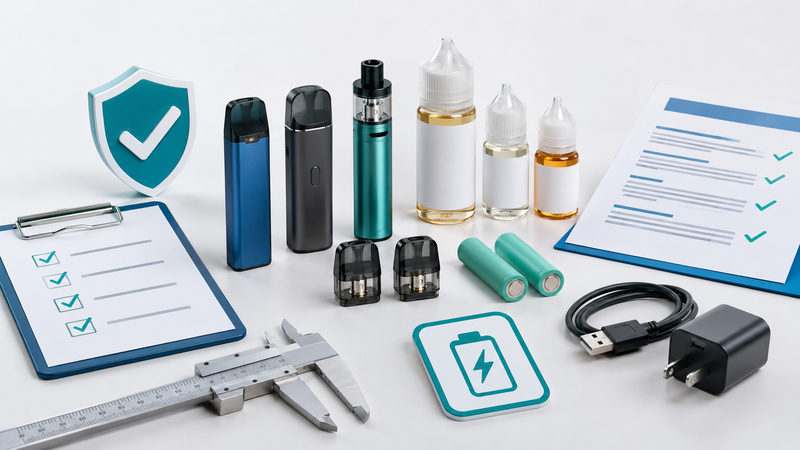
Some standards explain how to test a battery or measure an aerosol. Others impose mandatory limits, warnings, reporting duties, or approval procedures. Authorities may also regulate the device and its liquid under separate legal frameworks. Before launching a complete product, a business needs to identify every rule that applies.
Risks that standards can reduce
A poorly assembled device may leak liquid onto the user’s skin. An electrical fault, meanwhile, could cause overheating or accidental activation in a pocket. Contaminated liquid may introduce unwanted chemicals, and inaccurate filling can lead to inconsistent nicotine amounts. Standards target these predictable risks—the ones manufacturers can reasonably control.
- Contamination: Ingredient and hygiene controls help prevent unwanted chemicals, particles, and microorganisms.
- Leakage: Container and device tests examine seals, closures, tanks, cartridges, and refill mechanisms.
- Battery failure: Electrical protections can reduce short circuits, overcharging, overheating, and unsafe discharging.
- Accidental exposure: Secure packaging helps keep nicotine liquid away from children and other unintended users.
- Inconsistent delivery: Formulation and performance checks can reveal large differences between units or batches.
- Misleading information: Label controls support accurate ingredient, nicotine, warning, and manufacturer details.
Compliance does not prove that a product is free of health risks. It means the responsible business followed defined requirements and produced evidence to support that work. Regulators may still restrict a technically compliant product because of marketing, sales, or wider public health rules. Compliance is continuous, not a certificate earned once and forgotten.
2. Who Creates Vape Standards and How Rules Differ
There is no single global authority responsible for every vape requirement. National legislatures pass laws, while health or tobacco regulators develop more detailed rules and guidance. Consumer-product agencies may separately oversee batteries, chargers, electrical safety, or general product defects. One product can therefore fall under several authorities at once.

At national borders, customs agencies check imported goods, declarations, duties, and restricted products. Environmental bodies may regulate batteries, electronic waste, recycling, and hazardous materials. Recognized standards organizations also publish technical methods for testing devices, liquids, containers, and electrical components. Laws may adopt these methods directly or accept them as evidence of compliance.
National rules are only part of the picture
State, provincial, regional, and local governments may add their own obligations. A city, for example, might restrict flavored products even though national law allows them. A state may require licenses, taxes, product registrations, or particular retail notices. Checking national legislation alone can leave major compliance gaps.
Market rules often differ in several key areas:
- Whether manufacturers need authorization, notification, registration, or another form of premarket review.
- Which nicotine strengths, container sizes, ingredients, flavors, or device types the law permits.
- Which warnings, symbols, language versions, ingredient details, and contact information must appear.
- Whether packaging needs child-resistant closures, tamper evidence, inserts, or standardized presentation.
- How authorities tax, track, import, advertise, display, distribute, and sell vaping products.
- Which age limits, online verification methods, and retail licensing conditions apply.
Enforcement varies just as much. One authority may simply request documents; another might take samples, order laboratory testing, or conduct an unannounced inspection. Customs officials may also hold a shipment until the importer proves compliance. Businesses should connect every requirement with the authority that enforces it.
Rules evolve as evidence, products, and public policy change. An older test report or label review may no longer be enough to support a new shipment. Companies should make someone responsible for tracking regulatory changes in each target market. If the position remains uncertain, qualified local advice can help avoid expensive assumptions.
3. Device Design, Battery Safety, and Performance Testing
A vaping device brings together a liquid reservoir, heating element, airflow path, electronics, and power source. Any one of these parts can become hazardous if it fails or interacts poorly with another component. Designers need to assess the system as a whole, not just the individual pieces. Normal wear and predictable misuse matter too.

Mechanical design controls commonly cover leakage, breakage, loose parts, sharp edges, and weak connections. Refillable products may also need features that reduce spills during filling. Drop, vibration, pressure, and temperature tests can uncover faults that an ordinary bench inspection would miss. Durable markings help users recognize controls and operating limits as well.
Electrical and battery protections
Lithium-ion cells hold a great deal of energy in a small space. Poor charging, physical damage, heat, or short circuits can make them unstable. Built-in protections may limit excessive current, voltage, charging time, and operating temperature. Locking controls can also reduce accidental firing during storage or transport.
Charging compatibility needs close attention. An unsuitable cable or power source, for example, may create conditions the device cannot safely handle. Manufacturers should specify supported input values and test devices near foreseeable operating limits. Instructions should clearly cover charging, storage, inspection, and disposal.
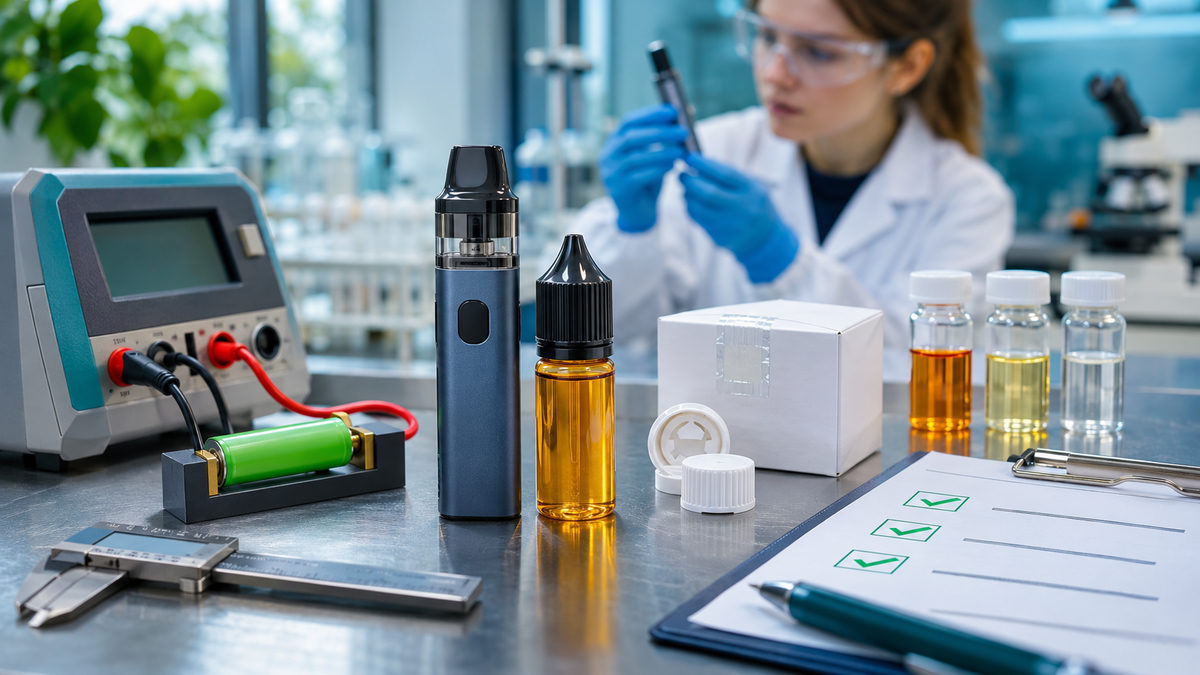
A structured device testing program may evaluate:
- Enclosure strength, button durability, connectors, seals, mouthpieces, and cartridge retention.
- Short-circuit protection, overcharge protection, low-voltage cutoff, and excessive-current controls.
- Battery temperature during charging, repeated activation, blocked airflow, and extended use.
- Charging behavior with compatible equipment and foreseeable variations in power delivery.
- Automatic firing, activation locks, timeout controls, and resistance to accidental operation.
- Power output, temperature regulation, puff consistency, and operation across the expected battery range.
Performance testing asks another question: do different units behave consistently? Laboratories can compare power, aerosol production, puff duration, and liquid consumption across multiple samples. One unit that performs well says little about an entire production run. Test plans need enough samples to reveal meaningful variation.
Testers also need to record the exact device configuration used in every evaluation. Coil resistance, power settings, airflow, liquid, and battery condition can all influence the outcome. Without those details, another laboratory may be unable to reproduce the results. Thorough records turn a set of isolated measurements into credible compliance evidence.
4. E-Liquid Safety Standards, Ingredients, and Emissions
E-liquid controls start with knowing exactly what each ingredient is and whether it is suitable. Manufacturers need specifications for nicotine, solvents, flavors, acids, and other formulation components. They should confirm supplier information through appropriate testing or documented qualification. A familiar ingredient name alone does not prove that it is suitable for inhalation.
Nicotine concentration calls for particular care because even small formulation errors can have consequences. One mixing mistake could affect thousands of containers before anyone spots it. Controlled weighing, calibrated equipment, checked calculations, and batch testing all help reduce that risk. Accurate filling also stops containers from exceeding declared volumes or legal size limits.
Purity, contamination, and consistency
Laboratory analysis can verify nicotine identity, concentration, and selected impurities. Tests may also look for prohibited substances, unwanted metals, residual chemicals, or microbial contamination. The appropriate testing panel depends on both the formulation and local rules. Risk assessments should also account for chemicals that containers, seals, and device components might introduce.
Formulations need to remain consistent from batch to batch and throughout their shelf life. Manufacturers often check appearance, odor, composition, nicotine strength, and compatibility with the container. Stability studies can reveal whether heat, light, oxygen, or time alters the liquid. Those results support suitable storage instructions and a defensible shelf-life period.
Useful e-liquid controls commonly include:
- Approved ingredient specifications and verified supplier identities.
- Defined formulation instructions with independent calculation checks.
- Calibrated weighing, mixing, filling, and laboratory equipment.
- Batch sampling for nicotine strength, composition, contamination, and fill quantity.
- Container compatibility, leakage, stability, and storage evaluations.
- Retention samples that support later complaint or incident investigations.
Testing the generated aerosol
Testing only the liquid in the bottle cannot show what a user actually inhales. Heating may transfer metals from the device or create new chemical compounds. Aerosol testing therefore measures the emissions produced under defined operating conditions. Laboratories may test for nicotine, carbonyl compounds, metals, particles, and other relevant substances.
A useful test method must reflect realistic use while still producing repeatable results. Puff length, interval, volume, airflow, power, and coil condition can each change the measured emissions. A nearly dry or overheated coil may behave very differently. Reports should state these conditions clearly and explain why the researchers chose them.
Aerosol findings require context. One number cannot represent every user, device setting, or stage of a product’s life. Still, comparative testing can expose unusually high emissions or unstable performance. Businesses should examine both liquid chemistry and device behavior before releasing a product.
5. Vape Manufacturing Standards and Quality Control
Even a well-designed product can fail in an uncontrolled factory. Manufacturing controls turn approved specifications into consistent products at commercial scale. They cover hygiene, staff training, equipment, materials, processes, testing, records, and final release. Each batch should match the approved design and formulation.
Production areas should make clean handling easier and help prevent mix-ups. Keeping materials separate and using clear status labels, for example, reduces the chance of substituting the wrong ingredient. Cleaning schedules can limit residue from earlier products or maintenance work. Staff also need to understand not only their tasks, but why the critical controls exist.
From suppliers to finished batches
Supplier approval is the first layer of manufacturing control. Companies need to assess whether suppliers can consistently meet the required material and component specifications. Incoming checks can then confirm identity, condition, quantity, and documentation. Higher-risk items may also need sampling or independent laboratory verification.
Production records should show who performed the work, which equipment and materials they used, the quantities involved, and the relevant process settings. Deviations and adjustments belong in those records too. If a complaint arrives months later, investigators should be able to reconstruct what happened. Missing information can turn a contained defect into market-wide uncertainty.
A practical quality-management system connects several activities:
- Supplier qualification, purchasing controls, and incoming material inspection.
- Approved formulas, assembly instructions, and controlled design specifications.
- Equipment maintenance, calibration, cleaning, and staff training.
- In-process checks for mixing, filling, sealing, assembly, and coding.
- Finished-product testing and documented release decisions.
- Batch numbering, distribution records, complaints, investigations, and corrective action.
Release decisions and corrective action
A company should release a product only after reviewing all required production and testing records. Commercial pressure is never a substitute for documented acceptance criteria. If a result fails, the company should investigate before retesting or discarding it. Otherwise, repeated testing may conceal a genuine process problem.
Corrective action deals with the cause of a failure, not merely the batch it affected. Replacing a damaged seal, for example, may fix one leak. Preventing another could require a change to the supplier, tool, inspection method, or assembly process. Whatever the action, the company should verify that it works.
Traceability links finished products to their ingredients, components, test results, and customers. With accurate records, a company can limit a recall to the batches actually affected. Poor traceability may force it to withdraw far more products. Reliable records protect consumers and responsible businesses alike.
6. Vape Labeling, Packaging, and Market Authorization
Packaging is more than a marketing tool. It protects the product, helps prevent accidental exposure, carries required information, and supports traceability. Secure closures can make nicotine liquids harder for young children to reach. Tamper-evident features also warn buyers if someone has already opened the container.
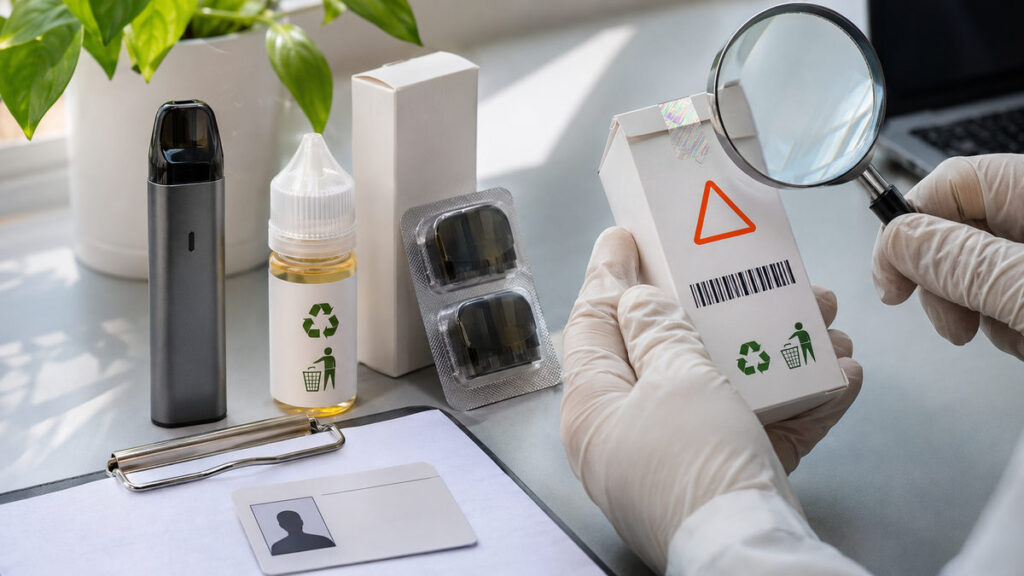
Rules may apply to nicotine-liquid containers, cartridges, disposable devices, and outer retail boxes. Some jurisdictions limit container volumes, presentation, colors, images, or flavor descriptions. Environmental requirements may add battery, recycling, or disposal information. Businesses need to review the whole package, including inserts and removable labels.
Information users and regulators may need
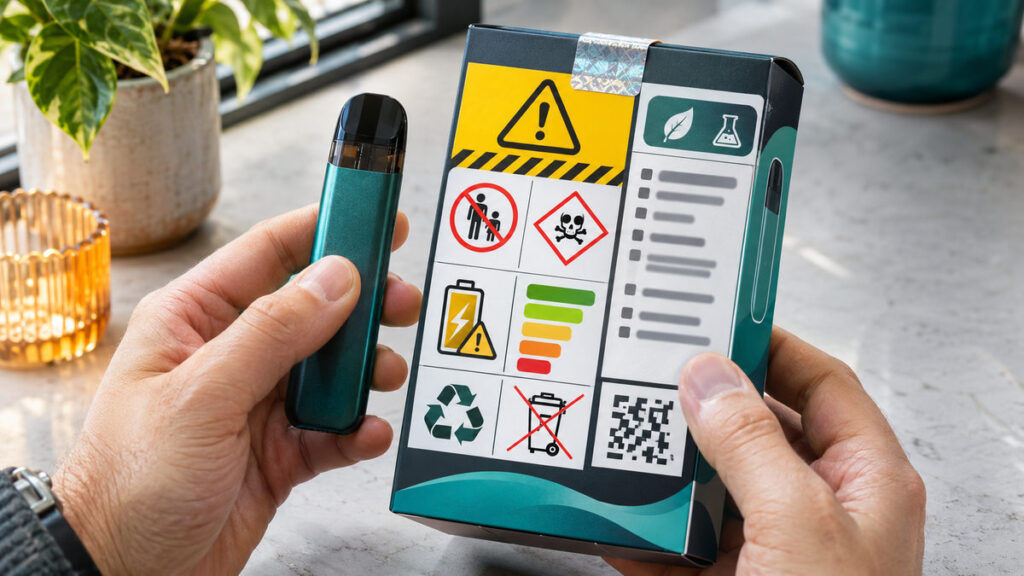
A label should describe the product accurately without suggesting that it is safer than it is. Local law may require nicotine content, ingredients, warnings, batch codes, and details of the responsible business. Instructions can cover filling, charging, storage, maintenance, and disposal. All of this information should remain readable throughout the product’s expected life.
Common labeling and packaging elements include:
- Product identity, quantity, nicotine concentration, and formulation details.
- Required health warnings, hazard statements, symbols, and language versions.
- Manufacturer, importer, or other responsible business contact information.
- Batch, lot, serial, or date codes that support traceability.
- Child-resistant closures, leak controls, and tamper-evident features where required.
- Operating, charging, storage, handling, disposal, and emergency instructions.
Entering and remaining on a market
In many markets, a vaping product cannot legally go on sale until the business takes certain steps. These may include notification, registration, authorization, licensing, or a detailed scientific review. Authorities might request formulation data, manufacturing information, risk assessments, labels, and laboratory reports. The required submission can differ for liquids, devices, and product variations.
Not every product family qualifies for a single shared submission. A change in flavor, nicotine strength, coil, battery, or packaging could prompt another regulatory assessment. Businesses should define each product precisely before filing. Later changes should pass through a formal review process as well.
Authorization is not the end of compliance. Companies may have to renew registrations, pay fees, provide sales data, or report product changes. Authorities can request samples, inspect facilities, or challenge claims. Safety findings or legal changes may also cause a product to lose market access.
7. Compliance Checks, Counterfeits, Incidents, and Recalls
Regulators may inspect businesses, sample products, examine documents, and order laboratory tests. If a product fails, they can require corrective notices, sales stops, withdrawals, seizures, or recalls. Misleading health or performance claims may also lead to enforcement, even when a product passes its technical tests. Product and marketing compliance go hand in hand.
Businesses need a clear process for handling complaints and adverse incidents. Reports of burns, poisoning, leakage, overheating, or battery fires require prompt attention. Whenever possible, investigators should preserve the device, packaging, charger, batch details, and photographs. Those details can show whether the event resulted from isolated misuse or a wider defect.
Counterfeit and suspicious products
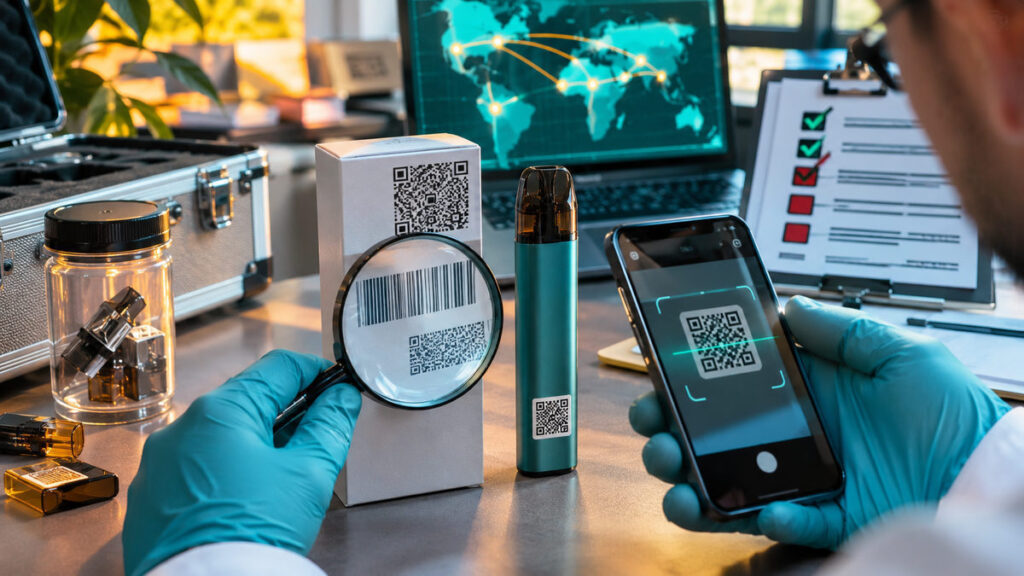
Counterfeit products can copy legitimate branding while bypassing the manufacturer’s controls. Poor printing, altered codes, unusually low prices, missing business details, and inconsistent packaging are common warning signs. Yet sophisticated counterfeits may look convincing. Businesses should verify suppliers and buy only through documented, authorized channels.
Consumers can watch for signs of regulatory care, though no single check can guarantee compliance. Useful checks include:
- Clear nicotine, ingredient, warning, manufacturer, importer, and batch information.
- Intact seals, secure closures, undamaged batteries, and packaging without leakage.
- Readable instructions for operation, charging, storage, and safe disposal.
- Consistent verification codes or serial details confirmed through legitimate manufacturer systems.
- A traceable retailer that provides receipts and answers product-origin questions.
- No unsupported claims that the product is harmless, healthy, or suitable for everyone.
Importers, distributors, and retailers have to go further. They should confirm supplier identity, authorization status, test evidence, labels, batch codes, and storage conditions. They also need records showing which batches went to each customer or location. In an urgent withdrawal, that information can save time and narrow the response.
Managing failures and recalls
A failed test calls for immediate containment and investigation. Companies should locate the affected stock, halt further distribution, and evaluate the risk to consumers. They must also notify the appropriate authority when required. Quietly replacing products without finding the cause leaves the door open for the defect to return.
A recall plan should identify decision makers, contact routes, customer notices, product recovery methods, and final disposal arrangements. It also needs a way to measure whether the recall worked. A business might, for instance, compare the number of recovered units with its distribution records. Corrective action should then address weaknesses in design, suppliers, production, or labeling.
Companies should practice recalls before a real emergency occurs. Even a short simulation can uncover missing contacts, incomplete records, and unclear responsibilities. The team can then close those gaps before any consumer faces immediate danger. That preparation turns traceability records into real protection.
Conclusion
Vape product standards cover device engineering, batteries, liquids, emissions, manufacturing, packaging, labeling, and traceability. They can also regulate authorization, distribution, incident reporting, and post-market monitoring. Working together, these controls reduce preventable problems such as contamination, leakage, overheating, and inaccurate labeling. They do not, however, make vaping safe or remove its health risks.
Requirements vary by both product type and jurisdiction. A report, label, or approval accepted in one market may fail to meet the rules in another. National requirements can also overlap with state, provincial, city, customs, tax, and environmental rules. Before moving products across borders, businesses must examine the full legal framework.
Check with the relevant national and local regulator before manufacturing, importing, distributing, selling, or purchasing a vaping product. Verify the current rules for each target market and every product variation. Support compliance with documented testing, controlled manufacturing, dependable traceability, and active incident monitoring. If the requirements are still unclear, seek qualified advice for the jurisdiction concerned.