
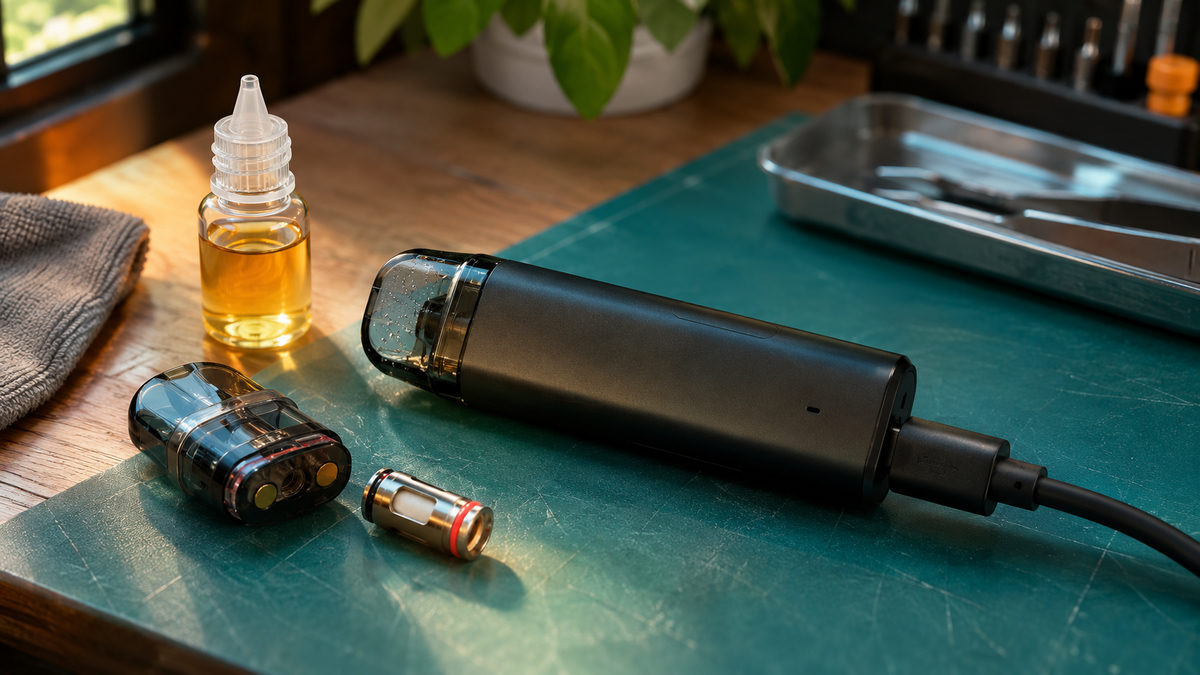
Your vape was working moments ago, but now it will not fire, charge, or produce vapor. Why do vape devices stop working? Several faults can cause nearly identical symptoms. The issue may lie with the battery, coil, airflow path, sensor, e-liquid supply, or electrical contacts.
Trying random fixes can damage the device or create a battery hazard. The safer approach is to start with the visible symptoms and perform a few simple external checks. This guide covers both disposable and rechargeable devices and explains when replacement makes more sense than repair.
1. Why Do Vape Devices Stop Working?
How a vape produces vapor
A vape needs four things to work properly: power, heat, liquid, and airflow. The battery sends electricity to a heating coil, which heats the e-liquid held in an absorbent wick. As you inhale, incoming air carries the resulting aerosol through the mouthpiece.
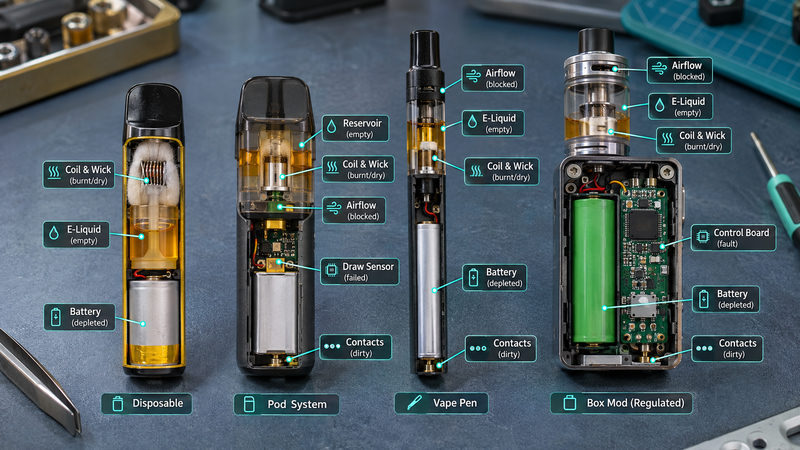
The pod or tank stores the e-liquid and usually contains the coil. Electrical contacts connect this assembly to the battery, while air openings provide a clear path from the intake to the mouthpiece. A leak or blockage anywhere along that route can disrupt operation.
Many rechargeable devices use a fire button to begin the process. Draw-activated models work differently: an auto-draw sensor detects pressure changes when you inhale. Control circuitry manages the power and watches for unsafe conditions, stopping activation if it detects excessive heat, low voltage, or an electrical fault.
Common points of failure
A fault at any point in this sequence can stop vapor production. A depleted battery, for example, cannot provide enough power to heat the coil. An empty reservoir leaves the wick dry, while poor electrical contact prevents current from reaching the heating element.
- Power failure: The battery has discharged, degraded, disconnected, or entered protection mode.
- Liquid failure: The reservoir is empty, leaking, or unable to supply the wick.
- Connection failure: Dirty or loose contacts interrupt power between the battery and coil.
- Airflow failure: Condensation, debris, or thick residue blocks an intake or mouthpiece.
- Activation failure: A button, sensor, or control board does not register the draw.
- Safety cutoff: The device detects overheating, excessive puff duration, or a short circuit.
Troubleshooting options vary widely between designs. Most disposable vapes have sealed housings with no user-serviceable parts. Pod systems may let you replace the pod or coil, while vape pens and regulated mods often include more controls, screens, and replaceable components.
Always check the manual for your exact model. Indicator patterns, compatible coils, locking controls, and charging requirements differ between manufacturers. A flashing red light might signal low power on one device but indicate a short circuit on another.
2. Start With Safe, Symptom-Based Vape Troubleshooting
Complete the external checks first
Start by placing the device on a stable, nonflammable surface. Check for cracks, dents, swelling, leaking liquid, or a loose charging port. If the device is new, make sure all protective stickers and silicone plugs have been removed. Clothing, packaging, or debris may also be covering the airflow openings.
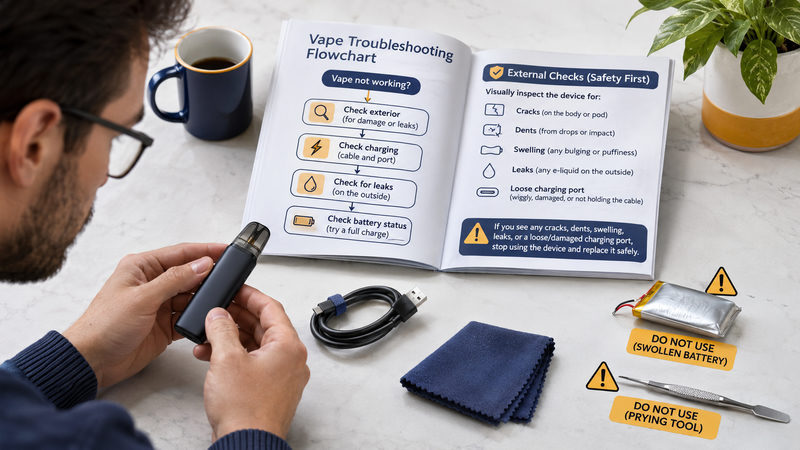
Next, make sure a rechargeable device is switched on and unlocked. Many models lock or unlock with three or five rapid button presses, but the controls are not universal. Check the manual rather than guessing. If the pod or tank is transparent, look at the visible liquid level too.
Now break the problem into a few basic functions. Does the device turn on, display a light, or illuminate its screen? Will it accept a charge and recognize the pod? Finally, take a gentle draw and see whether air moves freely through the mouthpiece.
- Check whether the light or screen activates.
- Listen for quiet crackling from the coil during normal use.
- Notice whether the coil produces any warmth.
- Test whether airflow feels open, restricted, or completely blocked.
- Record any blinking pattern or screen message.
Use charging equipment carefully
If the manufacturer allows charging, use a known-compatible cable and an appropriate power source. Cables can fail internally even when they look fine. Compare the cable with one that works on another suitable device, but never exceed the manufacturer’s specified voltage, current, or charging method.
Keep the vape within sight while it charges. Disconnect it immediately if the housing becomes unusually hot or gives off an odor. Never charge a wet, damaged, swollen, or leaking device, and only recharge a disposable model if the manufacturer specifically designed it for that purpose.
Know when to stop immediately
Never open a sealed housing or attempt to bypass its built-in protection system. Do not insert metal objects into charging ports, contacts, or airflow holes either. Repeatedly firing a malfunctioning device can make electrical damage or overheating worse. Heating, freezing, striking, or squeezing the housing adds even more risk.
Stop troubleshooting if the battery area looks swollen, corroded, or wet. If the device becomes unusually hot, starts hissing or smoking, or releases a chemical odor, isolate it from combustible materials. Do not hold an obviously failing battery in your hand. If the heat or smoke continues, follow local emergency guidance.
Leaked e-liquid may contain nicotine, which the body can absorb through the skin. Keep it away from your eyes, children, and pets. Wash exposed skin promptly with soap and water. For eye exposure, ingestion, or troubling symptoms, follow local poison-control or medical guidance.
3. Power, Battery, and Charging Problems
Recognize a power-related failure
A fully depleted battery may produce no light, screen activity, heat, or vapor. A partially depleted one can cause weak vapor or repeated blinking instead. Some devices activate for a moment and then cut off. This often points to insufficient voltage or a triggered protection circuit.
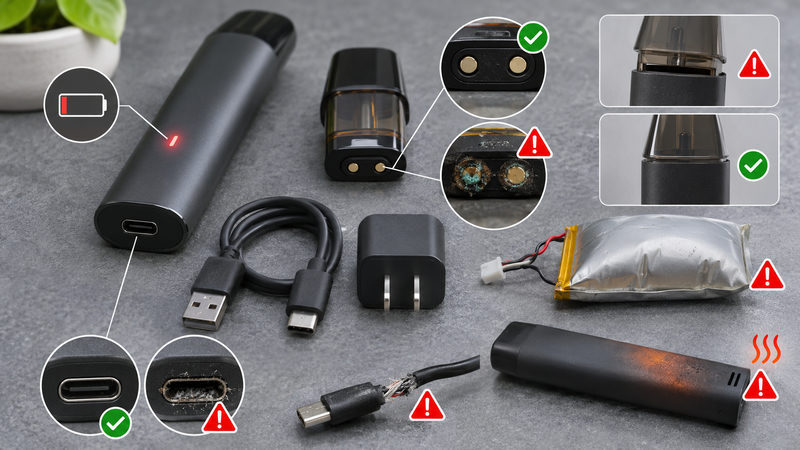
First, make sure the device is not locked or switched off. If it has a removable battery, inspect it according to the manufacturer’s instructions. A loose connection may interrupt power, but visible damage is more serious. Never use a battery with torn wrapping, dents, corrosion, leakage, or other obvious defects.
Internal batteries can fail without showing any damage on the outside. A degraded battery, for instance, may seem to charge within several minutes and then die after one or two draws. Unusual heat during normal charging can also signal serious deterioration.
Check the cable and power source
When charging is permitted, connect only a known-working, compatible cable. If possible, test the suspected cable with another suitable device, then try a different power source that still falls within the manufacturer’s specifications. This simple comparison can reveal whether the cable or the vape is at fault.
A high-powered adapter is not automatically safe for every vape. Some older devices need very specific charging conditions. Use the supplied equipment whenever it is available, and stop charging if the cable, plug, port, or housing becomes hot.
Examine the charging port under good lighting, but do not probe it. Look for lint, corrosion, bent components, moisture, looseness, or dark discoloration. Does the port move inside the housing? If so, it may be broken internally and will usually require manufacturer service or device replacement.
Clean accessible electrical contacts
Condensation commonly builds up between a pod and the battery contacts. When that happens, the device may report a missing atomizer or work only intermittently. Switch it off before cleaning whenever possible, and remove the pod only if the manufacturer says it is safe to do so.
Wipe accessible contacts gently with a dry, lint-free cloth or cotton swab. Never scrape them with a pin, knife, or another metal object. Let all condensation dry before putting the device back together, and check that the contacts are clean, level, and free of loose fibers.
If liquid keeps appearing around the contacts, the pod may be leaking or a seal may be damaged. Cleaning might help briefly, but it will not solve the underlying fault. Replace the leaking user-serviceable component with a compatible part, and do not fire the device while liquid surrounds the electrical connection.
Understand protective cutoffs
Control circuitry may cut the power after a puff lasts too long. It can also respond to overheating, repeated activation, low resistance, or a short circuit. That cutoff is there to protect both the battery and the user. If the device is hot, let it cool naturally on a safe surface.
Do not repeatedly restart a device that reports an electrical fault. Consult the manual and inspect only the parts meant to be serviced by the user. If the battery overheats, drains immediately, or no longer holds a charge, it may be permanently degraded. Replacement or approved service is the safer choice.
4. Why a Vape Lights Up, Blinks, or Fires Without Vapor
Light without coil activation
A light only shows that one part of the device detected an input. It does not confirm that electricity reached the coil. Poor pod contact, for example, can leave the controls functioning while the heating circuit remains open. A broken heating element may cause the same symptom.
An incompatible coil, poorly seated pod, or loose replaceable coil can also be responsible. Switch off the device and reseat user-serviceable parts as described in the manual. Check that each component is made for the exact model, since similar-looking pods may use different resistance values or contact layouts.
If air flows but no vapor appears, start with the e-liquid level. Then inspect the pod seating, coil installation, and accessible contacts. During normal activation, listen for quiet crackling and check for gentle warmth from the coil. No warmth often means power is not reaching the heating element.
Interpret blinking lights carefully
Repeated blinking can mean several different things. It may signal a low battery, overheating, a puff-duration cutoff, or locked status. A device might also blink because of a missing atomizer, short circuit, or unsupported resistance. The number, color, and speed of the flashes all matter.
- Low battery: The cell needs approved charging or has reached its usable limit.
- Puff cutoff: The draw exceeded the device’s maximum activation time.
- Temperature protection: The electronics or battery became too warm.
- Missing atomizer: The device cannot detect the pod, tank, or coil.
- Short or low resistance: The heating circuit presents an unsafe electrical condition.
- Locked status: The device requires its documented unlocking sequence.
Light colors and blinking patterns are not universal. Compare the exact signal with the manufacturer’s manual rather than following instructions for a similar-looking model. The electronics and warning system may be completely different.
Read screen messages as safety information
“No atomizer” or “check atomizer” usually means the device cannot detect the heating assembly. A “short circuit” warning points to an unsafe connection, while “low resistance” means the attached coil falls outside the permitted range. “Low battery” and “temperature protection” indicate power or heat limits.
Loose pod seating or dirty contacts may cause intermittent operation. So can a worn coil, failing sensor, damaged wiring, or unstable internal connection. If the device cuts out when moved, a physical connection problem is especially likely. Try replacing compatible user-serviceable parts before deciding that the sealed device itself has failed.
Never continue firing a device that displays a short-circuit or low-resistance error. Repeated attempts can put stress on both the battery and the control board. If reseating the correct component does not clear the warning, stop using the device and contact the manufacturer or replace it safely.
5. Coil, Pod, E-Liquid, and Airflow Failures
Identify coil installation and wear problems
For a coil to work, it must fit correctly, contact the battery, and receive enough liquid. A loose or incompatible coil may produce no vapor at all. A worn heating element can also lead to weak output and inconsistent activation. Always use a coil or pod that matches the exact device specification.
A dry wick that has not been primed can burn on its first activation. The result is usually a harsh sensation and a scorched flavor that does not go away. Reduced vapor, a darkened wick, or visible damage may appear as well. Once the burnt taste persists, replacing the coil is generally the only practical fix.
Prime compatible replacement coils exactly as the manufacturer instructs. This usually involves saturating the exposed wick openings, filling the pod or tank, and waiting before use. Some products need several minutes to absorb the liquid fully. Avoid pouring too much liquid into the center tube, though, as it can flood the airflow path.
Recognize flooding and liquid-supply problems
A flooded coil may gurgle, spit droplets, or produce very little vapor. Liquid can leak through the airflow holes or pool inside the mouthpiece. Drawing too hard may worsen the problem by pulling in more liquid than the coil can vaporize. Follow the manual’s cleaning guidance instead of trying to clear it with high heat.
An empty or nearly empty reservoir can leave sections of the wick dry. Too much liquid creates the opposite problem, interfering with efficient heating and airflow. The wrong e-liquid viscosity can make either condition worse: thick liquid feeds slowly, while very thin liquid may leak through the seals.
- Check for a cracked pod or tank.
- Inspect accessible seals for displacement or visible damage.
- Keep the reservoir within its marked filling limits.
- Use only e-liquid types supported by the manufacturer.
- Replace a pod that leaks repeatedly after correct installation.
Cold weather can thicken e-liquid and slow its movement toward the wick. Let the device return naturally to a moderate room temperature before using it. Keep it away from heaters and open flames. Forced heat can damage the seals, electronics, and battery.
Clear airflow safely
Condensation, lint, dust, and thick residue may clog the mouthpiece. Leaked liquid can cover intake holes near the base as well. The draw may then feel unusually tight—or completely blocked. Restricted airflow can also stop an auto-draw sensor from activating properly.
Turn off the device before cleaning whenever possible. Remove only the components identified as user-serviceable, then wipe the accessible openings with a dry, lint-free cloth or cotton swab. Make sure the intake holes stay uncovered during use and storage.
Do not use needles, blades, or other sharp tools. They can puncture seals, damage sensors, or touch electrical components. Avoid blowing forcefully into the battery housing too, since this can push moisture deeper into the electronics.
Condensation near an auto-draw sensor can cause delayed or intermittent activation. After wiping accessible areas gently, let them dry completely. A sealed sensor, however, usually cannot be repaired safely. If the problem continues, replace the device or contact the manufacturer.
6. Disposable Vape Failures, Replacement, and Prevention
Why sealed disposables stop
A disposable vape may stop because its battery has reached the end of its charge. The e-liquid might be gone, or the wick may no longer receive enough of it. The draw sensor or an internal connection can fail too. Because these components are sealed inside, there is usually no safe way to repair them.
Signs of an empty vape often include weaker vapor and fading or altered flavor. A burnt taste that will not go away suggests the wick lacks liquid. The light may also blink after activation without producing vapor, and some transparent reservoirs reveal little or no liquid remaining.
Visible liquid does not necessarily mean the device can still use it. The liquid may have moved away from the wick due to its orientation, viscosity, or internal design. The battery can also die before the reservoir is completely empty. Shaking or striking the device is not a safe fix.
Never open, puncture, or rewire a sealed disposable. Recharge it only if the manufacturer clearly identifies that model as rechargeable. The presence of a charging port is not permission to improvise. Always follow the stated cable and power requirements.
Environmental damage and replacement
Extreme heat speeds up battery deterioration and can increase the chance of leaks. Cold conditions may reduce battery output and thicken the e-liquid. Moisture, dust, impact damage, and long periods without use can affect contacts or sensors as well. Never leave a vape in direct sunlight or inside a parked vehicle.
Replace a device that has suffered serious impact damage or overheats repeatedly. Manufacturer support or warranty service may be available for persistent electrical errors. Replacement also makes sense when a sealed sensor fails or basic external checks do not help. Do not continue using any device with unsafe physical damage.
Do not throw a battery-powered vape into household rubbish where local rules prohibit it. Use an approved battery or electronic-waste collection service instead. Until disposal, keep the device away from children and combustible materials. Follow the facility’s instructions for handling leaking or damaged batteries.
Prevent repeat failures
- Clean accessible contacts regularly with a dry, lint-free material.
- Use pods, coils, and e-liquids approved for the exact model.
- Prime compatible replaceable coils before their first activation.
- Charge only with suitable equipment and observe the device during charging.
- Store the vape at moderate temperatures away from moisture and sunlight.
- Protect airflow openings from pockets, lint, dust, and loose debris.
- Replace worn coils and damaged pods before they cause leaks or electrical problems.
Pay attention as soon as performance starts to change. Even a slight drop in flavor or vapor can warn of coil wear before complete failure. Replacing components early may prevent leaks, burnt wicks, and irritating cutouts. Regular care makes future troubleshooting much simpler too.
Conclusion
Work from the outside inward. Begin with battery hazards and visible damage, then check the power, approved charging equipment, and accessible contacts. Make sure the pod and coil fit correctly before moving on to the e-liquid supply, airflow path, and model-specific warning codes.
Stop if the fault involves a damaged battery, sealed component, or persistent electrical warning. Swelling, overheating, hissing, smoke, and chemical odors are also clear reasons to step away. Never bypass a safety cutoff or repeatedly activate a device reporting a short circuit. A replacement costs far less than the consequences of battery failure.
Run through the symptom checklist once and replace only the parts the manufacturer identifies as user-serviceable. If the problem remains, contact the manufacturer or request warranty support. Otherwise, take the device to an approved battery or electronic-waste facility. When routine external checks cannot restore reliable operation, safe replacement is the right choice.







