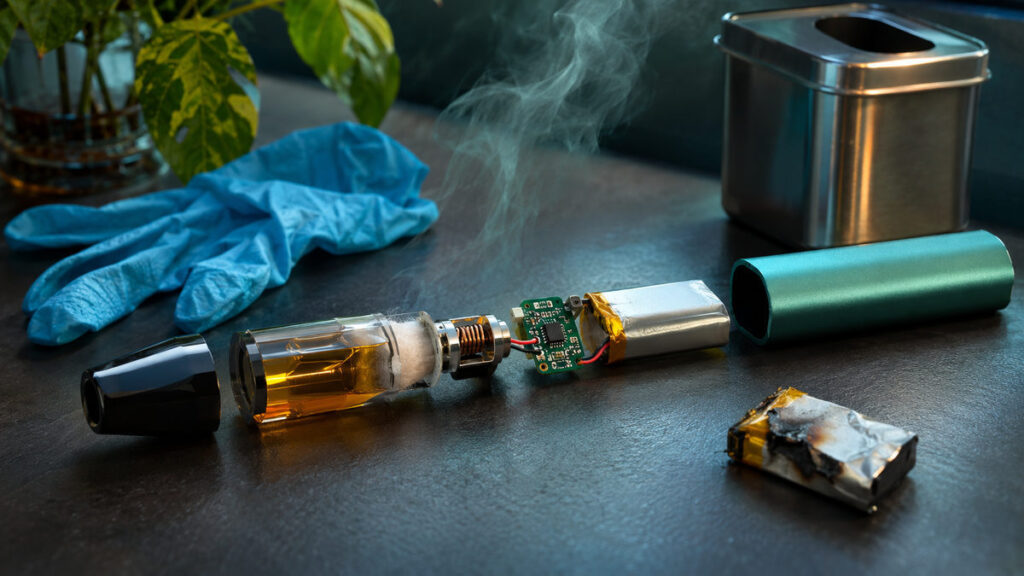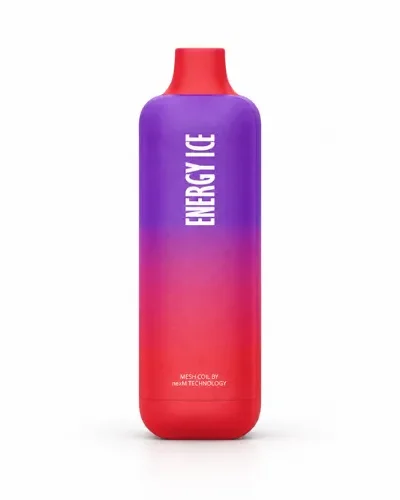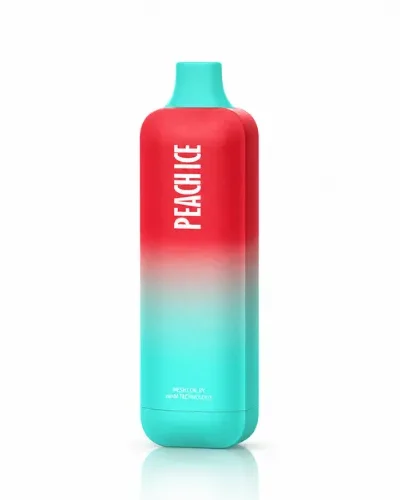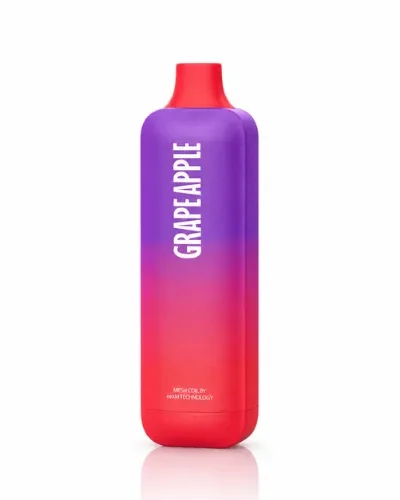
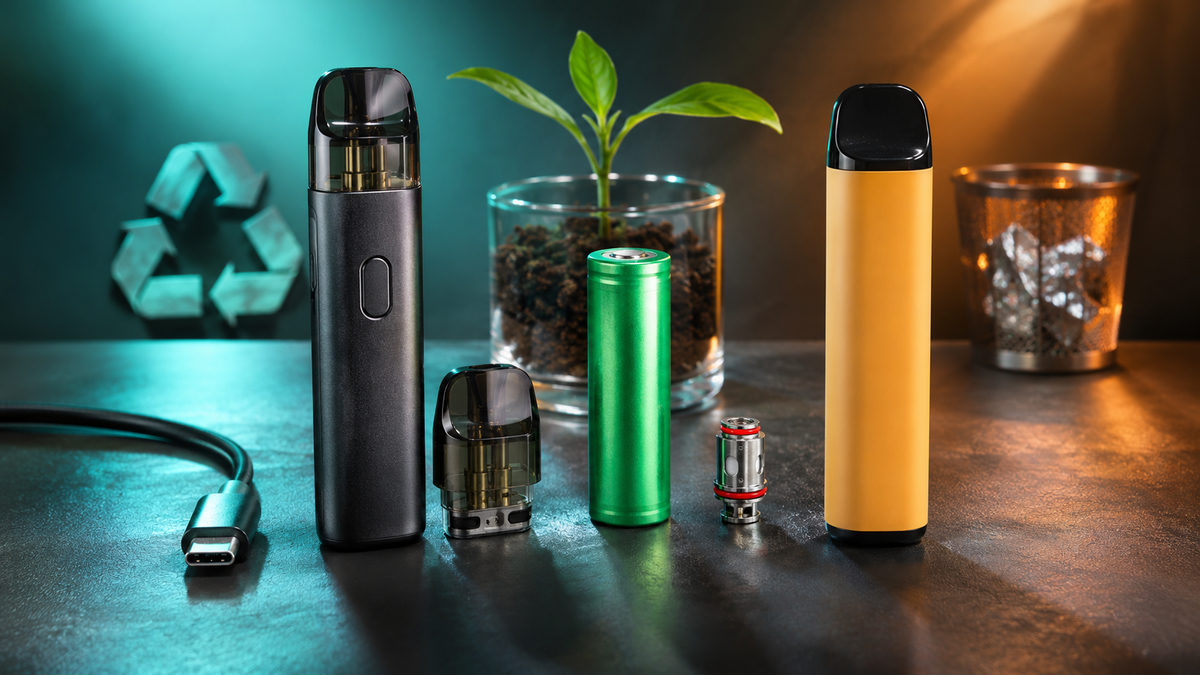
Two vapes that look almost identical can contain very different hardware. The Rechargeable vs Disposable Vapes: Technical Differences become easier to see when you look closely at the batteries, coils, liquid systems, and control circuits. The trouble is that labels such as rechargeable, reusable, refillable, prefilled, and disposable often overlap. That can make an accurate comparison surprisingly tricky for adult buyers.
A rechargeable device, for example, may still have a sealed liquid tank. That makes it rechargeable, but not refillable. Another rechargeable model might accept replaceable pods, coils, and user-selected liquid. Some products sold as disposable even have charging ports because the liquid supply lasts longer than a single battery charge. A charging port alone, then, does not define the category.
This guide compares the main designs by looking at their hardware and ownership requirements. It covers performance, lifespan, cost, maintenance, safety, and environmental impact. Advertised puff counts are not treated as guaranteed results. Instead, the focus is on the technical factors that affect everyday use.
1. Rechargeable vs Disposable Vapes: Technical Differences at a Glance
Clear definitions for overlapping categories
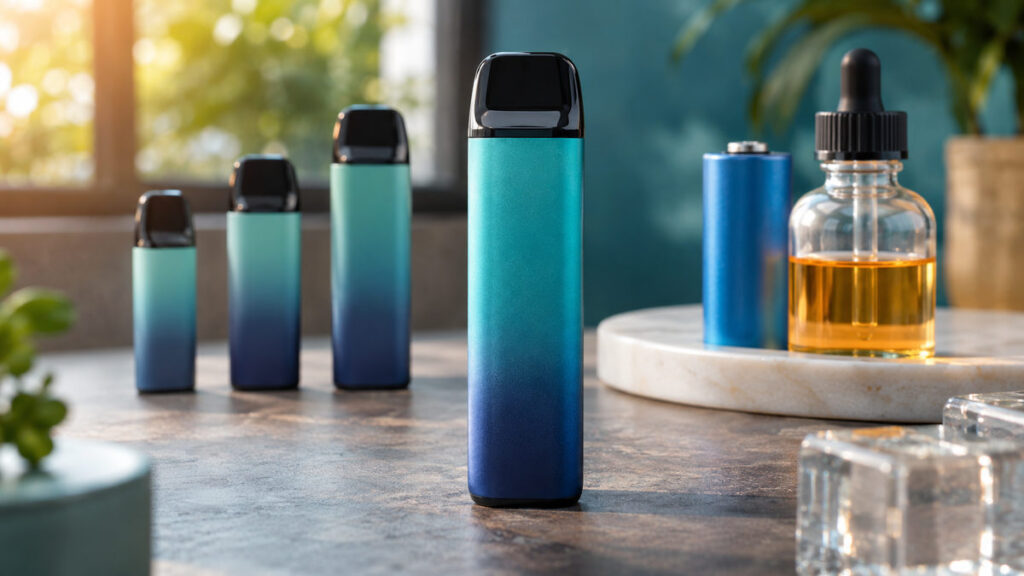
A traditional disposable vape places the battery, liquid reservoir, coil, sensor, and control board inside one sealed body. You use it until the battery or liquid supply runs out. The entire unit must then be discarded according to local battery rules. In most designs, the internal components are not practically accessible.
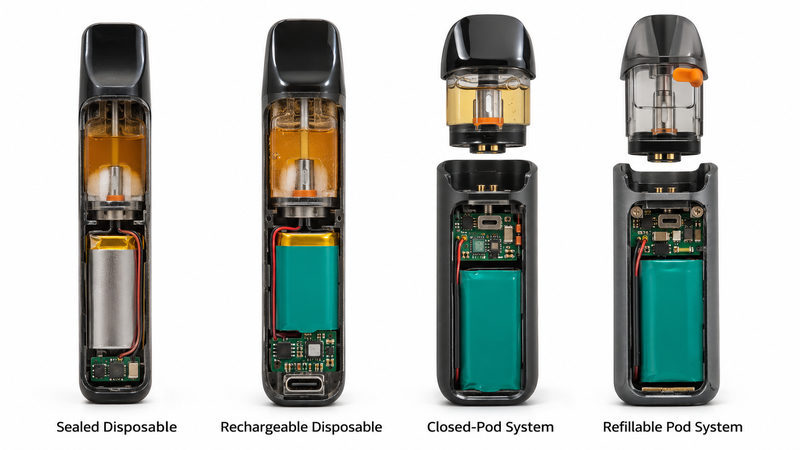
A rechargeable disposable uses the same sealed-product concept but includes a charging port. The battery may handle several charges, yet the reservoir and coil usually cannot be replaced. Recharging simply allows the battery to keep using the factory-filled liquid. It does not make the whole product reusable in the same way as a pod system.
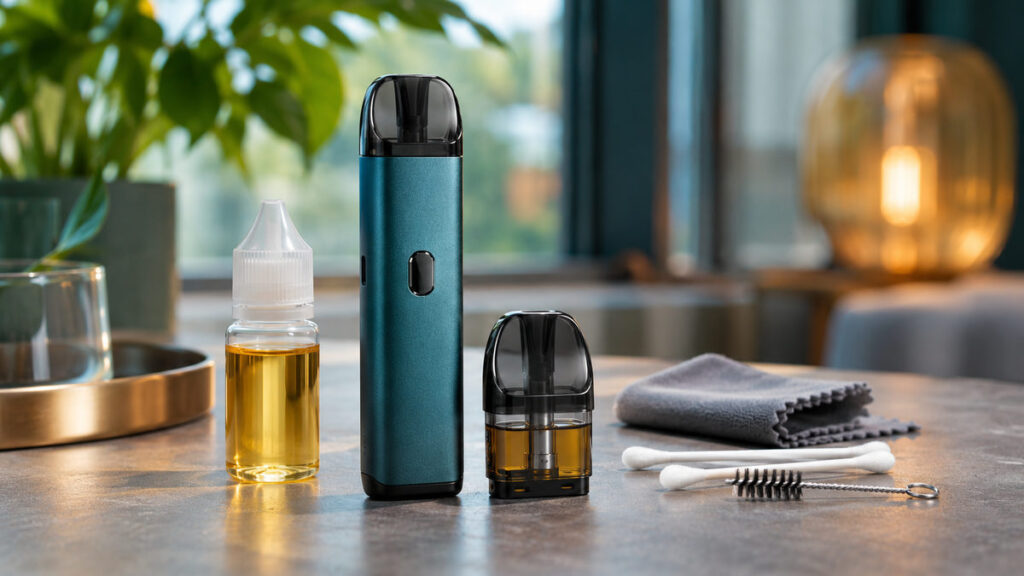
Closed rechargeable systems pair a permanent device body with replaceable, prefilled pods or cartridges. Open rechargeable systems let users refill a pod or tank themselves. Many open systems also accept replaceable coils and provide adjustable power. These design choices have a major effect on control, upkeep, and long-term cost.
Concise technical comparison
| Feature | Disposable | Closed rechargeable system | Open rechargeable system |
|---|---|---|---|
| Architecture | Sealed all-in-one body | Reusable body with prefilled pods | Reusable body with refillable pod or tank |
| Battery | Single-use or rechargeable internal cell | Rechargeable internal cell | Internal or replaceable rechargeable cell |
| Liquid system | Factory-filled and sealed | Replaceable prefilled cartridge | User-refillable reservoir |
| Coil | Fixed inside device | Usually fixed inside each pod | Fixed pod coil or replaceable coil head |
| Controls | Usually automatic and fixed | Automatic or button activated | Automatic, button controlled, or adjustable |
| Lifespan | Ends with liquid, battery, or component failure | Body lasts through many pod replacements | Body lasts through many refills and coil changes |
| Maintenance | Minimal | Charging and pod replacement | Charging, filling, cleaning, and coil care |
| Cost pattern | Low initial cost with repeated complete purchases | Device cost plus recurring pod purchases | Higher setup cost with separate liquid and coils |
| Waste pattern | Complete device discarded | Pods discarded while body remains | Coils and containers discarded while major parts remain |
Buyers should compare individual products instead of trusting a single marketing term. A rechargeable model can still become waste once its sealed liquid supply is empty. By contrast, a refillable pod may reuse the same battery and housing dozens of times. The architecture tells you far more than the label.
2. Device Architecture, E-Liquid Delivery, and Controls
How the internal layout changes ownership
Every vape needs a power source, control circuit, heating coil, airflow path, and liquid delivery system. Disposable designs pack these parts closely together to keep size and assembly costs down. That compact arrangement leaves little space for serviceable connections, though. A failed sensor or flooded airflow channel may disable the entire device.
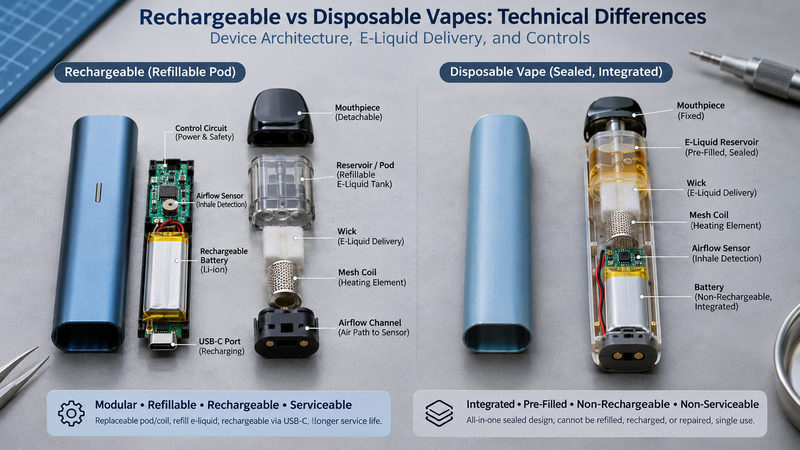
Closed pod systems separate the pod from the battery body. A weak flavor or leak can often be addressed simply by replacing the pod. The reusable body holds the battery, charging circuit, and activation electronics. This modular setup reduces repeated hardware disposal, although proprietary pods only fit selected devices.
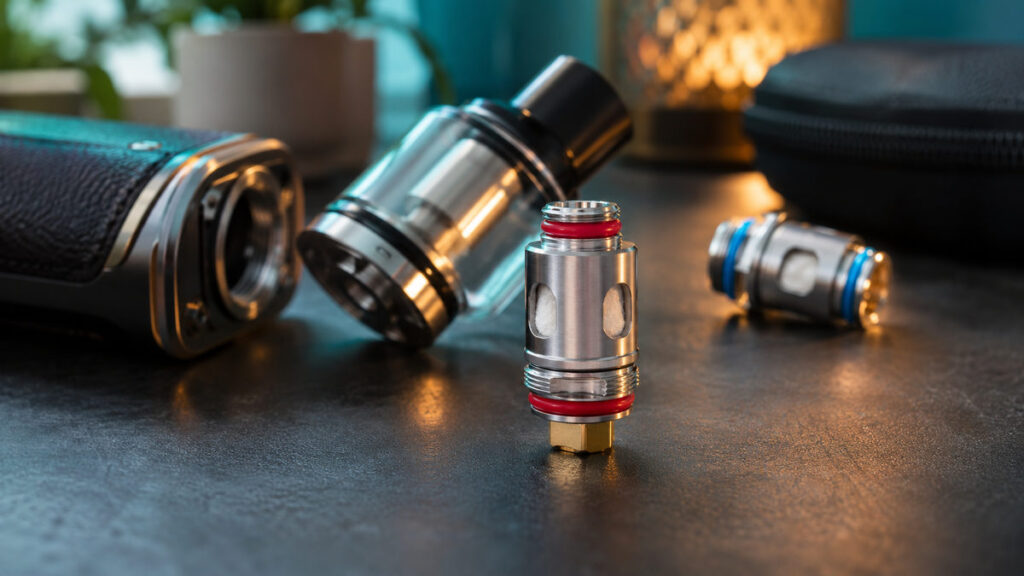
Open systems break the hardware into even more parts. A tank, for example, may separate into a mouthpiece, reservoir, coil head, airflow base, and seals. This gives users more control over worn components and liquid choice. The trade-off? Extra joints mean more opportunities for leaks, loose connections, and incorrect assembly.
Liquid delivery and airflow
The coil draws liquid through an absorbent material, usually cotton or another porous wick. Small inlet openings restrict liquid flow, while larger ones support faster consumption. Airflow moves vapor away from the coil and cools it before inhalation. Stable performance depends on the balance between airflow, liquid flow, and heat.
Disposable and closed-pod products arrive with the liquid path already configured by the manufacturer. Users avoid filling errors and most compatibility decisions. But they also have little ability to correct a restricted wick or unsuitable airflow setting. Once condensation or leakage develops, a sealed reservoir cannot be cleaned in any practical way.
Refillable products allow more hands-on adjustment, but careful handling matters. Users need to avoid overfilling, keep liquid out of the central airflow tube, and secure every seal. A newly installed coil may also need several minutes to become fully saturated. Fire a dry wick, and its surface can be damaged within seconds.
Activation and power controls
Many disposables rely on a pressure sensor that activates when the user inhales. Closed pods may work the same way, use a manual button, or support both methods. Some systems can also detect compatible pods and select the power automatically. These features keep operation simple, but they leave less room for adjustment.
Open devices may provide controls for power, temperature, airflow, and activation. That flexibility helps users match the output to a coil’s supported range. Poor settings, however, can overheat liquid, reduce coil life, or drain the battery quickly. As adjustability increases, product instructions and coil markings matter even more.
3. Disposable and Rechargeable Vape Battery Performance
Capacity, voltage, and usable energy
Battery capacity is usually shown in milliamp-hours, or mAh. On paper, a 650 mAh cell appears larger than a 400 mAh cell. That number alone cannot predict how many usable puffs the battery will deliver. Coil power, puff length, circuit efficiency, and voltage limits all affect runtime.
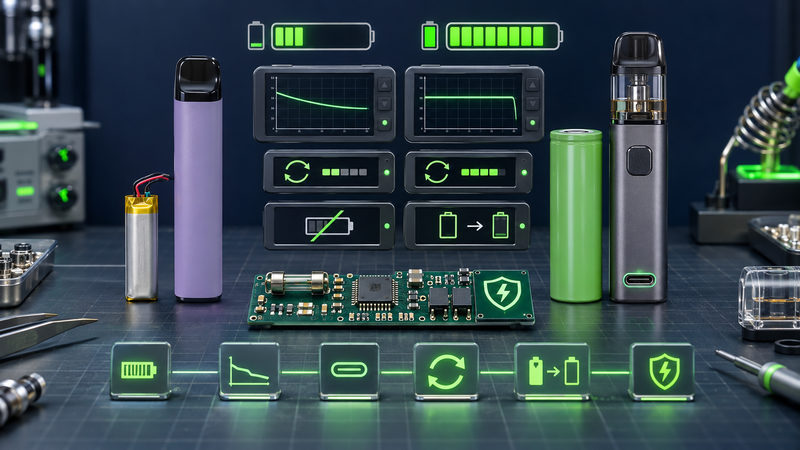
The voltage of a lithium-ion cell falls as its stored energy is used. A regulated circuit can compensate by adjusting current and keeping coil power steadier. A simpler circuit may instead produce gradually weaker output as the voltage drops. Two devices with the same battery capacity can therefore feel quite different as they approach depletion.
A small coil running near 8 watts may use less energy than a larger coil operating near 20 watts. Still, the lower-power device could involve longer puffs or a less efficient circuit. Airflow can also influence inhalation habits and energy demand. Battery size is useful context, but it is never the full story.
Charging support and cycle life
Traditional disposables use non-rechargeable or intentionally single-cycle power arrangements. Rechargeable disposables add an external port and a charging controller. Reusable pod systems, meanwhile, contain cells built for repeated charge cycles. Even then, practical lifespan depends on heat, charging habits, cell quality, and discharge depth.
Rechargeable batteries slowly lose capacity through chemical aging. A device that once lasted all day, for example, may eventually need another charge by afternoon. Frequent high-power use can speed up that decline by increasing current and heat. Extreme storage temperatures may also harm performance.
The shape of the connector does not determine charging speed. A modern-looking connector, for instance, does not guarantee rapid charging or advanced communication features. Accepted current and cutoff behavior are controlled by the internal electronics. Users should follow the manufacturer’s guidance on cables and power sources.
Replaceability and electronic protections
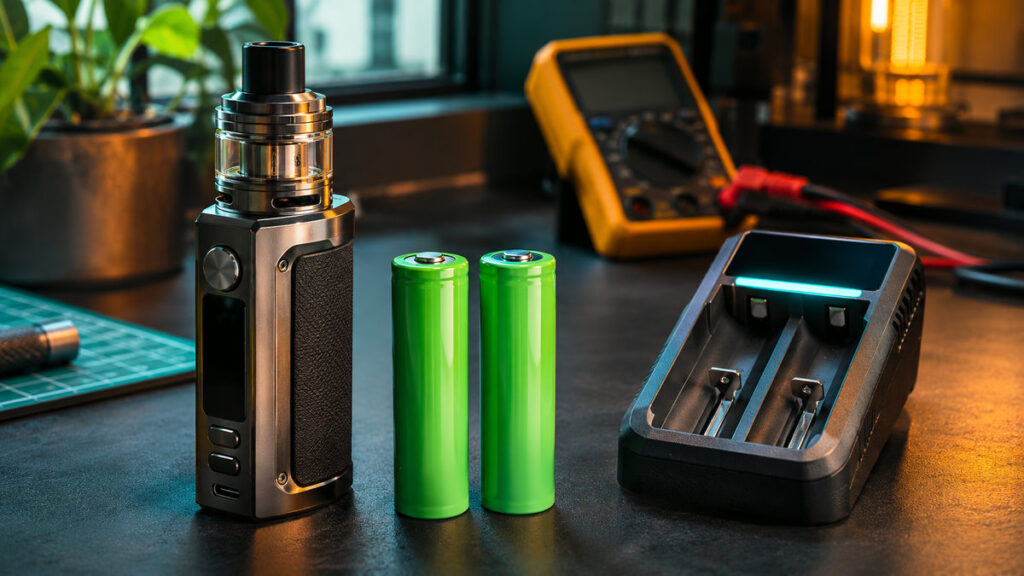
Most slim rechargeable devices contain permanently installed cells. Some larger open systems use removable cells, making correct battery selection essential. Those removable batteries also need undamaged wraps and protective transport cases. Never carry loose cells in a pocket with coins, keys, or other metal objects.
Control circuits may provide short-circuit, overcharge, over-discharge, overcurrent, and timeout protection. The quality of those protections varies between products. Physical damage, liquid intrusion, or an unsuitable charger can still create a hazard. Electronic safeguards help, but they are no substitute for careful use.
Battery life and device life are not always the same. A disposable may still have power after its liquid is gone. Its coil or sensor might also fail while liquid remains. Rechargeable systems can survive several pod replacements, yet connector wear, contamination, and battery degradation eventually take their toll.
4. Coils, Resistance, Vapor Output, and Flavor Consistency
How resistance and coil structure affect heat
A coil turns electrical energy into heat, vaporizing the liquid held in the wick. Its electrical resistance, measured in ohms, affects current demand at a given voltage. Resistance alone does not define performance. Coil material, surface area, mass, airflow, and power settings also influence the result.
Lower-resistance coils often support higher power and produce more vapor. That can mean greater liquid and battery consumption with each puff. Higher-resistance coils typically run at lower power and create less vapor. Even so, two coils with equal resistance may behave differently because of their construction.
Mesh coils distribute heat across a broad, patterned surface. When the liquid supply keeps up, this can provide fast heating and even vaporization. A traditional wire coil may have less surface area but require less liquid. Neither design guarantees good performance without appropriate power and wicking.
Performance throughout the product’s life
A fresh disposable should provide reasonably consistent output while its battery and wick stay within their intended ranges. Flavor may weaken as battery voltage falls or liquid runs low. Long or closely repeated puffs can also outrun the wick’s ability to resaturate. That dry sensation is a warning that the coil is not receiving enough liquid.
Charging a rechargeable disposable restores battery voltage, not a worn wick. A device can show a full battery and still produce weak or unpleasant vapor. The reverse is possible too: usable liquid may remain even after the battery circuit stops working. With a sealed body, neither problem is practical to repair.
Closed pods replace the coil and liquid path every time the cartridge is changed. A new pod can often restore flavor without forcing the user to replace the battery body. Open systems offer similar renewal through a fresh coil or pod. They also let users clean the contacts and airflow channels.
User behavior has a strong effect on flavor consistency. Rapid consecutive puffs, for example, leave less time for liquid to reach the coil. Thick liquid may travel slowly through narrow wick openings. Too much power can scorch the wick, while too little may produce weak output and condensation.
5. Lifespan, Puff Counts, Reliability, and Maintenance
Why puff counts vary
Advertised puff counts generally come from controlled machine tests using a fixed puff duration. Real people inhale with different strength and for different lengths of time. Treat the stated count as a comparison point, not a promise. After all, a three-second puff uses more liquid and energy than a one-second puff.
Temperature can affect both battery output and liquid flow. Cold conditions may slow wicking and temporarily reduce cell performance. Very warm storage, meanwhile, can thin the liquid and raise the risk of leaks. Device orientation, blocked airflow, and normal production tolerances create even more variation.
A small sealed disposable might last anywhere from part of a day to several days, depending on capacity and use. Larger rechargeable disposables can continue longer because they carry more liquid and can be charged. Their sealed coils, however, must survive the entire liquid supply. A large reservoir does little good if the wick fails too soon.
With proper care, rechargeable device bodies may last for months or longer. Users replace pods or coils along the way as performance fades. Batteries gradually lose capacity, while ports and contacts undergo mechanical wear. Construction, frequency of use, handling, and storage all influence the actual lifespan.
Maintenance requirements
Maintaining a disposable usually means keeping its mouthpiece and air inlet clean. A sealed product should not be opened, refilled, punctured, or modified. A blocked inlet can cause unusual airflow or prevent activation. If simple cleaning fails, safe disposal is generally the only practical option.
Closed systems need regular charging and occasional pod replacement. Users should also remove condensation from the pod contacts with a dry, lint-free material. Storing some designs upright may help reduce leakage. Check the product instructions to determine whether the pod should stay installed during storage.
Open systems need the most ongoing attention. Typical tasks include:
- Refilling the reservoir without flooding its airflow path.
- Replacing coils or pods when flavor and output decline.
- Cleaning condensation from connectors and exterior surfaces.
- Inspecting seals, glass, threads, and charging ports for damage.
- Matching liquid and power settings with the installed coil.
Common reliability problems
Disposables can develop depleted batteries, blocked sensors, internal leaks, dry wicks, or failed control boards. Closed pods may suffer from poor contact, cracked cartridges, or inconsistent automatic activation. Open systems, meanwhile, can leak through worn seals or incorrectly installed coils. More serviceable parts provide more repair options, but they also bring extra assembly responsibilities.
Gurgling often points to excess liquid around the coil or inside the airflow channel. Flooding can lead to spitting, while a burnt taste commonly suggests poor saturation or coil damage. Stop using any device that becomes unusually hot, swollen, cracked, or electrically unstable. Visible safety problems always take priority over performance troubleshooting.
6. Nicotine Options, Cost, Convenience, and Environmental Impact
Product choice and recurring cost
Disposable and prefilled pod ranges usually come in a limited selection of strengths and flavors. Refillable systems tend to support a wider variety of compatible liquids. Compatibility still depends on the coil design, liquid thickness, and manufacturer guidance. Adult buyers should check local restrictions on both products and nicotine.
The first purchase is only one part of the total ownership cost. When a disposable reaches the end of its usable life, the buyer needs another complete device. Closed systems require new pods, while open systems need liquid and coils. Eventually, rechargeable products also need a replacement battery body or complete kit.
Take an illustrative four-week comparison. One buyer might go through eight complete disposables, while another purchases one device and several pods. A refillable user might buy a kit, one bottle of liquid, and two coils. Real totals will vary with local prices, usage, leakage, failures, and replacement frequency.
Over extended use, rechargeable systems often cost less because their main components stay in service. The upfront price may be higher, though. Losing or breaking the device can also wipe out the expected savings. A realistic monthly estimate is more useful than a simple comparison of shelf prices.
Convenience and environmental trade-offs
Disposables work immediately and need almost no setup. They can suit situations where portability and low maintenance come first. The drawback is frequent replacement of the whole product. Rechargeable disposables still need access to charging, despite keeping the same sealed construction.
Closed pods offer a middle ground, combining convenience with partial hardware reuse. Refillable systems reduce the need for repeated device purchases but involve liquid handling and spare parts. Convenience works on a sliding scale. More serviceability usually means more responsibility.
Every category generates waste, including plastic, metal, circuit boards, absorbent material, and packaging. With a disposable, all of these materials are combined with a battery in each discarded unit. That makes sorting and recovery difficult. Lithium-powered devices can also start fires in collection equipment when thrown into ordinary waste.
Rechargeable systems keep the main battery and electronics in use through several pod or coil changes. This can reduce hardware waste over a given period. Pods, coils, bottles, and worn-out devices still require appropriate disposal. Whether facilities accept complete vapes, batteries, or separated components depends on local services.
7. Battery Safety and a Practical Device Selection Framework
Basic battery precautions
Safe battery use begins with the product instructions. Follow the recommended charging method and place the device on a stable, nonflammable surface. Keep it away from water, direct sunlight, vehicles, heaters, and freezing temperatures. Never charge a device that looks wet or damaged.
Check the body, port, cable, and battery compartment before charging. Stop using the product if it swells, leaks, cracks, hisses, or becomes unusually hot. Never puncture, crush, burn, or dismantle a sealed vape. Doing so can damage the cell and create a serious fire hazard.
When transporting the device, protect it from physical impact and accidental activation. Removable cells belong in individual protective cases. Air carriers may limit vapes and spare lithium batteries to carry-on baggage. Travelers should verify airline and destination rules before leaving.
Where available, use an appropriate battery or electronic-waste program for disposal. Do not put lithium-powered products in household recycling unless local guidance specifically allows it. Retail take-back services vary by location. Local authorities can provide instructions on preparation and accepted drop-off methods.
Matching hardware with priorities
An adult looking for immediate simplicity may choose a legal disposable or prefilled product. Someone focused on reusing hardware might prefer a closed pod system. A user who wants more liquid choice and adjustable output may lean toward an open system. That extra flexibility also brings more setup and cleaning.
Before choosing, compare these product-specific details:
- Whether the liquid, pod, coil, or battery can be replaced.
- Battery capacity, supported charging method, and protection features.
- Coil resistance, recommended power range, and liquid compatibility.
- Expected recurring costs for pods, coils, liquid, and replacement hardware.
- Warranty coverage, manufacturer instructions, and local disposal options.
- Applicable age, product, travel, workplace, and public-use rules.
Above all, avoid products with vague labeling or missing safety instructions. A low price does not make up for uncertain battery specifications or poor construction. Choose hardware from lawful sources that provide traceable product information. Always let the product-specific requirements guide operation.
Conclusion
Rechargeable and disposable vapes differ in far more than whether they have a charging port. Their architecture shapes battery behavior, liquid delivery, coil serviceability, output control, and reliability. Each design also strikes a different balance between convenience and maintenance. Once the categories are clearly defined, those trade-offs are much easier to judge.
Disposable devices focus on immediate simplicity with minimal setup. Closed-pod systems keep the battery body in use while making pod changes straightforward. Refillable rechargeable systems provide more component reuse, liquid choice, and output control. In return, they demand more cleaning, compatibility checks, and technical care.
Neither battery capacity nor an advertised puff count can guarantee real-world lifespan. Puff duration, power, airflow, temperature, coil condition, and liquid flow all affect the outcome. Recurring purchases also influence total cost far more than the initial price suggests. Material waste and battery handling deserve just as much attention.
Compare the specifications and recurring costs of legally available devices before making a purchase. Read the manufacturer’s safety instructions and look for clear product labeling. Check local rules covering age, travel, products, and battery disposal as well. A careful technical comparison makes it easier to choose the design that fits your priorities.