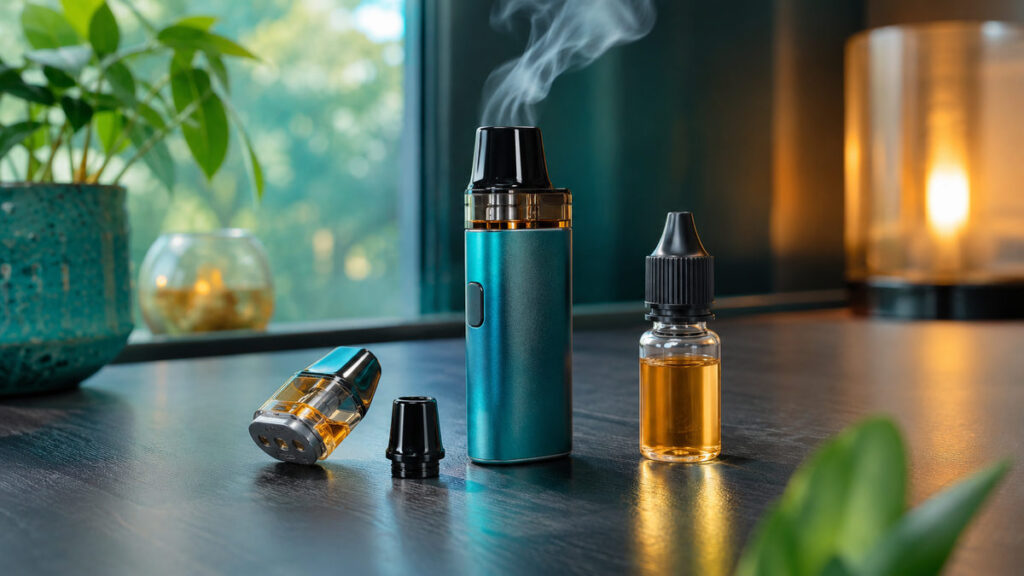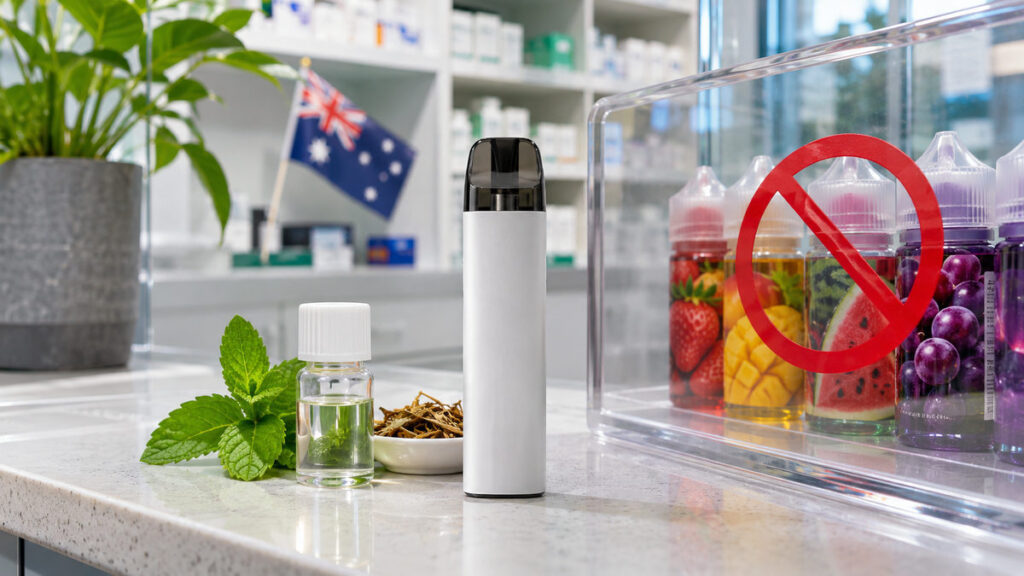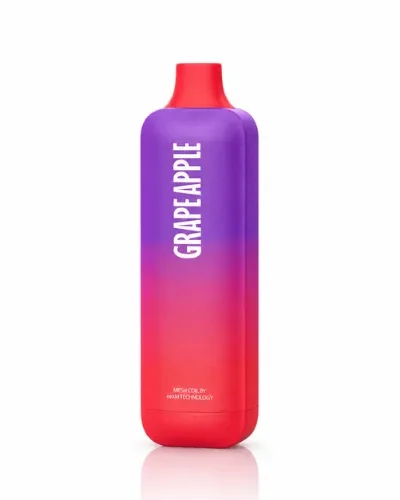

What risks could be hiding inside a device smaller than a marker pen? Disposable Vapes Explained: Components and Risks reveals far more than flavored mist. Beneath the sealed casing are liquid, electronics, a heating coil, and a lithium battery. Working together, these parts raise chemical, health, fire, and environmental concerns.
Packaging does not always make those risks easy to assess. Nicotine strength may be listed as a percentage, in milligrams, or through vague puff estimates. Claims such as “water vapor” or “nicotine-free” can also offer false reassurance. Knowing how the device works can help you make safer choices for yourself and your family.
This evidence-based guide distinguishes well-established findings from research that is still developing. It covers comparisons with smoking, secondhand exposure, safe handling, disposal, and quitting. Just as importantly, it recognizes that products and users are not all the same.
1. Disposable Vapes Explained: Components and Risks
A disposable vape is a compact electronic cigarette with a prefilled liquid reservoir. It is designed to be thrown away once the liquid or battery runs out. Most devices arrive ready to use, with no filling or coil replacement required. Simple on the surface, yes—but several interconnected components are hidden inside.
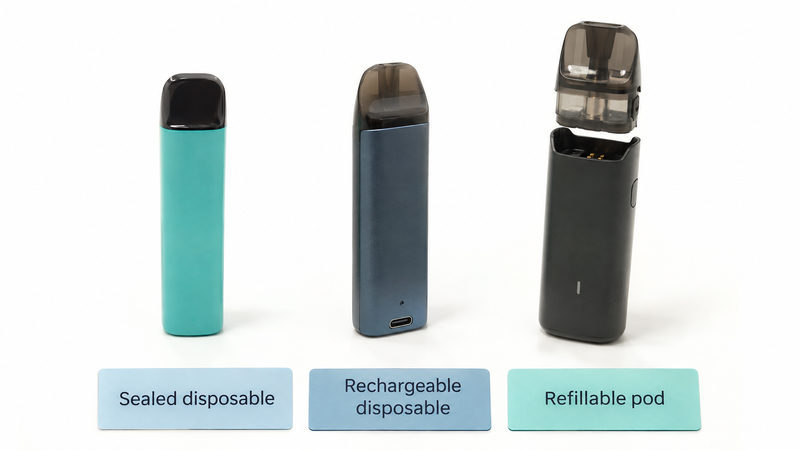
Single-use and rechargeable designs
Traditional disposables have a non-rechargeable battery and a fixed supply of liquid. Once either is depleted, the whole device becomes waste. Newer products may include a charging port but still lack a refillable reservoir. Although they can be recharged, these models remain disposable because users eventually discard the entire unit.
Refillable pod systems operate differently. The user recharges the main device and replaces or refills the liquid pod. This can reduce repeated battery disposal, though cartridges and leftover liquid still create waste. These systems also demand more handling, maintenance, and care when choosing compatible components.
Disposable designs differ widely in size, airflow, coil resistance, battery capacity, and liquid volume. Nicotine concentrations and chemical formulations also vary between brands and regions. Even a device advertised for thousands of puffs may not deliver nicotine consistently throughout its lifespan. Puff length and inhalation depth further change a person’s actual exposure.
Four main sources of risk
- Chemical exposure: Heating liquid can produce nicotine, particles, flavoring chemicals, metals, and irritating compounds.
- Dependence: Nicotine salts can deliver high nicotine doses with less throat irritation.
- Device hazards: Damaged batteries may overheat, ignite, leak, or explode.
- Waste: Every discarded unit combines electronics, plastic, metal, liquid residue, and a lithium battery.
Product quality influences every one of these risks. Poor manufacturing may lead to leaks, inaccurate labels, overheating, or inconsistent nicotine delivery. A familiar shape or pleasant flavor is no guarantee of predictable performance—or safety.
2. How Disposable Vapes Work and What Is Inside
From inhalation to aerosol
Most disposable vapes switch on when the user inhales through the mouthpiece. Air enters through small intake holes and moves past an airflow sensor. That sensor signals a control circuit, which connects the battery to the heating coil. The entire process takes only a fraction of a second.
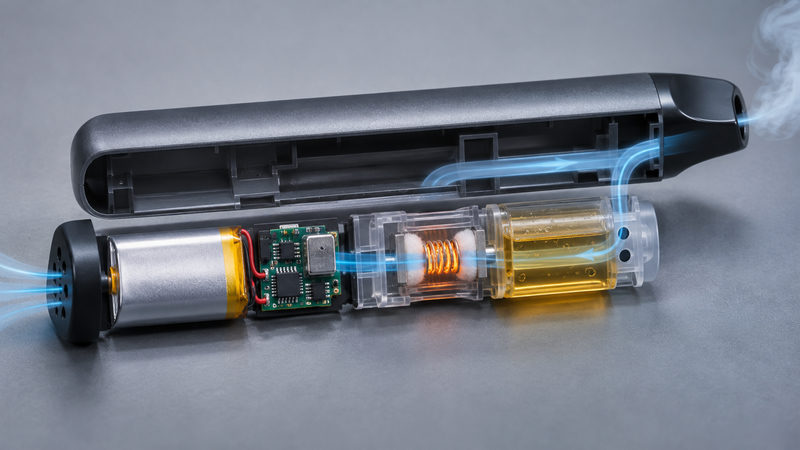
The coil heats liquid drawn from an absorbent wick. Liquid near the coil becomes a heated vapor, then cools rapidly. This cooling forms an aerosol made up of tiny liquid droplets, gases, and solid particles. The user draws that mixture through an internal channel and out of the mouthpiece.
So, the visible cloud is not harmless water vapor. Water may account for a small portion of some formulations or exhaled breath, but the cloud can also carry nicotine, solvents, flavoring compounds, ultrafine particles, and by-products created during heating. Under certain conditions, coil materials may add metals to the mixture.
Parts inside the casing
- Mouthpiece: Directs aerosol into the user’s mouth and lungs.
- Airflow channel: Moves incoming air past the sensor and heating area.
- Sensor and circuit: Detect inhalation and control power delivery.
- Lithium battery: Supplies energy to heat the coil.
- Heating coil: Converts electrical energy into heat.
- Wick or absorbent material: Carries liquid toward the coil.
- Liquid reservoir: Stores the prefilled formulation.
- Outer casing: Holds the components and may include charging contacts.
The circuit may provide protection against short circuits, long puffs, or low voltage. Still, the quality of these safeguards varies from one device to another. Physical damage, manufacturing defects, or unsuitable charging equipment can cause them to fail. Because the casing is sealed, inspecting the parts inside is also difficult.
Why use conditions matter
A coil may become hotter when the wick does not contain enough liquid. This “dry puff” often produces a burnt taste. The extra heat can alter the chemical mixture and increase irritating breakdown products. Stop using a device if it tastes burnt, leaks, hisses continuously, or feels unusually hot.
Airflow patterns also affect particle size and nicotine delivery. One long, deep inhalation can draw in more aerosol than a short puff. Frequent use may keep nicotine levels elevated throughout the day. That is why a printed puff count cannot capture one person’s exact exposure.
Cold conditions can reduce battery performance, while extreme heat may damage both the battery and the liquid. Leaving a device in a hot car can also increase pressure inside the casing. Never puncture, crush, or deliberately take apart a sealed vape. Doing so could release liquid or start a battery fire.
3. Vape Liquid Ingredients, Nicotine Salts, and Aerosol
What the liquid commonly contains
Vape liquid generally contains propylene glycol, vegetable glycerin, or a blend of the two. These ingredients carry flavorings and help form an inhalable aerosol. Vegetable glycerin tends to create thicker clouds, while propylene glycol often carries flavors effectively. Some formulations also include water, cooling agents, sweeteners, acids, or other additives.

Many disposable vapes contain nicotine, even when their branding focuses heavily on flavor. Manufacturers may use either freebase nicotine or nicotine salts. At higher concentrations, freebase nicotine can feel harsh. Nicotine salts, by contrast, use acids to soften that sensation and allow higher nicotine concentrations.
This means a small device may deliver a substantial amount of nicotine without causing intense throat irritation. The actual delivery depends on device power, liquid concentration, and inhalation habits. Labels can add to the confusion: a percentage and a milligram-per-milliliter figure may simply express the same concentration in different ways.
For example, a label showing 5% nicotine commonly means about 50 milligrams per milliliter. Labeling conventions and permitted tolerances differ by market, though. Concentration alone also cannot show how much nicotine a user absorbs from each puff. Liquid volume and frequency of use matter too.
Edible does not mean inhalation-safe
Some flavoring ingredients have a history of use in food. But swallowing a substance is very different from repeatedly drawing it into delicate lung tissue. The lungs and digestive system process chemicals through different pathways. Being suitable for food does not prove that an ingredient is safe to inhale.
Heating adds another source of uncertainty. At certain temperatures, propylene glycol and glycerin can break down into irritating carbonyl compounds. Flavors may also react with solvents or change during storage. The final mixture can shift with coil temperature, device age, and puffing style.
Studies of vape aerosol have found substances of concern in some products. These include volatile organic compounds, ultrafine particles, and metals such as nickel, tin, or lead. The amounts vary considerably across products and testing conditions. A single laboratory result cannot represent every device or every real-world puff.
Labels have limits
Labels may leave out minor additives, impurities, or compounds created when the liquid is heated. Unauthorized or poorly controlled products can also contain unexpected ingredients. Even a “nicotine-free” claim depends on reliable testing. Trace nicotine, contamination, and incorrect labeling are still possible.
Color and smell cannot tell you whether a liquid is safe. Nor does a smooth flavor prove that its aerosol is free of irritants. Cooling additives, in particular, may dull throat sensations without reducing chemical exposure. That can make repeated inhalation feel deceptively easy.
Never taste leaked liquid or handle it with bare skin. Nicotine can enter the body through the skin, eyes, or accidental swallowing. If liquid gets on your skin, wash the area promptly with soap and water. Seek urgent advice after suspected poisoning, especially if a child or pet was exposed.
4. Disposable Vape Health Risks and Nicotine Dependence
What evidence establishes clearly
Nicotine is addictive and can lead to cravings, tolerance, and withdrawal. Withdrawal commonly brings irritability, anxiety, restlessness, poor concentration, and changes in sleep. Nicotine can also temporarily raise heart rate and blood pressure. With repeated use, the brain learns to expect regular doses.
Young people face added concerns because the brain continues developing into early adulthood. During this period, nicotine can affect attention, learning, mood, and impulse control. Pregnancy also brings risks to fetal development. Young people, pregnant people, and non-users should avoid vaping altogether.
Vaping may irritate the mouth, throat, and airways. Common complaints include coughing, throat dryness, headaches, and shortness of breath. Severe symptoms are different. Persistent chest pain, serious breathing difficulty, confusion, or blue lips require urgent medical attention and should never be dismissed as a normal reaction.
Liquid nicotine poses a separate poisoning risk. A spill can reach a child’s hands, mouth, or eyes in seconds. Possible symptoms include nausea, vomiting, dizziness, sweating, rapid heartbeat, weakness, or breathing problems. Keep every device securely stored, and contact local poison services after any suspected exposure.
Supported concerns still developing
Research has linked vaping to airway inflammation and changes in blood-vessel function, raising concerns about respiratory and cardiovascular harm. Some users may also experience worsening asthma symptoms. Reactions differ from person to person, but feeling fine right now does not prove the product is safe.
Scientists are also examining the effects of repeated exposure on immunity, lung repair, and exercise tolerance. In laboratory studies, some aerosol chemicals can damage cells. Yet laboratory doses do not always reflect everyday use. Researchers still need to connect these findings with long-term outcomes in people.
Oral and dental concerns include dry mouth, irritated gums, and changes in oral bacteria. Sweet flavors may encourage people to vape frequently throughout the day, repeatedly exposing oral tissues to aerosol. Regular dental care matters, but it cannot eliminate the exposure itself.
What remains uncertain
Disposable vaping has not been around long enough to reveal every lifetime effect. Exact long-term rates of cancer, chronic lung disease, and cardiovascular disease therefore remain uncertain. Rapid changes in product design make long follow-up studies even harder. That uncertainty should not be mistaken for evidence of no risk.
It simply reflects the limits of what current research can show. The full scale of cigarette-related harm also took decades to measure. Meanwhile, vape aerosol already contains substances known to be toxic or irritating. It makes sense to avoid assuming safety while long-term evidence continues to develop.
Why personal risk differs
Risk can vary with age, pregnancy, heart disease, lung disease, and mental health. Exposure also changes according to nicotine strength, puff frequency, product quality, and duration of use. Someone who takes occasional puffs has a different exposure pattern from someone who inhales every few minutes. Neither pattern is risk-free.
The comparison also depends on whether vaping replaces smoking. An adult smoker who switches completely may reduce exposure to many toxins produced by combustion. Someone who continues smoking while vaping, however, may retain substantial harm. Dual use can also raise total nicotine intake or prolong dependence.
- Lower-risk direction: A smoking adult switches completely, then works toward stopping nicotine.
- Higher-risk direction: A non-user starts vaping and develops dependence.
- Misleading compromise: A smoker adds vaping but continues regular cigarette use.
- Especially concerning use: A child, teenager, or pregnant person uses nicotine products.
Nicotine dependence can creep up quietly. Social use may gradually turn into carrying a device everywhere. Needing a puff soon after waking can point to stronger dependence. Other warning signs include using more than planned or repeatedly trying—and failing—to quit.
5. Secondhand Exposure, Smoking Comparisons, and Device Safety
Exposure beyond the user
Anyone nearby may breathe in aerosol exhaled by a user. That mixture can contain nicotine, particles, solvents, and other chemicals. Residue may also settle on tables, fabrics, car interiors, and surrounding surfaces. Researchers are still studying what repeated contact with these residues may mean for health.
The level of exposure depends on ventilation, distance, room size, and how often someone vapes. Aerosol usually disperses faster outdoors than it does inside a closed vehicle. Even so, opening a window does not guarantee that it will be completely removed. Avoid vaping around children, pregnant people, and those with heart or lung disease.
Indoor policies should treat aerosol as a preventable exposure, not merely an unpleasant scent. Never vape in bedrooms, childcare spaces, or vehicles carrying children. Waiting until others are no longer nearby also limits immediate exposure. A vape-free space remains the safest choice indoors.
Vaping compared with smoking
Burning tobacco produces smoke containing thousands of chemicals. Because vaping does not involve combustion, its aerosol generally contains fewer harmful chemicals than cigarette smoke. Fewer is not the same as harmless. This comparison is most relevant to adults who already smoke and then switch completely.
For someone who uses neither product, taking up vaping adds risk without removing any cigarette exposure. Vaping cannot undo damage caused by past smoking, either. Switching completely may reduce exposure, but quitting both products offers the clearest health benefit. Qualified healthcare professionals can help smokers assess approved cessation options.
Common myths
- “It is only water vapor.” The cloud contains aerosolized liquid, particles, and gases.
- “No smoke means no risk.” Combustion is absent, but chemical and nicotine exposure remain.
- “Nicotine-free means safe.” Other ingredients and heating products may still irritate or harm.
- “A sweet flavor proves mildness.” Flavor and cooling sensations can mask throat irritation.
- “Using both products protects smokers.” Dual use can maintain serious smoking-related exposure.
Battery and charging safety
Lithium batteries store a great deal of energy in a very small space. Damage or internal defects can trigger rapid overheating, fire, or explosion. Stop using any device that is swollen, cracked, leaking, or unusually hot. If you see smoke or flames, move away and call emergency services when needed.
Only recharge a model specifically designed by the manufacturer to be charged. Use compatible equipment, and keep an eye on the device while it is plugged in. Place it away from bedding, direct sunlight, heaters, oxygen equipment, fuel, and other flammable materials. Never charge a vape that is wet or physically damaged.
Avoid carrying a loose device next to keys or coins when its contacts are exposed. Metal objects can cause a short circuit. Do not alter the wiring or try to replace an embedded battery. If a device starts activating continuously, keep it away from people and anything combustible.
6. Environmental Impact, Safe Disposal, and How to Quit
A complicated waste stream
Every discarded vape contains a mix of plastic, metal, circuitry, absorbent material, and a lithium battery. Some nicotine-contaminated liquid may remain inside. That makes one tiny product surprisingly difficult for waste processors to handle. Multiply it by millions of short-lived devices, and the result is persistent electronic waste.
Extracting lithium, copper, and other materials consumes energy and natural resources. Yet the sealed design often makes those materials difficult to recover. Crushed lithium batteries may also ignite inside compactors, putting collection crews, vehicles, recycling plants, and nearby communities at risk.
Leftover nicotine may harm people, pets, and aquatic organisms as well. Never pour leaked liquid into a sink, toilet, drain, or onto soil. The complete device does not belong in ordinary curbside recycling, either. Requirements differ by location, so follow the guidance provided by your local waste authority.
Safer storage and disposal
- Keep used devices upright, cool, dry, and inaccessible to children or pets.
- Do not crush, puncture, burn, or dismantle a sealed device.
- Do not remove an embedded battery unless local professionals specifically instruct you.
- Take the device to an authorized household hazardous-waste or approved e-cigarette collection site.
- Ask your local waste authority about transport and packaging requirements.
- Report damaged or smoking batteries to emergency services when they create an immediate danger.
These precautions lower the immediate risk, but they do not make continued vaping safe. Repeatedly buying disposable products also keeps adding batteries and plastic to the waste stream. Quitting stops both future device waste and personal exposure. It may save a substantial amount of money too.
A practical path toward quitting
Begin by tracking when, where, and why you vape for three days. Note whether you reach for the device after waking, during stress, while driving, or around friends. Next, pick a quit date and move spare devices out of easy reach. Tell one supportive person exactly how they can help.
A healthcare professional can evaluate your dependence and suggest appropriate support. Depending on your circumstances, that might include counseling and approved nicotine-replacement medicines. Telephone, text, and local cessation services can offer continued encouragement as well. Pregnant people and younger users should receive age-appropriate professional guidance.
- Delay the first puff of the day and extend vape-free periods.
- Replace automatic hand-to-mouth habits with water, gum, or brief movement.
- Avoid familiar triggers during the first difficult days.
- Plan a response for cravings, such as walking for five minutes.
- Treat a lapse as information, then restart the plan promptly.
Withdrawal is often most intense near the start of a quit attempt, then gradually eases. The timeline varies from person to person. If low mood, anxiety, or distress becomes severe, seek help. A quitting plan should support both physical and mental health.
Conclusion
Disposable vapes rely on batteries and heating coils to turn chemical liquid into an aerosol—not harmless water vapor. Their risks include nicotine dependence, respiratory and cardiovascular effects, poisoning, secondhand exposure, battery incidents, inconsistent quality, and lasting electronic waste.
Adults who would otherwise keep smoking cigarettes may reduce some exposures by switching completely. Even then, vaping carries risks and is not appropriate for non-users, young people, or pregnant people. Dual use can maintain serious smoking-related harm. Stopping both products offers the clearest path for long-term health.
Check the nicotine strength of your device, and keep it away from children, pets, heat, and flammable materials. Instead of putting it in household trash or curbside recycling, find an authorized local disposal site. Then contact a qualified healthcare professional or cessation service. Together, you can create a realistic quitting plan that fits your health and everyday life.