Can you vape outside a café, next to a train station, or near the entrance to a public building in NSW? The answer catches many people off guard. Vaping Laws in NSW: Public Places and Smoke-Free Areas apply to more locations than many residents and visitors expect. Individual venues may also enforce restrictions that go beyond statewide law.
NSW generally treats vaping the same way as smoking in public spaces. Put simply, if smoking is banned somewhere, vaping usually is too. This guide covers the main restrictions, real-world examples, enforcement options, and practical steps businesses can take to stay compliant.
1. Vaping Laws in NSW: Public Places and Smoke-Free Areas
The core rule
In NSW, you cannot vape anywhere that smoke-free environment laws prohibit smoking. The fact that a vape produces aerosol rather than tobacco smoke does not make it acceptable. In most cases, a standard no-smoking rule also applies to e-cigarettes and similar vaping devices.
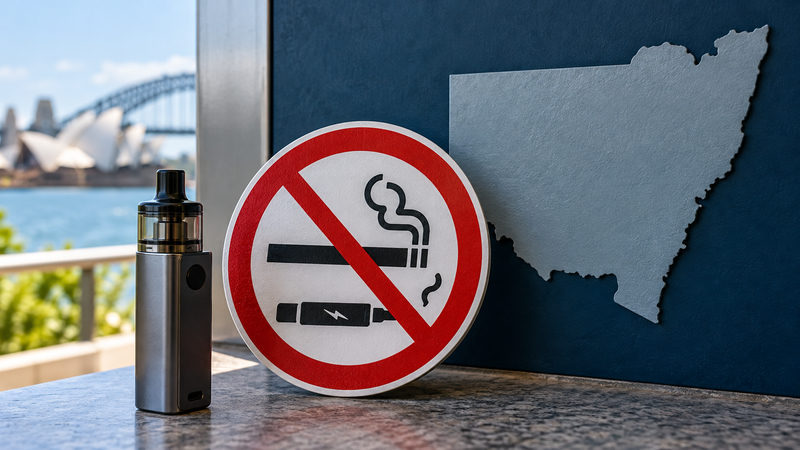
The main legislation is the Smoke-free Environment Act 2000 and the Smoke-free Environment Regulation 2016. Together, they establish smoke-free enclosed public places and several protected outdoor areas. Other laws and policies also apply across transport systems, workplaces, hospitals, and council-managed land.
What the key terms mean
Vaping means using an e-cigarette or another device that heats liquid to produce an aerosol for inhalation. An enclosed public place is generally a covered space open to the public. The precise legal definition, though, can depend on the structure, the size of its openings, and how the space is used.
A smoke-free area is simply a place where smoking is prohibited by law. In NSW, that ban generally extends to vaping. It applies whether the device contains nicotine, no nicotine, flavouring, or another permitted ingredient.
Location rules are separate from the laws regulating vaping products. Other provisions govern their sale, supply, advertising, importation, and purchase. Being allowed to possess a product does not mean you can use it wherever you like.
The reverse is also true: finding a lawful place to vape does not mean the product was supplied legally. Pharmacies must meet specific requirements, while other retailers cannot lawfully sell vaping products. Consumers and businesses need to consider product regulation and smoke-free location rules as two separate compliance issues.
2. Where Vaping Is Banned in Enclosed Public Places
Hospitality, retail, and service premises
Vaping is banned in enclosed public areas throughout NSW. That includes restaurant dining rooms, cafés, pubs, clubs, cinemas, libraries, and shopping centres. Enclosed corridors, foyers, toilets, and other areas open to the public are covered as well.
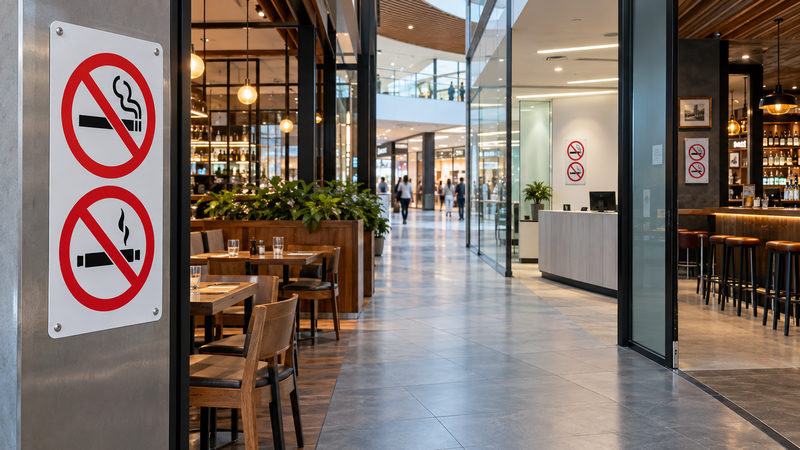
A customer, for example, cannot vape while seated inside a restaurant just because the windows are open. Nor can a shopper vape in a shopping-centre corridor. An enclosed part of a pub also remains smoke-free, even if its doors lead directly to an outdoor area.
Many enclosed workplaces and public-facing service premises are covered when members of the public can enter them. Reception areas, professional offices, government service counters, and indoor entertainment facilities are common examples. Workplace safety duties may also require employers to control aerosol exposure beyond these public-access restrictions.
Policies can extend beyond the law
Being outdoors does not necessarily mean vaping is allowed. Property owners, occupiers, employers, and venue operators can introduce broader vape-free policies. A business may therefore ban vaping across its grounds, including car parks, balconies, courtyards, and staff areas.
A private office complex, for instance, may prohibit vaping across the entire site. Its policy can include outdoor spaces that are not subject to a specific statewide ban. Visitors and employees must still comply with valid entry conditions and workplace directions.
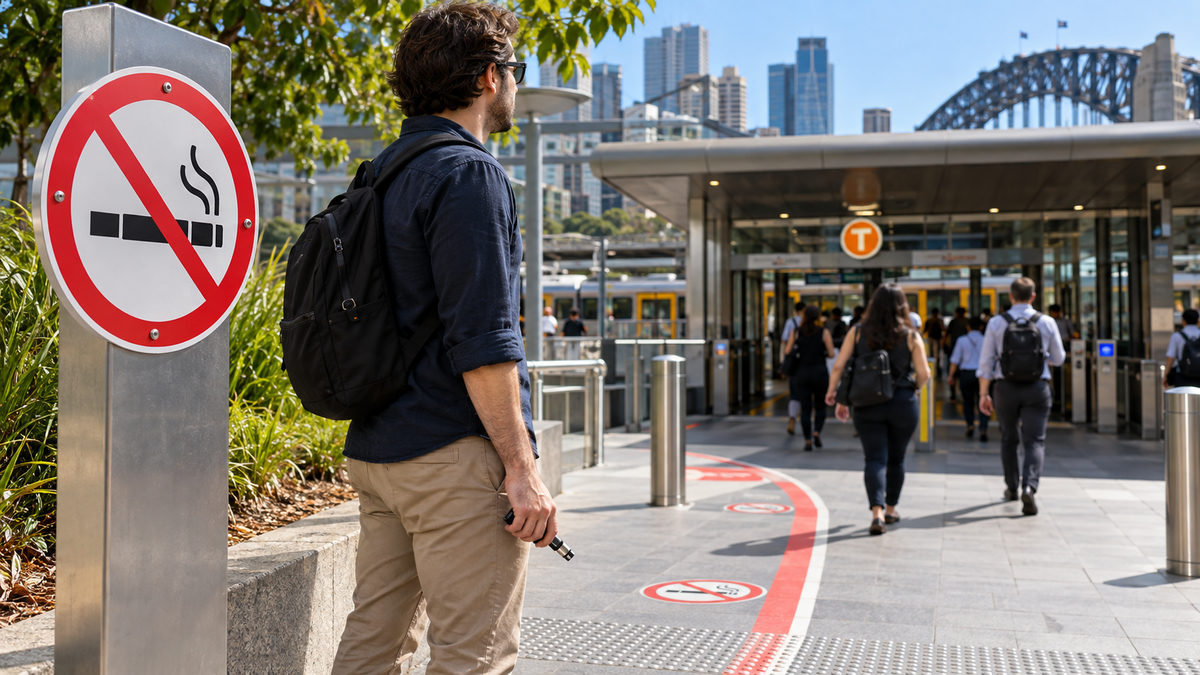
No-smoking signs should usually be understood as covering both smoking and vaping. NSW Health makes this clear with the message “No Smoking means No Vaping.” Even if a sign displays only a cigarette symbol, vaping may still be legally prohibited.
Signs are not the source of every restriction, however, and the lack of one does not mean vaping is permitted. Before using a device, consider the location, nearby facilities, and any venue rules. Not sure? Ask a staff member or move to a place where vaping is clearly allowed.
3. Outdoor Smoke-Free Areas and the NSW Four-Metre Rule
Dining, playgrounds, pools, and sporting events
Commercial outdoor dining areas are smoke-free across NSW. You cannot vape on a café terrace, restaurant courtyard, or pub deck while the space is being used for dining. This applies even if there is no roof or surrounding walls.
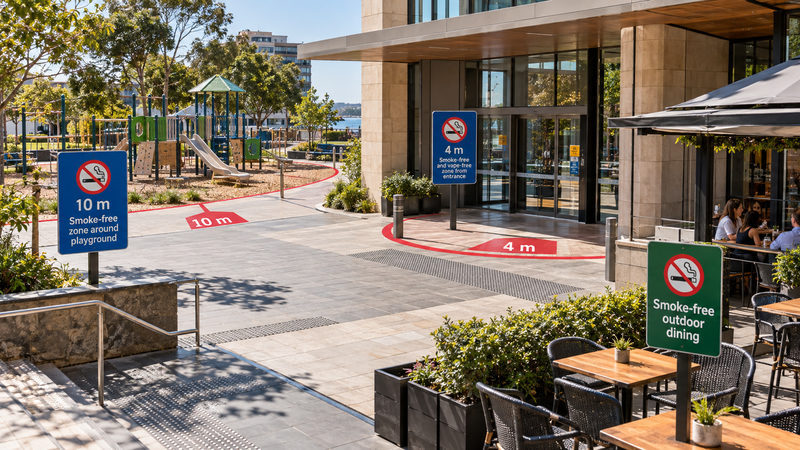
Picture a pub courtyard with dining tables and a food service area. A customer cannot simply step away from the table and start vaping nearby. They need to leave the restricted area and follow any additional rules imposed by the venue.
Vaping is also banned within 10 metres of children’s play equipment in an outdoor public place. The protection extends to the area around the equipment, not just the equipment itself. An empty playground does not suddenly become a lawful place to vape once the children have gone.
Public swimming-pool complexes are smoke-free too. The ban also applies to spectator areas at sports grounds and other recreational areas during organised sporting events. A parent watching weekend football, for example, cannot vape from the sideline when it is being used as a spectator area.
The four-metre entrance rule
Smoking and vaping are prohibited within four metres of a pedestrian entrance to, or exit from, a public building. This covers libraries, hospitals, government offices, shopping centres, restaurants, and many commercial premises. Standing beside one of these doorways with a vape may lead to enforcement action.
The four-metre zone is measured from the pedestrian access point, and it applies whether or not a sign is displayed. Someone who merely walks through the area while vaping, rather than remaining there, may be treated differently under the law.
Buildings used only for residential purposes generally fall outside this particular entrance rule. Mixed-use buildings need closer scrutiny because entrances serving non-residential premises may still qualify. Limited exemptions and detailed statutory definitions can also affect unusual layouts and shared entrances.
If the boundaries are difficult to identify, check the latest NSW Health smoke-free guidance. It is also worth consulting the official legislation before making assumptions. This is especially useful around arcades, plazas, shared courtyards, and buildings with multiple access points.
Councils and land managers can designate additional smoke-free or vape-free places. A council might, for example, restrict vaping at beaches, parks, civic spaces, or sporting facilities under its control. Venue operators can likewise adopt wider restrictions across privately managed outdoor land.
4. Vaping on Public Transport, Platforms and in Vehicles
Vaping is banned on NSW public passenger vehicles, including trains, buses, ferries, and light rail. The rule applies for the whole journey. Passengers cannot vape beside a door, inside a toilet, or in a supposedly quiet carriage.
The ban extends to public transport waiting and access areas, including train and metro platforms, bus stops, ferry wharves, light-rail stops, and taxi ranks. These places remain smoke-free even when they are uncovered, only partly covered, or temporarily empty.
Being the only person at an outdoor bus stop, for example, does not make vaping legal. The area outside station gates may also be covered if it remains part of the station. A nearby public footpath, however, might fall outside the transport zone if no other restriction applies.
Take care when moving from a platform towards the street. You might leave the transport zone only to enter another restricted area near a public building entrance. Outdoor dining restrictions or local council rules may also continue to prohibit vaping nearby.
NSW law also bans vaping inside a vehicle when a child under 16 is present. Opening the windows makes no difference. The rule applies whether the device contains nicotine or nicotine-free liquid.
This restriction is designed to protect children from involuntary aerosol exposure in a confined space. It is enforced by NSW Police. Drivers and passengers should wait until the child is no longer in the vehicle and confirm that the surrounding location allows vaping.
Taxis, rideshare services, rental-car companies, and fleet operators can set stricter rules of their own. A vehicle owner may ban vaping even when no child is present. Cleaning fees, employment policies, and rental conditions can also apply independently of statutory penalties.
5. Where Can You Legally Vape in NSW?
A potentially lawful location
Vaping may be lawful outdoors if the location is not within any prescribed smoke-free area. The owner must permit it, and there must be no workplace, council, or venue policy banning it. Whether you can vape therefore depends on both the location and the rules governing the property.
One possible example is a private outdoor area where the owner has given permission. It would need to be away from public entrances, dining areas, playgrounds, transport stops, and other protected places. Nobody can vape inside a vehicle carrying a child under 16, either.
Private property does not automatically mean vaping is permitted. Apartment bylaws, tenancy conditions, workplace policies, and event terms may all restrict it. Aerosol drifting into neighbouring homes or shared spaces can also prompt complaints and raise other legal concerns.
Examples that remain unlawful
Several familiar locations clearly come under NSW smoke-free restrictions:
- An outdoor café terrace operating as a commercial dining area.
- A position within 10 metres of public playground equipment.
- A bus stop, train platform, ferry wharf, or taxi rank.
- An enclosed shopping centre or indoor restaurant dining room.
- A spot within four metres of a covered public-building entrance.
Before vaping, check for signs and take note of nearby entrances or protected facilities. If a boundary or site policy is unclear, ask the property operator. Simply moving a few metres may put you inside another restricted zone, so look at the whole setting first.
The statewide laws apply in Sydney and throughout regional NSW. Councils, hospitals, universities, businesses, and event organisers can still establish larger vape-free areas. What is tolerated at one location may break the rules at another.
Three quick questions can help you avoid most problems:
- Is smoking prohibited at this location?
- Does the property, employer, council, or venue impose its own restriction?
- Could children, workers, or other people face involuntary aerosol exposure?
If any answer points to a restriction, do not vape there. Follow requests from staff and property managers too. Choosing a clearly permitted outdoor spot well away from others lowers the legal risk and helps prevent unwanted exposure.
6. NSW Vaping Fines, Enforcement and Reporting Breaches
Who enforces the rules?
Authorised NSW Health inspectors monitor and enforce smoke-free requirements. Depending on the circumstances, they may educate people, investigate complaints, issue cautions, or impose penalties where the legislation permits. NSW Police enforce the separate ban on vaping in vehicles carrying children under 16.
Transport staff, councils, venue security, and other authorised officers may also deal with conduct in the places they oversee. Their powers vary according to the setting and the relevant legislation. A single incident can therefore involve several rules or enforcement bodies.
Anyone who vapes in a smoke-free area may be fined or face further action. Occupiers can have separate duties of their own, including requirements involving signage and reasonable compliance measures at specified locations. The person vaping may not be the only one exposed to risk.
Penalties and enforcement arrangements may change. Before quoting a figure or relying on one, check the current NSW Health guidance and the official NSW legislation database. Businesses should do the same to keep their policies, notices, and staff instructions accurate.
How to report a suspected breach
Suspected smoking or vaping breaches can be reported through the NSW Health online reporting service. You can also call the Tobacco Information Line on 1800 357 412 for information. These channels can help you work out whether the issue is a smoke-free breach or illegal retail activity.
A helpful report includes specific, factual information:
- The exact location and type of premises.
- The date and approximate time of the incident.
- Whether the conduct happens repeatedly.
- Where the person stood within the restricted area.
- Whether required or relevant signs were visible.
Make observations from a safe place and avoid confronting anyone. Do not put yourself in danger to collect photographs or personal information. NSW Health can review the report and decide whether education, monitoring, or enforcement is the right response.
Ordinary vaping breaches should generally be directed to the appropriate compliance service. Threats, violence, fire, dangerous driving, or an immediate medical risk are different. Call emergency services whenever there is an urgent threat to life or safety.
7. Why the Rules Exist and How Organisations Can Comply
Vape aerosol may expose nearby people to fine particles and other substances. NSW therefore applies the same protections across smoke-free public places. A consistent approach also avoids arguments over whether a particular device contains nicotine.
Children have little control over exposure in playgrounds, vehicles, and busy public spaces. Workers may likewise spend hours near entrances, dining terraces, or customer areas. Exposure may also be a greater concern for pregnant people and those with respiratory or cardiovascular conditions.
Businesses and employers should put their smoking and vaping rules in writing. The policy needs to clearly identify prohibited indoor spaces, outdoor boundaries, vehicles, entrances, and any designated areas. It should also state who is responsible for complaints and repeated non-compliance.
A policy document alone is not enough. Staff need practical training so they can explain the rules calmly, ask someone to comply, and call a manager when needed. They should also know when an incident requires security, inspectors, police, or emergency services.
Clear, prominent signs can stop confusion before it turns into a dispute. Display them at entrances, outdoor dining areas, staff spaces, transport access points, and other restricted locations. Referring specifically to vaping helps visitors understand that a cigarette symbol also covers e-cigarettes.
Organisations should review their site layouts and how each space is used. Adding tables, for instance, may turn a regular courtyard into a commercial outdoor dining area. Moving an entrance or installing a new playground can also shift the practical boundaries.
Managers should keep up with legislative changes and the latest advice from NSW Health. When legal precision is needed, they should consult the official NSW legislation database as well. Regular reviews keep policies current and make it easier for staff to apply them consistently.
Conclusion
In NSW, vaping is generally prohibited anywhere smoking is banned. That includes enclosed public places, commercial outdoor dining areas, designated recreation areas, public transport facilities, and passenger vehicles. Prescribed zones also protect playgrounds and entrances to public buildings.
The restrictions cover both nicotine and nicotine-free vapes, and owners or operators may set even broader rules. Before vaping or creating workplace policies, check the latest NSW Health guidance and official legislation. Suspected breaches can be reported through the NSW reporting service or by calling the Tobacco Information Line on 1800 357 412.