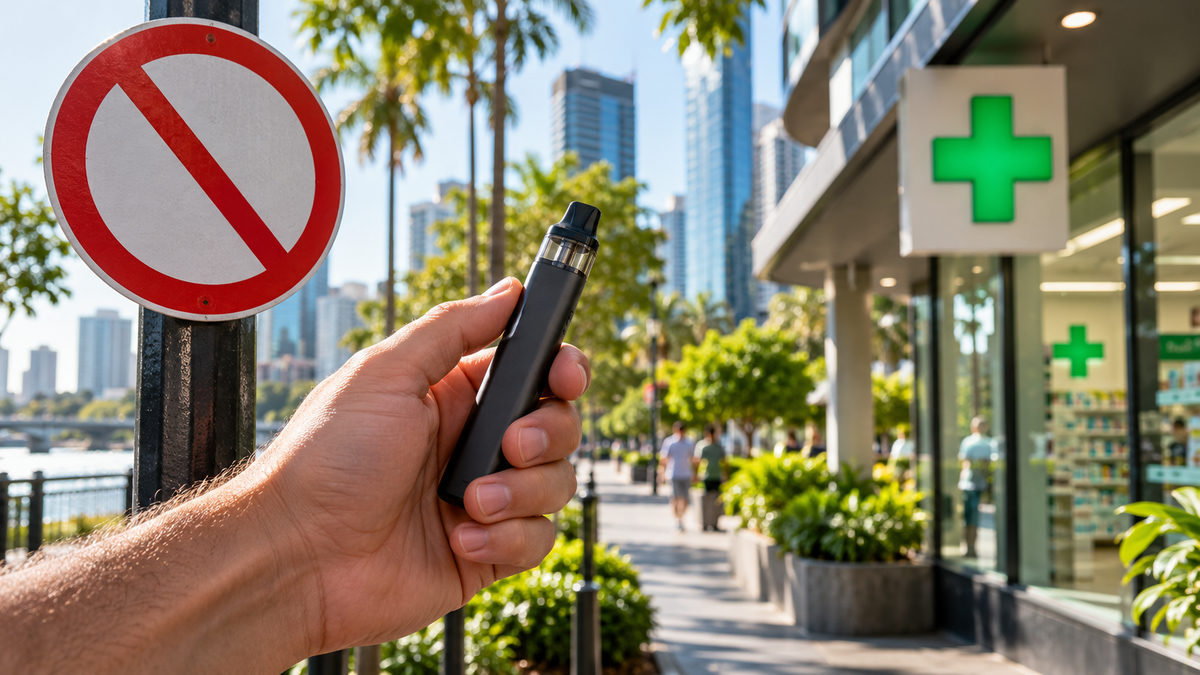
Can you carry a vape, use it outside a café, or buy one without a prescription in Queensland? Understanding Vaping Laws in Queensland Explained requires separating two legal systems that overlap. Queensland decides where people can vape, while national law governs which products may be lawfully supplied. So, a vape can be legal to possess for personal use yet illegal to sell or use in a particular location.
These details affect users, parents, travellers, pharmacists, retailers, employers, and property managers. Pharmacy access does not mean vaping is allowed in every smoke-free location. Businesses dealing with illicit products may also face serious penalties, product seizures, and closure action. If the circumstances are unclear, check current government guidance or get professional advice.
1. Vaping Laws in Queensland Explained: The Legal Framework
Two legal systems operate together
Queensland law generally treats vaping the same as smoking, whether or not the vape contains nicotine. It covers smoke-free places, retail practices, sales to children, licensing, enforcement, and some possession matters. In particular, the Tobacco and Other Smoking Products Act applies to electronic cigarettes and related goods. Nicotine is also regulated under Queensland medicines and poisons laws.
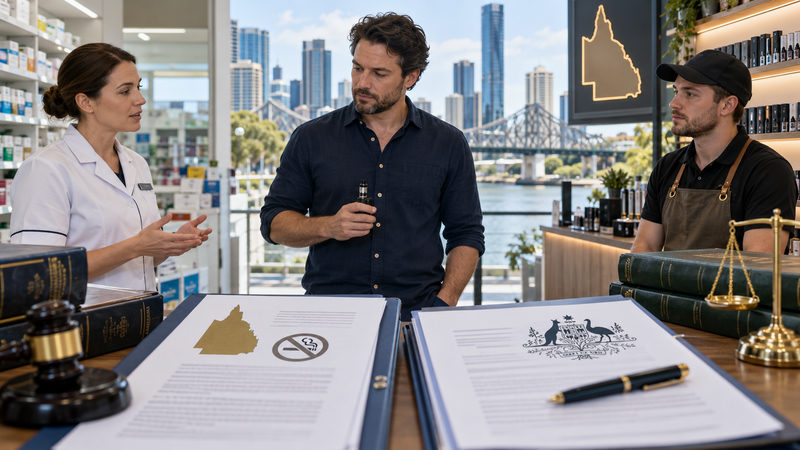
Commonwealth law deals with a different part of the market. It controls the importation, manufacture, advertising, commercial possession, and supply of vaping goods across Australia. National reforms now limit lawful consumer supply to compliant therapeutic products available through participating pharmacies. These rules extend to nicotine and nicotine-free vapes, devices, pods, liquids, and relevant accessories.
Take an ordinary disposable vape displayed beside a convenience-store counter. Queensland rules apply to the shop, the way it operates, and any enforcement action taken against it. At the same time, Commonwealth law may prohibit the commercial possession and supply of that product. Once someone uses the device, Queensland’s smoke-free rules come into play as well.
Is vaping or possession legal?
The short answer? It depends. Adults may lawfully obtain suitable therapeutic vapes through participating pharmacies to help them stop smoking or manage nicotine dependence. That access does not give anyone permission to vape wherever they like. Queensland smoke-free areas, property rules, and workplace requirements still apply.
National vape reforms do not generally criminalise genuine personal possession of a small quantity. Their commercial-possession rules instead focus on retailers, distributors, and black-market supply chains. Queensland restrictions involving illicit nicotine products may also apply. The legal position can turn on the product’s source, quantity, intended purpose, and the conduct surrounding it.
Carrying one vape for personal use, for example, is very different from keeping hundreds behind a shop counter. National commercial-quantity thresholds may be reached with nine devices, 60 accessories, or 400 millilitres of liquid. Quantity is not the only factor enforcement officers consider, though. Sales records, packaging, premises, customer messages, and payment evidence can all point to commercial activity.
Simply saying “vaping is legal” does not answer the practical questions. Personal use, lawful supply, commercial possession, and location restrictions are separate issues. Travellers must also comply with border rules, including quantity limits and therapeutic-purpose conditions. Anyone importing, storing, wholesaling, or selling these products should seek advice tailored to their situation.
2. How to Buy Therapeutic Vapes Legally in Queensland
The pharmacy-only pathway
Consumers cannot lawfully purchase vapes from tobacconists, convenience stores, service stations, or ordinary vape shops. That includes products marketed as nicotine-free. Lawful retail access is instead available through an Australian pharmacy that participates in the therapeutic vaping scheme. Even then, pharmacies are not required to stock or supply the products.

Therapeutic vapes are intended to help people stop smoking or manage nicotine dependence. They are not ordinary lifestyle products or recreational consumer goods. The Therapeutic Goods Administration has not approved them through its usual register assessment process. Instead, they remain unapproved therapeutic goods supplied under special regulatory pathways.
An adult cannot just pick a product from an open shelf. Pharmacies must store vaping goods behind the counter and out of public view. A pharmacist must also decide whether the product is suitable for the person’s clinical needs. Behavioural support and approved quitting medicines may be considered first-line options.
Access without a prescription
In Queensland, someone aged 18 or older may request a therapeutic vape without a prescription. This option applies only to nicotine strengths of 20 milligrams per millilitre or less. Before supplying a product, the pharmacist must conduct a treatment consultation. Proof of age is part of the process.
The pharmacist should ask about the person’s smoking or vaping history, previous attempts to quit, and treatment goals. Questions may also cover medicines, health conditions, pregnancy, and possible interactions. The pharmacist then explains dosage, frequency, treatment duration, and how the dose may be reduced gradually. Supply can proceed only after the person gives informed consent.
A pharmacist can refuse supply if vaping appears unnecessary or unsuitable. Someone who has never smoked, for example, may not satisfy the therapeutic purpose. A person with complex medical needs may instead need help from a doctor or nurse practitioner. Being over 18 and carrying identification does not guarantee a sale.
When a prescription is required
A prescription is needed when the nicotine concentration is above 20 milligrams per millilitre. People under 18 also require one, provided treatment is clinically appropriate and legally permitted. Those with complex health needs may likewise need assessment by a medical or nurse practitioner. Products containing more than 50 milligrams per millilitre cannot be supplied through the therapeutic framework.
Younger patients receive closer clinical oversight. Access pathways can differ for patients under 16 and may involve extra approval or authorised-prescriber requirements. Parents should not buy a vape and casually pass it on to a child. An appropriate prescriber and participating pharmacist should be involved.
A prescription does not let someone collect a vape from a vape store. The patient must still use a participating Australian pharmacy that carries a compliant product. Pharmacists also need to verify the relevant access pathway and prescription details. If an approval or authorisation needs checking, they may contact the prescriber.
Product, flavour, and quantity limits
Participating pharmacists may supply only products included on the official notified vape list. Sponsors declare that these listed goods comply with relevant product and packaging standards. Listing does not, however, mean the regulator has fully assessed every product for safety, quality, and effectiveness. Patients should understand this distinction before they consent to treatment.
Permitted products are subject to strict controls, including:
- Nicotine concentrations no higher than 50 milligrams per millilitre.
- Mint, menthol, or tobacco flavouring only.
- Plain packaging, restrained product names, and required information.
- Compliant devices, substances, kits, packs, and accessories.
- Ingredients and technical features allowed by national product standards.
Under the prescription-free pathway, an adult may receive no more than one month’s reasonable therapeutic supply. A pharmacist can supply that amount only once in a month. This does not give every patient an automatic right to a set number of pods. The quantity depends on the product, dosing plan, and pharmacist’s clinical judgment.
Buying a month’s supply from one pharmacy, for instance, does not allow another purchase somewhere else later that week. The limit applies to the patient’s total therapeutic supply. Pharmacists must also provide quitting-support information and discuss alternative treatments. Patients should ask what follow-up care and dose reduction will involve.
3. Where Vaping Is Prohibited in Queensland
Indoor areas and sensitive facilities
Queensland’s smoke-free rules apply to every vape, including nicotine-free products. Changing liquids or arguing that a device creates vapour does not get around a ban. Vaping is prohibited in enclosed places where smoking is not allowed. Venue operators may also have a duty to stop prohibited behaviour.
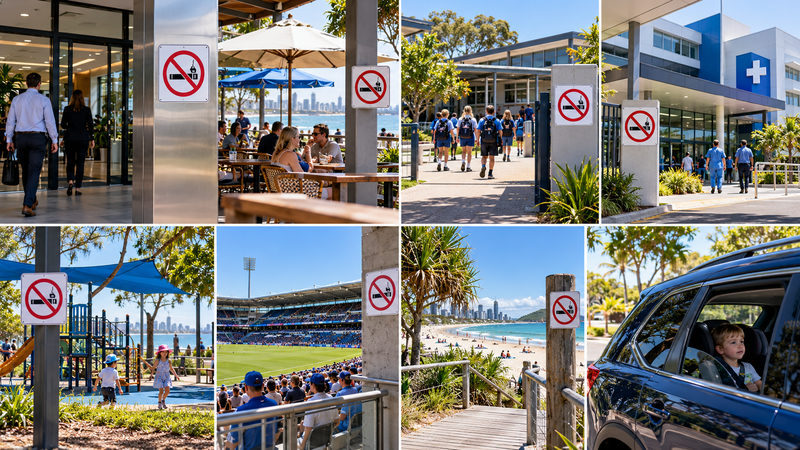
Major smoke-free indoor and facility-based locations include:
- Enclosed workplaces and enclosed public places.
- Enclosed areas of cafés, restaurants, pubs, and clubs.
- Schools, school car parks, and early childhood facilities.
- Hospitals, healthcare facilities, and residential aged-care facilities.
- Enclosed common areas of multi-unit residential accommodation.
- Public transport vehicles and other locations covered by transport rules.
- Major sports facilities and declared major event facilities.
Schools and early childhood facilities stay smoke-free outside their normal operating hours. The restriction still applies on weekends and during holidays. It covers students, parents, employees, volunteers, visitors, and community groups using the grounds. In other words, an empty school oval on a Sunday is not automatically a lawful place to vape.
Healthcare restrictions often go beyond the building itself. Smoking and vaping are prohibited on relevant facility land and within the required boundary buffer. For many health facilities in Queensland, that buffer extends five metres beyond the boundary. Residential or business premises inside certain buffers may qualify for statutory exceptions.
Outdoor places and buffer zones
Outdoors does not always mean vaping is allowed. Queensland protects many open-air places where families, crowds, and workers gather. Local governments can create additional smoke-free public spaces too. Signs are useful, but the absence of one does not necessarily mean vaping is lawful.
Important outdoor restrictions include:
- Outdoor eating and drinking areas, including prescribed nearby buffers.
- Public transport waiting points and five metres beyond them.
- Within five metres of non-residential building entrances.
- Outdoor pedestrian malls and designated government precincts.
- Public swimming facilities and specified outdoor swimming areas.
- Within ten metres of public children’s playground equipment.
- Skate parks and the ten-metre surrounding area.
- Patrolled beach areas between the red and yellow flags.
- Outdoor markets and five metres from marked entrances or exits.
- Protected areas within national parks.
- Organised children’s activities and under-18 sporting events.
At a bus stop, the ban covers both the waiting point and the five-metre buffer around it. It may also extend along the entire queue, even when some people are standing farther away. Outdoor-market restrictions apply during setup and pack-down as well. A market can establish a compliant smoking-only area, but food is not allowed inside it.
In national parks, restrictions apply at campsites and within ten metres of certain public facilities. These can include picnic tables, barbecues, toilets, shelters, jetties, and boat ramps. Organised youth activities also receive ten-metre protection around activity, viewing, and playing areas. The rules may apply during training and breaks, not just formal competition.
Venues, vehicles, and practical boundaries
A café courtyard may feel completely open and still count as an outdoor eating area. A customer cannot assume vaping is permitted simply because there is no roof over the tables. Some licensed venues may provide compliant designated outdoor smoking areas. Their location and operation, however, must meet detailed legal requirements.
Queensland also bans vaping in a vehicle when a child under 16 is inside. The purpose is to protect children from exposure in a confined space. Opening a window makes no difference. Police and authorised health officers can enforce the restriction if they witness the conduct.
At a major sports facility, the vaping ban may cover the whole declared facility. Some roads, car parks, picnic areas, or parkland may sit outside that particular restriction. Even so, another law, venue condition, or event rule could still apply. Visitors should pay attention to signs and follow directions from authorised venue staff.
Boundaries can be confusing around mixed-use properties. In defined circumstances, a five-metre buffer may end where residential or business premises begin. The precise rules also vary between schools, transport points, markets, and building entrances. Unsure where the line falls? Move well away and check the relevant Queensland Health guidance.
4. Vaping in Apartments, Rentals and Shared Properties
Private homes versus common areas
Queensland’s statewide smoking law does not generally ban vaping inside a detached private home. Nor does it automatically prohibit vaping inside a private apartment, courtyard, veranda, or balcony. That only describes the general public smoking restriction, though. Leases, body corporate rules, nuisance law, and workplace duties may impose stricter limits.
Vaping is banned in enclosed common areas of multi-unit residential accommodation, such as enclosed foyers, lifts, hallways, and stairwells. The statewide ban does not automatically extend to outdoor pools, paths, or car parks. A valid body corporate by-law may still prohibit smoking and vaping in those places.
Consider a tenant who vapes on a private balcony every evening. That balcony may sit outside the general statewide ban. But what if vapour repeatedly drifts into a neighbour’s bedroom? Within a community titles scheme, regular second-hand smoke exposure may amount to a nuisance, hazard, or unreasonable interference.
Additional property and workplace controls
Bodies corporate may adopt by-laws that restrict smoking on common property and in certain outdoor areas. The rules can cover car parks, shared gardens, pool areas, and balconies. Residents should therefore read the registered by-laws rather than relying on statewide guidance alone. Owners should clearly explain any restrictions to tenants and their guests.
A tenancy agreement may include no-smoking conditions that also cover vaping. Breaching a valid condition can have tenancy consequences, even if public health law otherwise permits private use. Landlords and agents must still follow the proper notice and dispute processes. They should not jump straight to assumptions about eviction or property damage.
Mixed residential and commercial properties can also be subject to workplace rules. A manager’s office, reception area, maintenance room, or staff space may count as a workplace. Employers must manage health and safety risks that affect workers. People working from home should also consider whether employees or clients enter the property.
Property managers should record complaints, establish exactly where the conduct occurred, and check the relevant governing instrument. Residents can document dates and practical effects without turning the matter into a confrontation. Serious or repeated disputes may need tenancy, body corporate, or legal advice. Public smoking law cannot settle every disagreement between neighbours.
5. Illegal Vape Sales, Penalties and Enforcement
Who may supply vaping goods?
Only participating pharmacies may lawfully supply therapeutic vapes to consumers through the relevant clinical pathway. Ordinary retailers cannot sell any vape, even one labelled nicotine-free. A smoking-product licence does not allow tobacconists, vape shops, convenience stores, or service stations to sell vapes. Nor does a Queensland retail licence override the national pharmacy-only system.
Calling a payment a membership fee or donation does not help a retailer avoid the ban. Supplying a free vape with another purchase may still count as supply. Online orders, delivery services, social media sales, and stock kept off-site can also attract attention from authorities. Employees should not assume that responsibility rests entirely with management.
Pharmacies face strict conditions as well. They cannot operate like ordinary recreational vape shops. Products must be compliant, stored behind the counter, and supplied through the correct consultation or prescription pathway. Pharmacists must also meet the relevant requirements for age, quantity, strength, documentation, and professional practice.
Different conduct attracts different penalties
The consequences depend on which law was breached, who was involved, and the scale of the conduct. Importing products unlawfully is different from selling one at retail. Commercial possession, advertising, supply to a child, unlicensed activity, and vaping in a prohibited place are distinct offences. A single investigation may therefore uncover several alleged breaches.
Possible consequences include:
- Warnings and on-the-spot infringement notices.
- Seizure and destruction of illicit products.
- Improvement notices or other compliance directions.
- Short-term administrative closure orders.
- Longer court-ordered closures in serious cases.
- Civil penalties or criminal prosecution.
- Imprisonment for serious Commonwealth offences.
- Licence consequences for regulated businesses.
Queensland often states fines in penalty units. The monetary value of a penalty unit can change through periodic adjustments. As a result, a dollar amount copied today may not remain accurate. Businesses and individuals should check the current penalty table before making decisions or responding to a notice.
Serious offences involving unlawful supply or commercial possession can attract substantial national penalties. Commercial-quantity thresholds may begin at nine devices, 60 accessories, or 400 millilitres of liquid. Reaching one of those thresholds does not by itself establish every element of an offence. On the other hand, remaining below a threshold does not make retail sales lawful.
Inspections, seizures, and reporting
Queensland Health environmental health officers inspect relevant premises and investigate complaints. Where legislation allows, they may issue warnings, fines, improvement notices, and closure orders. Officers can also seize prohibited products and begin legal proceedings. Police have additional powers involving children, vehicles, illicit nicotine products, and unlawful supply.
At the Commonwealth level, enforcement agencies include the Therapeutic Goods Administration and Australian Border Force. Border officers may intercept prohibited imports, while national regulators handle advertising and supply-chain breaches. State authorities generally take the lead on retail and wholesale enforcement. Agencies may share information and carry out coordinated operations.
Someone approached while vaping in a prohibited location may be required to provide accurate identifying details. Businesses should retain invoices, staff records, consultation documents, and supply information. For complex allegations, however, they should get legal advice before responding. Moving or destroying suspected stock may make matters worse.
Possible breaches can be reported to Queensland Health through 13 QGOV, using 13 74 68. A report might involve unlawful sales, illicit possession, licensing breaches, or vaping in a protected place. Transport-related complaints may need to be directed to the relevant transport authority. The authorities will decide whether the evidence justifies an inspection, seizure, fine, or prosecution.
A community report does not guarantee immediate action or a publicly disclosed result. Investigations may involve surveillance, product testing, financial records, and cooperation between agencies. A brightly packaged vape marked “nicotine-free,” for example, may still contain nicotine. Enforcement officers do not simply take a retailer’s label at face value.
6. Practical Compliance, Health Support and Reliable Advice
Actions for users and organisations
Users should purchase only from a participating pharmacy and retain proof of lawful supply. Before using a product, they should check the boundaries of any smoke-free area. Travellers also need to review border exemptions before bringing vapes into Australia. An exemption may restrict the number of devices and accessories, the volume of liquid, and the intended therapeutic use.
Parents should speak with a doctor, nurse practitioner, or pharmacist about a young person’s dependence. Buying products informally for them is not the answer. Retailers, meanwhile, should remove unlawful stock from sale and seek guidance on compliant disposal. Putting products out of sight behind a counter does not make their possession or supply legal.
Pharmacists should verify the notified product, the patient’s eligibility, its strength and quantity, and the appropriate access pathway. Employers should address vaping in workplace smoking policies and mark restricted areas clearly. Property managers should also compare the legislation with tenancy agreements and body corporate by-laws. Good signage and consistent records can head off avoidable disputes.
Health support and dependable guidance
Vaping products can lead to nicotine dependence and carry other health risks. They are not the first treatment choice for everyone trying to quit. Users should discuss approved medicines, behavioural support, and a clear endpoint for treatment. Confidential quitting support is available from Quitline on 13 78 48.
Rules, penalty values, product standards, and notified product lists can change. For location and enforcement rules, check Queensland Health; for supply requirements, consult the Therapeutic Goods Administration. A pharmacist or doctor can provide personal health guidance. This guide offers general information rather than individual legal or medical advice.
Conclusion
Queensland controls where every vape can be used, whether or not it contains nicotine. National law, meanwhile, restricts lawful consumer supply to compliant therapeutic products from participating pharmacies. Age, prescription status, product strength, quantity, retail conduct, and location must each be considered separately. Personal possession is not permission to sell, supply, or vape anywhere.
Before buying, supplying, storing, or using a vape, check the latest guidance from Queensland Health and the Therapeutic Goods Administration. Seek legal advice if the issue involves enforcement, business stock, tenancy, or a property dispute. For help with quitting, contact a pharmacist, doctor, or Quitline. As the rules change, current professional advice remains the safest way forward.