A nearby vape cloud may vanish in seconds, but does that mean the aerosol—and the risk—has disappeared? Second-Hand Vape Aerosol: What Are the Risks? is a relevant question anywhere people share indoor air. Unfortunately, the familiar claim that it is “harmless water vapor” leaves out some important facts.
E-cigarettes release more than water into the surrounding air. An open window may dilute those emissions, but it cannot remove every particle, gas, or deposit left on surfaces. Knowing what the evidence shows can help families, workers, landlords, and schools make safer decisions.
1. What Is Second-Hand Vape Aerosol—and Is It Just Water Vapor?
Second-hand vape aerosol consists of emissions that people nearby may breathe after someone uses an electronic cigarette. Most exposure comes from the aerosol the user exhales. Some devices may also release small amounts directly into the air during or between puffs.

How e-cigarettes create aerosol
An electronic cigarette uses a battery-powered coil to heat liquid stored in a cartridge, pod, or tank. The liquid usually contains propylene glycol, vegetable glycerin, flavorings, and sometimes nicotine. When heated, it produces gases and tiny droplets that combine into an inhalable aerosol.
So, the visible cloud is not simply harmless water vapor. It may contain suspended liquid droplets, ultrafine particles, nicotine, flavoring chemicals, and compounds created by heat. Some of these components remain invisible after the cloud itself has disappeared.
How other people become exposed
Anyone nearby can inhale airborne emissions simply by breathing. Substances may also settle on floors, furniture, clothing, toys, bedding, and the interiors of vehicles. Touching this residue later creates another possible route of exposure.
A child, for example, might touch a contaminated table and then put their fingers in their mouth. Activity can also disturb contaminated dust and send it back into the air, where someone may inhale it. Researchers still need more evidence, however, to understand the health significance of these indirect exposures.
Passive exposure is not the same as using a vape directly. Nor is it the same as swallowing e-liquid, sustaining a battery burn, or being injured by an exploding device. Those are separate hazards that may require poison-control guidance or emergency treatment.
2. Second-Hand Vape Aerosol: What Are the Health Risks?
Indoor vaping can reduce air quality and expose non-users to substances they otherwise would not breathe. Measurements taken after vaping indoors have detected nicotine, particulate matter, and other chemicals. For that reason, public-health agencies do not describe these emissions as harmless water vapor.
Possible short-term effects
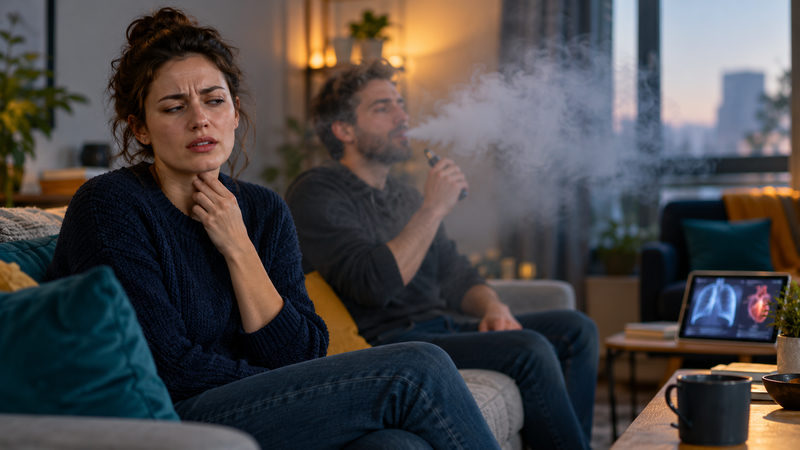
After being near someone who is vaping, some people report irritated eyes, a sore throat, nasal discomfort, or coughing. Others experience headaches, dizziness, nausea, chest discomfort, or trouble breathing. The symptoms—and their severity—can vary considerably.
Of course, these symptoms do not automatically prove that vape aerosol was responsible. Infections, fragrances, anxiety, cleaning products, allergens, and outdoor pollution may cause similar reactions. Still, symptoms deserve attention if they begin during exposure and ease after the person leaves.
Respiratory concerns
Airway irritation is especially concerning for people whose lungs are sensitive or already damaged. Aerosol particles, scents, and reactive chemicals may trigger coughing, tightness, or wheezing. Exposure may also bring on or worsen symptoms in people with asthma or chronic obstructive pulmonary disease.
Imagine someone with asthma entering a small room where another person recently vaped. The cloud may no longer be visible, yet lingering irritants could still cause discomfort. That person’s established asthma action plan can help determine what to do next.
Heart, blood vessel, and nervous system concerns
Nicotine can affect the heart rate, blood pressure, blood vessels, and nervous system. Ultrafine particles and certain chemicals may also contribute to irritation, inflammation, or oxidative stress. Researchers are continuing to investigate the possible cardiovascular and neurological effects.
Finding a biological response, though, does not prove that passive vaping causes a particular disease. Exposure measurements reveal what entered the environment or body. Biological studies, by comparison, look for changes such as inflammation, altered heart rate, or impaired blood-vessel function.
What the evidence can establish
An association means that an exposure and an outcome occurred together more often in a study. That alone does not always show that one caused the other. Researchers must account for existing illnesses, behavior, other exposures, and possible measurement errors.
Establishing clinical outcomes requires stronger evidence gathered from appropriate populations over suitable periods of time. E-cigarettes are relatively recent products, and the devices change quickly. As a result, long-term research into repeated passive exposure remains limited and is still developing.
No single study can represent every device, liquid, room, or vaping pattern. Current evidence supports avoiding unnecessary exposure, particularly for vulnerable people. It does not show that every brief encounter will cause illness.
3. Chemicals, Nicotine, Particles, and Metals in Vape Aerosol
The composition of vape aerosol varies, but researchers repeatedly identify several broad groups of substances. They include nicotine, small particles, solvents, flavorings, volatile compounds, carbonyls, and metals. Concentrations can differ greatly from one device to another—and even from puff to puff.

Nicotine, solvents, and ultrafine particles
When a nicotine-containing liquid is used, non-users may absorb nicotine from second-hand emissions. The amount is generally different from direct vaping and depends heavily on the surrounding conditions. Even so, avoidable nicotine exposure is most concerning for children, pregnant people, and individuals with certain health conditions.
Vaping can release fine and ultrafine particles as well. Because they are so small, some can travel deep into the lungs. Particle counts may climb quickly when someone vapes repeatedly in a small room or vehicle.
Propylene glycol and vegetable glycerin are the base ingredients in many e-liquids. Manufacturers add flavoring chemicals to produce fruit, mint, dessert, or tobacco tastes. But a substance considered suitable for eating may behave very differently after it is heated and inhaled.
Volatile compounds and heat-generated chemicals
Researchers have found volatile organic compounds in some e-cigarette emissions. Heating solvents and flavorings may also create carbonyls, including formaldehyde, acetaldehyde, and acrolein. These compounds can irritate tissue, although measured amounts vary widely among products and testing conditions.
Some unwanted chemicals may form in larger amounts at higher coil temperatures. An old coil, or one that is not receiving enough liquid, may overheat the liquid and produce a harsh “dry puff.” Actual exposure depends partly on whether users notice and avoid these unpleasant conditions.
Metals and device materials
Metals can enter the aerosol from heating coils, solder, electrical connections, and other device components. Studies have identified nickel, chromium, lead, iron, copper, tin, and zinc in certain products. The metal involved and its concentration, however, depend on the device’s design, condition, and manufacturing quality.
What enters the air is shaped by several practical factors:
- Device power, resistance, temperature, and coil condition
- E-liquid ingredients, acidity, flavorings, and nicotine concentration
- Puff length, puff frequency, and the user’s inhalation style
- Distance from the user and time spent in the room
- Room size, ventilation, surfaces, and total vaping frequency
Disposable devices, refillable systems, and nicotine-salt pods may therefore produce different emissions. Modified, counterfeit, contaminated, or illicit products introduce additional, unpredictable risks. Findings from one model cannot reliably describe every product available on the market.
4. Vape Aerosol Versus Cigarette Smoke: Lower Is Not Risk-Free
Cigarettes use combustion to burn tobacco, paper, and additives. E-cigarettes, on the other hand, heat liquid without burning tobacco. That basic distinction produces different emission profiles and different forms of environmental contamination.
Cigarette smoke contains thousands of chemicals released or produced during combustion. A burning cigarette also gives off smoke continuously between puffs. Most e-cigarette emissions, meanwhile, enter the room when the user exhales, though this can vary by device and pattern of use.
Understanding relative exposure
Vape aerosol may contain lower levels of many combustion-related toxicants than cigarette smoke. But the comparison changes with the product, liquid, device settings, puffing behavior, and measurement method. Lower levels of certain toxicants do not make passive vaping harmless.
A room with less carbon monoxide than a smoke-filled room, for instance, may still contain nicotine and particles. Researchers have not established a universal safe threshold for the mixture as a whole. Looking at only one chemical can miss other important differences.
Scientists have investigated second-hand cigarette smoke for several decades and across large populations. Long-term population evidence on passive vaping is far less complete. The products also evolve faster than researchers can study their lifetime effects.
That uncertainty is not a good reason to allow unrestricted vaping indoors. The practical response is straightforward: keep both cigarette smoke and e-cigarette aerosol out of enclosed shared spaces. This protects non-users without suggesting that the two emissions are identical.
5. Who Is Most Vulnerable to Passive Vaping?
Anyone who shares the air can be exposed, but certain people need greater protection. Their bodies may take in a larger dose relative to their size, or they may react more strongly. Some also have little ability to leave the affected space.
Infants, children, and pregnancy
Children’s lungs are still developing, and they often breathe faster than adults. Because their bodies are smaller, the same environment can deliver a larger relative dose. Infants also spend considerable time near floors and frequently put their hands in their mouths after touching surfaces.
Residue can collect on the toys, carpets, blankets, and furniture where children play. Vaping in another room is therefore not a reliable safeguard. A closed door might slow the movement of emissions, but they can still pass through gaps and shared ventilation.
Vaping around pregnant people is not considered safe. Nicotine can interfere with fetal brain and lung development, while the aerosol may contain other potentially harmful substances. A nicotine-free label does not guarantee that a product produces no emissions.
People with existing health conditions
Particles, fragrances, and chemical irritants may affect people with asthma. Those living with chronic bronchitis, emphysema, or other lung diseases may have less breathing reserve. Even brief airway irritation can therefore cause more serious distress.
Exposure to nicotine and particulates is also a concern for people with heart or cardiopulmonary conditions. Older adults may have several health issues that make them more sensitive. Still, individual risk varies with health status, exposure intensity, and treatment.
People facing repeated exposure
Employees, students, tenants, caregivers, and healthcare workers may face frequent exposure. A tenant, for example, might repeatedly encounter emissions traveling through a hallway or shared ventilation system. A worker may not be able to step away every time a customer vapes.
Stronger protections matter most in places such as:
- Cars and other enclosed vehicles
- Small rooms and poorly ventilated buildings
- Schools and childcare facilities
- Hospitals, clinics, and care homes
- Shared housing and indoor workplaces
In these settings, repeated use can add fresh emissions before earlier material has cleared. The occupants may also include children or people with serious health conditions. Fully vape-free rules offer clearer, more consistent protection than case-by-case requests.
6. How Long Aerosol and Third-Hand Vape Residue Remain
A visible cloud may disappear within seconds or minutes, but sight is not a reliable measure of safety. Smaller particles and gases can stay in the air after the plume is gone. How long they persist depends on airflow, room volume, surfaces, device output, and vaping frequency.
What happens in indoor air
One puff in a large, well-ventilated room may disperse more quickly than repeated vaping inside a car. Yet dilution is not the same as immediate removal. Some substances exit through ventilation; others settle, react, evaporate, or remain suspended.
With repeated vaping, indoor concentrations may rise because new emissions enter before older ones have cleared. Several people vaping in a small room, for example, can create a visible haze. Even when no haze appears, instruments may detect particles or chemicals above normal background levels.
Understanding third-hand vape residue
Third-hand vape residue refers to substances left behind on surfaces and in dust after vaping. Nicotine and other components may settle on walls, floors, clothing, upholstery, toys, bedding, and vehicle interiors. Some deposited chemicals can later re-enter the air.
People may absorb residue through skin contact or inhale it in contaminated dust. Hand-to-mouth transfer offers another route, particularly for infants and young children. Researchers are still working to determine how much ordinary residue contributes to health risks.
That uncertainty is no reason to disregard residue. Surfaces touched often should be cleaned after repeated indoor vaping. Better yet, prevent indoor emissions in the first place; contaminants are difficult to remove from carpets, fabric, and vehicle upholstery.
Why ventilation and filters have limits
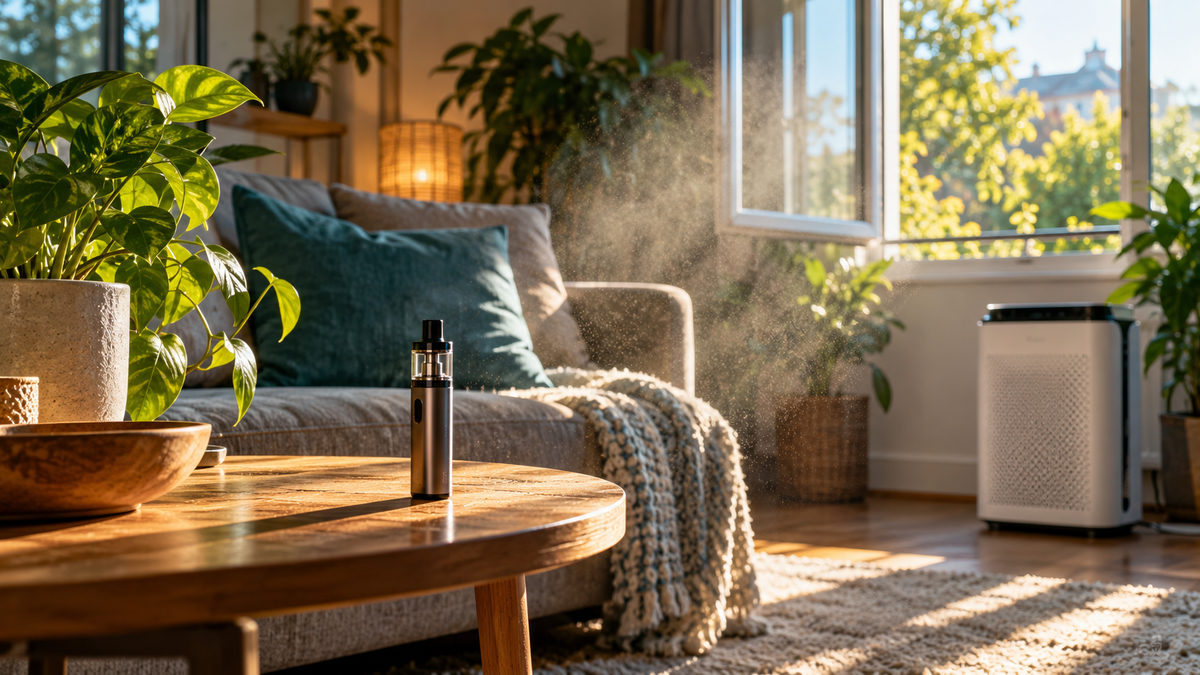
Under favorable conditions, open windows and fans can dilute aerosol. HVAC systems may remove some material, though they can also carry it elsewhere. These methods do not reliably prevent exposure and may spread emissions into adjoining rooms.
Setting aside one indoor room for vaping has the same basic problem. Air escapes through doors, cracks, ducts, and pressure differences. Simply separating users cannot guarantee protection unless contaminated air is fully exhausted outdoors.
Air purifiers fitted with suitable particle filters may lower the amount of some airborne particles. Even so, typical consumer units may not capture gases or stop deposits from forming on surfaces. Nor can they remove nicotine already lodged in dust, fabric, or porous materials.
The U.S. Environmental Protection Agency advises that the only way to eliminate second-hand aerosol exposure is to prohibit vaping inside or near enclosed spaces. Ventilation and filtration may reduce pollutants, but they are unlikely to remove them entirely. Air cleaning should complement vape-free rules, not take their place.
7. How to Reduce Exposure and Respond to Symptoms
A completely vape-free indoor environment offers the strongest protection. The rule should cover homes, cars, schools, workplaces, rental properties, and healthcare settings. Ask users to vape outdoors and away from doors, open windows, and air intakes.
Actions for families and organizations
Do not vape near children, pregnant people, or anyone with heart or lung disease. After heavy exposure, changing outer clothing may help reduce contact with residue. Users should also wash their hands before holding infants or touching children’s belongings.
Clean frequently touched surfaces in places where indoor vaping has occurred. Use cleaning methods that are safe for the material, and never mix household chemicals. Cleaning, however, does not make continued indoor vaping acceptable because porous items can retain contaminants.
Schools, employers, landlords, and healthcare facilities have several ways to protect people:
- Create a clear written policy covering vaping and smoking
- Post visible signs at entrances and shared areas
- Apply rules consistently to employees, visitors, and residents
- Offer confidential methods for reporting repeated violations
- Provide respectful cessation support for people who vape
What to do after unwanted exposure
If possible, leave the affected area and move into fresh air. Avoid further exposure, then watch for changes in symptoms. Anyone with asthma or another respiratory condition should follow their personal action plan and use prescribed treatment.
Speak with a healthcare professional if coughing, wheezing, headaches, nausea, chest discomfort, or breathing problems persist or worsen. Be specific about when the exposure happened, how long it lasted, and whether the symptoms improved somewhere else. Those details can help with the clinical assessment.
Severe breathing difficulty, blue or gray lips, fainting, confusion, intense chest pain, or a serious asthma attack requires emergency care. Do not simply wait and hope the symptoms pass. While emergency assistance is on the way, use prescribed rescue medication as directed.
Swallowing e-liquid, getting a large amount on the skin or in the eyes, and suffering battery burns are separate emergencies. Contact poison-control or emergency services for the right instructions. These incidents should never be handled as routine second-hand aerosol exposure.
Conclusion
Second-hand vape aerosol is more than harmless water vapor. It can release nicotine, ultrafine particles, volatile compounds, flavoring chemicals, carbonyls, and metals into indoor air. Material deposited by the aerosol may also remain on surfaces long after the visible cloud has gone.
This exposure differs from second-hand cigarette smoke and may include lower levels of many toxicants associated with combustion. Lower, however, does not mean harmless, and researchers are still studying the long-term effects. Prevention is especially important around children, pregnant people, and those with heart or lung conditions.
Keep shared indoor spaces and vehicles completely vape-free. Talk with a healthcare professional about persistent symptoms linked to exposure. When setting policies for homes, schools, workplaces, healthcare facilities, or rental properties, rely on guidance from authoritative public-health sources.