Can you really trust the first search result when Australian vaping rules vary by product, activity, location, and user? Learning How to Check Official Australian Vaping Regulations takes more than reading a retailer’s explanation. Federal restrictions can also apply alongside separate state or territory laws.
Consumers, travellers, and businesses often mix up these different legal layers. Even an older government page may describe rules that have since changed. This guide sets out a practical, repeatable way to find, verify, and record requirements using primary Australian government sources.
This information is general regulatory guidance, not legal advice. Before buying, importing, possessing, supplying, or using a vape, check the rules for your specific circumstances. High-risk business decisions may also call for professional legal or regulatory advice.
1. How to Check Official Australian Vaping Regulations
Define the question before searching
First, identify the activity you need to check. The rules for purchasing or possessing a vape may differ from those governing importation or advertising. Be specific: does your question involve prescribing, pharmacy supply, use, manufacture, wholesale distribution, retail sale, or something else?

Next, define the product rather than treating “vape” as a catch-all term. Are you dealing with a device, accessory, pod, cartridge, liquid, or another vaping substance? Record whether it contains nicotine, is disposable, has a therapeutic purpose, or contains cannabis.
Then establish who is involved and which jurisdiction applies. A traveller, for example, may encounter border controls that do not affect an ordinary pharmacy customer. Pharmacists, prescribers, retailers, importers, wholesalers, minors, and adult consumers may all face different requirements.
Work from government guidance to legislation
Start with the TGA Vaping Hub and the Australian Government health department. Both explain the national framework and point readers to more detailed requirements. Retailer pages, forums, social posts, and search snippets, however, are not legal authority.
Check when every official page was published or last updated. Look at its page history, commencement dates, transitional arrangements, and linked legal instruments as well. A page may remain online after a temporary arrangement has expired, so context is crucial.
Follow any legislative links to the Federal Register of Legislation. Confirm that the relevant Act, regulation, standard, scheduling decision, or exemption is still in force. Use the current compilation, not an older copy saved or downloaded elsewhere.
Cross-check and document the result
Commonwealth guidance seldom answers every local question. Cross-check it with the relevant state or territory health department and medicines regulator. If your question involves possession, pharmacy practice, or public use, review local smoke-free legislation too.
Finally, make a brief research record that someone else could follow. Save the official URL, access date, jurisdiction, product category, activity, and legislative instrument. Include any quantity limit, commencement date, exception, or question that remains unresolved.
- Activity: Buying, supplying, importing, possessing, using, advertising, manufacturing, or selling.
- Product: Device, accessory, substance, disposable product, therapeutic product, or cannabis-related product.
- Person: Consumer, minor, traveller, pharmacist, prescriber, retailer, importer, or wholesaler.
- Location: The applicable state, territory, border entry point, and intended place of use.
- Evidence: Current government pages, legislation, legal instruments, dates, and written regulator advice.
Guidance pages make the law easier to understand, but they are not a substitute for the legislation itself. A linked standard or exemption may contain a decisive detail omitted from the summary. Get qualified advice when an error could lead to serious financial, licensing, health, or criminal consequences.
2. Which Government Authorities Regulate Vaping in Australia?
Commonwealth regulators
The Commonwealth framework covers a range of national activities involving vaping goods, including importation, manufacture, commercial possession, supply, advertising, and therapeutic-goods requirements. Different provisions may apply to the device, the liquid inside it, and the material used to promote it.

The Therapeutic Goods Administration, or TGA, oversees therapeutic vaping goods and their product standards. It maintains the notified vape list and publishes guidance for pharmacists, prescribers, suppliers, and consumers. The TGA also carries out compliance work and accepts reports of suspected unlawful supply or advertising.
The Department of Health, Disability and Ageing publishes national public-health information and explains vaping reforms. Its official vaping pages are useful for understanding the broader policy framework. For practical details, though, follow its references to the TGA and current legislation.
Border and local authorities
Australian Border Force explains the controls that apply when goods cross the Australian border. The Office of Drug Control, meanwhile, provides information about relevant import licences and permissions. Travellers and importers should consult both before ordering goods or entering Australia.
State and territory authorities regulate areas that overlap with the national framework. They may set rules for medicines, poisons, pharmacy practice, prescribing, dispensing, age-related access, and possession. They also administer many tobacco-control, smoke-free, licensing, and local enforcement requirements.
Federal guidance might, for example, describe a national pharmacy pathway for adults. A state law can still add another condition within that jurisdiction. These sources often govern different legal layers, so an apparent difference is not necessarily a contradiction.
If two sources seem inconsistent, compare the activities, products, jurisdictions, and update dates they cover. Open their legislative links and identify the provision that applies to your circumstances. If significant uncertainty remains, ask the responsible regulator for written clarification.
- Use the TGA for therapeutic goods, standards, notified products, advertising, and national compliance guidance.
- Use the federal health department for national policy, reform summaries, and public-health information.
- Use Australian Border Force for border procedures and accompanied-baggage information.
- Use the Office of Drug Control for relevant import permissions and permit requirements.
- Use state or territory regulators for pharmacy, medicines, possession, licensing, and smoke-free rules.
3. Pharmacy Access, Prescriptions and Legal Vape Products
Understanding pharmacy-only access
Therapeutic vaping goods intended for smoking cessation or nicotine-dependence management can enter lawful patient supply only through participating Australian pharmacies. Federal requirements apply alongside the rules of the relevant state or territory. Simply finding a product for sale at an ordinary retailer does not make access lawful.

An adult aged 18 or older may be able to obtain an eligible pharmacist-only therapeutic vape without a prescription. The product must contain no more than the applicable pharmacist-only nicotine threshold, currently 20 mg/mL. State or territory law must also allow the supply, and the customer must have an in-person consultation with a pharmacist.
The pharmacist decides whether supply is clinically appropriate for smoking cessation or nicotine-dependence management. The consultation may cover current use, treatment options, dosage, and safety. The customer must also meet the identity and age requirements tied to the supply process.
A prescription is still required in several circumstances. This includes products above the pharmacist-only nicotine threshold and some patients with more complex clinical needs. Local legislation may also require a prescription even where the broader Commonwealth pathway would otherwise allow supply.
Rules for minors and prescribed products
People under 18 generally need a prescription under the Commonwealth access pathway. That prescription does not automatically guarantee lawful supply in every jurisdiction. Some states or territories may prohibit supply to minors or impose tighter conditions.
Medical and nurse practitioners may prescribe through the relevant pathways for unapproved therapeutic goods. Before dispensing, pharmacists must verify the prescription and confirm that the pathway requirements have been met. Patients should check local rules before booking an appointment or travelling to a pharmacy.
Do not choose a product based only on its advertised nicotine strength or flavour name. Check current TGA product standards and pharmacy guidance instead. These sources address permitted flavours, concentration limits, ingredients, packaging, labelling, device features, and finished-product requirements.
Using the notified vape list correctly
The TGA’s notified vape list lets users search for products by identifying details. Review the exact product name, sponsor, nicotine form, concentration, flavour, volume, and notification information. Compare the package being supplied with the listed entry; matching the brand alone is not enough.
Notification is not the same as ARTG registration or individual TGA approval. Sponsors generally notify the TGA that their goods meet the applicable minimum requirements. These notified unapproved products have not necessarily undergone independent assessment for safety, quality, efficacy, or performance.
Current TGA guidance states that no vaping goods for smoking cessation or nicotine-dependence management appear in the ARTG. Readers therefore need to understand the unapproved-goods pathways that govern notified products. Check this position again before making each new decision.
Being included on the notified list does not guarantee that a product will be available from a pharmacy. Pharmacists are not required to stock or supply therapeutic vapes. They must meet their professional obligations, assess clinical appropriateness, and follow jurisdictional law.
- Confirm that the pharmacy participates in therapeutic vape supply.
- Check whether the patient needs a prescription.
- Verify the exact product against the current notified vape list.
- Review nicotine concentration, flavour, volume, packaging, and labelling.
- Confirm additional state or territory conditions before supply.
4. Sales, Possession, Advertising and Product Restrictions
Retail and product restrictions
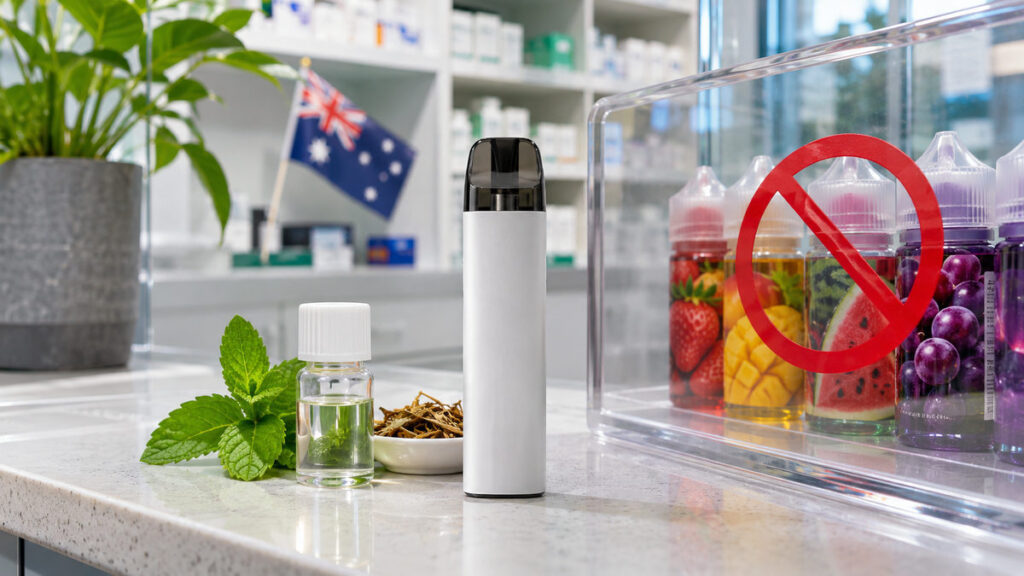
Tobacconists, convenience stores, service stations, and specialist vape shops generally cannot lawfully sell vaping goods. That includes vaping goods labelled nicotine-free. Lawful therapeutic supply, by contrast, takes place through participating pharmacies and is subject to clinical, product, and jurisdictional conditions.
National reforms prohibit affected non-therapeutic vaping goods and disposable vapes across several activities. The way a particular item is treated, however, can depend on definitions and limited exemptions. Check the current definitions and product-format standards in the TGA Vaping Hub before drawing a conclusion.
A “zero nicotine” label does not automatically place a product outside vaping regulation. Both nicotine and non-nicotine goods may fall within the national framework. Laboratory findings or the product’s design may also contradict the retailer’s description.
Possession and promotional activity
Personal possession is not the same as commercial possession, supply, or holding stock for sale. A small quantity kept for personal use may be treated differently from boxes stored behind a shop counter. Still, personal-possession offences and enforcement practices vary between jurisdictions.
A business cannot assume there is no advertising risk simply because no direct sale occurs. Restrictions may cover websites, social media posts, influencer campaigns, sponsorships, signs, displays, discounts, and promotional giveaways. Any exception for authorised communication is likely to have narrow wording and specific conditions.
A pharmacy, for example, may need to provide factual information about lawful access. That does not amount to broad permission for lifestyle promotion or public product displays. Businesses should review both therapeutic-goods advertising controls and any other advertising laws that apply.
Enforcement and reporting
Regulators have several possible enforcement responses, depending on the conduct and the law involved. These may include detention, seizure, forfeiture, infringement notices, civil proceedings, or criminal prosecution. Regulated businesses may also face consequences involving licences, registration, leases, or professional obligations.
Quoting a single penalty figure can be misleading because maximum amounts and offence provisions change. Penalties may also vary according to the person, company, conduct, and jurisdiction involved. Check the current legislation and regulator guidance for the specific alleged breach.
Suspected unlawful imports, supply, manufacture, or advertising can be reported through the TGA’s online non-compliance channel. Depending on the conduct, the right contact may instead be the state health regulator, police, consumer regulator, or local enforcement body. Keep receipts, photographs, dates, packaging, and precise location details.
- Do not treat a shop’s open display as evidence of legality.
- Do not rely on “nicotine-free” wording without checking the regulatory definition.
- Separate personal possession from commercial stock or supply.
- Review every promotional channel, including discounts and influencer content.
- Report suspected breaches to the authority responsible for that activity.
5. Imports, Overseas Orders and Rules for Travellers
Online orders and import controls
The general TGA Personal Importation Scheme is not a pathway for importing vaping products. A prescription does not necessarily make an overseas online order lawful. Sending the goods through the post may breach separate prohibited-import requirements.
Before ordering, review the current TGA import restrictions and the Customs (Prohibited Imports) Regulations. Check Australian Border Force guidance and Office of Drug Control permit information as well. An overseas seller’s promise of discreet delivery carries no legal weight.
Commercial importers may need licences, permissions, compliant goods, and supporting documents before a shipment leaves. The exact requirements depend on the product and the proposed activity. Nicotine, cannabis, medicines, and other regulated substances may also be subject to separate controls.
The accompanied-baggage pathway
A limited traveller exemption may apply when a person brings vaping goods in accompanied baggage for treatment. Current federal material sets limits of two vapes, 20 cartridges, capsules, or pods, and 200 mL of liquid. Recheck those limits immediately before travelling.
Make sure the goods meet the current conditions for product type, purpose, and quantity. They must travel in accompanied baggage and genuinely relate to treatment. Disposable cannabis vapes and other controlled substances may be governed by different traveller rules.
- Confirm that the goods meet the legal definition of vaping goods.
- Check that every item travels in accompanied baggage.
- Verify the current numerical and liquid-volume limits.
- Confirm that the purpose satisfies the treatment condition.
- Investigate separate medicine, cannabis, or controlled-substance restrictions.
Border officers may detain, seize, or refer undeclared, excessive, or otherwise unlawful goods for enforcement action. Keep the current ABF page and relevant TGA guidance handy while travelling. Save or print them shortly before departure, as conditions and permit requirements may change.
6. State and Territory Checklist and Vaping Law FAQ
Jurisdiction checklist
For each relevant jurisdiction, consult the official health department and medicines or poisons regulator. The jurisdictions are the ACT, New South Wales, Northern Territory, Queensland, South Australia, Tasmania, Victoria, and Western Australia. If supply happens in one place and possession in another, check both.
In each location, review the rules for pharmacy supply, prescribing, dispensing, and people under 18. Then look at personal possession, commercial possession, retailer enforcement, and any relevant licensing scheme. Record the exact page and legislation that supports every answer.
Smoke-free rules need their own location-specific check. They may apply to indoor workplaces, hospitality venues, public transport, schools, healthcare grounds, outdoor dining areas, events, and vehicles carrying children. The protected places and required distances are not identical across jurisdictions.
Other lawful restrictions may also govern vaping in a particular place. Councils, transport operators, employers, landlords, and venue managers can adopt additional rules. A policy may therefore prohibit vaping even where no general vaping offence applies.
Frequently asked questions
Where can I find the latest official Australian vaping regulations?
Start with the TGA Vaping Hub and the Department of Health, Disability and Ageing. For imports or travel, verify the information published by Australian Border Force. Then check the relevant state or territory government pages and current legislation.
Can adults legally purchase vapes?
Adults may be able to obtain eligible therapeutic goods through participating Australian pharmacies. Clinical, product, age, concentration, and jurisdictional conditions still apply. Sales through vape shops, convenience stores, service stations, or tobacconists are not a lawful alternative.
When is a prescription required?
Consider the patient’s age, nicotine concentration, product schedule, clinical circumstances, and local law. Products above the pharmacist-only threshold generally need a prescription. Minors also generally require one under the Commonwealth pathway, although stricter local rules may prohibit supply altogether.
Are disposable vapes illegal?
National restrictions prohibit disposable vapes across key importation, manufacture, and supply activities. Defined exemptions and legal product classifications may still affect a particular case. Check current TGA definitions and standards before deciding how the law applies to a specific item.
Can a person possess a vape?
That depends on the nature and purpose of the possession. A small amount held for personal use is different from commercial possession, stocking, supply, or keeping goods for sale. Always verify the legislation and official enforcement guidance for the relevant jurisdiction.
Where is vaping prohibited?
Check the state or territory’s smoke-free laws for the specific venue or location. Review policies issued by councils, transport operators, workplaces, schools, landlords, and event managers too. A venue rule can extend beyond the statutory prohibition.
How can a business verify compliance?
Check TGA industry guidance, product standards, notified-product status, and national advertising restrictions. Then review state rules covering licensing, medicines, pharmacies, possession, and retail activity. If an uncertain interpretation could materially affect operations, request written advice from the regulator.
The final verification test
Can every important conclusion be traced to a current government page or legal instrument? Do not rely on retailer claims, news reports, social posts, forums, or cached search text as legal authority. Make sure every source addresses the same product, person, activity, and jurisdiction.
Next, compare update dates, commencement provisions, definitions, and exemptions. If anything remains unclear, contact the regulator responsible for that activity. Keep its written response with your research record and note the date you received it.
Conclusion
Reliable vaping research takes more than locating a single government page. Begin by defining the product, activity, person, and jurisdiction. Then review TGA and federal health guidance, consult border information for imports, and verify local rules on pharmacies, possession, and smoke-free areas.
Before taking action, open the TGA Vaping Hub and record its update date and legislative links. Complete the relevant state or territory checks, along with any border checks your situation requires. Repeat the process whenever the product, activity, destination, or applicable law changes.