
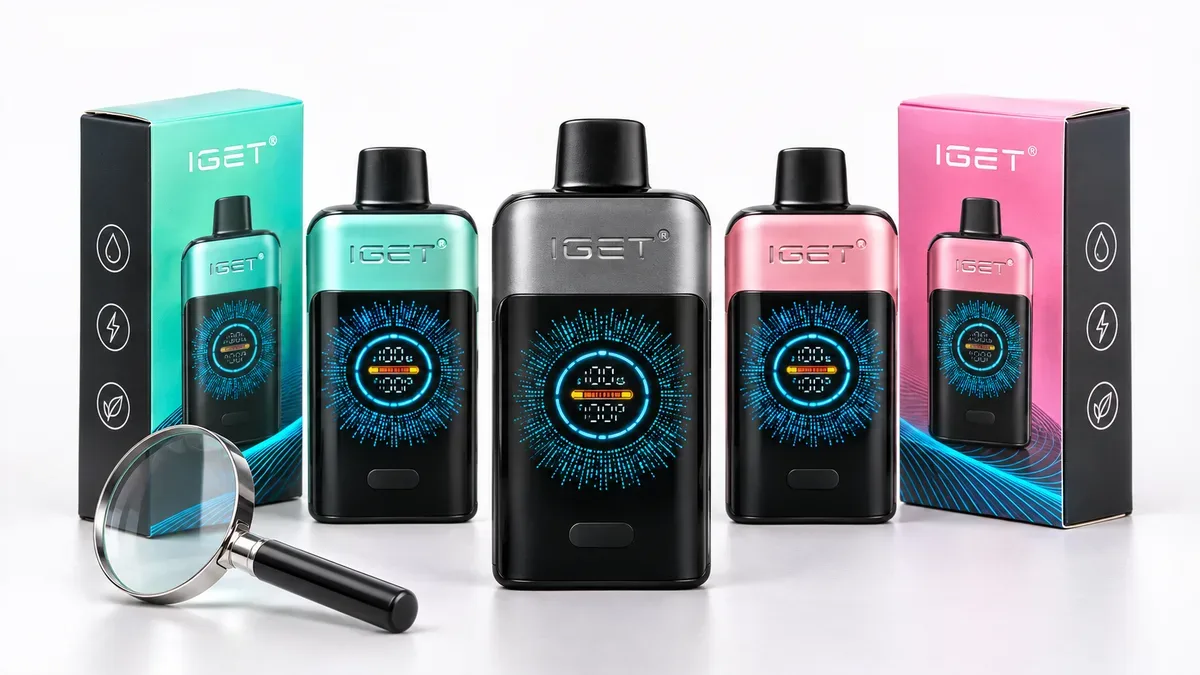
If one IGET Bar Pro 10000 Puffs listing says 5% and another says 50 mg/mL, do they mean the same thing? Understanding nicotine concentration claims starts with knowing what each number measures. However, a percentage can leave out its measurement basis, and a listing can leave out the exact variant. Meanwhile, the advertised puff count describes a different feature entirely.
A retailer’s strength claim, a package label, and a lab result can each answer a different question. Therefore, start with who made the claim and which device it covers. Then check whether the units match before drawing a conclusion about the package in front of you.
What Nicotine Strength Is Listed for the IGET Bar Pro 10000 Puffs?
What the manufacturer specifies
The manufacturer identifies the model as IGET BAR PRO and advertises it at 10,000 puffs. Specifically, the public product page repeats that count in its specification table. The table also gives dimensions, battery capacity, and coil type. However, it gives no nicotine concentration.

That omission matters when you compare information from several pages. For instance, a listing may reproduce the manufacturer’s model name and puff count, then add its own strength figure. Seeing those details together can make them look like they came from the same document. Therefore, check the source of each figure separately.
Likewise, the model name identifies a product range, while a package can identify a particular version within that range. A flavor name, product code, or batch number makes the identification more specific. In practice, those details become important when you want to connect an online claim to an individual unit.
Where the 50 mg/mL claim comes from
An Australia-facing retailer trading as Official IGET lists the Bar Pro 10000 at 50 mg/mL and describes it as nicotine salt. Elsewhere in the same guide, the retailer pairs 50 mg/mL with 5%. However, the guide does not explicitly identify the percentage as weight per volume or weight per weight.
Specifically, the retailer presents the concentration as a model-level claim across the flavor range it describes. The guide supplies no batch identifier or corresponding laboratory result for an individual unit. As a result, the claim tells you what the retailer reports for that range. The concentration of a particular unit remains open until you can match its variant and batch to supporting documentation.
For instance, suppose a package says “IGET BAR PRO” and shows the same 10,000-puff rating. Those details give you a starting point for identifying the model. However, the strength comparison still depends on the package’s nicotine statement and any identifiers that connect it to a specification. A matching model name alone leaves that part of the comparison unresolved.
When recording the claim, keep the source attached to the number. Write “50 mg/mL, retailer claim” alongside the model name and any variant information the page gives. Then record the manufacturer’s puff rating separately. This makes it easier to see which details you can confirm when another listing uses different wording.
How to Compare Nicotine Percentage With mg/mL
When the percentage means weight per volume
mg/mL means milligrams of nicotine per milliliter of e-liquid. The milligrams describe the nicotine, and the milliliters describe the liquid. Meanwhile, a percentage describes an amount per hundred, but the label needs to define what that hundred represents.
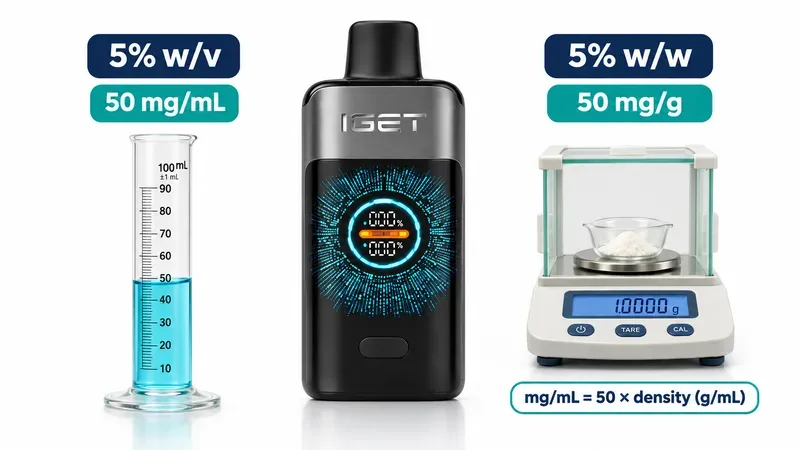
Specifically, 5% weight per volume, written 5% w/v, means 5 grams of nicotine per 100 milliliters of liquid. Since each gram contains 1,000 milligrams, 5 grams equals 5,000 milligrams. Therefore, dividing 5,000 milligrams by 100 milliliters gives 50 mg/mL.
For instance, a specification that explicitly says 5% w/v agrees numerically with one that says 50 mg/mL. Both express the same nicotine mass per volume of liquid. However, that conversion resolves only the units. You still need to match the product details before linking the two documents to the same device.
When the percentage means weight per weight
5% by weight, written 5% w/w, means 5 grams of nicotine per 100 grams of liquid. In this case, dividing 5,000 milligrams by 100 grams gives 50 mg/g. Therefore, converting to mg/mL requires the liquid’s density in grams per milliliter.
For instance, imagine a liquid with a density of 1.10 g/mL. Each milliliter of that hypothetical liquid would weigh 1.10 grams. Therefore, multiplying 50 mg/g × 1.10 g/mL gives 55 mg/mL. The density belongs to this worked example, and the sources reviewed provide no measured density for this IGET model.
Restek’s e-liquid analysis illustrates why laboratories account for density when comparing mass-based and volume-based figures. In practice, use a density documented for the liquid you are comparing. Without that input, you can report the original mg/g value and flag the volume-based concentration as unresolved.
How to read incomplete nicotine labels
However, a label that says only “5%” leaves the basis open. Look for w/v, w/w, or a manufacturer’s definition in the matching specification. Similarly, “50 mg” states a mass without specifying the volume or other quantity it refers to. Check whether the source means total nicotine, nicotine per milliliter, or an amount associated with another stated quantity.
Additionally, check what the number counts when one source uses the words “nicotine salt.” Ask whether both figures describe the mass of nicotine itself or whether one describes the mass of the salt compound. In practice, the two statements need a shared basis before their numbers can be compared directly. If the source skips that detail, record the wording as printed and keep the comparison open.
What the Advertised 10,000-Puff Count Tells You
What the product page reports
The manufacturer advertises 10,000 puffs for the IGET BAR PRO. That figure represents the advertised number of draws. However, the public specification table gives no puff duration, puff volume, or test protocol. Those details would help another tester reproduce the count under the same conditions.
For instance, two laboratory tests could count the same number of draws while using different durations for each draw. They could also pull different volumes of air through the device. Consequently, the count alone leaves out how the tests were run. The public table gives readers the advertised number without those test conditions.
Meanwhile, mg/mL describes the composition of the liquid before use. An advertised draw count gives no information about how many milligrams of nicotine each milliliter contains. Therefore, two devices could display the same puff rating and report different concentrations. The reverse can also happen when devices share a concentration but carry different puff ratings.
Why draw count cannot estimate nicotine intake
An experimental study measured nicotine in aerosol while varying puffing conditions, device voltage, and liquid nicotine concentration. Specifically, it found that puff duration and voltage affected nicotine yield under the conditions it tested. Here, yield means the amount of nicotine the researchers collected in the aerosol. The study reports findings for its experimental setup.
In practice, the amount of nicotine a device emits can change even when the liquid concentration stays the same. A puff count leaves out those changes. Moreover, measuring aerosol at the device does not establish how much nicotine a person inhales or absorbs. Those quantities require evidence about exposure during use.
Therefore, read “10,000 puffs” as the manufacturer’s advertised draw count. Use the concentration statement to compare the liquid, provided the units and variant match. For questions about nicotine exposure, look for measurements that specify the conditions and explain exactly what the researchers measured.
Nicotine Concentration, Total Nicotine, and Nicotine Inhaled per Puff
Concentration and total nicotine in the liquid
Nicotine concentration tells you how much nicotine the liquid contains per stated unit. Specifically, a 20 mg/mL concentration means 20 milligrams of nicotine per milliliter. Therefore, two devices can share the same concentration and contain different total amounts if their fill volumes differ.
For instance, imagine two generic devices with liquid labeled 20 mg/mL. One contains 2 mL, while the other contains 4 mL. The second holds twice as much liquid. As a result, it also holds twice as much nominal nicotine at the same concentration.
To calculate the nominal total, multiply the concentration in mg/mL by the documented fill volume in mL. For the first device, 20 mg/mL × 2 mL = 40 mg. The milliliter units cancel, leaving milligrams of nicotine. Here, nominal means the calculation uses the stated figures.
However, both inputs need to describe the same variant. A concentration from one listing and a fill volume from another can produce plausible arithmetic with mismatched inputs. For the Bar Pro 10000, the sources reviewed leave the nominal total unverified. A matched specification would need to give both the nicotine concentration and the actual fill volume.
What happens between the liquid and the bloodstream
During use, some nicotine in the liquid can enter the aerosol. Researchers can collect that aerosol and measure how much nicotine the device emits under a defined test protocol. Meanwhile, a person’s inhaled amount describes what they breathe in. The absorbed amount describes what enters their body.
For instance, the aerosol study measured emissions under controlled conditions. A separate human study measured nicotine concentration in blood plasma and also recorded how participants puffed. Specifically, the human study examined how liquid concentration and user experience influenced nicotine delivery. Its blood measurements describe exposure among the study participants under those conditions.
However, dividing 40 mg of nominal liquid nicotine by an advertised draw count would only spread that starting amount across hypothetical draws. It would assume the device emitted all that nicotine and divided it evenly among those draws. Furthermore, it would leave out how much aerosol a person actually inhaled and how much nicotine they absorbed.
Therefore, the quotient gives no reliable estimate of nicotine emitted, inhaled, or absorbed per puff. Each quantity needs evidence that measures or estimates it under defined conditions. When a report gives a number, check whether it refers to the original liquid, collected aerosol, or a measurement from a person.
Why Two Listings Can Show Different Nicotine Strengths
Check the units and product details first
Start by copying the strength exactly as each listing prints it. Specifically, keep the unit and any percentage basis alongside the number. Once both bases are clear, convert the figures to the same unit. Then check whether the displayed precision could explain a small difference.
For instance, 49.8 mg/mL corresponds to 4.98% w/v, which rounds to 5.0% w/v to one decimal place. Rounding can explain why those display values differ. However, rounding alone cannot resolve a discrepancy when one source leaves its units or percentage basis unspecified.
Next, compare the intended market, exact model, flavor, SKU, and packaging revision. A SKU is the code a seller or maker uses to identify a particular product version. Meanwhile, a reused photo, copied specification, omitted unit, or similar model name can cause an apparent conflict.
A market or formulation difference is also possible. However, treat it as a hypothesis until documentation identifies the versions and explains which strength applies to each. For instance, a retailer’s location tells you who publishes the page, but the packaging or specification can clarify the product’s intended market.
A comparison table you can copy
The entries below show two hypothetical mismatches. Specifically, the first pair describes the same example variant in different units. The second pair uses the same units for two different versions.
| Source | Intended market | Exact variant | Quoted strength | Measurement basis | Documentation date |
|---|---|---|---|---|---|
| Listing A | Market A | Example device, SKU A1, revision 2 | 5% w/v | Nicotine mass per liquid volume | Saved 4 March |
| Matching specification | Market A | Example device, SKU A1, revision 2 | 50 mg/mL | Nicotine mass per liquid volume | Issued 5 March |
| Listing B | Market A | Example device, SKU B1, revision 1 | 20 mg/mL | Nicotine mass per liquid volume | Saved 4 March |
| Matching specification for revision 2 | Market A | Example device, SKU B2, revision 2 | 30 mg/mL | Nicotine mass per liquid volume | Issued 5 March |
In the first pair, the unit conversion reconciles both figures, and the identifiers match. In the second pair, the SKUs and revisions differ, so the values apply to different named versions. Therefore, a package marked B1 would need documentation for B1. For a real comparison, record the full date and identify whether it marks publication, revision, or capture.
What to Check When the Packaging and Online Listing Disagree
Document the package and matching listing
Start with the physical package and copy its nicotine statement exactly. For instance, capture the full wording if the front says “5%” and a side panel defines the basis. Photograph those panels and keep a dated screenshot of the conflicting listing. Then make a short record with these details.
- The exact model name and any puff rating printed beside it
- The flavor or named variant, plus the SKU if the package gives one
- The lot or batch code and any packaging revision
- The intended market, if the packaging or documentation identifies it
- The nicotine statement as printed, including units and any salt wording
Next, send the images and identifiers to the manufacturer and request a written specification. Specifically, ask for the nicotine concentration, its units, and the basis of any percentage. Ask which variant and batch the specification covers. Additionally, include the conflicting wording so the manufacturer can address the discrepancy directly.
A reply that repeats a general model figure may still leave the package question open. For instance, it might quote 50 mg/mL without explaining the “5%” label or identifying the batch. If the manufacturer cannot match the details or explain the difference, record the strength as unresolved.
Check what an independent test actually measured
Packaging and manufacturer documentation establish the stated strength. In contrast, a chemical assay measures the concentration in the liquid that a laboratory sampled. For a useful comparison, look for the following details in the report.
- The exact model and variant tested
- A batch code or sample identifier
- The analytical method and reporting units
- A numerical nicotine concentration for the sampled liquid
Australia’s Therapeutic Goods Administration publishes test results for samples of other IGET models. For instance, some entries for IGET Hot 5500-puff devices report that testing detected nicotine. However, a finding of “nicotine present” gives no numerical concentration. Each entry provides evidence about the sample the regulator tested.
The sources reviewed here yielded no verified independent quantitative assay for the exact IGET Bar Pro 10000. Therefore, a regulator result for another IGET device cannot confirm the concentration of a Bar Pro package. If a matching report becomes available, check its sample identifiers and units before comparing the result with the label.
Conclusion
The manufacturer identifies the device as IGET BAR PRO and advertises 10,000 puffs. Meanwhile, an Australia-facing retailer trading as Official IGET lists 50 mg/mL nicotine salt and pairs that figure with 5%. Comparing those strengths takes a known measurement basis and a matching variant. A sample-specific chemical assay can establish the measured concentration of the liquid tested.
Moreover, the advertised draw count gives no reliable estimate of nicotine intake. If a package and listing disagree, photograph the nicotine label and batch code. Then send those details to the manufacturer and request a written strength specification that identifies the exact variant.







