A tiny code can reveal when a vape was made, where it came from, and whether it is affected by a quality warning. So, what is a vape batch number? It identifies products manufactured together under similar conditions. Finding and interpreting that code, though, may take more effort than you expect.
Buyers often mistake batch numbers for serial numbers, barcodes, QR codes, or authenticity labels. One package may actually carry all five, each serving a completely different purpose. This guide explains how to find, check, document, and use batch information. It also looks at recalls, warranty claims, defects, and potentially counterfeit products.
1. What Is a Vape Batch Number and Why Is It Used?
A vape batch number is a code assigned by the manufacturer to a particular production group. That group might contain devices, pods, coils, cartridges, or e-liquid bottles. The products generally share similar materials, machinery, production dates, or quality-control conditions. This lets the manufacturer trace them without inspecting every item one by one.
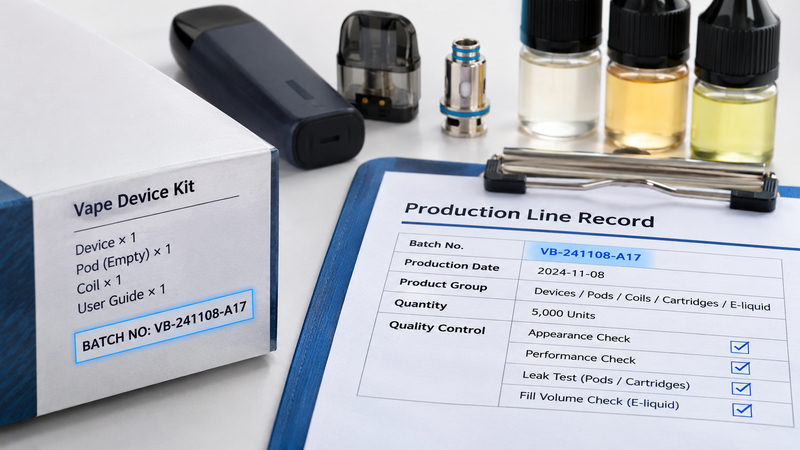
For example, a factory may fill 8,000 e-liquid bottles in a single production run. Every bottle from that run could have the same batch number. Several thousand disposable devices assembled on one line might also share a code. So, matching batch numbers do not automatically mean the packaging was copied or counterfeited.
Batch Numbers Identify Groups, Not Individual Items
A batch number typically identifies a group, not a unique product. A serial number, by contrast, commonly identifies an individual device. Manufacturers create their own coding systems, however, so formats and labels vary. Always confirm what a code is for before drawing conclusions from it.
Manufacturers may use batch number and lot number to mean the same thing. Some companies prefer “lot” for e-liquid and “batch” for hardware, while others use a single term for every product category. In practice, both usually help with production tracking and quality investigations.
What the Code May Contain
A batch format can contain letters, numbers, or a combination of the two. Different sections might refer to a factory, date, production line, shift, or filling run. A code such as “L3A0518,” for instance, could hold several production references. Still, consumers should not assume “0518” is a date without official confirmation.
Some manufacturers rely on internal databases instead of recognizable date patterns. A short code may link to extensive records about ingredients, components, test results, and distribution. On its own, the printed code might reveal very little. Its real value lies in the records connected to it.
Companies use those records to investigate complaints and isolate affected products. Suppose a defective component appears only in devices from two production runs. The company can focus its response on those batches, allowing unaffected products to remain available while the relevant stock is addressed.
2. Where to Find a Vape Batch or Lot Number
Code locations vary by brand, package design, and product category. Check the product itself as well as every piece of packaging you kept. A code might be easy to spot on the box but faint on the device. In other cases, it appears only on a bottle label or sealed outer wrapper.
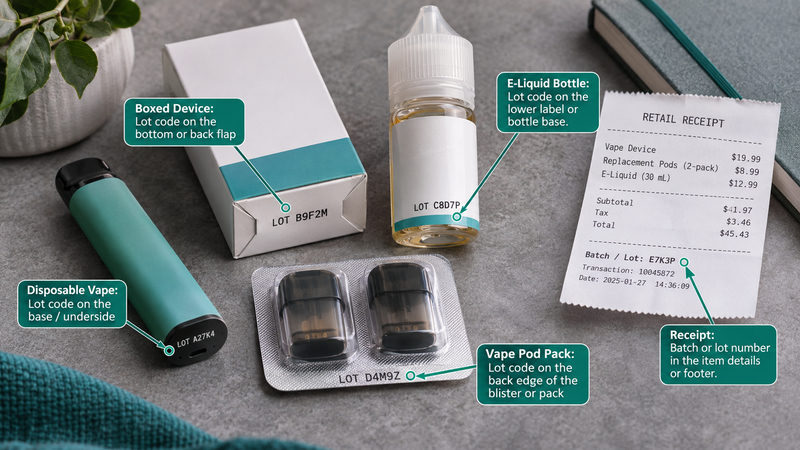
Look for labels that explain the code’s purpose. Common terms include:
- LOT or LOT NO.
- BATCH or BATCH NO.
- BN
- Production code
- Manufacturing code
- MFG code
Common Locations on Devices and Packaging
For disposable vapes, inspect the bottom, side, rear label, and the area around the charging port. Check the inner tray and outer box too. Some manufacturers apply the code in ink; others use laser engraving. If it looks faint, bright light aimed from an angle can make it easier to read.
On refillable devices, look at the base, battery compartment, and regulatory label. You can also check beneath removable panels if the manual says they can be safely removed. Never take apart a sealed device just to find a code. You could damage the battery, void coverage, or expose hazardous components.
For e-liquid, check the bottle base, edge of the label, neck, and cap area. If the bottle came in a carton, inspect that as well. Lot information is sometimes printed with dot-matrix ink, which can become hard to read after rubbing, leakage, heat, or regular handling.
Pods, coils, and cartridges may have codes printed on their foil packs or small boxes. The component itself may simply be too small to hold readable production details. Keep the individual wrapper until you know the product works properly. It may become useful evidence if you need to report a defect.
How to Search Without Losing Evidence
Begin with the outer packaging and work your way inward. Photograph each code before opening or throwing anything away. Take a close-up, then a wider photo that shows where the code appears. This helps support staff connect the characters with the right product and package.
If the printing is unclear, do not scrape the surface or use solvents. Try natural light, a flashlight, or your phone’s macro setting instead. Take photos from several angles as well. A reflection may conceal laser engraving in one shot and reveal it clearly in the next.
Do not decide that a batch number is missing after looking at only one surface. Packaging can include multiple panels, folded flaps, stickers, and removable sleeves. A retailer’s label may even cover the manufacturer’s code. Inspect everything carefully without tearing labels that could help establish where the product came from.
3. Batch Number vs Serial Number and Verification Codes
Codes should be identified by what they do, not how they look. A batch number can resemble a serial number, and either one might appear beneath a barcode. An authenticity code may also consist entirely of digits or use a long mix of characters. Appearance alone rarely gives you a reliable answer.
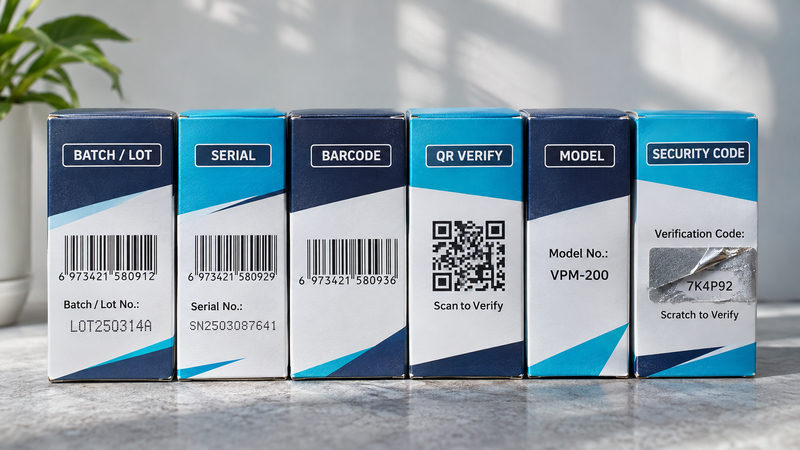
How the Main Codes Differ
- Batch or lot number: Identifies a group made under similar production conditions.
- Serial number: Usually identifies one individual device or hardware unit.
- Barcode: Allows machines to read product, stock, or distribution information.
- QR code: Directs a phone to stored text, an application, or a web address.
- Authenticity code: Supports a brand’s verification process and may permit limited checks.
- Model number: Identifies a product design, version, or configuration.
A genuine box may display several of these codes at once. A device, for example, could carry a shared batch number and its own unique serial number. The carton might also have a retail barcode and a concealed verification code. Several different numbers on one package do not necessarily point to a problem.
Repeated serial numbers across multiple devices, on the other hand, may be worth investigating. Serial numbers generally identify individual units, although manufacturer practices differ. Ask the manufacturer whether that particular number should be unique. Online guesses about unfamiliar formats are not enough.
Barcodes and QR Codes Require Careful Checking
A barcode alone does not prove authenticity. Counterfeiters can copy a visible barcode from genuine packaging, and ordinary shopping apps may show nothing more than a product name or catalog listing. That confirms the database entry—not the origin of the physical item in your hand.
A QR code also needs to be viewed in context. Preview its destination before entering any information, and inspect the domain closely. Look for misspellings, added words, unusual endings, or unexpected requests to log in. Even a professionally printed QR code can lead to an unofficial or harmful site.
A valid verification page is not a guarantee that every package carrying the code is genuine. Someone could copy one working code onto many counterfeit boxes. Some official systems detect repeated checks; others do not. That is why buyers should consider the code alongside evidence from the seller, packaging, and product.
Manufacturing Dates and Expiration Dates
A manufacturing date tells you when production took place, while an expiration date gives a recommended period of use. Neither one automatically counts as a batch number. A manufacturer may, however, build a date into its batch format. Only the company can explain that structure reliably.
Two bottles could share a date yet have different lot numbers because they came from separate filling lines or ingredient lots. The reverse can happen too: one batch may continue across a date boundary. Never fill in a missing batch code with your own date-based guess.
4. How to Check a Vape Batch Number
Most consumers cannot decode a manufacturing code on their own. It may contain production details, but companies rarely publish their full coding rules. Formats can change, making public decoding confusing. Detailed rules could also make copied packaging easier to create.
Think of the printed code as a reference key. In the manufacturer’s records, it may connect to component suppliers, test results, factory lines, and distribution destinations. Those details are not necessarily available to the public. Verification usually calls for an official tool or a direct request to support.
Step 1: Preserve the Product and Evidence
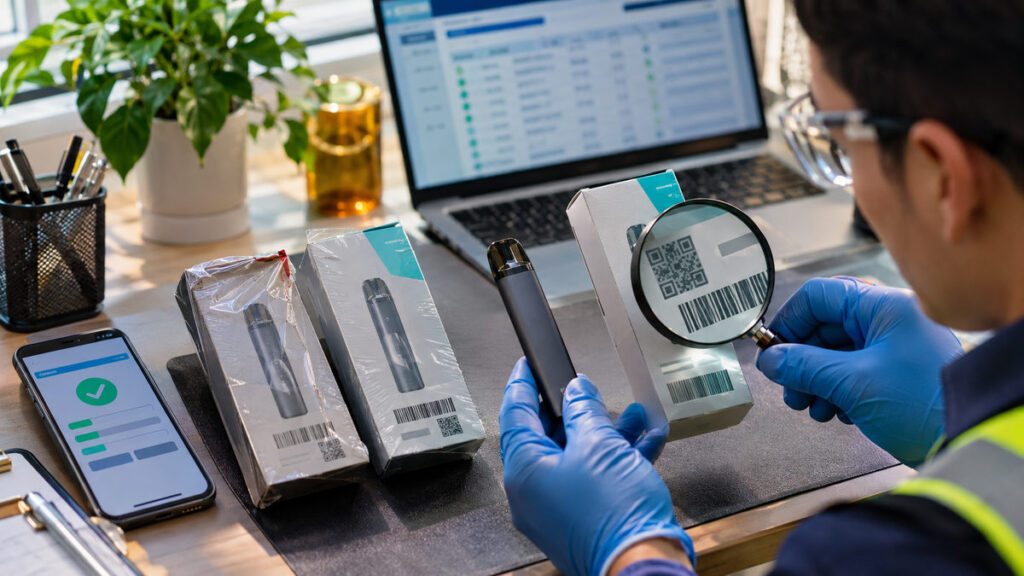
Before checking the number, stop altering the package. Photograph the front, back, sides, seals, labels, and every code you can see. Save the receipt, order confirmation, seller information, and delivery packaging too. Together, these records help show where and when you obtained the product.
If you spot leakage, swelling, overheating, damage, or an unusual odor, stop using the product. Keep it away from flames, heat, children, and pets. Do not puncture, crush, or dismantle it. A damaged lithium battery can pose serious fire and chemical hazards.
Step 2: Identify the Code’s Label and Location
Copy the code exactly as it appears. Keep every space, hyphen, leading zero, and capital letter. A zero and the letter “O,” for example, can look almost identical. Include a clear photo whenever you ask someone to confirm the code.
Then record where you found it. A number next to “LOT” probably serves a different purpose from one marked “SN.” Note whether the same code appears on both the device and the box. An unexplained mismatch may need attention, though device and packaging batches can legitimately be different.
Step 3: Use Only Official Verification Channels
Use the manufacturer’s official website, manual, or support details printed on confirmed packaging. Only enter a code when the company offers a dedicated checking system. If a QR destination seems suspicious, type the official address yourself. Steer clear of independent “batch decoder” sites that ask for unnecessary personal details.
Some companies offer authenticity checks without providing batch decoding. If so, contact support and explain precisely what you want confirmed. Ask whether the code matches the product, format, market, and approximate production record. The company may not share detailed factory information, however.
Step 4: Contact the Manufacturer or Authorized Distributor
A good message gives support enough evidence to investigate the issue efficiently. Include:
- The full batch or lot number
- The serial and authenticity codes, if present
- Clear photographs of the product and packaging
- The product name, flavor, strength, and model
- The seller’s name and purchase location
- The purchase date and receipt
- A description of any defect or safety concern
Ask specific questions instead of simply requesting an authenticity opinion. You might ask whether the lot format belongs to that product line. Also ask whether it is covered by any quality alert, recall, or distribution restriction. Focused questions tend to bring more useful answers.
Step 5: Compare the Entire Product, Not Just One Code
Check the print quality, seals, spelling, regulatory labels, and instructions included with the product. Compare its model, nicotine strength, capacity, and package contents against official product information. Major differences may justify further investigation. Keep in mind, though, that packaging can vary between legal markets and production updates.
Consider the seller and price as well. A deeply discounted item from an unknown seller brings more uncertainty than stock purchased from an authorized retailer. Still, a high price proves nothing by itself. Counterfeit screening is strongest when several independent clues lead to the same conclusion.
Step 6: Keep a Record of the Response
Keep support emails, case numbers, photos, and any instructions you receive. You can use them to show what the manufacturer confirmed if you later request a return or make a warranty claim. They may also help if the retailer disputes the problem. Above all, follow safety instructions promptly.
5. Recalls, Defects, Warranty Claims, and Missing Codes
Batch information links a product with manufacturing, testing, distribution, and complaint records. When several buyers report the same failure, investigators can compare their lot numbers. Matching codes may point to a shared component or production condition, helping the company define the affected group more precisely.
Using a Batch Number During a Recall
A recall notice may list particular batches, models, dates, or serial-number ranges. Compare every character closely; similar-looking codes can belong to different production groups. Confirm the notice with the manufacturer or relevant authority as well. A screenshot or social media post should not be your only source.
If your code matches, stop using the product and follow the provided directions. You may be asked to return or exchange it, submit a photo, or use an approved disposal method. Do not mail a battery-powered device unless the instructions specifically allow it. Lithium batteries can require special shipping and handling.
Reporting Defects and Requesting Warranty Support
When reporting a defect, stick to what you observed. Explain when it began, how often it happens, and whether the device became hot. Include any leakage, damaged seals, unusual tastes, charging trouble, or unexpected activation. Do not keep testing a product that might be unsafe.
A warranty claim may call for the serial number, batch number, receipt, and seller information. Some companies also ask for photos or a brief description of normal use. Keeping the box can save a surprising amount of time. Once discarded, its label may take the only readable production reference with it.
What to Do When the Code Is Missing
A missing code is not proof of counterfeiting, but it does warrant a closer look. It may have been printed on packaging removed by the retailer. The ink might also have rubbed off, or another label could be covering it. Before using an uncertain product, contact both the seller and manufacturer.
Use extra caution if the packaging appears altered or required labels are missing. Stop using anything that seems contaminated, damaged, recalled, or counterfeit. While you request instructions, keep it away from heat and children. Never improvise by opening, burning, puncturing, or putting it in household recycling.
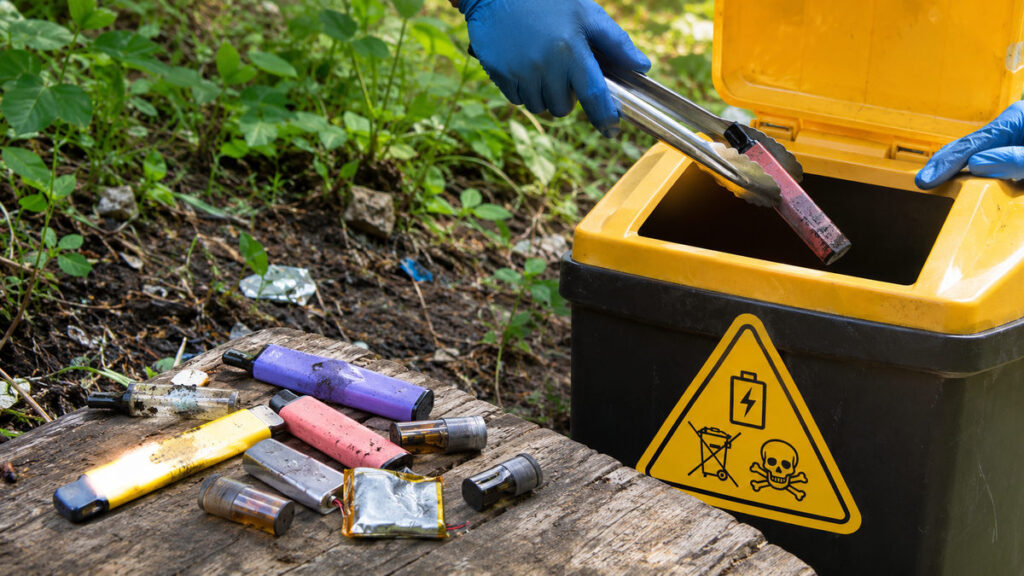
Rules for battery disposal differ by location. Follow the manufacturer’s instructions along with applicable local waste guidance. Relevant authorities or approved battery collection services may also be able to advise you. The safest approach depends on both the condition of the device and local handling rules.
6. Counterfeit Warning Signs and Vape Batch Number FAQ
A batch number is useful evidence, but it cannot establish legitimacy on its own. Counterfeit packaging may reproduce a genuine lot code, barcode, or QR image. Consider the product, seller, packaging, and verification response together. Several details that agree with one another offer more reassurance than a single printed number.
Common Counterfeit Warning Signs
- Missing, altered, or poorly printed production codes
- Repeated serial numbers on supposedly unique devices
- Broken seals or packaging that appears resealed
- Spelling mistakes and inconsistent fonts
- Unexpected colors, capacities, flavors, or nicotine strengths
- A QR code leading to an unrelated or misspelled domain
- A seller who refuses to provide receipts or origin details
- A price far below typical authorized retail pricing
No single warning sign gives a final answer. Packaging changes, and products sold in different regions may not look identical. Genuine items can also have printing errors or suffer damage in transit. If you are still unsure, ask the manufacturer to examine the evidence.
Buy only from reputable sellers that comply with the law. Ask for a receipt and hold on to the original packaging. You should also follow local age restrictions, product requirements, and vaping regulations. Since these rules differ widely, check the requirements in your area.
Can Two Genuine Vapes Have the Same Batch Number?
Yes. One batch number generally applies to multiple products made under similar conditions. Hundreds or even thousands of units may carry the same code. If a serial number is provided, that is more likely to identify a single device.
Can I Decode a Vape Batch Number Myself?
Usually not, at least not reliably without access to the manufacturer’s records. Some formats may look date-based, but guessing can lead to the wrong answer. Use an official checking system or contact the manufacturer instead. Send photos and explain exactly where the code appears.
Does a Valid Batch Number Prove a Vape Is Genuine?
No. A counterfeiter can copy a valid batch number from genuine packaging. A code may also look convincing without matching the company’s records. Pair official confirmation with other evidence, including seller history, packaging quality, seals, receipts, and product details.
Why Do the Box and Device Show Different Numbers?
They may be different types of codes. The box, for instance, could show a packaging batch while the device carries a serial number. Device assembly and final packaging can also happen at separate stages of production. If the labels are still confusing, ask the manufacturer to explain them.
What If an Authenticity Page Says the Code Was Checked Before?
The buyer or retailer may simply have scanned it earlier. Repeated checks, however, can also be a sign of copied packaging. Save the result and reach out to official support. Share the product, seller, code, and purchase details so they can review the case.
Should I Use a Vape While Waiting for Verification?
Do not use it if you have doubts about its origin or safety. Stop immediately if you find damage, leakage, swelling, overheating, contamination, or recall information. Store the product safely while you wait for instructions, keeping it away from heat, flames, children, and pets.
Conclusion
A vape batch number identifies a production group and helps trace products. It can link devices or liquids to quality tests, complaints, recalls, distribution records, and warranty cases. It is not the same as a serial number, barcode, or authenticity code, though. Nor can it prove legitimacy on its own.
Whenever you buy a vape product, keep its packaging and receipt. Photograph every relevant code before labels fade or boxes are discarded. If you have doubts, verify the product through the manufacturer’s official channels. Most importantly, stop using it if its origin or safety cannot be confirmed.