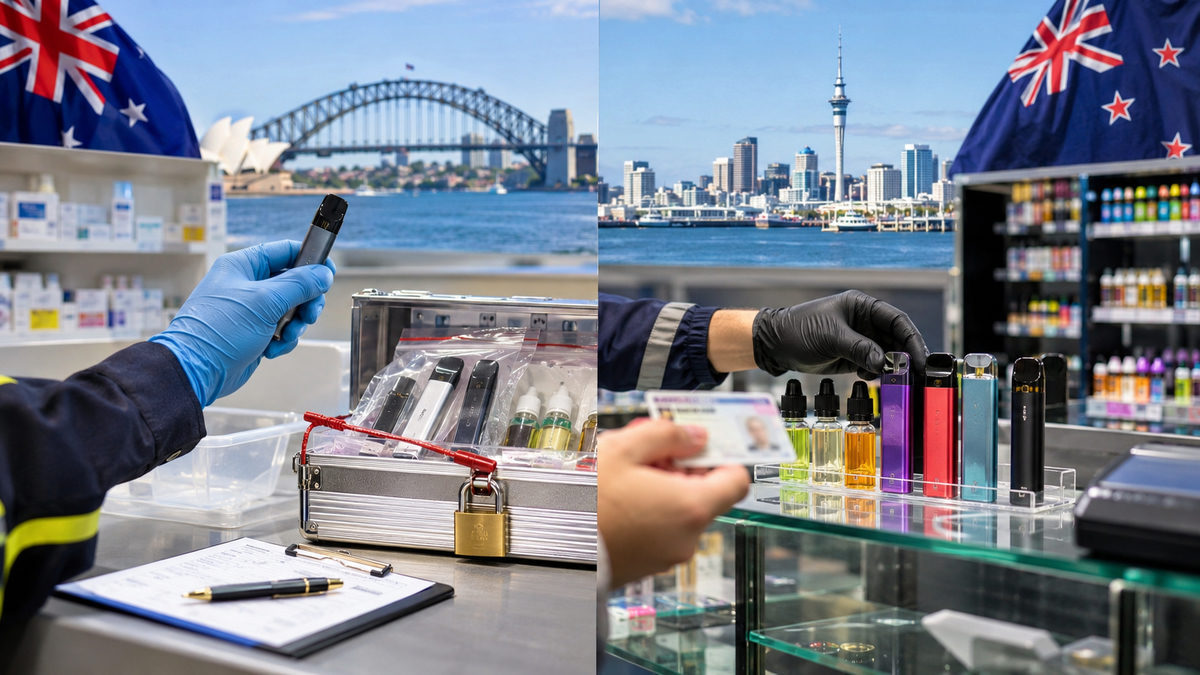
The same vape can fall under fundamentally different rules once it crosses the Tasman. How Australia Regulates Vaping Compared With New Zealand matters to residents, travellers, health professionals, retailers, and researchers alike. In Australia, products usually need to be supplied through a pharmacy for a therapeutic purpose. New Zealand, by contrast, permits regulated sales to adults through eligible retailers.
Neither country, however, treats vaping as harmless or freely available. The rules cover prescriptions, age limits, disposables, flavours, imports, promotion, and public use. And legal availability does not amount to medical approval or mean that vaping carries no health risks.
1. How Australia Regulates Vaping Compared With New Zealand
Vaping is legal in both countries, but under tightly controlled systems. Australia largely treats lawful vapes as therapeutic goods used for smoking cessation or managing nicotine dependence. New Zealand allows a broader consumer market, while still regulating retailers, products, promotion, and youth access.

The biggest difference is where people can buy them. In Australia, lawful retail supply is generally limited to pharmacies. Participating pharmacists may provide suitable products to adults after a consultation, subject to federal and local rules. In New Zealand, adults can buy compliant products from registered general retailers or approved specialist vape retailers.
Side-by-side comparison
| Issue | Australia | New Zealand |
|---|---|---|
| Basic legality | Legal mainly as therapeutic vaping goods supplied through pharmacies. | Legal within a regulated adult retail market. |
| Sales channels | Participating pharmacies generally provide the only lawful consumer retail channel. | Registered general retailers and approved specialist vape retailers may sell eligible products. |
| Prescription | Sometimes required, including for higher strengths and patients under 18. | Ordinary compliant retail products generally require no prescription for adults. |
| Minimum retail age | Non-prescription pharmacy supply requires an adult aged at least 18. | Retailers cannot sell vaping products to anyone under 18. |
| Disposable devices | Importation, manufacture, commercial possession, and supply are prohibited. | Manufacture, sale, supply, and distribution are prohibited. |
| Flavours | Therapeutic products generally use mint, menthol, tobacco, or permitted unflavoured formulations. | General retailers have narrow flavour options, while approved specialists have a broader permitted range. |
| Nicotine limits | Up to 20 mg/mL without prescription, or 50 mg/mL through qualifying prescription pathways. | Usually 20 mg/mL, or 28.5 mg/mL for qualifying nicotine-salt substances in reusable devices. |
| Advertising | Public advertising is broadly prohibited, with narrow professional supply communications. | Advertising, online product displays, discounts, giveaways, and rewards face strong restrictions. |
| Imports | Commercial imports need permissions; ordinary overseas consumer orders face prohibition and seizure risk. | Commercial sellers must meet notification and product rules; personal imports require careful legal checks. |
| Public use | State and territory smoke-free laws commonly extend to vaping. | Indoor workplaces, licensed premises, schools, and early-childhood grounds are vapefree. |
| Enforcement | Federal, border, state, territory, and local agencies share responsibility. | Health authorities, enforcement officers, Customs, and local bodies enforce different requirements. |
A vape legally sold in Auckland may therefore be unlawful to sell in Sydney. Similarly, finding a product in an Australian pharmacy does not mean the TGA has individually approved it. Both systems aim to limit access to unsuitable products, but they go about it in different ways.
2. Governing Laws, Regulators, and Legal Access
Australia’s therapeutic model
Australia’s framework is built around the Therapeutic Goods Act 1989 and related legal instruments. The Therapeutic Goods Administration, or TGA, oversees product standards, notifications, pharmacy pathways, advertising, and compliance for therapeutic goods. The Australian Border Force and Office of Drug Control also manage key import controls.

State and territory laws create another layer of regulation. They cover medicines, poisons, pharmacy practice, tobacco control, youth access, and smoke-free locations. This means a federal pathway may still be unavailable if local law blocks that particular form of supply.
Pharmacies may supply therapeutic vaping goods for smoking cessation or the management of nicotine dependence. Tobacconists, convenience stores, ordinary vape shops, and service stations generally cannot. That restriction applies to both nicotine and nicotine-free vaping products.
Australian pharmacy access
An adult aged 18 or older can approach a participating pharmacy without a prescription. The pharmacist must hold a consultation and verify the customer’s identity and age. They must also decide whether vaping is appropriate for that person’s therapeutic needs, taking first-line options into account.
The product must be included on the TGA’s notified vape list. Under the pharmacist-only pathway, its nicotine concentration cannot exceed 20 mg/mL. The amount supplied must cover no more than one month of reasonable therapeutic use, and it can be provided only once during that month.
Still, pharmacists are not required to stock or supply vapes. They must follow professional standards as well as the relevant state or territory law. Local rules, for example, may prevent non-prescription supply even when the federal pathway would otherwise allow it.
A prescription is still needed in several circumstances. These include products stronger than 20 mg/mL, supply to patients under 18, and jurisdictions where pharmacist-only access is unavailable. Products supplied through a qualifying prescription pathway may contain up to 50 mg/mL of nicotine.
New Zealand’s regulated retail model
New Zealand’s system rests on the Smokefree Environments and Regulated Products Act 1990 and its supporting regulations. The Ministry of Health and its Vaping Regulatory Authority oversee retailer approvals, product notifications, and regulatory compliance. Enforcement officers also monitor age limits, displays, promotions, and product requirements.
A general retailer might be a supermarket, dairy, service station, or ordinary online seller. It must notify the Ministry that it sells regulated products and renew that notification when required. Its flavour range and product displays, however, are more limited than those of a specialist retailer.
An approved specialist vape retailer must mainly sell vaping products and satisfy the approval criteria. A physical shop becomes an approved vaping premise, while an online business needs an approved internet site. People under 18 cannot enter an approved specialist vaping premise.
Specialist status allows a broader range of notified flavours, but the wider rules still apply. Retailers must comply with location, visibility, age, product, and promotional restrictions. So, while New Zealand offers broader retail access, it is nowhere near an unrestricted market.
3. Disposable Devices, Nicotine, Flavours, and Product Standards
Disposable and reusable devices
Both countries prohibit disposable vaping devices, though they use different legal mechanisms. Australia bans the import, manufacture, supply, and commercial possession of disposable single-use vapes. The relevant federal controls cover both therapeutic and non-therapeutic disposable products.

New Zealand prohibits the manufacture, sale, supply, or distribution of disposable vaping devices. The definition covers devices that cannot be recharged or refilled. It also captures devices whose pod, cartridge, or similar container cannot be replaced by the user.
A rechargeable device with replaceable prefilled pods may therefore remain legal in New Zealand, provided it meets every other product requirement. Australia takes a different route: reusable therapeutic devices and related goods must comply with its notification and pharmacy-supply framework.
Nicotine and flavour limits
Australia’s non-prescription pharmacy pathway permits nicotine concentrations of up to 20 mg/mL. Qualifying prescription products can contain as much as 50 mg/mL. In either case, the product must meet the relevant therapeutic standards and be supplied through a lawful pathway.
New Zealand generally caps nicotine concentration at 20 mg/mL. Nicotine-salt substances intended for reusable devices may contain up to 28.5 mg/mL. Retail containers that hold nicotine are also subject to limits on total nicotine and container capacity.
Those figures do not tell the whole story. A concentration permitted through one pathway may still be unlawful through another sales channel. Nicotine-free vapes are regulated too, with controls covering supply, ingredients, packaging, devices, and promotion.
Australia allows only a narrow range of therapeutic flavours, mainly mint, menthol, and tobacco. Some compliant notified products may also be sold as unflavoured formulations. Flavour combinations and names designed to appeal to young people generally fail the applicable standards.
In New Zealand, general retailers may sell only tobacco, menthol, or permitted mint-category flavours. Approved specialist retailers can offer a broader selection of notified flavours through approved premises or internet sites. Even then, variant names must use accurate, permitted flavour descriptions, and colouring substances are prohibited.
Safety standards and notification
Australian therapeutic goods must meet standards covering ingredients, packaging, labelling, and device construction. These include child-resistant packaging, plain presentation, English-language labels, warnings, batch details, and information leaflets. Device rules also address batteries, electrical safety, risk management, and toxicological assessment.
The TGA’s notified vape list records goods that sponsors declare comply with the applicable standards. It includes substances, devices, kits, packs, and accessories. But inclusion does not mean the TGA has individually tested or approved a product.
In New Zealand, manufacturers and importers must notify each product before offering it for sale. The standards cover nicotine, ingredients, containers, leakage, child-safety mechanisms, and traceable serial or batch numbers. Labels must state nicotine content clearly in mg/mL and correctly identify products with zero nicotine.
New Zealand also restricts cartoons, toys, misleading flavour descriptions, and certain ingredients. Where specified, containers need suitable anti-spill, tamper-evident, or child-resistant features. Once again, notification records regulatory information; it is not a government guarantee of safety or effectiveness.
4. Buying, Importing, and Travelling With Vapes
Buying and importing in Australia
Australian adults should obtain therapeutic vaping goods from a participating pharmacy. A prescription and clinical assessment may be necessary, depending on the product’s strength and the person’s circumstances. Products sold by tobacconists, convenience stores, ordinary vape shops, or unverified websites, on the other hand, may be unlawful.
Commercial importers need the appropriate notices, licences, and import permissions before bringing vaping goods into Australia. Products intended for supply must also meet notification and product-standard requirements. Border officers can stop shipments that lack permission or contain prohibited goods.
Ordinary consumers can no longer rely on the former personal importation model for overseas postal orders. A foreign website might accept the payment, but that does not make the shipment legal. Postal packages may be detained, seized, forfeited, or referred for further investigation.
There is a limited traveller exemption for therapeutic vaping goods carried in accompanied baggage. Eligible travellers may bring up to two vapes, 20 cartridges, capsules, or pods, and 200 mL of liquid. The products must be for the traveller’s treatment or the treatment of someone in their care.
Buying and importing in New Zealand
Adults in New Zealand may purchase notified products from eligible general or specialist retailers. General retailers carry a smaller flavour range, while approved specialist sellers may stock more permitted variants. Online sellers must meet the registration, approval, display, age, and product duties that apply to them.
Manufacturers and importers must notify products before offering them for sale in New Zealand. Commercial imports must also comply with customs declarations, classification rules, product standards, and the ban on supplying disposable devices. Simply importing stock does not authorise its later sale.
Personal overseas purchases call for extra care. An item may enter the country yet still breach the rules if it is supplied, distributed, or resold. Its nicotine source, device design, ingredients, quantity, and intended use can also affect how other laws apply.
Checklist before entering Australia
- Confirm the device is reusable and not a prohibited disposable vape.
- Check the nicotine strength and intended therapeutic purpose.
- Stay within two devices, 20 pods or cartridges, and 200 mL of liquid.
- Keep products in original, clearly labelled packaging where possible.
- Carry supporting medical or pharmacy documents, even when border rules do not require them.
- Place spare lithium batteries in cabin baggage and protect exposed terminals.
- Check airline, state, and territory restrictions before departure.
Checklist before entering New Zealand
- Check whether the device meets the reusable-device definition.
- Confirm nicotine concentration, ingredients, and flavour descriptions.
- Keep quantities consistent with genuine personal use.
- Retain invoices, original packaging, and accurate product information.
- Declare goods when the traveller declaration requires it or when uncertain.
- Follow airline rules for devices, liquids, and lithium batteries.
- Check current Customs and Ministry of Health guidance before travelling.
Clearing the border does not answer every legal question after arrival. Different provisions may govern possession, supply, sale, advertising, and use. Travellers should not sell, share, or publicly use imported products until they have checked the local rules.
5. Advertising, Public Vaping, Enforcement, and Penalties
Promotion and product visibility
Australia broadly bans unauthorised advertising of vaping goods. The restrictions may apply to websites, social media, public displays, promotional claims, and messages that encourage supply or use. Lawful professional communications are largely confined to businesses involved in wholesale or pharmacy supply.
Pharmacies must store therapeutic vapes behind the counter, away from normal customer self-selection. Public-facing promotion is tightly constrained. Businesses must also avoid claiming that an unapproved product offers proven health benefits or guaranteed smoking-cessation results.
New Zealand likewise prohibits advertisements that encourage use, promote sales, or publicise product availability. The bans extend to online product images, public social posts, giveaways, retail discounts, gifts, rebates, competitions, and purchase rewards. General stores cannot display products openly, and specialist premises cannot make them visible from outside.
Specialist retailers once had exemptions that allowed broader customer communications and promotional offers. Many of those exemptions ended when stronger restrictions came into force. What remains is narrow, including prescribed notices and limited displays inside approved premises where the law permits them.
Specialist approval, then, is not a licence to advertise freely. Retailers need to separate neutral compliance information from promotional material. Health and smoking-cessation claims may also trigger medicines, consumer-protection, or fair-trading laws.
Where vaping is prohibited
Australian state and territory laws generally ban vaping wherever smoking is prohibited. Common examples include indoor workplaces, hospitality venues, schools, public transport, aircraft, airports, and enclosed public spaces. The precise rules for outdoor areas vary by jurisdiction.
Local restrictions may also cover playgrounds, sports grounds, transport stops, hospital grounds, beaches, or building entrances. Property owners are free to adopt stricter policies. Check the signs and local law before vaping outdoors.
New Zealand prohibits vaping inside workplaces, licensed premises, and specified enclosed public areas. Schools and early-childhood centres are vapefree across their entire grounds. Restrictions also apply to public transport, passenger services, aircraft, and other smoke-free settings.
Councils and property operators can designate additional vapefree areas. Approved specialist premises have a limited workplace exception for lawful demonstrations or product trials. Ordinary shops, offices, and hospitality venues do not share that exception.
Enforcement and consequences
Enforcement in Australia is divided among the TGA, Australian Border Force, Office of Drug Control, police, and health regulators. State, territory, and local officers may inspect retailers and enforce youth-access or smoke-free rules. Pharmacist conduct is also supervised by pharmacy regulators and professional bodies.
In New Zealand, the Ministry of Health and designated enforcement officers oversee retail and product compliance. Customs handles border declarations and imported goods within its authority. Local bodies, employers, transport operators, and other agencies enforce the place-based restrictions relevant to them.
Consequences can include warnings, infringement notices, product seizure, injunctions, civil penalties, prosecution, or the loss of retail approval. In Australia, illegal importing, commercial possession, advertising, and retail supply may carry serious consequences. New Zealand also penalises supplying minors, advertising, selling disposables, and offering products that do not comply.
New Zealand’s disposable-vape offence, for example, can expose some large businesses or notifiers to substantial court fines. The exact amount depends on the offence, the offender, the legal pathway, and the legislation in force. Businesses should check the current penalty provisions rather than rely on a single headline figure.
6. Public-Health Goals, Practical Effects, and Official Guidance
Different approaches to adult access
Australia treats vaping chiefly as a supervised response to nicotine dependence. Its framework favours pharmacist consultation, a therapeutic purpose, controlled quantities, and limited recreational retail availability. Health professionals are also expected to consider established first-line cessation treatments before recommending a vape.
New Zealand approaches adult access and smoking harm reduction differently. It allows regulated retail sales while restricting youth access, promotion, flavours, ingredients, and product design. Its ban on disposable devices also responds to youth appeal, safety concerns, and environmental waste.
For adult smokers, Australia’s model provides professional oversight but fewer places to buy products. Pharmacists take on both an assessment role and new reporting duties. New Zealand consumers have wider access, although the type of retailer still determines which flavours are available and how products may be purchased.
Convenience stores, tobacconists, and vape shops in Australia generally cannot sell vaping goods. New Zealand general retailers can take part after notification, though strict flavour and display rules apply. Approved specialist retailers face additional approval, premises, age-control, and compliance obligations.
What lawful supply does not mean
Australian therapeutic vapes are generally still unapproved therapeutic goods. Nicotine vaping goods do not appear in the Australian Register of Therapeutic Goods. The TGA has not individually assessed them for safety, quality, efficacy, or performance.
Sponsors notify the TGA that their goods meet the applicable minimum standards. This self-declared notification is not the same as product registration or clinical endorsement. The notified vape list simply identifies products eligible for lawful supply through specified therapeutic pathways.
Vaping is not risk-free, and nicotine can lead to dependence. Australia does not consider vaping a universal first-line cessation treatment. Clinicians and pharmacists may first discuss counselling, nicotine-replacement products, and other approved options.
The same distinction applies in New Zealand: notification does not mean the Ministry guarantees a product. Compliance remains the responsibility of manufacturers and importers. Researchers should keep retail legality, product notification, clinical evidence, and individual health outcomes separate.
Common misconceptions
Australia has not prohibited every form of vaping. Adults may obtain qualifying therapeutic goods from participating pharmacies, subject to consultation and local law. Recreational retail sales and most ordinary consumer imports, however, remain prohibited.
Nor does New Zealand permit unrestricted vaping products or promotion. Sales to anyone under 18 are banned, as is the supply of disposable devices. The country also regulates nicotine, flavours, ingredients, packaging, advertising, displays, retailer categories, and vapefree settings.
Tourists, businesses, and health professionals should check current government guidance before making decisions. Useful sources include the TGA, Australian Border Force, state or territory health agencies, and New Zealand’s Ministry of Health. Border and battery requirements should also be confirmed with customs authorities and airlines.
Conclusion
Australia has the more restrictive framework, limiting lawful vaping products mainly to therapeutic supply through pharmacies. New Zealand allows a controlled adult retail market, with different rules for general and specialist retailers. Both countries, however, restrict youth access, disposable devices, promotion, unsafe products, and vaping in designated places.
The two countries strike a different balance between cessation access and harm prevention. A product that is legal on one side of the Tasman may not be legal on the other. And lawful availability does not make vaping harmless or automatically confer medical approval.
Before buying, importing, supplying, or travelling with a vape, consult the latest guidance from the TGA or New Zealand Ministry of Health. Check the relevant customs, state, territory, council, and airline rules as well. A quick check before paying or departing can prevent seizure, penalties, and a costly misunderstanding.