
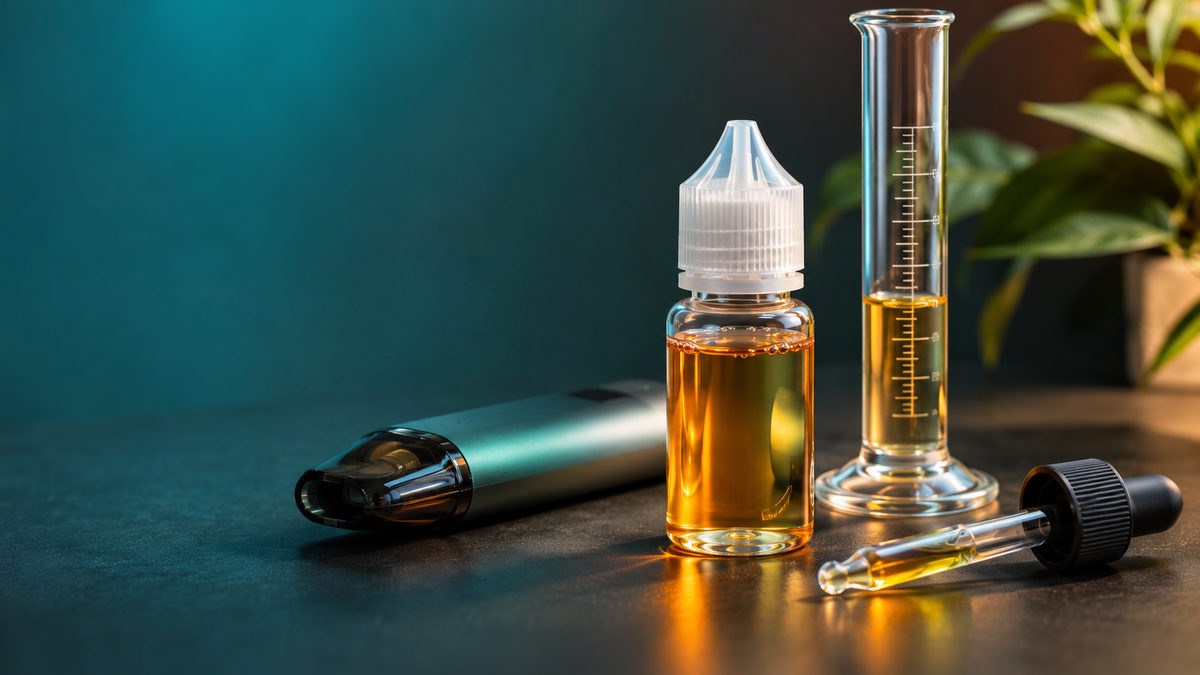
A vape label may say 20mg/mL, 20mg, or 2%, but do all three figures describe the same nicotine strength? What Does 20mg/mL Nicotine Mean? It means that each milliliter of e-liquid contains 20 milligrams of nicotine. That number alone, though, does not tell you the container’s total nicotine content or how much your body absorbs.
Nicotine labels can make concentration, total content, and actual intake look like the same thing. They are not. Each measurement answers a different question, and knowing the difference helps adults compare products, select compatible devices, and avoid choosing an unsuitable strength.
1. What Does 20mg/mL Nicotine Mean?
Understanding the concentration
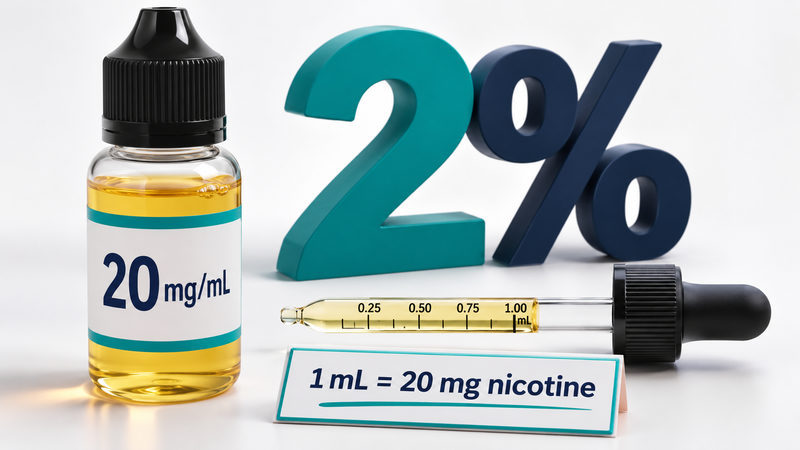
20mg/mL means that every milliliter of e-liquid contains 20 milligrams of nicotine. This measurement describes concentration, not the size of the container. One milliliter contains 20mg, for example, while two milliliters contain 40mg in total.
Think of a drink with 10 grams of sugar per 100 milliliters. A bigger bottle contains more sugar in total, but the concentration remains the same. The same principle applies here: 20mg/mL liquid has the same strength whether it comes in a small pod or a larger bottle.
Concentration versus total quantity
Concentration tells you how much nicotine is present in each milliliter. Total quantity tells you how much nicotine the entire container holds. To calculate that total, you need both the concentration and the liquid capacity.
Take a 2mL pod at 20mg/mL. It contains 40mg of nicotine altogether. A 10mL bottle at the same strength contains 200mg, yet both liquids still have the same concentration: 20mg/mL.
Why labels may look different
Manufacturers may list the strength as 20mg/mL, 20mg, or 2%. A prominent “20mg” will usually mean 20mg per milliliter. Still, check the smaller print, since an unclear label could use “20mg” to describe the total content instead.
The percentage follows a common weight-to-volume labeling convention. Converting mg/mL to a percentage is simple: divide the number by ten. So, 20mg/mL divided by ten equals 2%, which means the two labels are generally equivalent.
One distinction matters most. Concentration is not the amount of nicotine released into the aerosol or delivered to your mouth, and it is not the amount that enters your bloodstream. Device performance, puffing habits, formulation, and personal physiology all influence those later stages.
2. How to Calculate Total Nicotine in E-Liquid
The basic nicotine formula
Total nicotine is easy to calculate. Multiply the concentration in mg/mL by the container volume in milliliters. The answer is the total number of milligrams of nicotine in the liquid.
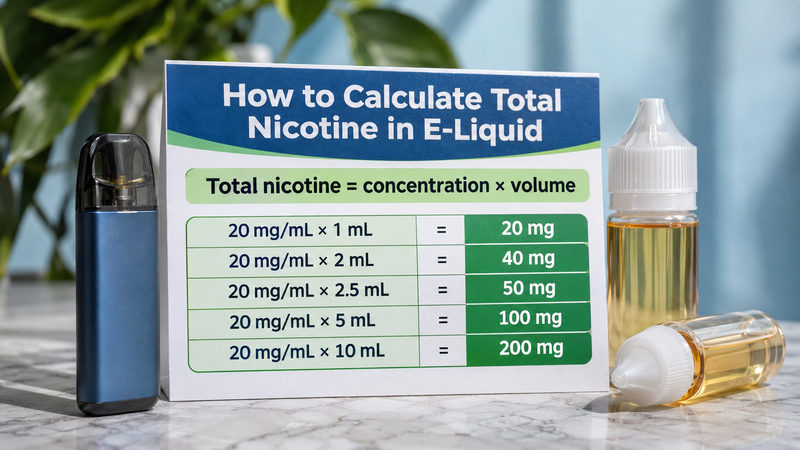
Total nicotine in mg = concentration in mg/mL × volume in mL. For example, 20mg/mL multiplied by 2mL equals 40mg. A full pod of that size therefore contains 40mg of nicotine before use.
Common pod and bottle calculations
A 1mL pod filled with 20mg/mL liquid holds 20mg of nicotine. A 2mL pod holds 40mg, while a 2.5mL pod holds 50mg. Remember, these numbers describe the container’s total content, not the amount your body automatically absorbs.
The same calculation applies to refill bottles. At this concentration, a 5mL container holds 100mg. A 10mL bottle holds 200mg because 10 multiplied by 20 equals 200.
| Container volume | Concentration | Multiplication | Total nicotine |
|---|---|---|---|
| 1mL | 20mg/mL | 1 × 20mg | 20mg |
| 2mL | 20mg/mL | 2 × 20mg | 40mg |
| 2.5mL | 20mg/mL | 2.5 × 20mg | 50mg |
| 5mL | 20mg/mL | 5 × 20mg | 100mg |
| 10mL | 20mg/mL | 10 × 20mg | 200mg |
How to interpret the result
A 10mL bottle containing 200mg does not deliver one 200mg dose. The nicotine is spread throughout the entire bottle, and your body will not necessarily absorb every milligram in the liquid you use.
When comparing products, look at both the strength and the stated capacity. A disposable can hold more liquid than a small pod even when both have the same concentration. That means it may contain substantially more nicotine in total.
Use this formula for pods, disposables, and bottled vape juice before you buy. Also check whether the listed capacity refers to usable liquid or simply the tank’s maximum size. A clear label should state both the volume in milliliters and the nicotine concentration.
3. Is 20mg Nicotine Strong? Comparing Vape Nicotine Levels
Where 20mg/mL sits on the strength scale
Yes, 20mg/mL represents a high nicotine concentration compared with many commonly sold e-liquids. Other widely available strengths include 3mg/mL, 6mg/mL, 10mg/mL, and 12mg/mL. The jump from 3mg/mL to 20mg/mL is substantial.
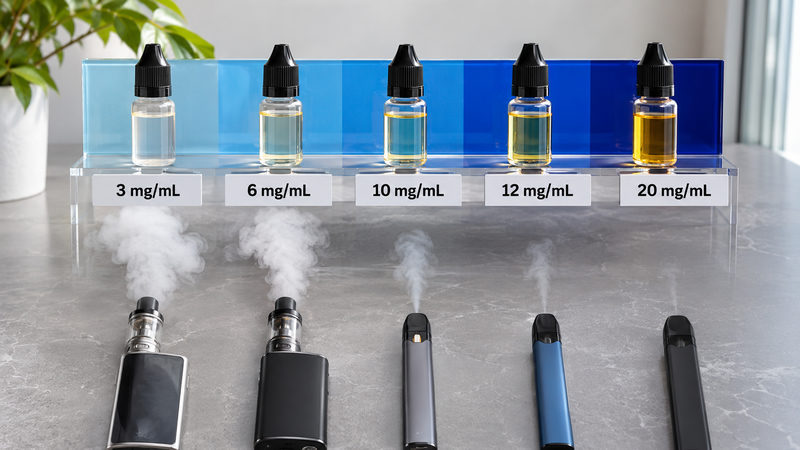
- 3mg/mL: Each milliliter contains 3mg of nicotine.
- 6mg/mL: Each milliliter contains 6mg of nicotine.
- 10mg/mL: Each milliliter contains 10mg of nicotine.
- 12mg/mL: Each milliliter contains 12mg of nicotine.
- 20mg/mL: Each milliliter contains 20mg of nicotine.
For comparison, 20mg/mL has more than three times the concentration of 6mg/mL liquid and over six times the concentration of 3mg/mL. Even so, the label cannot predict exposure by itself. The device and the way it is used matter too.
Strength and vapor output work together
Lower concentrations are commonly paired with equipment that produces larger clouds and more aerosol per puff. By contrast, 20mg/mL usually goes with lower-power devices that create smaller amounts of vapor. This pairing limits how much high-strength liquid is turned into aerosol with each puff.
Someone using 3mg/mL liquid may consume several milliliters in a day. A person using 20mg/mL might consume far less. Daily liquid use therefore matters just as much as the number printed on the label.
Who might consider this strength?
Some adult smokers who are switching completely from cigarettes may consider 20mg/mL if lower strengths do not control persistent cravings. Experienced adults who use compact pods may also prefer the stronger nicotine delivery. Someone who smokes heavily will often have different needs from an occasional smoker.
For light or infrequent nicotine users, however, 20mg/mL may be too much. A person who is sensitive to nicotine could feel nauseated or dizzy after only a few closely spaced puffs. Anyone who does not already use nicotine should not start vaping.
Finding an appropriate level
Before choosing a strength, consider your smoking history, cravings, vaping frequency, and the output of your device. Notice unwanted effects too, along with how often you reach for the device. Make adjustments gradually, since a large change can quickly become uncomfortable.
There is no perfect concentration for everyone. The same 20mg/mL liquid can lead to different levels of exposure in two devices—or in two people. Treat the label as essential product information, not as a guaranteed personal dose.
4. Nicotine Absorption and Comparisons With Cigarettes
Three different nicotine measurements
Nicotine use has three distinct stages. First, the unheated liquid contains a stated amount. The device then releases some of that nicotine in aerosol, and the body ultimately absorbs only part of what reaches it.
Those stages do not produce identical measurements. Some liquid may stay behind in the pod, coil, or device. Some aerosol also escapes into the air or leaves the body when you exhale.
Using one milliliter of 20mg/mL liquid therefore does not mean your body absorbs all 20mg. The calculation only tells you how much nicotine was originally in that milliliter. Measuring delivery and bodily uptake accurately would require laboratory testing.
What changes nicotine delivery?
Device power affects how fast the coil heats and how much liquid turns into aerosol. Coil resistance, airflow, and temperature control also shape the output. The nicotine formulation can change both the sensation and the delivery experience as well.
Then there is user behavior. Longer puffs, deeper inhalation, frequent sessions, and closely spaced puffs may raise intake. Occasional short puffs usually create a different exposure pattern.
- Device power and operating settings
- Coil resistance and condition
- E-liquid formulation and nicotine type
- Puff length and frequency
- Mouth-to-lung or direct-to-lung inhalation
- Total liquid consumed each day
- Individual metabolism and physiology
Experience can shape these habits too. Someone using a weaker liquid, for example, may take longer or more frequent puffs to manage cravings. That compensatory puffing can make the real-world difference between two labeled strengths smaller than expected.
Why cigarette comparisons remain uncertain
Cigarette nicotine yield and e-liquid concentration are measured in different ways. An e-liquid label gives the amount of nicotine per milliliter. Cigarette figures, on the other hand, may show machine-tested smoke yield rather than total tobacco nicotine or the amount a person absorbs.
Cigarette design, puff intensity, smoking speed, and ventilation holes can all change nicotine delivery. Vaping adds its own mix of variables: liquid, coil, power, and user behavior. There is no dependable universal formula that converts one pod or milliliter into an exact number of cigarettes.
A cigarette-equivalence estimate may provide rough context, but it should not be treated as a precise promise. Two people might use the same pod over very different lengths of time. They may also take different-sized puffs and absorb different amounts of nicotine.
A more practical way to monitor intake
Rather than relying only on cigarette comparisons, track your cravings, daily liquid use, and vaping frequency. Notice whether you vape continuously or in defined sessions. Together, these details give you a clearer view of your own pattern.
Watch closely for nausea, dizziness, headache, sweating, shakiness, or a racing heartbeat. These symptoms may point to excessive nicotine exposure. If strong cravings continue, speak with a qualified healthcare professional or a smoking-cessation service.
5. 20mg Nicotine Salts vs 20mg Freebase Nicotine
The concentration stays the same
A 20mg/mL nicotine salt liquid and a 20mg/mL freebase liquid contain the same stated amount of nicotine per milliliter. Both provide 20 milligrams in every milliliter. Their chemical forms and the way they feel, however, can be noticeably different.
Nicotine salt liquids combine nicotine with an acid in their formulation. Freebase products use nicotine in a different chemical form and follow a different formulation approach. So, matching numbers on the labels do not guarantee the same throat sensation or delivery experience.
Why nicotine salts often feel smoother
At 20mg/mL, nicotine salts often feel smoother and less harsh than freebase nicotine. That smoother sensation can make a higher concentration easier to inhale. It does not mean the liquid contains less nicotine.
The formulation and device design also shape the aerosol and the user’s sense of satisfaction. Acidity, flavor ingredients, coil performance, and puff style can all change the experience. They may influence how quickly nicotine reaches the user too.
Typical device pairings
Manufacturers commonly make 20mg/mL nicotine salts for compact, low-power pod systems. Mouth-to-lung devices offer the tighter draw that many cigarette smokers recognize. They also tend to produce less vapor per puff than high-output equipment.
In comparison, 20mg/mL freebase nicotine may feel considerably harsher on the throat. It is also less commonly chosen for high-vapor devices. Put either formulation into unsuitable equipment, and it may deliver more nicotine than expected.
Before you buy, check these four details:
- The nicotine type, such as salt or freebase
- The concentration stated in mg/mL or percent
- The manufacturer’s recommended device category
- The operating instructions and compatible power range
Do not judge liquids by the large number on the front label alone. Two 20mg/mL products can feel quite different because their formulations and recommended devices are not the same. Whenever you switch the liquid, device, or nicotine type, start cautiously.
6. Choosing a Device and Using 20mg/mL More Safely
Choose equipment designed for the strength
Low-power pod systems and mouth-to-lung devices are the usual match for 20mg/mL liquid. They generally vaporize smaller amounts of liquid with each puff. That makes them better suited to high-strength liquids than powerful, cloud-producing equipment.
Do not put 20mg/mL liquid into a sub-ohm, high-power, or direct-to-lung device unless the manufacturer explicitly confirms the combination is suitable. High-output equipment can turn much more liquid into aerosol per puff. Nicotine delivery may then rise quickly and substantially.
Before filling a tank, check the device manual, coil resistance, and recommended wattage. Read the e-liquid manufacturer’s instructions as well. If either manufacturer warns against the combination, use a different liquid or device.
Recognize excessive nicotine exposure
If you feel unwell, stop vaping—especially if you have recently changed the strength or equipment. Move into fresh air and avoid any further nicotine exposure. Common warning signs include:
- Nausea or vomiting
- Dizziness or light-headedness
- Headache
- Sweating or clammy skin
- Shakiness or unusual weakness
- Throat discomfort
- A rapid or irregular heartbeat
Seek medical advice if the symptoms are severe, get worse, or continue after you stop. Get urgent help for breathing problems, confusion, collapse, seizures, or suspected poisoning. Contact your local emergency service or poison center for immediate instructions.
Prevent spills and accidental exposure
Nicotine can enter the body through inhalation, swallowing, skin contact, and mucous membranes. Keep e-liquid away from your skin and eyes. If it touches your skin, wash the area promptly with soap and water and follow the product’s safety instructions.
If e-liquid gets into your eyes, rinse them immediately with plenty of clean water. Never swallow e-liquid, and do not induce vomiting unless a medical professional tells you to. Contact a poison center promptly if someone swallows the liquid or develops concerning symptoms.
Keep all nicotine products sealed, upright, and in their original child-resistant packaging. Store them in a locked place away from children and pets. Clean up leaks carefully, and follow local guidance when disposing of damaged or unwanted products.
Understand local product rules
Twenty milligrams per milliliter is a common maximum in markets that follow TPD-style rules. UK consumer regulations, for example, limit nicotine e-liquid strength to 20mg/mL. They also set requirements for capacity, packaging, notification, and labeling.
Laws and product requirements differ between countries and regions. Check the current rules with your local regulator before buying, importing, or traveling with nicotine products. A product that is legal in one market may not meet the requirements of another.
Quick selection checklist
Before purchasing 20mg/mL e-liquid, look at the whole product rather than one eye-catching number. Confirm each of the following:
- Nicotine salt or freebase formulation
- Concentration in mg/mL or percent
- Pod, disposable, or bottle volume
- Total nicotine calculated from concentration and volume
- Manufacturer-confirmed device compatibility
- Expected vapor output and operating power
- Your previous nicotine use and personal tolerance
Take it slowly after changing devices, coils, strengths, or formulations. Give yourself time to notice the effects before taking another puff. A smoother formulation may feel less harsh, but that is no reason to use it continuously.
Conclusion
20mg/mL means every milliliter of e-liquid contains 20 milligrams of nicotine. Under common labeling conventions, this concentration is the same as 2%. Multiply 20mg by the container volume to find the product’s total nicotine content.
Total content is not the same as the amount your body absorbs. Formulation, device power, coil design, puffing behavior, and personal physiology all affect exposure. This relatively high concentration is also generally better suited to compact, low-power devices than high-output equipment.
Before purchasing, check the nicotine type, concentration, container volume, and the device recommended by the manufacturer. Start cautiously, pay attention to how you feel, and stop if unwanted effects occur. If you are still unsure which strength fits your needs, seek professional guidance.







