
Which SOEKE model meets your needs without adding unnecessary capacity, cost, or complexity? The SOEKE Product Line: Technical Specifications Guide helps adult buyers compare the current S7 and S9 families carefully. However, several important engineering values remain absent from SOEKE’s public product pages. Therefore, buyers should treat packaging, manuals, and written manufacturer confirmation as the final authority.
Specifications often appear across product pages, packaging, retailer listings, and regional catalogs. Moreover, similar-looking devices may carry different batteries, liquid capacities, nicotine strengths, or charging arrangements. This guide separates confirmed information from values that require verification. It also explains how to evaluate installation, compatibility, safety, and ongoing support before ordering.
1. SOEKE Product Line: Technical Specifications Guide Overview
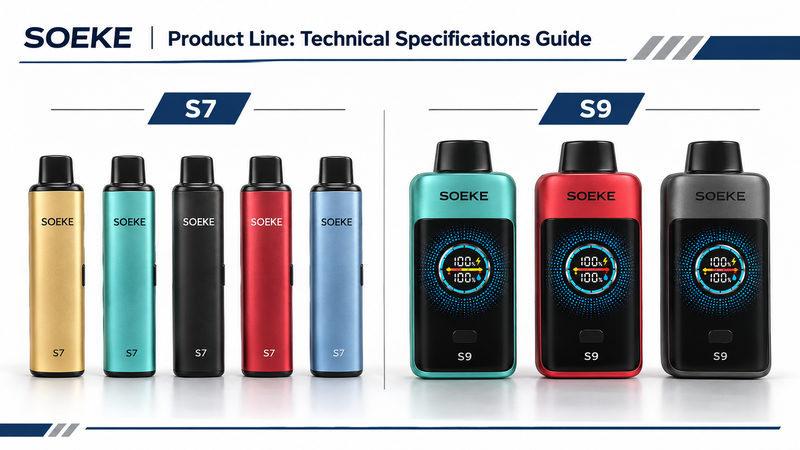
SOEKE currently presents two principal device families: the S7 and S9. The S7 uses a slim, pen-style format intended for straightforward portable use. Meanwhile, the S9 uses a broader body with a color display and selectable operating modes. SOEKE also displays a Liquid 01 category, although public technical documentation remains limited.
The principal market consists of existing adult smokers and adult vaping consumers. Specifically, these products are not industrial instruments, laboratory controllers, or general-purpose electronic components. Their typical application involves self-contained personal vaporization. Therefore, terms such as capacity, output, accuracy, and duty cycle require a different interpretation than industrial equipment terminology.
Identifying the correct configuration
Start with the complete model name printed on the retail package. For instance, “S9” alone may not identify its puff designation, operating modes, regional nicotine configuration, or production revision. Additionally, flavor names identify consumable variants rather than separate hardware models. Buyers should record the model, batch code, verification code, warnings, and distributor details.
- Model family: Confirm S7 or S9 before comparing specifications.
- Rating suffix: Check any printed puff designation or capacity statement.
- Regional version: Verify nicotine content, warnings, and lawful supply status.
- Revision: Compare package details with the latest manual or product sheet.
- Lifecycle status: Ask whether the configuration remains current or has been replaced.
Notably, retailer descriptions can conflict about charging methods and battery ratings. Therefore, never combine specifications from two sellers into one assumed configuration. Use manufacturer documentation covering the exact packaged unit. If SOEKE cannot confirm a value, classify it as not publicly documented rather than estimating it.
2. Model-by-Model SOEKE Technical Specifications
Physical specifications
The following comparison covers the current S7 and S9 families shown in SOEKE’s public portfolio. However, SOEKE does not publicly provide complete engineering drawings for either family. Dimensions, weights, enclosure polymers, mounting footprints, and component part numbers require written confirmation. Consequently, buyers should request a controlled datasheet before planning storage, transport, or display fixtures.
| Model | Format and enclosure | Dimensions and weight | Internal components | Connections and configurations |
|---|---|---|---|---|
| SOEKE S7 | Slim, pen-style body; exact material not publicly documented | Not published by SOEKE; confirm from the current datasheet | Integrated battery, liquid chamber, airflow sensor, and vaporizing element; component grades require confirmation | Draw-activated format; charging arrangement and regional variants must match the package |
| SOEKE S9 | Broader handheld body with color status display; exact material not publicly documented | Not published by SOEKE; confirm from the current datasheet | Integrated battery, display, liquid chamber, control electronics, and vaporizing system | Regular and Turbo modes; connection and charging details require configuration-level confirmation |
Neither device needs a permanent mounting footprint during normal handheld use. Even so, retailers need accurate package dimensions for shelving and shipping. Moreover, recycling contractors may request battery chemistry and material declarations. Ask SOEKE for those documents instead of identifying materials from appearance alone.
Performance specifications
| Model | Published capacity | Controls and response | Accuracy and tolerances | Operating limits |
|---|---|---|---|---|
| SOEKE S7 | Commonly identified as up to 6,000 puffs; treat this as an estimate | Automatic draw activation; response time is not publicly specified | Output accuracy, puff-count tolerance, and resolution are not published | Temperature, duty cycle, puff duration, and airflow limits require confirmation |
| SOEKE S9 | Up to 28,000 puffs in Regular Mode and 22,000 in Turbo Mode, according to published product materials | Selectable Regular and Turbo modes with a color status display | Display resolution, remaining-capacity accuracy, and output tolerance are not published | Maximum draw duration, duty cycle, temperature, and electrical limits require confirmation |
Puff ratings do not represent guaranteed service life. In fact, longer draws and higher-output settings can reduce the achieved count considerably. Ambient temperature, storage history, and airflow behavior also influence performance. Therefore, compare operating experience under similar conditions instead of relying only on the largest printed number.
3. SOEKE Product Comparison and Functional Differences
Side-by-side comparison
| Selection factor | SOEKE S7 | SOEKE S9 |
|---|---|---|
| Physical profile | Slimmer pen-style form | Broader screen-led form |
| Published puff designation | Up to 6,000 | Up to 28,000 Regular or 22,000 Turbo |
| User controls | Simple draw activation | Draw activation with selectable modes |
| Display | No comparable color display publicly listed | Color status display |
| Expandability | No modular expansion documented | No modular expansion documented |
| Environmental protection | No public ingress rating | No public ingress rating |
| Best fit | Compact, uncomplicated portable use | Higher stated capacity and visible status information |
The S7 prioritizes portability and simple operation. Conversely, the S9 offers a much higher stated puff count, two modes, and richer status information. However, the larger numerical rating does not automatically create better value. A short usage period may leave unused liquid or battery capacity when disposal becomes necessary.
Turbo Mode illustrates an important tradeoff. It offers stronger operation, yet its published puff estimate falls from 28,000 to 22,000. As a result, buyers exchange endurance for higher immediate output. Users who value predictable longevity may prefer Regular Mode, while others may value the alternative response.
Lifecycle cost also includes storage stability, failure risk, and compliant disposal. Moreover, a larger device may cost more even when its extra capacity remains unused. The S7 can make practical sense for buyers prioritizing size and simplicity. Meanwhile, the S9 better suits adults who actively use its display and mode controls.
4. Operating Parameters, Compatibility, and Installation
Power and system compatibility
These models operate as self-contained products rather than system-integrated modules. Therefore, buyers should not connect them to external controllers, laboratory supplies, or unsupported adapters. SOEKE does not publicly list communication protocols, programmable interfaces, or third-party software dependencies. The S9 display functions locally and does not establish general equipment compatibility.
Charging information needs special attention because seller descriptions can differ. Specifically, confirm whether the exact package includes a charging port and which input rating applies. Never assume that a familiar connector accepts every charger. Furthermore, use only the cable, adapter type, and electrical limits approved for that configuration.
- Confirm the input voltage and permitted charging current.
- Check whether a cable comes with the packaged configuration.
- Inspect the connector for contamination, moisture, or damage.
- Keep charging equipment away from combustible materials.
- Stop using any unit that becomes unusually hot or swollen.
Site, storage, and commissioning requirements
SOEKE does not publish complete temperature, humidity, altitude, vibration, or ingress-protection limits on its public pages. Consequently, keep unopened products in a cool, dry location away from sunlight. Avoid vehicles, windowsills, wet areas, and dusty workspaces. Also protect each unit from crushing, puncture, vibration, and uncontrolled heat.
No fixed mounting, grounding conductor, or ventilation duct normally applies to these handheld devices. However, battery safety still demands open airflow during any approved charging process. Maintain clearance from fabrics, paper, aerosols, and flammable liquids. Additionally, never charge or store a damaged device with normal inventory.
Commissioning should begin with a packaging inspection. Check seals, model markings, warning labels, verification codes, and visible damage. Next, follow the package instructions for activation and mode selection. If the device leaks, activates continuously, tastes burnt, or displays an error, isolate it and contact the supplier.
5. SOEKE Model Selection by Application
Representative use cases
The S7 suits adult users who prioritize a narrow profile and uncomplicated draw activation. For instance, it may fit occasional portable use where a display offers little practical benefit. The S9 suits heavier usage patterns requiring higher stated capacity and visible status information. Moreover, its two modes let users choose between endurance and stronger output.
Neither family should serve industrial, medical, laboratory, or safety-critical control applications. They also lack documented OEM interfaces, fieldbus support, calibration outputs, and enclosure ratings. Therefore, system integrators should treat them as finished consumer products only. Commercial buyers should focus on lawful retailing, storage controls, traceability, and battery disposal.
A retrofit decision usually means replacing another consumer device format. In that case, compare physical size, charging needs, nicotine labeling, and expected usage. Additionally, check whether existing storage racks and transport packaging suit the chosen model. Do not interpret flavor availability as hardware compatibility.
Buyer decision framework
- Application: Define expected daily use and preferred operating style.
- Performance margin: Allow for shorter real-world life than the headline puff estimate.
- Dimensions: Request verified device and package measurements.
- Materials: Obtain battery chemistry and material declarations when required.
- Environment: Confirm temperature, humidity, and storage restrictions.
- Compatibility: Verify charging inputs, cables, and regional configurations.
- Resources: Plan safe storage, inspection, handling, and disposal.
- Compliance: Confirm all local supply, labeling, and age restrictions.
- Accessories: Purchase only manufacturer-approved items.
- Availability: Confirm stock, flavors, lead time, and replacement policy.
- Total cost: Include purchase, shipping, failures, and disposal.
- Future needs: Decide whether extra capacity or display functions add measurable value.
Most importantly, document the final decision. Record which source supports every critical rating and when the supplier confirmed it. This simple step prevents assumptions from becoming purchasing specifications. It also makes later batch comparisons much easier.
6. Accessories, Configurations, Safety, and Compliance
Options and accessories
SOEKE does not publicly present a broad modular accessory system for the S7 or S9. No approved mounting kits, external sensors, controllers, or communication modules appear in the public portfolio. Consequently, avoid third-party modifications that bypass airflow, electronics, or battery protection. Such changes may create unpredictable electrical and thermal risks.
Potentially relevant items include approved cables, protective storage cases, retail display fixtures, and compliant battery-disposal containers. However, compatibility must come from the manufacturer or authorized distributor. A connector that physically fits may still deliver unsuitable power. Additionally, replacement internal cells, coils, or liquid chambers should not be improvised.
Safety and regulatory documentation
Nicotine is addictive, and these products are intended only for legally eligible adults. Furthermore, supply rules vary significantly by country and region. Australian buyers should verify current national, state, and territory requirements before purchase or resale. Product availability on a website does not prove lawful supply.
- Request electrical and battery safety documentation.
- Check electromagnetic compatibility records where applicable.
- Obtain transport documentation for lithium-battery shipments.
- Confirm ingredient disclosures and nicotine warnings.
- Verify regional markings, importer details, and batch traceability.
- Request environmental and recycling declarations when required.
Notably, SOEKE’s public pages do not establish every certification for every regional version. Therefore, buyers should not assume CE, RoHS, RCM, or other compliance from appearance. Ask for certificates naming the exact model and responsible manufacturer. Also confirm that certificate numbers remain valid with the issuing organization.
7. Maintenance, Troubleshooting, Warranty, and Documentation
Lifecycle care and fault checks
Routine care should remain simple and external. Keep the mouthpiece clean, inspect the enclosure, and store the unit upright when the instructions recommend it. Moreover, never puncture, dismantle, lubricate, or internally clean the device. These actions can expose liquid, energized components, and the battery.
- No activation: Check packaging instructions, airflow openings, and any displayed status.
- Weak output: Consider remaining capacity, selected mode, temperature, and airflow obstruction.
- Burnt taste: Stop use rather than repeatedly drawing from the device.
- Leakage: Isolate the unit and avoid skin or eye contact with the liquid.
- Unexpected heat: Move away from combustibles when safe and contact the supplier.
- Physical swelling: Do not charge, crush, ship, or place the unit in household waste.
Calibration and lubrication do not normally apply to these finished consumer devices. Furthermore, users should not replace internal batteries or vaporizing components unless official instructions explicitly permit it. Retailers should retain spare inventory by batch and monitor recurring faults. Repeated failures may indicate handling damage, storage problems, or a production issue.
Warranty and official support
Locate documentation through SOEKE’s official product, verification, contact, and wholesale channels. Request the latest datasheet, user instructions, safety file, compliance records, and written warranty terms. Specifically, match every document to the model code and package revision. Distributor assistance remains useful, but manufacturer confirmation should settle conflicting technical claims.
Before submitting a warranty request, record the batch code, purchase date, seller, fault symptoms, and storage conditions. Include photographs when the supplier requests them. However, do not mail a damaged lithium-battery product without approved shipping instructions. The warranty may exclude misuse, modification, impact damage, or unsupported charging equipment.
Conclusion
The correct SOEKE product should satisfy the required capacity, dimensions, environment, controls, installation conditions, compliance duties, and lifecycle support. It should not simply carry the highest puff rating. The S7 emphasizes a slim and simple format, while the S9 adds higher stated capacity, selectable modes, and a color display. However, missing engineering values still require direct confirmation.
Download the latest official SOEKE datasheets and manuals before ordering. Then complete the selection checklist and ask SOEKE or an authorized distributor to confirm the exact configuration. For local product assistance, contact VAPE CARE AU SHOP, 130 Carnarvon St, Silverwater NSW 2128, Australia. Additionally, you can call (+61) 451-708-145 to discuss availability and configuration details.







