
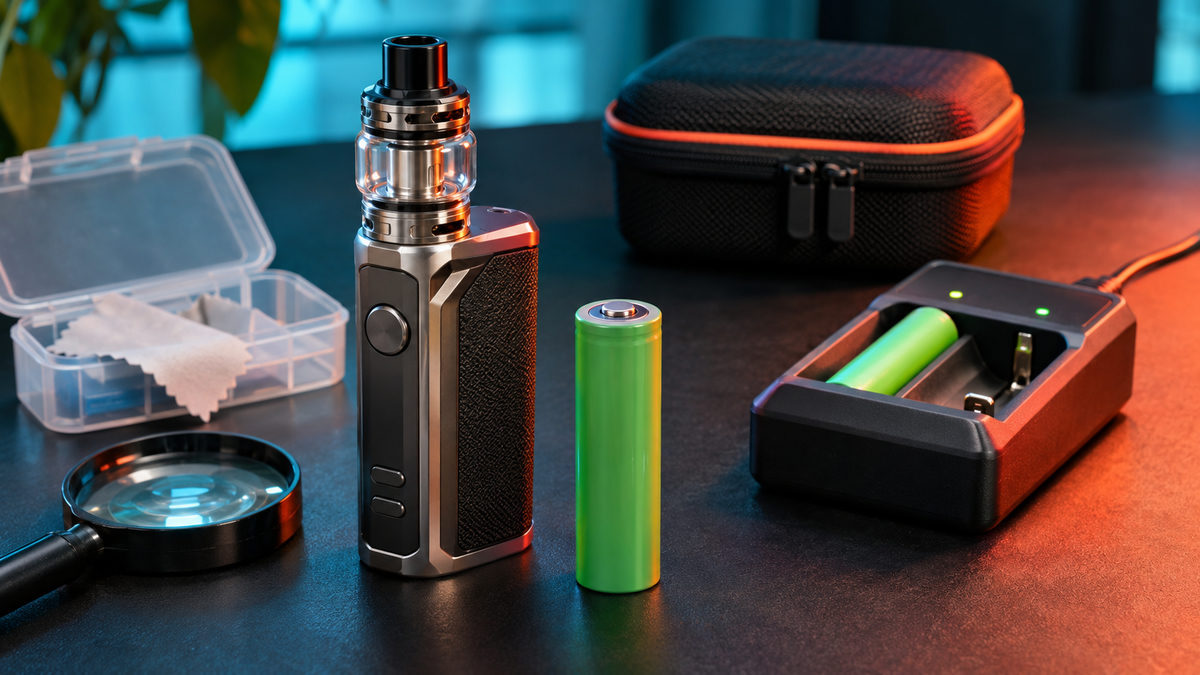
What happens when a pocket-sized battery releases all its stored energy in seconds? Lithium-Ion Battery Safety in Vaping Devices matters because a damaged cell can generate intense heat, smoke, or fire. Poor charging practices, metal objects, incompatible parts, and excessive current can quickly turn a small fault into an emergency.
Most battery incidents can be prevented when users recognize the warning signs and handle cells with care. This guide covers battery selection, charging, inspection, storage, transportation, replacement, emergency action, and responsible disposal. Above all, check your device manufacturer’s instructions before relying on general guidance.
1. Why Vape Batteries Can Overheat, Vent, or Explode
High Energy in a Small Cell
Lithium-ion batteries pack considerable energy into a compact, lightweight cell. That stored power lets a vaping device heat its coil almost instantly. The downside is that a damaged cell can also release a great deal of heat in very little time.
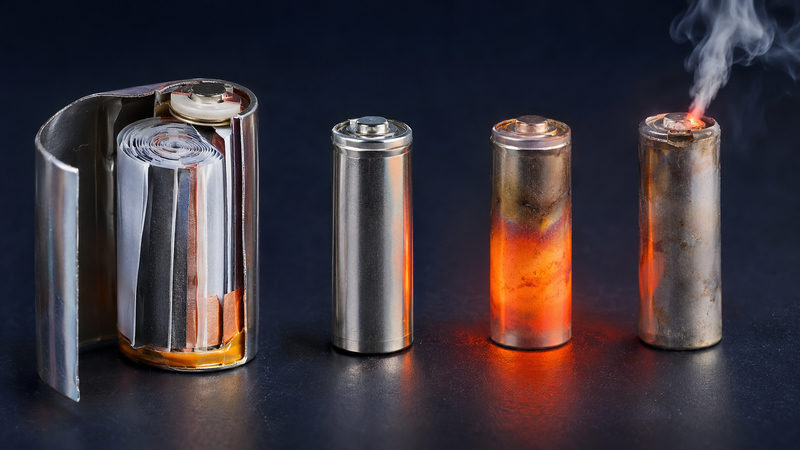
Inside the cell, thin layers separate the materials that hold and transfer electrical charge. If this separator fails, current may follow a path it was never meant to take. The battery can then heat up faster than its surroundings can cool it.
No lithium-ion battery is completely risk-free, even when used correctly. Manufacturing defects, age, concealed damage, or unexpected equipment failure can still create dangerous conditions. Safe handling habits matter throughout the battery’s working life.
Short Circuits and Common Failure Causes
An external short circuit occurs when conductive material directly connects a battery’s terminals. A coin, for example, can bridge the exposed terminals of a loose cell. The battery may release its stored energy almost at once, producing extreme heat or fire.
An internal short circuit forms inside the battery itself. A drop, crushing force, puncture, overheating, or manufacturing defect can damage the internal separator. Water exposure can also cause corrosion or create conductive paths within the equipment.
Several conditions can trigger a battery failure or make one worse:
- Charging beyond the cell’s safe voltage limit
- Drawing more current than the battery can safely provide
- Using damaged wraps, terminals, or insulating rings
- Installing a cell with reversed polarity
- Combining incompatible batteries, chargers, or devices
- Exposing equipment to water or excessive temperatures
When a cell vents, it releases pressure through its safety structure. Hot gas, smoke, electrolyte, or flammable material may escape. If the device is confined, pressure can build and make the event far more violent.
General advice should never override the instructions for your specific model. Device designs, battery arrangements, and charging systems differ widely. Follow every manufacturer warning, operating limit, and replacement requirement.
2. Lithium-Ion Battery Safety in Vaping Devices by Type
Built-In and Removable Batteries
Vaping devices generally use either built-in battery packs or removable lithium-ion cells. Neither option removes battery risk altogether. Each design simply gives the user a different set of responsibilities.
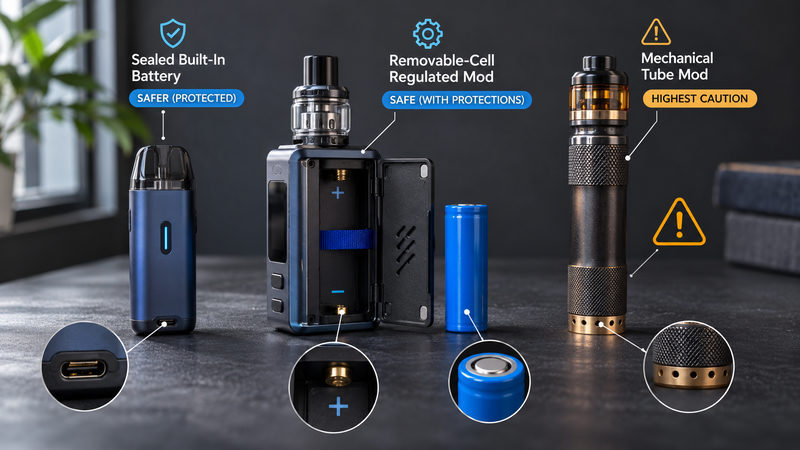
Built-in systems limit direct cell handling because the battery normally cannot be removed. Their safety still relies on healthy cells, functioning charging electronics, clean ports, and compatible power equipment. Damaged cables or faulty internal controls can still lead to overheating.
Stop using a built-in device if the case swells, separates, becomes unusually hot, or shows signs of impact damage. Do not open the housing to reach the battery unless qualified service guidance specifically allows it. Contact the manufacturer or a suitable recycling facility for safe handling instructions instead.
Removable cells demand closer inspection and more careful handling. Users need to select the correct format, observe polarity, and protect the outer wrap. Exposed terminals must never come into contact with coins, keys, jewelry, or other conductive objects.
Regulated and Mechanical Mods
Regulated mods use electronic circuits to manage power delivery. They usually provide protection against short circuits, excessive current, low voltage, and incorrect battery orientation. Those safeguards can fail, though, and they cannot compensate for every unsuitable battery choice.
Treat a warning screen or automatic shutdown seriously. Do not keep reactivating a device after it reports a battery or resistance fault. Disconnect it when safe, then investigate the cause by following the manufacturer’s instructions.
Mechanical mods connect the battery to the atomizer with little or no electronic protection. This means resistance and battery voltage directly control current demand. A short circuit or unsuitable coil can exceed the cell’s safe continuous discharge limit almost immediately.
Anyone using a mechanical mod needs advanced knowledge of electrical resistance, current calculations, voltage, and cell condition. Connection design and short-circuit prevention also need to be clearly understood. Even a small calculation error can push current demand far beyond a battery’s validated limit.
Without suitable technical knowledge and model-specific guidance, inexperienced users should avoid mechanical mods. Built-in protections in regulated equipment may reduce some hazards. Careful battery selection, charging, and inspection are still essential for every device type.
3. How to Choose the Correct and Authentic Vape Battery
Match Every Device Requirement
Begin with the device manufacturer’s battery specification—not an online recommendation or the color of a cell. Confirm the required size, chemistry, voltage, configuration, and current capability. Check whether the device calls for one cell, a matched pair, or another specific arrangement.
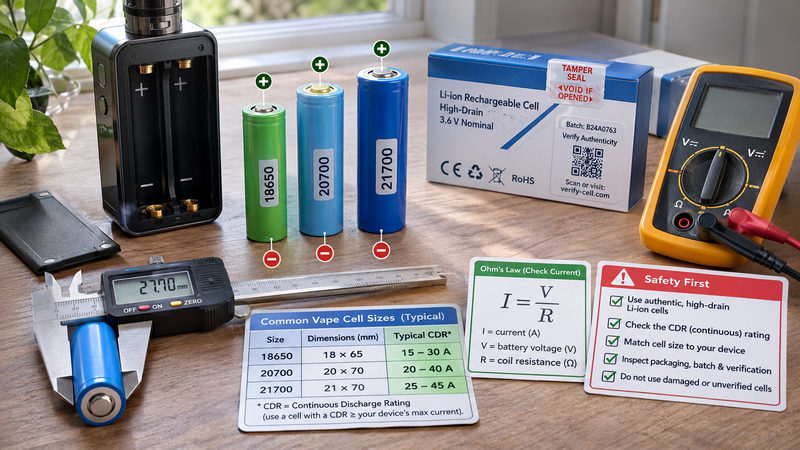
Common removable-cell formats include 18650, 20700, and 21700 cells. Those numbers indicate approximate physical dimensions, but they do not guarantee electrical compatibility. Never assume different formats are interchangeable simply because they look alike or can be pressed into place.
A cell can fit inside a compartment and still be wrong for the device. Its positive terminal design, chemistry, capacity, or discharge capability may not meet the required specifications. Forcing a battery into place can also damage the wrap and cause a dangerous short circuit.
The continuous discharge rating shows how much current a cell can deliver continuously within validated operating limits. Compare that verified figure with the device’s highest possible demand. Leave a sensible safety margin rather than running the battery at its limit.
Some labels feature pulse, burst, or maximum ratings in large print. Such figures may depend on poorly defined test periods, cooling intervals, or temperature limits. They are not a substitute for a dependable continuous discharge rating.
Avoid Counterfeit and Unknown Cells
Counterfeit, rewrapped, salvaged, and unknown-brand cells bring serious uncertainty. Their labels may overstate capacity or current performance. A damaged reclaimed cell can even be given a new wrapper that conceals its past.
Buy authentic batteries and chargers from reputable specialist retailers or authorized sources. A reliable seller should offer clear specifications, original packaging, and traceable product information. Marketplace ratings by themselves do not prove that a seller stocks genuine cells.
You cannot reliably confirm authenticity by appearance alone. Counterfeiters can copy wrapper colors, printed codes, warning text, and packaging. Legitimate manufacturers may also change production markings, which makes visual comparisons even less reliable.
Be wary of any cell claiming both exceptionally high capacity and unusually high current capability. Battery design typically involves tradeoffs among capacity, current performance, temperature, and service life. Extraordinary claims should be checked against dependable technical documentation.
Do not use a cell if its specifications or manufacturing history are unknown. Avoid batteries recovered from laptops, power tools, discarded packs, or damaged devices as well. They may contain hidden wear, mismatched characteristics, or weakened protective components.
Make sure the charger supports the selected cell chemistry and size. An adjustable charging bay may fit the battery physically without being electrically compatible. If information conflicts, follow the limits set by the battery and device manufacturers or consult a qualified specialist.
4. Safe Vape Battery Charging, Inspection, and Replacement
Create a Safer Charging Routine
Use chargers, cables, and power sources that are manufacturer-approved or demonstrably compatible. Just because a connector fits does not mean it supplies a suitable charging mode. Check the device manual before connecting fast-charging adapters, power banks, or replacement cables.
A device’s USB port may be suitable for charging when the manufacturer designed and approved it for that purpose. Some manufacturers, however, recommend using a quality external charger for removable cells. Follow that advice and choose a charger that monitors each bay independently.
Never leave batteries charging unattended or overnight. Charge them only while you are awake, close by, and able to respond quickly. Disconnect the equipment once charging is complete unless its instructions specify a different procedure.
Set chargers and devices on a stable, nonflammable surface. Keep them clear of bedding, sofas, carpets, paper, curtains, direct sunlight, and moisture. Children and pets should not be able to reach the cables, cells, or charging equipment.
Replace any frayed cable, bent plug, loose connector, or piece of equipment that becomes unusually hot. If a port needs cleaning, use only the method recommended by the manufacturer. Never put metal tools into a charging port or an energized charger.
Avoid overloaded extension leads and adapters that do not connect securely. Heat around a plug, socket, cable, or charger is a warning sign. Stop charging, disconnect the power when it is safe, and inspect the entire setup.
Inspect Before Every Installation
Inspect removable cells before charging or installing them. Look for tears, cuts, peeling edges, burns, dents, corrosion, or moisture on the outer wrap. Check the top insulator ring and both terminals for damage or contamination too.
Do not use a battery that appears swollen, crushed, punctured, rusty, wet, or discolored. Retire any cell that leaks, smells strange, makes noise, or grows abnormally hot. Even a small tear in the wrap can expose conductive metal and cause a short circuit.
Look inside the device’s battery compartment for debris, damaged contacts, or sharp edges. Check the polarity symbols before inserting the cell. Never force a battery into a device or charger.
Manage Multi-Cell Sets Correctly
Multi-cell devices often call for married batteries. In practice, this means purchasing identical cells together and keeping them as one permanent set. Charge, install, rotate, and retire them together so their age and usage remain similar.
Label each set without harming the wraps. Never mix cells from different brands, models, capacities, ages, or usage histories. If one cell becomes damaged, weak, or significantly degraded, replace the whole set.
Battery performance naturally declines with age and repeated charging. Reduced runtime, unusual voltage differences, and extra heat can all point to deterioration. Replace questionable cells before they fail instead of trying to squeeze more life from them.
5. Safe Storage and Transport of Vape Batteries
Prevent Contact With Metal Objects
Never carry loose removable cells in a pocket, purse, backpack, toolbox, or bag. Keys, coins, jewelry, and tools can connect the terminals. A short across the terminals can create severe heat before you have a chance to react.
A shorted cell may vent, set nearby material alight, or cause an explosion. A bag or item of clothing can also trap heat against the body. Keep each spare cell secured in its own dedicated nonconductive battery case.
The case needs to cover the terminals completely and stop the cell from moving around. Check it for cracks, damaged hinges, or missing closures. Never store damaged cells in the same case as healthy batteries.
Control the Storage Environment
Keep batteries in a cool, dry, well-ventilated place. Store them away from direct sunlight, combustible materials, water, humidity, radiators, and cooking areas. Choose a secure location that children and pets cannot reach.
Never leave a vaping device or battery in a hot vehicle. Temperatures inside can climb rapidly, even on a mild day. Freezing conditions can also harm performance and may cause condensation when the battery is brought back indoors.
During transport, protect devices and cells from drops, vibration, crushing, and punctures. Lock the device or turn it off so it cannot activate accidentally. Where possible, remove the batteries in line with the manufacturer’s transport instructions.
Do not position cells where other luggage can press switches or tear battery wraps. Have proper protective cases ready before setting out. A plastic bag or paper wrapper cannot protect the terminals reliably.
Airline and transport requirements may change. The rules can differ for installed batteries, spare cells, carry-on luggage, and checked baggage. Check the latest carrier and government requirements before departure instead of relying on what applied during an earlier trip.
6. What to Do During Battery Overheating, Venting, or Fire
Recognize the Warning Signs
Unusual heat, swelling, leaking, hissing, popping, smoke, or visible venting are urgent warning signs. A sharp smell, discoloration, or unexpected device activation also needs immediate attention. If the temperature is rising quickly, an internal failure may already be escalating.
Stop using or charging the device at once. Disconnect external power only if you can do so without moving close to dangerous heat, smoke, or flames. Do not directly touch a battery that is hot, swollen, smoking, or venting.
Do not hold the device while examining it at close range. Never put a failing battery in a pocket, ordinary bin, or enclosed drawer either. Doing so can cause burns and give the heat a chance to ignite nearby materials.
Protect People and Get Help
Back away from the incident and alert anyone nearby. If smoke, fire, or continued heating creates a hazard, evacuate the area. This limits exposure and leaves emergency responders enough space to work.
Call emergency services if there is fire, heavy smoke, spreading heat, or an escalating incident. Follow local fire-service advice, since the right firefighting response depends on the location, equipment, and surrounding materials. If you are unsure what to do, do not improvise.
Smoke and vapors from a battery may contain hazardous substances. Avoid breathing them and move into fresh air without passing through smoke. Stay out of the affected area until emergency personnel confirm that it is safe to return.
Never pick up, puncture, crush, open, or dismantle a failed cell. Do not try to recharge or reuse it once it has cooled. Internal damage may remain active, causing the battery to heat up again later.
Get prompt medical guidance after a burn, electrolyte contact, or smoke inhalation. Flush exposed skin or eyes as directed by emergency medical instructions. Tell medical professionals immediately about breathing difficulty, persistent coughing, dizziness, or worsening pain.
Even after cooling, a battery can remain a fire and chemical hazard. Isolate the area and follow instructions from the fire service, manufacturer, or an approved waste facility. Never put the failed battery in household rubbish or a standard recycling bin.
7. Daily Vape Battery Safety Checklist
- Inspect the device, wrap, insulator ring, terminals, charging port, cable, and charger before use.
- Use authentic, compatible batteries within verified continuous discharge limits.
- Confirm correct orientation and never force a cell into a device or charger.
- Charge only while awake and present on a stable, nonflammable surface.
- Keep charging equipment away from bedding, paper, moisture, children, and pets.
- Stop using batteries that become hot, wet, swollen, leaky, noisy, damaged, or odorous.
- Carry spare cells only in dedicated nonconductive cases, away from metal objects.
- Store batteries away from heat, freezing conditions, sunlight, moisture, and combustible materials.
- Keep married sets together and replace every cell when one becomes damaged or degraded.
- Recycle retired batteries through an approved collection facility, never household waste.
- Review manufacturer instructions and current travel rules whenever your equipment or circumstances change.
Conclusion
Safe battery use starts with authentic, compatible cells and verified current limits. It also depends on routine inspection, supervised charging, protected transportation, and careful storage. Built-in protections can reduce certain risks, but they cannot prevent every failure.
Prevent terminal short circuits and retire damaged batteries straight away. Keep questionable cells out of normal waste while you arrange approved recycling. Responsible disposal helps protect waste workers, recycling equipment, property, and the environment.
Take a moment to inspect your device and every removable battery today. Replace or safely isolate anything that looks questionable, then check the manufacturer’s instructions. Find an approved battery-recycling facility before you need one, so damaged or exhausted cells never end up in household rubbish.







