What happens inside a KUZ vape between an inhale and the aerosol reaching the mouthpiece? KUZ Vape Technology: Device Components Explained reveals a rapid sequence involving air pressure, electronics, liquid, and controlled heat. Product labels may promote battery capacity, puff estimates, or coil technology, yet those numbers rarely tell the complete story.
In fact, performance depends on several connected systems working correctly. This guide explains those systems, their operating sequence, common problems, routine care, safety, and responsible disposal. However, specifications differ between models, so always check the exact packaging and manufacturer instructions.
1. KUZ Vape Technology: Device Components Explained
KUZ vape technology combines electrical, heating, liquid-delivery, airflow, sensing, and user-interface systems. Together, these parts turn stored electrical energy and e-liquid into an inhalable aerosol. Moreover, the housing supports these systems while protecting them from everyday handling.
KUZ products may include sealed disposables, rechargeable disposables, reusable pods, or other documented formats. However, a rechargeable device is not automatically refillable or repairable. Specifically, charging capability only means the battery can receive power through its intended charging system.
Editorial note: Confirm every model-specific claim using its manual, packaging, or official manufacturer documentation. Broader explanations below describe general vape-device technology and may not apply to every KUZ model.
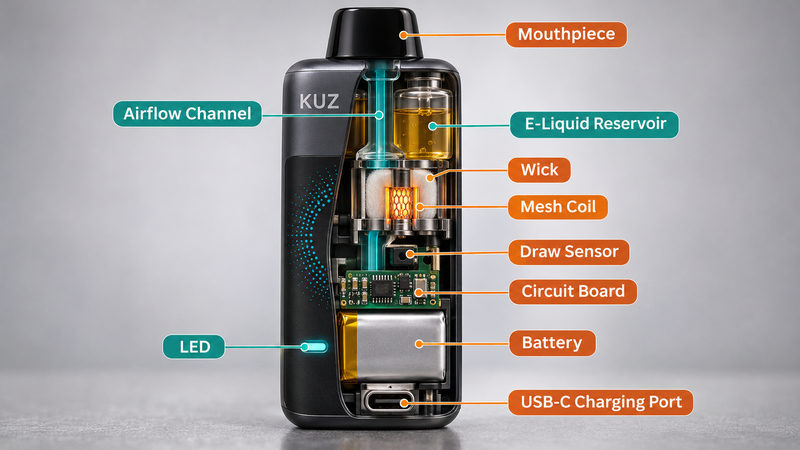
Labeled component overview
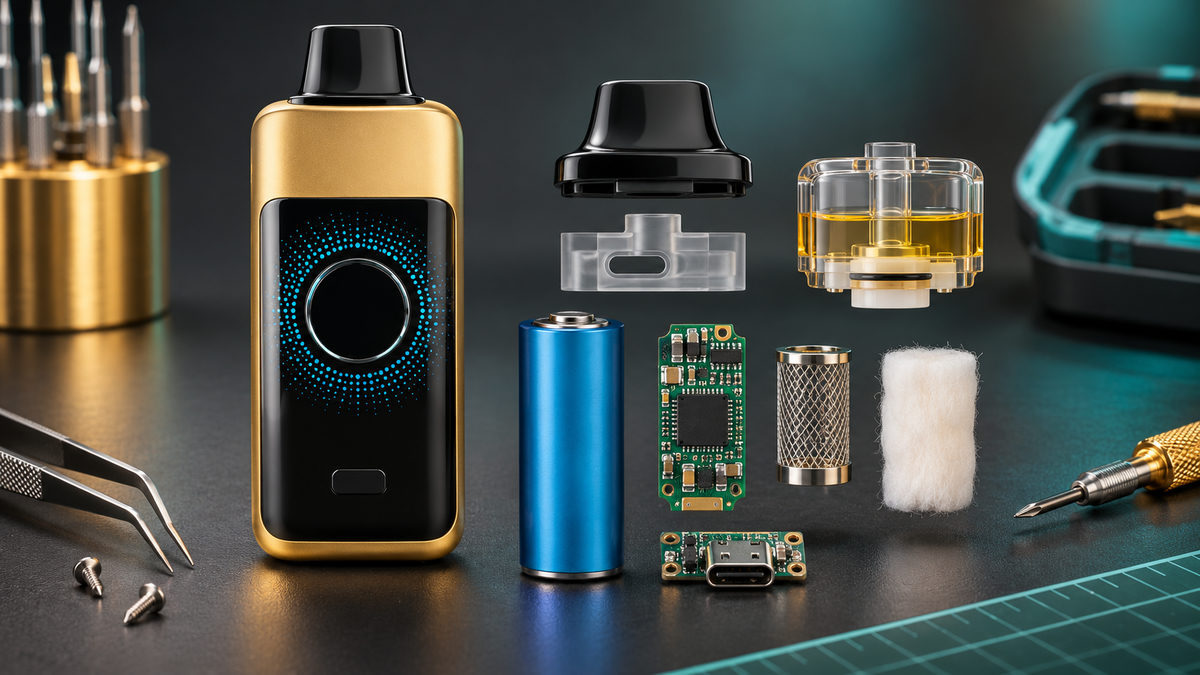
- Battery: Stores electrical energy and supplies power during each draw.
- Chipset or circuit board: Processes signals and manages power delivery.
- Activation sensor: Detects airflow or a pressure change during inhalation.
- Coil: Converts electrical energy into heat.
- Wick: Carries e-liquid from the reservoir toward the coil.
- Reservoir: Holds e-liquid in a sealed chamber, pod, or tank.
- Airflow channel: Guides incoming air around the heated coil.
- Mouthpiece: Directs the resulting aerosol to the user.
- Indicators: Communicate activation, battery status, or possible faults.
- Charging system: Manages incoming power on rechargeable models.
Additionally, seals help contain liquid and control the airflow path. Electrical contacts connect compatible pods, coils, batteries, or charging circuits. Meanwhile, heat-resistant internal materials separate warm components from the housing and other sensitive parts.
2. How a KUZ Vape Device Works From Inhalation to Aerosol
An inhale draws air through one or more inlets and changes pressure inside the device. Next, the draw sensor sends a signal to the control board. As a result, the board allows the battery to deliver regulated power to the heating coil.
Meanwhile, the wick keeps the heating area supplied with e-liquid through capillary action. Its tiny internal spaces pull liquid from the reservoir without requiring a pump. However, the wick must remain adequately saturated before and during heating.
From controlled heat to aerosol
The energized coil heats nearby e-liquid until volatile ingredients form tiny airborne droplets. These droplets create an aerosol containing the liquid’s ingredients and possible thermal by-products. Therefore, calling the output harmless water vapor would be inaccurate.
Incoming air passes through the inlet and travels around or through the coil assembly. Furthermore, that moving air cools the coil and carries aerosol into a central channel. The combined stream then exits through the mouthpiece.
Most compact devices use draw activation, which requires no separate firing control. However, some reusable formats may include a manual button where documented. A button can initiate heating before or during inhalation, depending on the model’s operating design.
Control circuitry may also limit unusually long draws. For instance, power may stop after a preset number of seconds, even while inhalation continues. This cutoff can reduce overheating, protect the coil, and prevent accidental continuous activation.
Notably, the entire process happens within seconds. A typical sequence includes sensing, power regulation, heating, aerosol transport, and automatic shutdown. Therefore, weak performance in one component can affect the complete experience.
3. Battery, Chipset, Charging, and Built-In Safety Systems
Battery capacity appears in milliamp-hours, commonly shortened to mAh. A higher figure generally stores more charge under comparable conditions. However, capacity alone cannot predict vapor output, flavor, device quality, or exact operating time.
Runtime also depends on output power, coil resistance, and individual draw length. Additionally, frequent use consumes stored energy faster than occasional use. Cold temperatures, battery age, and repeated charging cycles can further reduce practical runtime.
Puff estimates involve similar variables. For example, two users may take three-second and six-second draws from identical devices. As a result, the second user will usually consume more battery energy and e-liquid per puff.
The chipset as the control center
The chipset processes sensor input and controls voltage or power delivery to the coil. Moreover, it may operate lights, screens, liquid alerts, and fault indicators. In rechargeable products, the circuitry can also supervise charging and battery voltage.
Possible protections include short-circuit, overheating, overcharge, over-discharge, low-voltage, and puff-duration safeguards. However, never assume every KUZ device includes every protection. Check model-specific documentation before relying on any named safety feature.
Even protective electronics cannot eliminate all battery risks. Specifically, damaged cells, liquid intrusion, unsuitable chargers, or extreme heat can defeat normal safeguards. Therefore, users should treat physical condition and charging practices as essential safety factors.
Charging connections and indicators
Rechargeable models may use USB-C charging when the manufacturer documents that connection. The port transfers power to charging circuitry, which controls current and battery voltage. However, a matching plug shape does not prove that every power source is suitable.
Use the charging equipment and electrical ratings specified for the exact device. Additionally, keep the port clean, dry, and free from bent contacts. Never force a connector or continue charging a device that becomes unusually hot.
An LED may illuminate during inhalation, charging, or low-battery conditions. More advanced displays may show charge level, liquid status, puff information, or fault codes. Nevertheless, colors and blinking patterns vary, so consult the relevant instructions before interpreting them.
4. Coil, Wick, Reservoir, and Airflow Performance
The coil converts electrical energy into controlled heat at the e-liquid contact area. Its resistance, measured in ohms, influences current flow and suitable operating power. Therefore, the board, battery, and coil must function as a coordinated system.
Conventional wire and mesh coils
A conventional coil commonly uses wound resistance wire. By contrast, a mesh coil uses a perforated or woven heating surface. Mesh usually contacts more wick area, which can distribute heat more evenly under suitable operating conditions.
That larger surface may support quicker ramp-up, stronger vapor output, and steadier flavor. Moreover, even heating may reduce isolated hot spots and extend useful life. However, liquid formulation, power control, wick quality, and usage habits also affect longevity.
Resistance alone does not prove which design will perform better. Specifically, manufacturers tune airflow, liquid supply, power, and surface area together. Therefore, compare complete device specifications instead of judging only one coil number.
Wicking and common liquid-delivery problems
The wick draws e-liquid toward the heating surface through capillary action. Sufficient saturation helps the coil heat liquid instead of scorching dry wick material. Consequently, a newly filled replaceable pod may need a short soaking period before use.
- Dry hit: Too little liquid reaches the coil during heating.
- Burnt taste: The wick may have scorched or reached the end of its life.
- Flooding: Excess liquid enters the coil chamber or central airflow path.
- Spitback: Heated droplets travel through the mouthpiece instead of forming a smooth aerosol.
- Gurgling: Liquid obstructs normal airflow around the coil.
Chain use can outpace the wick’s ability to resaturate. Meanwhile, overfilling, damaged seals, condensation, or pressure changes may cause flooding. As a result, changing draw force alone may not correct the underlying problem.
Reservoir and airflow design
Sealed devices contain a factory-filled reservoir that users should not open. Reusable products may instead use cartridges, refillable pods, or tanks. However, never puncture or modify a sealed reservoir to imitate a refillable design.
Capacity determines how much liquid the reservoir can hold, not how efficiently it operates. Additionally, a practical refill system needs a secure fill port, reliable seals, and useful liquid visibility. Clean electrical contacts also help removable pods maintain a stable connection.
Anti-leak design may combine gaskets, chamber geometry, absorbent barriers, and controlled pressure paths. Nevertheless, no compact liquid system remains leak-proof under every condition. Heat, altitude changes, cracked plastic, loose plugs, or prolonged sideways storage can encourage leakage.
Air inlet placement and channel size shape draw resistance and cooling. Wider airflow can produce a cooler, airier draw with greater volume. On the other hand, restricted airflow may feel warmer and can make flavor seem more concentrated.
Blocked inlets can reduce vapor and raise operating temperature near the coil. Therefore, keep airflow openings clear without inserting sharp objects. Furthermore, never cover ventilation openings while using or charging the device.
5. Replaceable Parts, Maintenance, and Troubleshooting
Reusable models may support replaceable pods, separate coils, or refillable reservoirs. In contrast, sealed disposables generally contain no user-serviceable internal parts. Therefore, never dismantle a battery compartment or pry open a sealed housing.
Routine care and replacement signs
Wipe the mouthpiece and exterior with a clean, slightly damp cloth. Additionally, clean accessible pod contacts with a dry, lint-free material. Keep airflow openings unobstructed, but avoid pushing tools into internal channels.
Store the device upright in a dry place when practical. Moreover, protect it from direct sunlight, water, impacts, extreme cold, and excessive heat. Keep every device and e-liquid container away from children and pets.
Replace a serviceable pod or coil after persistent burnt flavor, weak output, or repeated leaking. Stop using the complete device after cracks, corrosion, swelling, unreliable activation, or unusual heat. Specifically, battery swelling demands immediate isolation from heat and combustible materials.
Quick troubleshooting guide
- Weak vapor: Check battery charge, airflow blockage, liquid level, pod seating, and coil age.
- No activation: Confirm the battery has charge and clean accessible pod contacts.
- Leaking: Inspect the pod, fill plug, seals, liquid level, and storage position.
- Gurgling: Look for flooding or condensation and follow the manufacturer’s clearing instructions.
- Burnt taste: Stop immediately, allow resaturation, or replace the serviceable coil or pod.
- Charging failure: Inspect the cable, compatible power source, port condition, and indicator pattern.
- Blinking indicator: Consult the model guide because patterns may represent different faults.
- Unexpected heat: Stop using and charging the device, then move it away from combustible items.
Do not keep testing a damaged, wet, swollen, leaking, or overheating device. Furthermore, do not attempt an internal repair, battery replacement, or improvised wiring fix. Instead, follow the supplier’s support process and local disposal guidance.
For model-specific replacement or care assistance, contact VAPE CARE AU SHOP. The shop is located at 130 Carnarvon St, Silverwater NSW 2128, Australia. Additionally, you can call (+61) 451-708-145.
6. Safe Use, Responsible Disposal, and Component FAQ
Use only compatible charging equipment with the correct electrical specifications. Furthermore, charge on a stable, dry, non-combustible surface with unobstructed ventilation. Inspect the device, cable, plug, and charging port regularly for damage.
Lithium batteries, circuit boards, pods, and residual e-liquid require responsible handling. Therefore, never place them in fire or casually discard them where local rules prohibit disposal. Follow local battery, electronic-waste, or household hazardous-waste programs.
Residual nicotine liquid can harm people or animals through swallowing or skin exposure. Consequently, contain leaking items carefully and keep them away from children and pets. Follow local guidance for packaging contaminated devices before transport.
Adult-use warning: Vaping products are not risk-free. Minors, non-users, pregnant people, and anyone advised to avoid nicotine should not use them. Additionally, adults should review product warnings and seek professional health guidance when needed.
Concise component glossary
- Battery capacity: Stored electrical charge, usually stated in milliamp-hours.
- Chipset: The electronic control system managing sensing, power, indicators, and charging.
- Coil resistance: Opposition to electrical current, measured in ohms.
- Mesh coil: A broad, perforated heating element designed for greater wick contact.
- Wick: Absorbent material that carries e-liquid toward the coil.
- Pod: A removable or integrated unit holding liquid and sometimes the coil.
- Reservoir: The chamber that stores e-liquid.
- Airflow: The controlled air path through the device.
- Draw sensor: A component that detects inhalation and signals activation.
- Puff count: An estimate influenced by draw length, power, liquid, and testing conditions.
Component FAQ
Can I replace parts in every KUZ vape? No. Only replace or refill components that the exact model documentation identifies as serviceable.
How long should the battery last? Runtime depends on capacity, output, resistance, draw duration, temperature, usage frequency, and battery age. Therefore, two users can receive different results.
Why does the puff estimate differ from my experience? Published estimates rely on specific testing conditions. Longer or more frequent draws consume battery energy and e-liquid faster.
What causes a burnt taste? Common causes include an undersaturated wick, an empty reservoir, rapid repeated use, or an exhausted coil. Stop using the device until you identify the cause.
Why is my device leaking? A damaged seal, overfilling, heat, pressure changes, cracks, or sideways storage may contribute. However, persistent leakage usually requires pod or device replacement.
How can I charge safely? Use compatible equipment and monitor the device on a stable surface. Additionally, stop charging if you notice swelling, unusual heat, odor, damage, or liquid near the port.
Can I recycle the complete device? Local rules vary because devices combine batteries, electronics, plastic, and residual liquid. Therefore, ask an approved battery or electronic-waste facility before dropping it off.
Conclusion
KUZ vape performance depends on coordinated electrical, heating, liquid-delivery, airflow, sensing, and safety systems. Understanding each component helps adults interpret specifications, recognize faults, and maintain serviceable parts. Moreover, that knowledge supports safer handling and more responsible disposal.
Check the exact KUZ model manual or packaging before charging, refilling, replacing components, troubleshooting, or disposing of the device. For further assistance, contact VAPE CARE AU SHOP at 130 Carnarvon St, Silverwater NSW 2128, Australia. Alternatively, call (+61) 451-708-145.