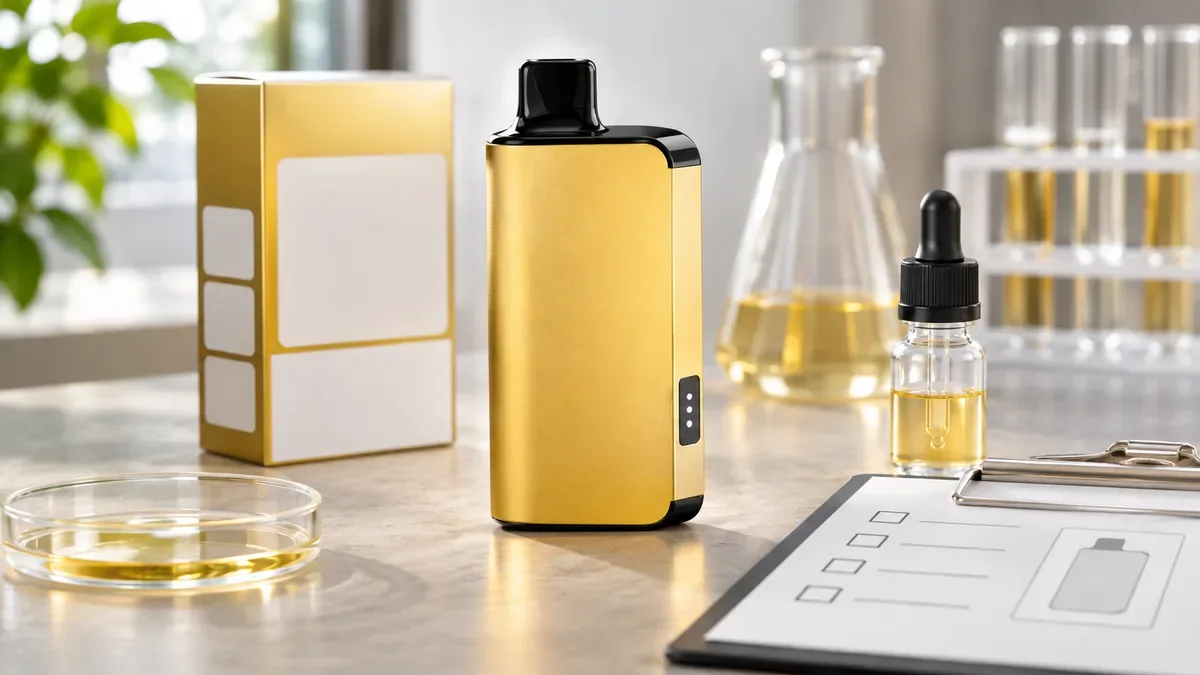
If the carton and retailer listing show different nicotine figures for the ALIBARBAR INGOT 9000 Puffs, which describes your unit? Understanding ALIBARBAR INGOT 9000 Puffs: Nicotine Content and Labelling Requirements starts with matching the claim to the carton. For instance, a listing can mix variants or markets, and two percentages can use different measurement bases. Meanwhile, the advertised puff count gives you no nicotine concentration.
Start with the strength printed on the carton and check which variant it describes. Then look for the original liquid fill volume if you need to calculate how much nicotine the liquid contains. In Australia, also check the packaging standard and whether the product qualifies for lawful supply.
ALIBARBAR INGOT 9000 Puffs Nicotine Content and Labelling
Identify the exact variant and market
Set the carton beside the listing and read the full product name on both. Next, compare the flavour or variant, including any extra wording that identifies a particular version. Meanwhile, look for a stock keeping unit, or SKU, in the listing or order details. If the carton carries a product code, ask the seller how it maps to the listing’s SKU.
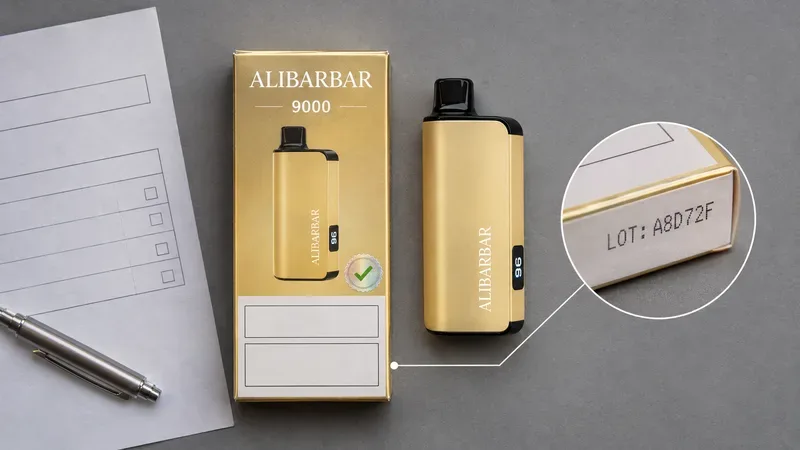
Then look for the lot or batch code on the carton. The lot identifies a production batch and gives the manufacturer a way to trace the unit. For instance, a seller may use one listing for several shipments while the cartons carry different lot codes. Record the code exactly, including any letters, leading zeroes or separators.
Also check which country or market the manufacturer intended the pack for. A local storefront or Australian dollar price tells you where the seller markets the listing. For stronger evidence, look for market information on the carton or ask the responsible supplier to confirm it. Additionally, save any packaging details that help the supplier identify the unit.
A shared model name alone leaves the strength question open. For example, two listings might both say INGOT 9000 and show the same flavour. However, a shared photo or product name cannot establish that the descriptions refer to the same version. Match the identifiers before carrying a strength claim from one listing to another.
Verify the declared strength
The available sources did not establish a nicotine figure from a verified carton or variant-specific manufacturer document. Therefore, the declared strength remains unverified in this guide. Treat any retailer figure as a lead and ask which carton or product specification supports it. Even several listings may repeat the same catalogue description.
If you obtain a readable carton or a matching manufacturer document, transcribe the strength and unit exactly as shown. For instance, keep any decimal point, percentage basis or wording that identifies the form of nicotine. Additionally, record the variant, intended market and source alongside the figure. Include the lot if the source ties the declaration to a specific batch.
Keep the original wording even if you later convert the figure into another unit. This gives you a record to compare with a corrected listing or a written reply from the manufacturer. Finally, describe the figure as the declared strength when the evidence comes from a label or specification. A test result would address the concentration measured in a particular sample.
How to Convert Vape Nicotine Percentage to mg/mL
Check the percentage basis
Milligrams per millilitre, written as mg/mL, measures how much nicotine each millilitre of liquid contains. A percentage needs a little more context because it can describe nicotine relative to volume or mass. Therefore, read the words or abbreviations next to the percentage before converting it.
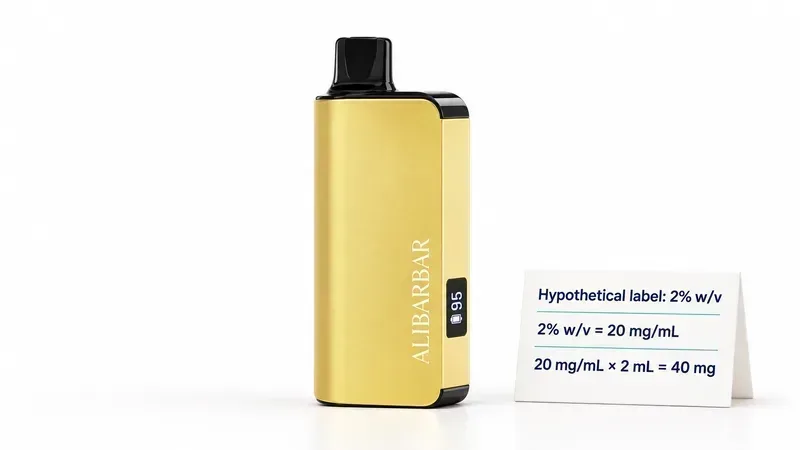
For a weight-by-volume value, look for w/v or an explanation that uses grams per 100 mL. Specifically, 1% w/v means 1 gram per 100 mL. That equals 1,000 milligrams divided by 100 millilitres, or 10 mg/mL. Therefore, multiply a confirmed w/v percentage by 10 to get the concentration in mg/mL.
However, a weight-by-weight percentage, or w/w, gives grams per 100 grams of liquid. To express that result per millilitre, you also need the liquid’s density in grams per millilitre. For instance, 2% w/w gives 20 milligrams per gram of liquid. Multiply that figure by the confirmed density to get mg/mL.
If a label gives a bare percentage, ask the manufacturer which basis it uses. Also ask whether the number refers to nicotine equivalent or the mass of the nicotine salt. The salt includes another chemical component, so those figures describe different quantities. Therefore, use the manufacturer’s confirmed nicotine equivalent when comparing it with a figure stated on that basis.
Calculate total nicotine in the liquid
Once you have a confirmed nicotine concentration, find the original fill volume for the same variant. Multiply the concentration in mg/mL by the fill volume in mL. The millilitre units cancel, leaving the amount of nicotine in milligrams. Additionally, check that the volume describes the original liquid fill, especially when a specification lists several capacities.
Hypothetical example. Suppose a label declares nicotine at 2% w/v and specifies an original fill of 2 mL. First, multiply 2 by 10 to get a concentration of 20 mg/mL. Then multiply 20 mg/mL by 2 mL to get 40 mg of nicotine in the liquid. These example figures illustrate the calculation and do not describe the INGOT 9000.
However, the result estimates what the liquid originally contained using the declared concentration and fill volume. The amount of nicotine that reaches the user depends on aerosol delivery and how the person uses the device. Additionally, the body absorbs only a portion of the nicotine delivered in aerosol. Consequently, the concentration and fill volume cannot establish an absorbed dose.
What the Advertised 9000-Puff Count Means
Read the number as a use estimate
The 9000 figure is an advertised estimate of how many draws the device can provide. To understand the estimate, look for a manufacturer test protocol tied to that version. Specifically, check whether it gives the length of each draw, the interval between draws and the test endpoint. The available sources did not verify those conditions for the rating.
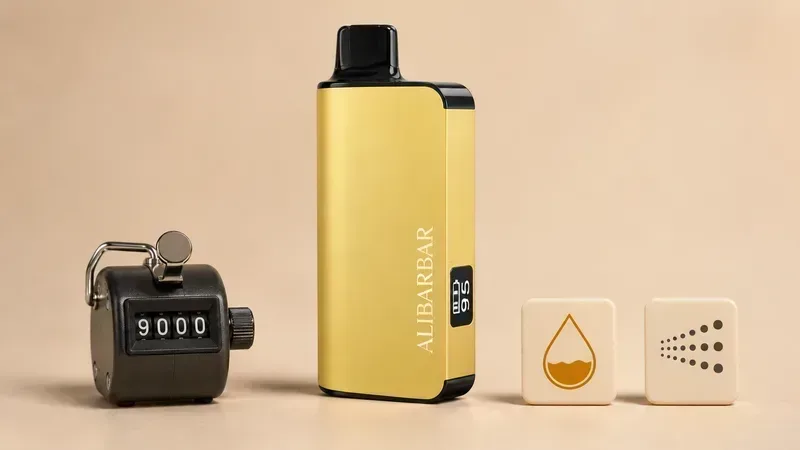
In practice, a longer draw can use more liquid than a shorter one. Moreover, battery performance and how the heating element operates can affect how long a device keeps producing aerosol. For instance, a device may stop producing usable aerosol with some liquid still inside. Therefore, two people using the same version can get different draw counts.
Keep puff counts separate from nicotine figures
The puff rating supplies neither the concentration nor the fill volume needed to calculate total nicotine in the liquid. For instance, devices with the same advertised draw count can hold different amounts or strengths of liquid. Start with the nicotine declaration and fill volume if you want to work out the amount in the original fill.
Even with both figures verified, dividing total liquid nicotine by 9000 gives only a mathematical average against the advertised count. That calculation assumes the original nicotine is spread evenly across those draws. However, the device can leave liquid behind, and aerosol output can vary between draws. As a result, that average cannot tell you how much nicotine any given draw delivers or the body absorbs.
Nicotine Disclosures and Warning Statements on Australian Vape Packaging
Identify the product type and label surface
For Australian therapeutic vaping goods, start with Part 5 of the Commonwealth standard known as TGO 110. First, identify the product type and the layer of packaging you are examining. The primary pack is the complete pack supplied to the customer. Meanwhile, the immediate container holds the substance, and some products also have an intermediate layer.
Next, find the main label, where the product name appears most prominently. A pack can have more than one main label when the name appears with equal prominence on multiple surfaces. Where the standard calls for the product name and strength together, check immediately below the name. The word nicotine and its concentration should appear on one line there.
Check that the declaration uses mg/mL. Specifically, a nicotine salt product declares the equivalent nicotine base concentration, while a nicotine base product declares its base concentration. For nicotine-free products, look for “nicotine 0 mg/mL.” Also compare the primary pack and immediate container with the provisions for each surface.
Text size depends on the label category. For instance, the TGA lists a 3 mm minimum for the product name and strength on a standard primary pack. Its table gives 2 mm for those details on small container labels and 1 mm for required very small container text. Check the relevant provisions and ask your state or territory regulator about additional requirements. TGA product standards and labelling guidance
Check warning wording and presentation
For products containing nicotine, find the warning panel on the applicable main label of the container and primary pack. This includes therapeutic vaping kits and packs where the general rule applies. Specifically, the panel must take up at least 30% of the total main label size under that rule. Check the full main label area before judging the panel’s share.
The prescribed warning reads “THIS PRODUCT CONTAINS NICOTINE, WHICH IS A HIGHLY ADDICTIVE SUBSTANCE.” Look for bold, uppercase, sans serif lettering in black on a white background. Additionally, the letters should have consistent size and thickness and face the same direction as the product name. The text should fill the panel as much as possible.
However, check the specific provisions before applying the general panel rule to size-restricted packaging. For instance, the TGA’s small container example calls for a bold warning statement, and very small containers have fewer required particulars. Check the outer pack separately if the product has one. For nicotine-free products, consult the applicable provisions for any other required warnings. TGA warning statement panel guidance
Australian Nicotine Limits and Rules on Lawful Supply
Check composition limits by product category
First, look up the standard that applies to the product category. For therapeutic vaping substances, including liquid in a therapeutic vaping substance accessory, TGO 110 sets a 50 mg/mL composition ceiling. That ceiling applies to nicotine or its equivalent in base form. For a salt product, use the equivalent base concentration when checking the limit.
Separately, 20 mg/mL is the threshold for pharmacist-only supply of eligible therapeutic vapes without a prescription. That pathway applies to adults aged 18 or older, subject to pharmacist assessment and state or territory law. Higher strengths require a prescription, and some jurisdictions require one even at or below 20 mg/mL.
For instance, a therapeutic vape at 25 mg/mL falls below the composition ceiling but requires a prescription. The product and the pharmacy supply must also meet the applicable requirements. Meanwhile, outside Australia, check your own regulator for concentration limits and access rules by product type. TGA therapeutic vape product standards
Check whether the product can be supplied
Australia prohibits commercial supply of disposable single-use vapes, including nicotine-free versions. Australian pharmacies may supply eligible therapeutic vapes for smoking cessation or the management of nicotine dependence. However, the pharmacy pathway does not permit commercial supply of disposable single-use vapes. A strength declaration and a correctly formatted warning cannot establish lawful supply.
Retailers should check supply eligibility before listing a product. First, confirm whether your business can lawfully supply vaping goods. Non-pharmacy retailers cannot sell vapes in Australia, including online. Additionally, pharmacies should verify the exact product’s eligibility, including its listing on the TGA’s notified vape list where applicable.
Finally, check the local dispensing conditions for any eligible therapeutic product. These include whether the pharmacist can supply it without a prescription and whether the person meets the access conditions. Keep the supply determination with the product records as well as the label evidence. TGA changes to vape regulation
How to Resolve Conflicting Packaging and Retailer Nicotine Claims
Make a like-for-like comparison
Photograph the device markings and every carton panel, including the ends and any printed lot code. Next, save a screenshot of the listing with the relevant option selected. If the page changes its specifications when you choose a flavour, capture that selection and the displayed strength together.
- From the carton and device. Record the product name, variant, product code, lot and any wording that identifies the intended market.
- From the listing. Record the selected variant, SKU, market, advertised strength and fill volume.
- From both sources. Copy the exact nicotine wording, including the units and any reference to nicotine equivalent or salt mass.
Then compare the identifiers side by side before doing any arithmetic. For example, a carton and listing can both say INGOT 9000 while showing different variant codes. If the codes differ, ask the seller to identify the version covered by each claim. Keep any figures from unmatched versions out of the comparison.
However, a difference in appearance can come down to units. In a hypothetical comparison, 2% w/v and 20 mg/mL agree when both describe nicotine on the same basis. If the listing only says 2%, ask what it means before treating the claims as equivalent. Additionally, compare the fill volumes before using either figure to calculate total liquid nicotine.
Escalate unresolved discrepancies
Ask the manufacturer or responsible supplier for written confirmation tied to the variant, market and lot. Include your photos and quote both claims so the recipient can see exactly what differs. Specifically, ask for the declared concentration, its units and the original fill volume. If the claim uses a percentage, ask for its measurement basis and what the figure measures.
However, a general reply about the product family leaves a batch-level question open. Ask for a matching label or specification and check that it covers your unit. If the records remain incomplete or contradictory, record the strength as unverified. A warning gives no numerical strength, and an omitted declaration leaves the strength unknown.
Likewise, stock photos and specifications for similar models cannot resolve a discrepancy with the carton in your hand. Retailers should resolve the discrepancy before publishing the figure or listing the unit for sale. Once you have matching written evidence, keep it with the carton photos and any updated product record. Then complete the separate check for lawful supply.
Conclusion
Verify the stated nicotine strength against evidence for the exact variant and intended market. Then use a confirmed concentration and original fill volume to estimate how much nicotine the liquid contains. In Australia, check the applicable packaging requirements and lawful supply rules separately.
Start by photographing the carton and its lot code. Next, compare those details and the printed nicotine declaration with the selected variant in the listing. If the figures differ, send the photos and both claims to the manufacturer or responsible supplier for written confirmation.