A vape may look legitimate, come in polished packaging, and appear on an Australian website. None of that, however, proves it can be supplied lawfully. Learning How to Check TGA Guidance for a Vape Product involves several distinct checks. You need to confirm the product, sponsor, notification status, standards, and proposed supply pathway.
Consumers, pharmacists, prescribers, importers, and wholesalers should begin with official Therapeutic Goods Administration records. Retailer claims can leave out withdrawn notices or mistake notification for approval. State and territory laws may add further restrictions. So, a product might meet one federal requirement but still be unsuitable for the proposed transaction.
The process is easier when you work through each field in order. Compare the exact product name, nicotine strength, flavour, format, supplier, and notification number. Next, review the relevant product standard and pharmacy rules. If even one detail differs, stop before buying, prescribing, importing, stocking, or supplying the product.
1. How Australian Therapeutic Vaping Goods Are Regulated
Australian law treats lawful vapes as therapeutic goods, not ordinary consumer products. They may only be used to support smoking cessation or manage nicotine dependence. Describing a product as “compliant” does not make recreational supply lawful. Its intended purpose, product details, supplier, and distribution pathway all count.
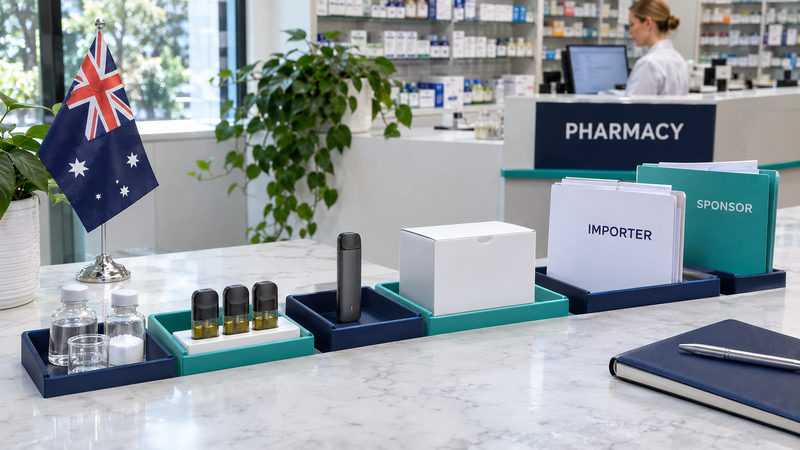
The national framework covers far more than nicotine liquid. It includes vaping substances, filled cartridges, prefilled pods, devices, device accessories, packs, and kits. It also regulates importation, domestic manufacture, commercial possession, distribution, advertising, and supply. Even nicotine-free vaping goods remain subject to the framework.
One framework, several product categories
One package can contain goods governed by different technical requirements. A kit, for example, might include a filled pod, battery-powered device, mouthpiece, and charging component. The substance-related parts may come under one standard, while the device and its accessories face separate medical-device safety requirements.
This distinction matters in every compliance review. Start by identifying what the item actually is instead of relying on its marketing category. Does it contain a vaping substance, administer one, or combine several components? A “starter kit” label alone will not tell you which rules apply.
- Vaping substances: Liquids or other materials intended for use in a vaping device.
- Filled goods: Prefilled pods, cartridges, or similar containers holding a vaping substance.
- Devices: Equipment that heats or otherwise delivers the substance for inhalation.
- Accessories: Components used with substances or devices, including certain containers and replacement parts.
- Packs and kits: Combined products that may include goods from several regulated categories.
Therapeutic purpose does not guarantee lawful supply
Calling a vape “therapeutic” does not resolve its legal status. The product still has to serve the permitted purpose and meet the relevant standards. Its sponsor must also complete the required notification steps before applicable import or pharmacy supply activities take place. Anyone proposing to hold or supply it must meet the possession and supply rules as well.
Take a wholesaler offering a mint pod for nicotine dependence. The stated purpose sounds right, but that is only the beginning. You still need to match the pod to a current notified entry and verify its strength. Its label, packaging, sponsor, and intended pharmacy pathway also need checking.
Federal controls sit alongside state and territory medicines and poisons laws. Rules can therefore vary between jurisdictions, particularly for prescription requirements and younger patients. Health professionals should verify their local obligations before prescribing or dispensing. Businesses operating across several jurisdictions may need regulatory advice.
2. How to Check TGA Guidance for a Vape Product
Start with the official TGA Vaping Hub, not a retailer’s compliance page. The hub points to the notified vape list, product standards, pharmacy guidance, prescriber information, and sponsor requirements. It also reflects regulatory updates that an older catalogue may not show. Record the date of your review in any relevant internal or clinical files.
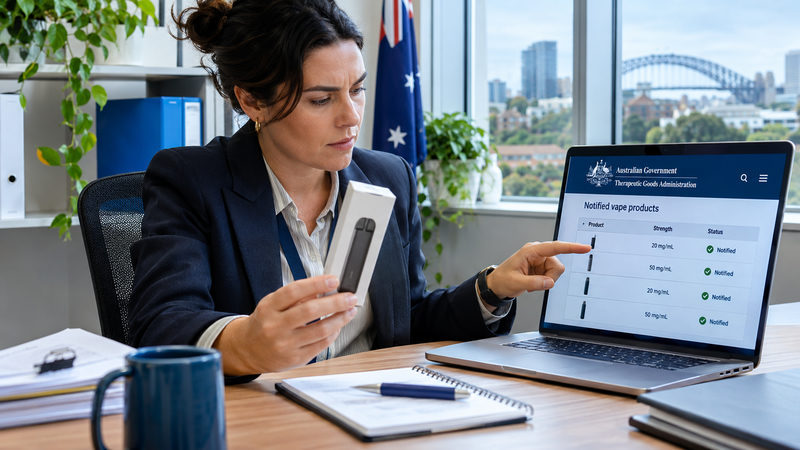
Then open the notified vape list and search with precise product details. A broad brand search might bring up several strengths, formats, or sponsors. Compare the physical product against the complete entry. Never assume that every item in a familiar product family is covered by the same notification.
Use a field-by-field comparison
Put the package, invoice, product information leaflet, and notified entry next to one another. Copy and compare each detail instead of trusting your memory. Small differences may point to a separate good that needs its own sponsor notice. A change in flavour, nicotine concentration, label, or formulation could require a new notification.
- Product type, such as substance, filled pod, device, or accessory.
- Full product name, including any model or range wording.
- Nicotine concentration, usually expressed in milligrams per millilitre.
- Flavour or variant, where the entry specifies one.
- Pack size, pod capacity, or other identifying presentation details.
- Supplier or sponsor name shown in the official record.
- Notification number and current notification status.
- Effective date of any withdrawal or cessation record.
Imagine a box labelled “ClearMint 20 mg/mL” containing two prefilled pods. An entry for “ClearMint 50 mg/mL” does not match. Nor does an entry for a bottle necessarily cover prefilled pods. If the matching name appears under another supplier, investigate further.
Check current and withdrawn records
A product may appear in the withdrawn or ceased sponsor notices table. A withdrawn notice means the sponsor chose to withdraw it. A ceased notice, by contrast, means the TGA determined that the good should no longer be supplied. Goods in that table must not be prescribed or supplied.
Check both the status and effective date, not just the product name. Screenshots, downloaded spreadsheets, and saved webpages quickly become outdated. Repeat the live check close to the proposed transaction. Businesses should also review products they continue to hold on a regular schedule.
Follow the guidance trail
Once the entry matches, read the product-standard guidance for that category. Then turn to the guidance written for your role. Pharmacists, prescribers, sponsors, importers, and patients have different responsibilities. Before acting, check the requirements set by the relevant state or territory health department too.
Sponsors should read the notification instructions and keep evidence supporting their declarations. Pharmacists need to check current supply conditions and professional guidance. Consumers, meanwhile, should confirm that a participating Australian pharmacy will carry out the required assessment. An online checkout cannot take the place of those regulatory and clinical steps.
Retailer pages, wholesaler catalogues, invoices, and verbal assurances may help with traceability, but they cannot replace the current TGA record. An invoice shows what the seller called the product, which may not be what the sponsor notified. Resolve any discrepancy with the sponsor and official guidance before going further.
3. What a TGA Notified Vape List Entry Does—and Does Not—Mean
A notified list entry shows that a sponsor submitted a notice for the identified vaping good. In doing so, the sponsor declares that the product complies with the applicable requirements. Publication also helps prescribers, pharmacists, businesses, and patients identify goods available through lawful pathways. The entry must still be current and match the exact product.
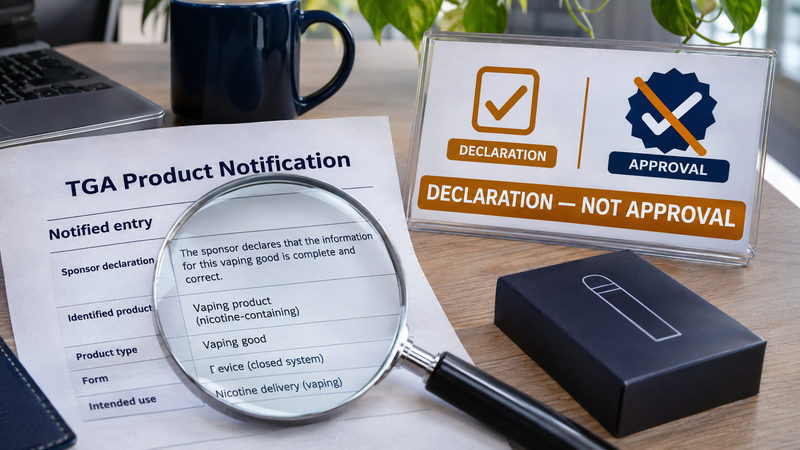
Notification is not TGA approval. The TGA has not assessed notified therapeutic vapes for safety, quality, efficacy, or performance. Appearing in search results does not make these products approved. Minimum standards and sponsor declarations simply do not offer the same assurance as a full premarket assessment.
What the entry can help establish
The list can show that the named sponsor notified a particular good. It may also provide the product type, product name, supplier, status, and notification number. That makes it a useful first checkpoint for lawful prescribing and supply. It also separates current notices from those that have been withdrawn or ceased.
- The sponsor submitted a notice concerning the listed good.
- The sponsor declared compliance with applicable regulatory requirements.
- The listed description identifies the good covered by that notice.
- The status indicates whether the notice remains current.
What the entry cannot establish
An entry does not independently prove that every package on the market matches the notified good. It cannot authenticate stock, confirm storage conditions, or validate a retailer’s supply chain. Nor does it establish whether the product is clinically suitable for a particular patient. Where required, that assessment belongs to a pharmacist or prescriber.
- It does not represent TGA approval or endorsement.
- It does not confirm a full TGA assessment of safety or effectiveness.
- It does not authorise every seller to stock or supply the product.
- It does not override prescription, pharmacy, import, or local legal requirements.
- It does not cover a different flavour, strength, pack, or supplier automatically.
What if the package name matches, but the sponsor on the list differs from the invoice supplier? That alone does not prove unlawful conduct, since a distributor may be separate from the sponsor. Still, you should obtain clear supply-chain records and confirmation from the sponsor before relying on the match.
Treat notification as one necessary part of a broader compliance picture. You must also check the product standard, lawful basis for possession, import permissions, pharmacy pathway, and local rules. If anything remains unclear, stop the transaction. Professional regulatory advice could prevent an unlawful supply, seizure, or costly recall.
4. Standards for TGA-Compliant Vape Products
Therapeutic Goods Order No. 110 is the main product standard for relevant therapeutic vaping substances and filled vaping goods. It addresses ingredients, containers, labels, packaging, and product presentation, among other matters. The standard applies to finished products within its scope. Sponsors must work out how its detailed provisions apply to each individual good.
The standard restricts the ingredients and flavours that may be used. Current TGA guidance lists nicotine, propylene glycol, glycerol, water, and permitted flavour ingredients. The permitted flavour categories are mint, menthol, and tobacco. Prescription vapes may contain no more than 50 mg/mL nicotine, while pharmacist-only supply is capped at 20 mg/mL.
Packaging, naming, and label checks
A compliant product should be presented more like a therapeutic good than a lifestyle purchase. The rules require plain packaging and restrict names that appeal to children or imply health benefits. Labels must also include the required information in English. Relevant goods need the prescribed information leaflet as well.
Do not stop at the front panel when inspecting a package. Check the nicotine concentration, flavour, product name, warnings, batch details, and sponsor information. Look closely at both the container and outer packaging for unexplained differences. Even a colourful online image may suggest that the seller is displaying obsolete or nonmatching stock.
- Confirm the ingredient and flavour category against current TGA guidance.
- Check that the stated nicotine concentration fits the proposed supply pathway.
- Review the product name for prohibited youth appeal or health suggestions.
- Inspect warnings, usage information, and English-language labelling.
- Confirm that the package includes the required patient information material.
- Compare batch and traceability details with supplier documentation.
Devices and device accessories follow another route
Therapeutic vaping devices and their accessories must meet the relevant medical-device requirements. Depending on the pathway, that may mean a Medical Device Standards Order or the Essential Principles. The Essential Principles cover medical-device safety and performance. A substance notification by itself therefore says nothing conclusive about device compliance.
Current device requirements cover manufacturing quality systems, risk management, design, construction, electrical safety, and battery safety. They also deal with labelling, instructions, and toxicological risk assessment. Designs should limit leakage, accidental activation, overheating, and child access. Sponsors need evidence to support whichever compliance pathway they use.
A filled disposable product shows why correct classification is essential. It combines a vaping substance and delivery device in a single unit. Different parts may therefore be subject to substance, packaging, and device requirements. Checking only the nicotine liquid standard would leave a major gap.
Standards reduce risk but do not eliminate it
Product standards are designed to control known quality and safety risks. Even so, compliance does not guarantee that a vape will be safe or effective for every patient. Under the current framework, therapeutic vapes remain unapproved goods. They are not considered a first-line treatment for smoking cessation or nicotine dependence either.
A device, for example, may satisfy electrical and battery requirements but still be clinically unsuitable. The patient could have a medical condition, medication interaction, or history of adverse reactions. Product compliance and clinical judgment are separate questions. Health professionals should discuss approved treatments and behavioural support when appropriate.
Packaging alone is never enough evidence of compliance. Sponsors must hold evidence supporting their declarations, and supply-chain participants should carry out due diligence proportionate to their role. Product changes can also affect the assessment. A new label, strength, flavour, manufacturer, or design may trigger further notification work.
5. Prescription, Pharmacy, Import, and Supply Checks
Product eligibility tells you whether a particular good appears within the notified framework. It does not tell you how the product can legally reach a patient. A second review is needed to cover prescriptions, pharmacy supply, access pathways, import controls, and local laws. The applicable conditions depend on both the patient and the proposed transaction.
Adults may obtain therapeutic vapes containing no more than 20 mg/mL nicotine from participating pharmacists without a prescription. The pharmacist must still assess clinical appropriateness and meet the applicable conditions. A prescription may also remain necessary under state or territory law. In addition, the pharmacist must follow the relevant pathway for notifying supply of unapproved goods.
Nicotine concentrations above 20 mg/mL generally require a prescription. The same applies to patients under 18 where local law allows supply. Some jurisdictions also place tighter controls on all therapeutic vapes. No notified therapeutic vape can exceed the applicable maximum of 50 mg/mL.
A list entry does not compel pharmacy supply
Pharmacists are not required to stock or supply therapeutic vapes. Even a valid prescription does not oblige a pharmacy to order the product. The pharmacist still needs to weigh professional duties, lawful access pathways, product status, and clinical suitability. Stock availability and the pharmacy’s compliance systems may also shape the decision.
Pharmacy supply usually takes place face to face with the patient or their carer. Vaping goods must be kept behind the counter and out of public view. Nicotine-free vapes are still restricted vaping goods. They cannot be sold as ordinary retail products simply because they contain no nicotine.
- Confirm the patient’s age and identity where required.
- Check the nicotine concentration and relevant scheduling category.
- Determine whether a prescription applies under federal and local rules.
- Verify the exact product on the current notified list.
- Confirm that the notice is neither withdrawn nor ceased.
- Complete the applicable Special Access Scheme or other access requirements.
- Document counselling, supply, and reporting obligations.
Prescribing and clinical access
Medical practitioners and nurse practitioners can use the relevant pathways for unapproved therapeutic goods. Depending on the patient and their circumstances, these may include Special Access Scheme or Authorised Prescriber arrangements. Age and product scheduling help determine which pathway is available. Prescribers must comply with state and territory medicines laws too.
Therapeutic vapes may only support smoking cessation or the management of nicotine dependence. Current TGA guidance does not treat them as first-line therapies. A clinician may therefore discuss behavioural support and approved pharmacotherapies first. Notification status is no substitute for assessing the individual patient.
Importation requires separate authority
A sponsor notice does not satisfy every import requirement on its own. Commercial importers may need a licence and permit from the Office of Drug Control, as well as customs compliance. The notification identifier may also form part of the import application process. All necessary approvals should be confirmed before shipment is arranged.
Individuals should not assume that the usual Personal Importation Scheme covers vaping products. Current TGA guidance excludes vaping products from that general scheme. Ordering from an overseas website can therefore carry serious compliance risks. Promises of “discreet shipping” offer no legal protection.
Commercial possession and distribution need a lawful basis as well. Warehouses, logistics providers, wholesalers, pharmacies, and authorised disposers should each understand their role. Supply-chain records need to connect the physical goods with the notified sponsor and lawful recipient. Any unexplained substitution or relabelling should be investigated.
6. Troubleshooting, Reporting, and Final Verification Checklist
If a product does not appear in your first search, try again with shorter or alternative terms. Search separately for the exact brand, model, nicotine strength, flavour, sponsor, and notification number. A failed search is not a minor administrative issue. Stop the proposed prescribing, purchase, import, or supply activity until it is resolved.
Be just as careful with a partial match. A 20 mg/mL mint pod is not the same as a 50 mg/mL tobacco pod. A notified device also does not automatically cover every compatible cartridge. Ask the sponsor to point to the precise official entry and account for any variation.
When the supplier and sponsor differ
A distributor can lawfully sell goods sponsored by another company. The relationship should still be traceable through invoices, supply agreements, batch records, or confirmation from the sponsor. Check that the package correctly identifies the notified sponsor. Make sure the distributor has not substituted a similar product either.
If a notice has been withdrawn or ceased, do not prescribe or supply the affected good. Segregate questionable stock under your organisation’s procedures, then contact the sponsor for current instructions. Businesses may also need advice on returns, disposal, patient communication, or corrective action.
Report problems through the right channel
Suspected adverse events and product defects should be reported through the appropriate TGA processes. Pharmacists and other regulated parties may also need to notify the sponsor. Keep the package, batch number, device details, and purchase records. Good evidence helps investigators tell isolated damage from a wider problem.
Suspected unlawful advertising, supply, or counterfeit activity may call for a different type of report. Explain what happened without making claims the evidence cannot support. Where available, include screenshots, dates, seller details, invoices, and product photographs. If a patient develops serious symptoms, seek urgent clinical help.
Final verification checklist
- Identify whether the good is a substance, filled product, device, accessory, pack, or kit.
- Confirm that its purpose involves smoking cessation or management of nicotine dependence.
- Search the current TGA notified vape list using exact product details.
- Match the product name, type, strength, flavour, format, sponsor, and notification number.
- Check the withdrawn and ceased sponsor notices table.
- Review TGO 110 requirements for applicable substances and filled goods.
- Review the relevant medical-device standard or Essential Principles for devices and accessories.
- Compare labels, packaging, leaflets, warnings, and traceability information.
- Confirm prescription, patient-age, pharmacy, and clinical assessment requirements.
- Check state or territory medicines and poisons restrictions.
- Verify import licences, permits, and customs obligations before shipment.
- Stop and seek TGA or professional regulatory advice when any detail remains uncertain.
Conclusion
A sound compliance check takes more than spotting a familiar name on the notified vape list. The exact product and sponsor need to match, and the notice must still be current. The correct substance or device standards must apply as well. Finally, the intended import or pharmacy pathway has to meet both federal and jurisdiction-specific rules.
Notification is not TGA approval, nor does it represent a full assessment of safety, quality, efficacy, or performance. A notified entry also does not require a pharmacist to stock or supply the product. Keep product verification separate from clinical and supply decisions. Where professional or commercial duties apply, document both checks.
Before proceeding, open the official TGA Vaping Hub and current notified vape list. Compare every field with the product in front of you, then search the withdrawn or ceased notices. Review the relevant pharmacy, sponsor, product-standard, and local health guidance too. If any detail remains unclear, seek advice from the TGA or a regulatory professional.