Tobacco smoking cost Australian society an estimated A$136.9 billion in 2015–16. What Is the Economic Cost of Nicotine Dependence in Australia? For tobacco smoking, most of that headline figure reflects lives cut short and health lost to illness. However, hospital spending, workplace losses, household purchases and tobacco tax receipts each answer a different question.
Picture someone missing shifts while a family member takes time off to help them recover. A hospital records the treatment, while the household and employer experience costs that never appear in its accounts. Likewise, the national estimate counts harms that have no invoice, including the loss of years someone could have lived. Australian studies of vaping and quitting help explain where that estimate ends and what other evidence can tell us.
What Is the Economic Cost of Nicotine Dependence in Australia?
What the A$136.9 billion measures
The national estimate was A$136.9 billion for tobacco smoking in the 2015–16 financial year, expressed in 2015–16 Australian dollars. Steve Whetton and colleagues published the study in 2019 through Curtin University’s National Drug Research Institute. Here, the reference year identifies the period the study examines. Meanwhile, the price year tells you the purchasing power of the dollars used to express the estimate.

The researchers took a societal perspective, meaning they counted costs across the community. That includes resources used to provide care, output people could otherwise have produced and the value of health lost. For instance, an unpaid hour spent caring for a relative can carry a cost even when no money changes hands. The value of that time matters because the caregiver could have used it elsewhere.
Some consequences also stretch beyond the financial year that anchors the study. For instance, when someone died prematurely in 2015–16, the researchers counted the value of future production lost because of that death. They converted that future loss into its value in the study year. Therefore, the estimate combines costs experienced during the year with certain future losses tied to events in that year.
How nicotine dependence fits into the estimate
Nicotine dependence can make smoking harder to stop, prolonging exposure to tobacco smoke. The report mainly attributes health and economic harms to combustible tobacco use and exposure to that smoke. For instance, its scope includes selected conditions linked to second-hand smoke, which can affect people who never smoked. So the population bearing the costs extends beyond the people who buy cigarettes.
Australian evidence on other nicotine products covers parts of their economic impact. However, it has yet to establish a comparable annual total across all these products. When quoting A$136.9 billion, describe it as a historical estimate of the social cost of tobacco smoking.
How Much Comes From Healthcare, Lost Productivity and Premature Death?
Healthcare and other resources
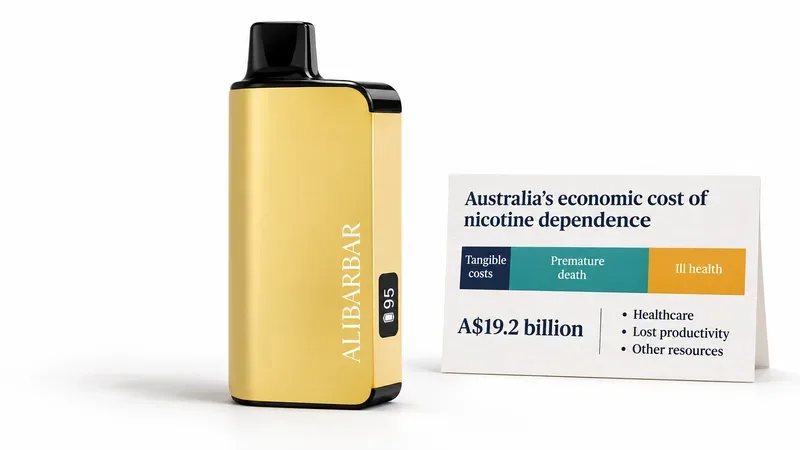
Whetton and colleagues put tangible costs at A$19.2 billion, or roughly 14% of the total. Tangible costs reflect resources used or output lost. Within that subtotal, the report groups about A$6.8 billion under healthcare and care. That grouping extends from hospital and primary care to support provided at home.
- Clinical care includes hospital treatment, emergency and outpatient services, ambulance services and primary care.
- Medicines and quit aids cover pharmaceuticals for smoking-related conditions and products that help people stop smoking.
- Aged care and informal care include residential services and unpaid help from relatives or friends.
The report also gives a narrower net health and social care estimate of about A$4.5 billion. It subtracts nearly A$2.3 billion in estimated future healthcare spending that would have occurred had people lived longer. However, the headline table puts that same offset under premature mortality. Use the A$6.8 billion care grouping with the net mortality line to count the offset once.
Additionally, the report estimates tangible costs from tobacco-related fires and litter. Fires accounted for about A$81 million, and litter accounted for about A$73 million. Together with the resource cost attributed to tobacco consumed by dependent smokers, these items came to about A$5.7 billion.
Missed work and production lost after early deaths
The study estimated around A$5.0 billion in workplace losses from absenteeism and reduced productivity while at work. Absences accounted for about A$4.23 billion, and reduced productivity on the job accounted for about A$760 million. For example, illness can cause someone to miss an entire shift or limit what they can do during it. Both affect how much work gets done.
Separately, the study counted around A$3.4 billion in future production lost because of premature deaths. Its mortality calculation also included lost unpaid household work and employer recruitment and training costs. After accounting for avoided future healthcare spending, the net tangible mortality cost was about A$1.8 billion. Use that net figure when adding up tangible costs.
Putting a dollar value on lost years and health
Intangible costs accounted for A$117.7 billion, or roughly 86% of the total. The researchers estimated A$92.1 billion for premature death and A$25.6 billion for smoking-related ill health. For mortality, they used an economic estimate of what people value reductions in fatal risk at across a population. Their report shows how valuing expected life years lost under different assumptions changes the result.
For illness, the researchers assigned a dollar value to time lived in poorer health. For instance, long-term breathlessness can limit ordinary activities even on days when someone receives no treatment. Together, these valuations capture consequences that spending and production figures alone leave out. The table follows the central estimates in Table 11.1 of the National Drug Research Institute report.
| Cost category | Estimate | What it includes |
|---|---|---|
| Healthcare and care | A$6.79 billion | Treatment, medicines, quit aids, and formal and informal care |
| Workplace productivity | A$4.99 billion | Missed work and reduced output while at work |
| Net tangible cost of premature death | A$1.77 billion | Lost production and related costs, after the healthcare offset |
| Other tangible costs | A$5.70 billion | Fires, litter and the resource cost of tobacco consumed by dependent smokers |
| Tangible subtotal | A$19.2 billion | About 14% of the total |
| Intangible cost of premature death | A$92.1 billion | Economic valuation of premature loss of life |
| Intangible cost of ill health | A$25.6 billion | Economic valuation of living in poorer health |
| Intangible subtotal | A$117.7 billion | About 86% of the total |
| Total social cost | A$136.9 billion | Tangible and intangible costs combined, with rounding |
Who Bears the Costs, and Where Does Tobacco Excise Fit?
Households pay in cash, time and lost income
Tobacco purchases are the most visible expense in a household budget. The Australian Institute of Health and Welfare (AIHW) reports average spending of A$4,932 in 2022, in 2022 prices. Specifically, that average covers only households reporting some tobacco expenditure. Households that reported zero tobacco spending fall outside the group used to calculate it.

Additionally, households may pay out of pocket for appointments or medicines. Someone managing a smoking-related illness may work fewer hours, while a relative may cut back on paid work to help. An early death can also remove income a household expected to rely on. Even when relatives keep their paid hours, caregiving can take time away from rest and other responsibilities.
The national study already includes about A$5.55 billion for the resource cost of tobacco consumed by dependent smokers. Specifically, the researchers excluded excise and goods and services tax (GST) before estimating the amount attributable to dependent smokers. The AIHW household figure describes what households spent, while the study item measures resources used under its accounting rules. The figures also refer to different years.
Employers, health services and the people who fund care
Employers can face reduced output when staff miss work or work while unwell. For instance, an absence can leave tasks unfinished or require a workplace to arrange cover. Meanwhile, smoking-related disease adds demand for hospital beds and primary care appointments. A single illness can therefore put pressure on a workplace and several parts of the health system.
The service provider and the payer can be different. For example, a state hospital can deliver treatment with funding from both the Commonwealth and the state or territory. In general practice, Medicare may rebate part of the fee, while the patient pays a gap. Depending on the service and the cover, private insurers can also fund part of private treatment.
What the Commonwealth received from tobacco
The Commonwealth’s Final Budget Outcome records A$9.816 billion in tobacco excise and customs duty receipts for 2015–16. Excise shifts money from purchasers to government through the price people pay. As a result, the receipts matter when examining public revenue. The illness, premature deaths and lost work behind the social cost estimate still occur.
Keep the receipts and gross household spending outside the A$136.9 billion calculation. Subtracting receipts would treat a transfer as a reduction in social harm. Likewise, adding gross sales would count taxes and overlap with tobacco resources already included in the study.
Do Australian Smoking Cost Estimates Include Vaping and Other Nicotine Products?
Where the historical estimate draws the line
The A$136.9 billion estimate excludes vaping and leaves harms from nicotine pouches and other non-combustible nicotine products unquantified. Its smoking cessation category does capture spending on aids such as nicotine replacement therapy. Specifically, that spending reflects resources used to help people quit tobacco smoking. It belongs in the same accounting exercise as the other costs associated with smoking.
What the A$179.6 million vaping projection measures
In Australian Health Review, Louisa Gordon and Paige Preston examined a specific pathway from vaping to smoking. Their model considers Australians who had never smoked, used e-cigarettes and subsequently took up cigarettes. It projected A$179.6 million in future annual healthcare costs for selected chronic diseases associated with that subsequent smoking. The result represents estimated future treatment costs under the model’s assumptions.
One assumption concerns the transition rate, or the share of those e-cigarette users who go on to smoke. For instance, raising that share increases the number of people whose future treatment costs the model attributes to the pathway. In the authors’ sensitivity analyses, the rate of initial e-cigarette uptake mattered more than the assumed transition rate. Actual healthcare spending would depend on what happens over time.
What an all-product comparison would need
AIHW vaping data help describe how people use e-cigarettes, including whether they also smoke tobacco. However, estimating social costs requires evidence about what happens to health and spending under different patterns of use. For a comparable estimate, researchers would need evidence on these outcomes and behaviours:
- Direct vaping harms and longer-term effects, including how often they require healthcare.
- Dual use of cigarettes and e-cigarettes, and how long people use both.
- Switching from cigarettes, including whether someone stops smoking altogether or later returns to it.
- Effects on healthcare use, productivity and quality of life under each pattern.
Therefore, adding the A$179.6 million projection to A$136.9 billion would mix a future estimate with a historical one. It would also mix selected healthcare spending with a broad societal measure. Moreover, the projected costs arise through subsequent smoking, so an all-product model would need to avoid counting those harms twice.
Why Do Estimates of the Cost of Smoking in Australia Differ?
Dates and the costs each study counts
Collins and Lapsley estimated a social cost of A$31.5 billion in 2004–05. Whetton and colleagues calculated its equivalent as about A$41.9 billion in 2015–16 prices. However, the difference between that figure and A$136.9 billion cannot show how much the burden changed. Inflation adjustment puts dollars on a common footing, while differences in methods and scope remain.
For instance, Whetton’s team included informal care and reduced productivity at work, two categories the earlier study omitted. The team also attributed more conditions to smoking and used different assumptions to value premature deaths. Meanwhile, AIHW’s health system spending series asks how much covered services spent on conditions attributable to tobacco. It focuses on spending for each reference year and leaves out losses such as unpaid care and reduced quality of life.
| Study | Reference year | Price year | Cost categories | Perspective | Time horizon |
|---|---|---|---|---|---|
| Collins and Lapsley | 2004–05 | 2004–05 originally. NDRI comparison uses 2015–16 prices. | Selected resource and productivity costs, plus the value of premature deaths | Society | Costs in the study year, allowing for effects of past smoking |
| Whetton and colleagues, NDRI | 2015–16 | 2015–16 | Care, productivity, other resources, and the value of lost life and health | Society | Study-year costs plus the present value of selected future consequences of deaths in that year |
| AIHW health system spending series | 2015–16, 2018–19 and 2023–24 | Each reference year for current prices. The series also offers constant-price comparisons. | Covered health services and medicines | Health system spending | One financial year per estimate |
How researchers attribute disease to smoking
Researchers combine information about smoking exposure with evidence about how strongly smoking raises the risk of particular diseases. This lets them estimate the share of cases or deaths that would have been avoided without that exposure. For example, lung cancer can develop years after someone quits, so past smoking can shape this year’s costs. Which diseases a study includes also changes the share of the burden it captures.
Finally, the accounting perspective determines whose costs the study counts. A societal estimate can assign a value to a family member’s unpaid care, which a spending series can leave outside its scope. Likewise, the assumed value of lost life and health affects the total. For models that count future costs, discounting and offsets also influence what those costs amount to in the study year.
Can Tobacco Prevention and Smoking Cessation Save Money?
Australia’s National Tobacco Campaign
Susan Hurley and Jane Matthews evaluated the first phase of Australia’s National Tobacco Campaign, which began in 1997. The campaign cost around A$9 million. In their model, the researchers followed an estimated 190,000 people who quit, from the time they stopped until death or age 85. It projected fewer cases of major smoking-related diseases and about A$740.6 million in healthcare savings.
As a result, the model projected healthcare savings well above campaign costs, alongside gains in length and quality of life. However, the result depends on how many people quit because of the campaign. If fewer quits can reasonably be attributed to the campaign, the model would project fewer avoided illnesses and lower savings. Those gains accumulate as the cohort ages.
Victoria’s Quitline call-back counselling
The Victorian Quitline evaluation modelled call-back counselling against a scenario without the service. It estimated about A$869,000 in healthcare savings, after allowing for the cost of the intervention. Moreover, the study projected a A$32.2 million reduction in societal costs over its 80-year horizon. That bigger figure includes productivity gains that extend beyond the health system.
Specifically, the wider estimate captured fewer absences, less loss of workforce participation and less productive time lost to early death. The model attributed the largest share of the savings to people remaining in the workforce. However, the study’s uncertainty range for healthcare spending included a possible cost increase. A projected saving is an estimate of what may happen under stated assumptions.
Cost-effectiveness, savings and annual budgets
Cost-effectiveness measures the additional cost per unit of health gained compared with an alternative. For example, researchers can use a year of life adjusted for health quality as that unit. A program saves money when it reduces total costs from the stated perspective. Therefore, a program can deliver good value for the health it improves while requiring extra spending.
Meanwhile, an annual budget tracks when spending changes for the organisation that pays. A health department may fund counselling now, with much of the avoided treatment occurring years later. When reading a long-run evaluation, check the assumed quit rate, how often people resume smoking and how researchers discount future costs. Those assumptions affect the size and timing of projected savings.
Conclusion
The estimated social cost of tobacco smoking was A$136.9 billion in 2015–16 Australian dollars. Premature death and ill health accounted for most of the total. Meanwhile, Australian evidence on vaping and other nicotine products still covers only parts of their economic impact. Australian campaign and Quitline evaluations suggest that some tobacco control and cessation programs can save money over long periods.
When you quote an Australian cost figure in an assignment, article or policy brief, record the details beside the number. Include the source, reference year, price year, products covered and cost categories. That gives readers enough information to judge which figures they can meaningfully compare.