Can a KUZ device really deliver its advertised puff count, steady flavor, and useful battery life during everyday use? This KUZ Vape Brand Review: Models and Technical Features separates confirmed specifications from promotional claims. However, regional variations, counterfeit products, and limited independent testing make careful comparison essential. Most importantly, vaping carries health risks, and nicotine can cause dependence.
Adult buyers also face a complicated legal market. A device available overseas may not qualify for lawful sale locally. Therefore, compare the hardware only after confirming local rules, seller credentials, and product authenticity. The following review uses KUZ materials and clearly identifies information that remains unavailable or market-dependent.
1. KUZ Vape Brand Review: Models and Technical Features
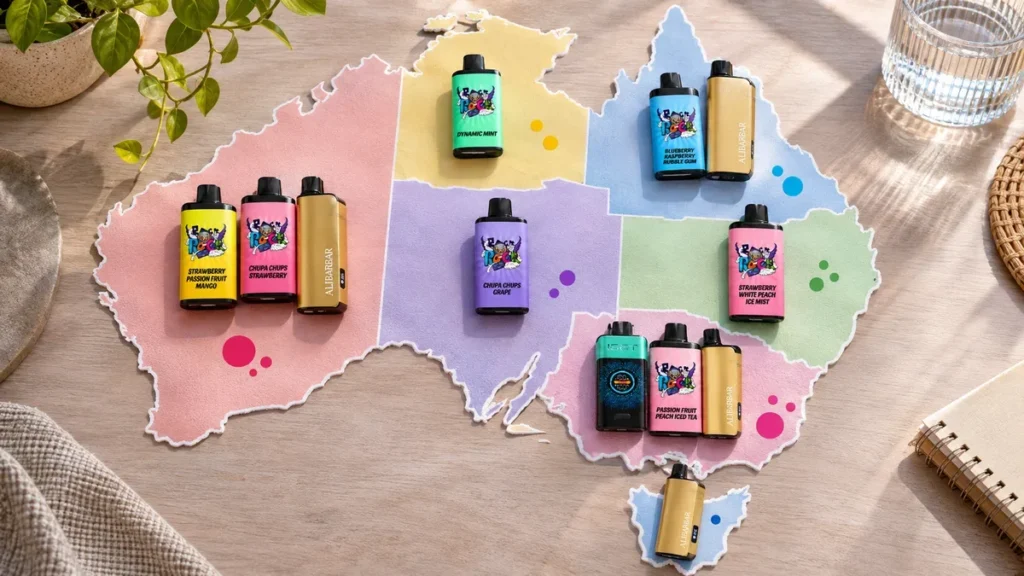
KUZ positions itself as a lifestyle-focused disposable vape brand for adults who already vape. Its official materials promote high-capacity devices, mesh coils, strong flavors, and simple draw activation. Moreover, the brand primarily targets the United States and selected international markets. Regional sellers also advertise KUZ products across Australia, although those listings do not prove lawful local supply.
KUZ publishes product information through its branded website and wholesale channels. However, those public materials do not clearly identify a legal manufacturer or corporate owner. Therefore, buyers should not confuse brand-controlled marketing with independent manufacturing verification. Packaging should identify the responsible company, production details, warnings, and a traceable serial or batch number.
The verified range mainly consists of prefilled disposable or rechargeable-disposable devices. Users cannot replace the coil or refill the liquid through a supported process. Additionally, rechargeable models only let users recharge the internal battery. They remain disposable products once the liquid, coil, or electronics reach their usable limit.
Availability differs sharply between markets. For example, nicotine concentration, flavor names, warning labels, and liquid capacity may change under regional rules. Meanwhile, devices called Nova 16000 or Pearl 30000 appear in regional retailer listings. Yet the main KUZ product materials reviewed did not provide enough matching documentation to verify every claimed specification.
2. KUZ Vape Models and Specifications Compared
Verification date: 18 November 2026. The table below prioritizes specifications published in KUZ product materials. Specifically, “not stated” means the reviewed source did not provide that detail. “Market-dependent” indicates that packaging or regional regulations may change the specification.
| Model | Advertised puffs | Liquid | Battery | Coil | Controls and display |
|---|---|---|---|---|---|
| KUZ C6000 | Up to 6,000 | 15 mL | 1,500 mAh | Type and resistance not consistently stated | Draw activated; charging and display details not consistently stated |
| KUZ 9000 | Up to 9,000 | 19 mL | 650 mAh | 1.0-ohm mesh | Battery and liquid display; rechargeable versions use USB-C |
| KUZ Lux9000 | Up to 9,000 | Not stated in reviewed official feature page | 2,500 mAh | 0.8-ohm dual mesh | Dynamic display; charging connection not clearly confirmed |
| KUZ Flow | Up to 25,000 | 23 mL | 850 mAh | 1.2-ohm mesh; selectable single or dual operation claimed | Large status screen and one-button mode control |
| KUZ Nova 16000 | Up to 16,000, according to regional sellers | Market-dependent or unavailable | Unavailable in reviewed brand materials | Some sellers claim 0.8-ohm mesh | Regional listings claim battery and liquid indicators |
| KUZ Pearl 30000 | Up to 30,000, according to regional sellers | Market-dependent or unavailable | Some sellers claim 850 mAh | Unavailable in reviewed brand materials | Regional listings claim a smart screen |
How to read conflicting specifications
Several listings use similar names for different devices. For instance, “KUZ 9000,” “Lux 9000,” and “9000 Ultra” may show different batteries or coil resistances. Therefore, buyers should compare the exact box, model code, and printed specifications. A product name alone cannot confirm the hardware inside.
Nicotine strength creates another important conflict. Official pages for some markets describe 5% nicotine, while earlier promotional material has referenced 20 mg/mL versions. Additionally, other regions may require lower strengths or nicotine-free products. Never assume two identical-looking packages contain the same formulation.
The table does not treat retailer-created models as fully verified products. Instead, Nova and Pearl remain regional listings until matching brand documentation confirms their complete specifications. This approach matters because counterfeiters often copy model names, graphics, and inflated capacity claims. In fact, missing company details or mismatched labels should outweigh an attractive puff number.
3. Puff Counts, Battery Life, and Charging Performance
An advertised puff count is an estimate, not a guaranteed number of personal draws. Manufacturers usually test short, controlled puffs under repeatable conditions. However, real users may inhale longer, activate higher power, or take repeated draws. As a result, two adults can empty identical devices on very different schedules.
Consider a device advertised for 9,000 puffs. A person taking three-second draws may consume substantially more liquid per puff than a short laboratory cycle. Moreover, stronger airflow can cool the coil and encourage longer inhalations. The device may therefore deliver fewer usable draws while still consuming its expected liquid volume.
Battery capacity versus liquid capacity
The C6000 combines a claimed 1,500 mAh battery with 15 mL of liquid. That capacity may reduce charging dependence if the version uses a non-rechargeable design. However, battery condition changes during storage. An old unit could lose power before the reservoir empties.
The KUZ 9000 uses a smaller 650 mAh battery with 19 mL of liquid. Therefore, it needs charging to access much of its claimed capacity. Meanwhile, the Flow pairs 23 mL with an 850 mAh cell. Its dual-coil mode should consume more power and liquid than its lower-output setting.
The Lux9000 presents a different balance. Its claimed 2,500 mAh battery appears unusually large for a 9,000-puff disposable. Consequently, buyers should confirm that number on genuine packaging. They should also verify whether the specific regional version supports charging.
Safer charging habits
Use a suitable low-power USB source and the correct undamaged cable. Additionally, place the device on a hard, non-flammable surface while charging. Disconnect it after charging finishes. Never charge a hot, swollen, leaking, wet, or physically damaged device.
A charging port does not make the product reusable forever. The internal liquid chamber and coil still have fixed service lives. Furthermore, repeated charging cannot restore depleted liquid or a burned wick. Stop using the device when flavor turns persistently burned, output collapses, or liquid appears exhausted.
4. Mesh Coils, Airflow, Flavor, and Vapor Performance
Mesh coils use a broad heating surface rather than a simple narrow wire. This design can heat liquid more evenly and produce consistent vapor. Specifically, KUZ confirms a 1.0-ohm mesh coil for the 9000. It also promotes a 0.8-ohm dual mesh system in the Lux9000.
The Flow lists a 1.2-ohm mesh configuration and a button-controlled operating choice. KUZ describes this as switching between single and dual mesh behavior. However, public information does not fully explain output wattage or electrical control. Therefore, “dual” should describe the advertised operating mode, not guaranteed doubled performance.
Draw style and vapor output
The KUZ 9000 should offer a relatively controlled draw based on its 1.0-ohm coil. Conversely, the Lux9000’s lower-resistance dual mesh design may produce warmer, denser vapor. Airflow geometry and power regulation also matter. Without measured airflow or wattage data, exact comparisons remain informed estimates.
The Flow gives users more influence over output. Its higher setting should emphasize vapor density and flavor intensity. However, that setting can shorten battery intervals and consume liquid faster. The lower setting may suit adults who value steadier endurance over stronger output.
Flavor quality and consistency
KUZ offers fruit, cooling, beverage, and mixed profiles in different regions. Examples include Double Apple, Cola Icy, coconut blends, berry combinations, and mint-style options. Moreover, sweeteners and cooling agents can create an intense first impression. They may also make coil decline easier to notice later.
A good device should maintain recognizable flavor without flooding, spitting, or sharp burned notes. Notably, sweetness may fade as the wick ages or the liquid level drops. Very frequent draws can also overheat the coil. Allowing short pauses may help the wick absorb liquid between uses.
Flavor does not reduce nicotine exposure or make vaping safe. In fact, pleasant flavors may encourage more frequent use and greater liquid consumption. Nicotine remains addictive, regardless of fruit, mint, or dessert flavoring. Adults who do not smoke or vape should not begin using these products.
5. Build Quality, User Experience, and Reliability
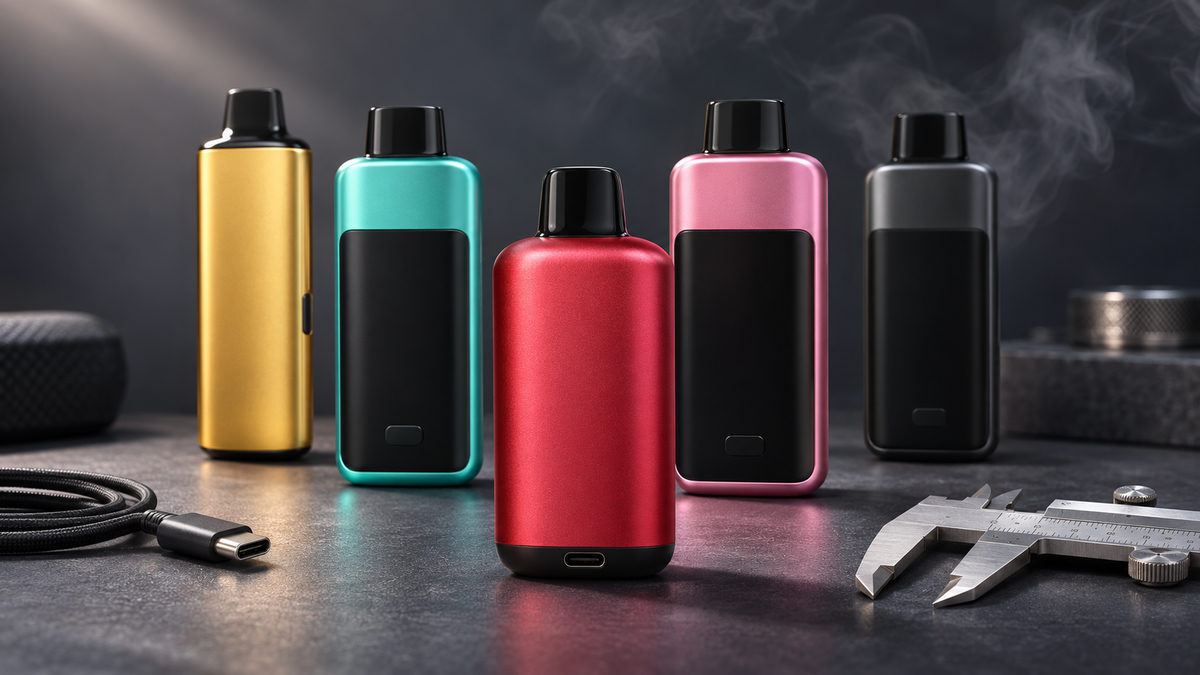
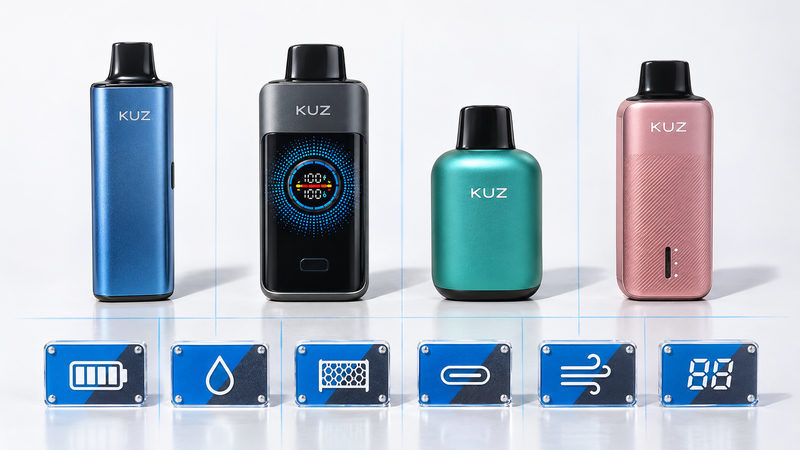
KUZ emphasizes rounded shapes, compact bodies, soft-touch finishes, and screen-equipped designs. The KUZ 9000 uses a leather-style exterior, while the Flow combines rubber coating with decorative electroplating. Additionally, a broad body may feel secure in hand. However, larger high-capacity models occupy more pocket space.
Mouthpiece comfort depends on edge shape, condensation control, and draw resistance. A smooth mouthpiece improves longer sessions, but it cannot prevent internal condensation. Therefore, users should keep the device upright when practical. They should also wipe exterior moisture rather than inserting tools into the airway.
Displays provide convenient estimates for battery and liquid status. However, a small screen cannot measure every remaining drop precisely. Its liquid indicator may calculate usage from puff activity rather than directly sensing volume. As a result, treat the display as guidance rather than an exact gauge.
Reliability across the device life cycle
Early performance often feels stronger because the battery, liquid level, and wick are fresh. Meanwhile, output may soften as the reservoir empties or residue accumulates on the coil. A gradual decline can be normal. Sudden heat, leaking, or uncontrolled activation is not normal.
Common failure symptoms include blinking lights, weak vapor, blocked airflow, charging failure, and a persistent burned taste. Additionally, gurgling can suggest condensation or excess liquid near the coil. Do not dismantle, puncture, refill, or bypass the electronics. These actions can expose liquid and damage the lithium battery.
Stop using the device if it becomes unusually hot, swells, hisses, leaks heavily, or activates without inhalation. Specifically, move it away from flammable materials when safe. Avoid touching leaked liquid with bare skin. Contact the seller about a defective new unit, and retain the receipt and packaging.
6. Best KUZ Vape by Priority, Price, and Alternatives
No KUZ model wins every category. The C6000 appears simplest and more compact, depending on the exact regional version. Meanwhile, the KUZ 9000 balances a screen, 19 mL capacity, and a moderate 650 mAh rechargeable battery. Adults prioritizing clear status information may prefer that combination.
- Portability and simplicity: Consider the C6000 after confirming its charging design and local specifications.
- Battery endurance: The Lux9000 claims 2,500 mAh, although buyers should confirm that figure on genuine packaging.
- Flavor intensity: The Lux9000 uses a claimed 0.8-ohm dual mesh coil.
- Adjustability: The Flow offers a button-controlled choice between lower and stronger output behavior.
- Balanced capacity: The standard KUZ 9000 provides 19 mL, a status display, and USB-C on documented versions.
- Overall value: Choose the lowest verified cost per realistic usable day, not the largest advertised puff number.
Comparing real cost
Suppose a 9,000-puff device costs $35 and lasts ten days. Its practical cost equals $3.50 per usable day. However, a $45 device lasting eighteen days costs $2.50 daily. This method gives a clearer comparison than dividing price by an unverified headline puff count.
Also record how often charging interrupts use and when flavor noticeably weakens. For instance, a device may technically activate after its taste becomes unpleasant. That final period offers little practical value. Therefore, count enjoyable, consistent use rather than every possible activation.
Regional taxes, pharmacy rules, shipping costs, and retailer margins can change pricing significantly. Alternatives include lawful refillable pod systems, nicotine-replacement products, and other verified therapeutic devices. Moreover, refillable systems may create less battery waste over time. Adults using nicotine to quit smoking should seek advice from a pharmacist or qualified clinician.
7. Authenticity, Legal Buying, Safety, and Disposal
Buy only from a seller legally permitted to supply the product in your location. Check the sealed package, model code, batch details, nicotine warning, and responsible company information. Additionally, compare printed specifications with official product information. Misspellings, broken seals, and unusually low prices should raise concern.
Keep the receipt and photograph the packaging before opening it. KUZ warranty guidance asks for purchase details, an order number, and the device serial number. Therefore, a seller that refuses documentation offers weak protection. Avoid marketplace vendors that hide their business identity or age-verification process.
Australia restricts vaping products to regulated therapeutic pathways. Disposable and non-therapeutic vape sales are prohibited, including sales through ordinary vape shops and convenience stores. Adults should confirm current requirements with the Therapeutic Goods Administration or a participating pharmacy. Consequently, an online listing or Australian address does not establish legal eligibility.
Store devices away from children, pets, sunlight, water, and hot vehicles. Furthermore, carry lithium-powered vapes in hand luggage when airline rules permit transport. Never use or charge them aboard an aircraft. Check both airline requirements and destination laws before travelling.
Do not place a used vape in household recycling or general waste. Its battery can ignite inside collection trucks or processing equipment. Instead, use an approved battery or e-waste collection service that accepts vaping devices. Ask the facility how to package leaking or damaged units safely.
Conclusion
KUZ devices deserve evaluation through verified specifications, realistic puff performance, charging behavior, coil consistency, and full-life reliability. The C6000 favors simplicity, while the 9000 adds useful status information. Meanwhile, the Lux9000 emphasizes battery and dual-mesh claims. The Flow targets capacity and adjustable output.
The best choice depends on whether an adult prioritizes portability, endurance, simplicity, or stronger vapor. However, no flavor or technical feature removes nicotine dependence and vaping risks. Legal availability and authenticity matter as much as performance. In Australia, disposable KUZ products do not fit the ordinary lawful retail pathway.
Compare the verified model table with your priorities, then confirm local legality and product authenticity. Purchase only through a credible, age-verified seller that holds the required authority. For Australian advice, consult a participating pharmacy rather than an ordinary vape retailer. Moreover, ask a healthcare professional about proven quitting options if reducing nicotine use is your goal.
VAPE CARE AU SHOP
130 Carnarvon St, Silverwater NSW 2128, Australia
(+61) 451-708-145