Does a 30,000-puff vape really provide 30,000 satisfying draws, or is that number based on controlled laboratory testing? BIMO Galaxy 30000: What Does the Puff Rating Mean? is a question worth asking when you compare the claim with everyday use. Buyers often expect the printed figure to translate into an exact ownership period. In practice, no puff rating can account for everyone’s habits.
A person who takes short, gentle draws may use much less liquid than someone who inhales deeply for several seconds. Frequent sessions, stronger power modes, airflow settings, and storage conditions can also affect how long the device lasts. Battery and coil performance play a part too. That is why two adults can buy identical devices and get very different results.
The advertised figure is still a useful comparison point, provided buyers understand its limits. It represents an estimated maximum under specific testing conditions. It does not guarantee consistent flavor, strong vapor, or exactly 30,000 enjoyable draws. Adult buyers should also weigh verified specifications, nicotine strength, charging safety, and responsible disposal—not just the headline number.
1. BIMO Galaxy 30000: What Does the Puff Rating Mean?
An estimate rather than a guarantee
The 30,000-puff label is a manufacturer-estimated maximum based on particular test conditions. Manufacturers may use standardized draw lengths, controlled airflow, and fixed intervals between activations. The result reflects repeatable testing, not every possible vaping style. Real people rarely inhale with machine-like consistency for the entire life of a device.
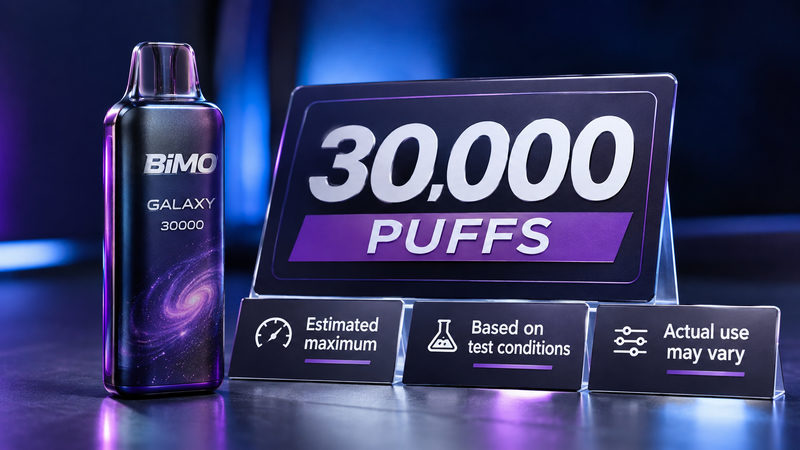
A puff usually refers to one activation of the heating system during a standardized draw. Still, every activation does not consume the same amount of e-liquid. A one-second draw may use considerably less liquid than a four-second draw. Stronger airflow or higher power can also produce more vapor with each activation.
Picture two adults who each take 300 puffs a day. One takes short draws; the other prefers long, forceful ones. Their counters may show similar totals, but the second user will probably run out of liquid sooner. Counting activations alone, then, cannot accurately describe total liquid consumption.
What the number does not measure
The rating does not guarantee a certain number of ownership days. For example, 30,000 estimated puffs would equal 100 days at 300 puffs per day. But that basic calculation assumes every advertised puff is available and that the user follows exactly the same routine each day.
The number also does not promise consistent flavor from the first draw to the last. Coil wear, liquid saturation, and battery output can gradually change the experience. A device may continue to activate even after its flavor quality has faded. Those remaining activations might not feel nearly as satisfying as the earlier ones.
Think of the rating as a comparison tool, not a precise countdown. It can help you compare devices tested with similar methods, but it cannot guarantee satisfaction, vapor quality, or personal suitability. A responsible purchase depends on more than one large number printed on the package.
2. How Disposable Vape Puff Ratings Are Calculated
The main inputs behind the estimate
Manufacturers usually start with the device’s available e-liquid volume. From there, they estimate how much liquid the coil uses during a standardized draw. Engineers factor in coil resistance, output power, airflow, and expected activation time. Together, these variables help estimate how many test cycles the liquid can support.
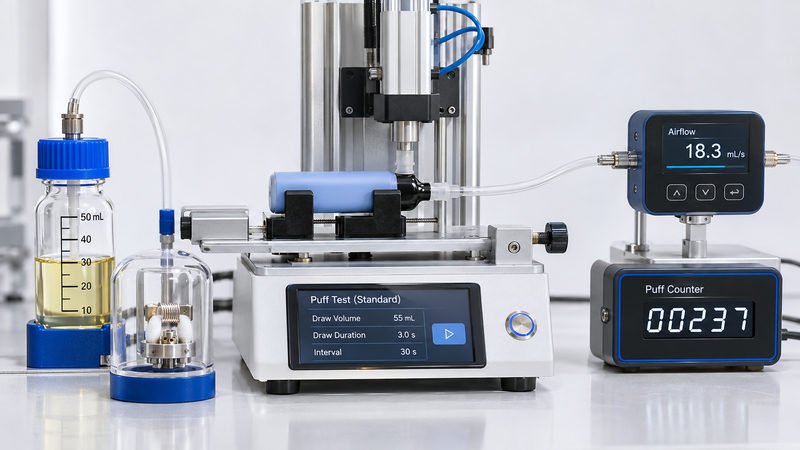
A testing machine may activate the device repeatedly with equal draw lengths and controlled pauses. It can also maintain consistent suction and stable surrounding conditions. Human behavior is far less uniform because people change their draw intensity throughout the day. Laboratory cycles therefore tend to represent favorable, highly consistent use.
Coil output influences the calculation as well. A higher-output coil may create denser vapor, but it can consume more liquid per second. A lower-output setting may conserve liquid by producing less vapor. If a device offers several power modes, its practical puff total may differ from one mode to another.
- E-liquid volume: More usable liquid can support more activations under equal conditions.
- Consumption per draw: Longer or hotter activations usually use more liquid.
- Coil characteristics: Resistance, heating area, and efficiency influence vapor production.
- Airflow: Air movement affects draw intensity, cooling, and vapor density.
- Test cycles: Draw duration and rest intervals shape the final estimate.
Why specification verification matters
Online product listings are not always accurate. Some marketplace sellers copy specifications, overstate capacities, or mix up similar models. Buyers should compare any claims with authentic packaging and official manufacturer information. Authorized sellers may also offer clearer details about regional versions and available nicotine options.
Check the printed e-liquid capacity, battery capacity, charging port, nicotine strength, and operating modes. The packaging should display suitable warnings, manufacturer details, and any regional compliance marks that are required. A polished box alone, however, does not confirm authenticity. Look for security codes or verification features whenever the manufacturer provides them.
It also helps to compare several reliable specification sources before accepting an unusual claim. A listing may promote an impressive puff figure without saying how it was tested. Two products showing the same rating can even rely on different assumptions. Verified specifications give you a firmer basis for comparison than promotional language alone.
3. How Long Does a BIMO Galaxy 30000 Last?
Use your own daily average
A practical estimate begins with a simple formula. Estimated days of use equals the realistic available puff estimate divided by average daily puffs. Keep in mind that the realistic total may be lower than the advertised maximum. Calculating both a maximum and a conservative scenario gives you a more useful range.
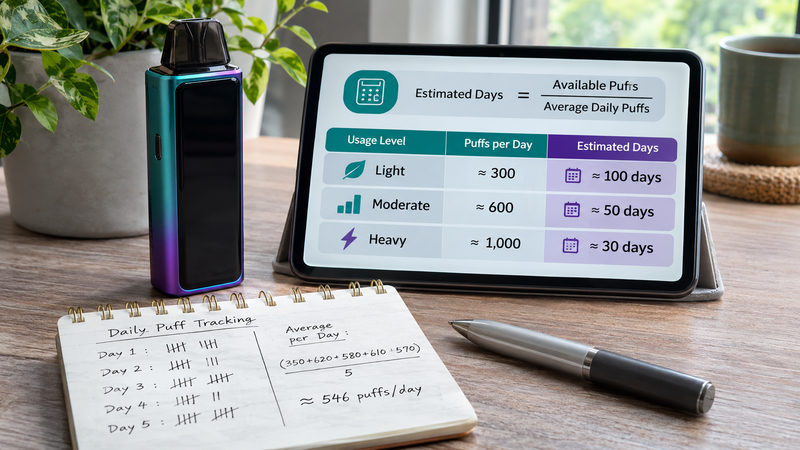
Suppose an adult averages 400 puffs per day. Dividing 30,000 by 400 produces a theoretical lifespan of 75 days. Using a more conservative estimate of 21,000 available puffs gives about 52 days instead. The actual result may land somewhere between the two.
An adult averaging 800 puffs per day would see very different figures. The maximum calculation comes to about 37 days, while 21,000 puffs works out to about 26 days. Daily frequency can change the ownership period considerably. Longer draws and stronger power settings may shorten it further.
- 200 puffs daily: Up to 150 theoretical days, or 105 days using 21,000 puffs.
- 400 puffs daily: Up to 75 theoretical days, or about 52 conservative days.
- 600 puffs daily: Up to 50 theoretical days, or 35 conservative days.
- 800 puffs daily: About 37 theoretical days, or roughly 26 conservative days.
Track normal days, not exceptional ones
A single day rarely captures someone’s normal routine. Use may rise during a stressful workday and fall on a busy travel day. Track at least five to seven typical days instead. Add the daily totals, then divide the sum by the number of days tracked.
For example, daily totals of 320, 410, 380, 500, and 390 add up to 2,000 puffs. Divide that total by five, and the average is 400 puffs per day. This approach limits the effect of one unusually heavy or light day. Separate weekday and weekend averages can make the estimate even more accurate.
Recalculate whenever your routine or device setting changes. A stronger power mode can use more liquid even if the puff counter looks similar. Cold weather, travel, and social situations may change your vaping frequency too. Your personal estimate is most useful as a flexible range, not a fixed expiry date.
4. Why Real-World Puff Counts Can Be Lower
Draw duration and power output
Longer draws keep the coil hot for longer, so it vaporizes more e-liquid during each activation. A four-second draw may consume substantially more liquid than a short laboratory draw. Stronger inhalation can also increase airflow and produce denser vapor.
Power modes introduce another major variable. A stronger mode generally heats the coil faster and creates warmer, fuller vapor. That extra performance usually takes more energy and liquid. Users who prefer maximum output may therefore get fewer total draws than the package suggests.
Airflow affects consumption too. Open airflow may accommodate larger inhalations, while restricted airflow can encourage slower mouth-to-lung draws. Even so, personal technique matters more than the setting by itself. Repeated deep draws can shorten the device’s practical lifespan in either position.
Usage patterns and coil condition
Rapid, back-to-back draws leave the coil with less time to cool and resaturate. The device may run hotter and use its liquid less efficiently. Chain vaping can also make dry or harsh draws more likely. Regular pauses give the wick time to absorb liquid before the next activation.
Coil condition changes as the device ages. Residue from sweet flavorings can build up on the heating surface and dull the flavor. Near the end, the wick may also struggle to deliver liquid consistently. Some users stop using the device before every possible activation has been reached.
Manufacturing variation can cause smaller differences between otherwise identical units. Battery cells, coils, sensors, and seals work within tolerances; they are not perfectly uniform. A minor leak or weak sensor, for example, can reduce usable performance. Authentic products and careful quality control remain important for this reason.
Storage and environmental conditions
Heat can thin the e-liquid and put extra stress on the battery. Extreme cold, meanwhile, may reduce battery performance and stop the liquid from flowing as effectively. Store the device upright in a cool, dry place. Keep it out of direct sunlight and away from hot vehicles.
Dust or condensation near the mouthpiece may interfere with airflow sensors. Carrying the device loosely can also expose it to impacts or accidental activation. A protective case may reduce physical damage during transport. Never use a device that is damaged, leaking, swollen, or unusually hot.
There are many reasons for a gap between advertised and real-world puff counts. Draw duration, power, airflow, coil wear, storage, and product variation all play a role. No single percentage reduction applies to every adult user. For planning purposes, a conservative estimate is more realistic than assuming perfect laboratory performance.
5. Battery, E-Liquid, Charging, and End-of-Life Signs
Several components determine usable lifespan
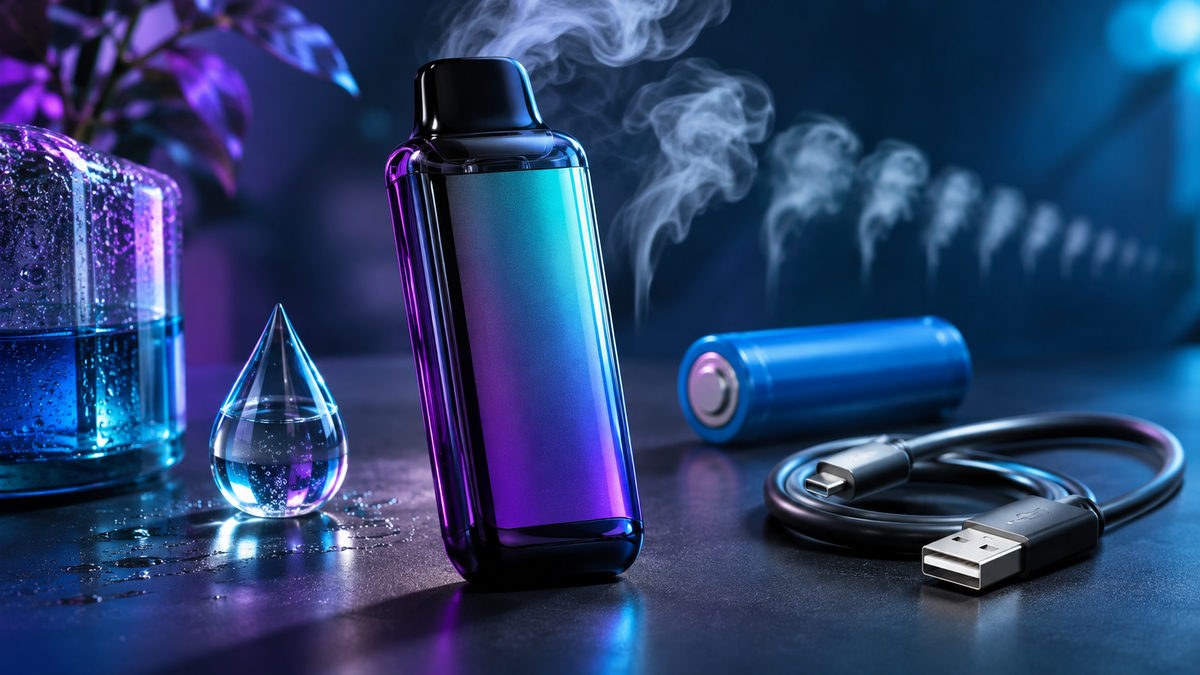
A high-capacity device has to balance its e-liquid supply, battery energy, and coil durability. If any one of these components fails early, the remaining capacity may go unused. A large liquid reservoir by itself cannot guarantee a long service life. The airflow sensor and internal electronics also need to keep working properly.
Rechargeability allows the battery to support a larger supply of e-liquid. Users may need to charge the device several times before the liquid runs out. How often depends on battery size, output mode, and daily use. Stronger modes can drain the battery faster.
But rechargeable does not mean refillable. Charging replenishes electrical energy; it does not replace e-liquid. Never open or alter a sealed disposable device. Puncturing the housing may expose the liquid, damage the battery, or create a serious safety hazard.
Charging behavior matters
Use a suitable cable and a stable power source that follow the manufacturer’s instructions. Charge the device on a hard, dry, nonflammable surface. Keep it away from beds, sofas, direct sunlight, and water. Stop immediately if it becomes unusually hot, swollen, damaged, or starts producing an odor.
Do not leave a charging vape unattended for long periods. Avoid charging it overnight or close to flammable materials. Once charging is complete, remove the cable as directed in the product guidance. Careful charging helps protect the battery and everything around it.
Recognizing the end of usable life
Several signs may show that the e-liquid or coil has reached its practical limit. The flavor can turn weak, burnt, unusually dry, or inconsistent. Vapor production may drop even when the battery has enough charge. Blinking indicators can also point to a low battery, timeout, fault, or depleted device.
- Persistent burnt or dry taste
- Very weak vapor after correct charging
- Repeated blinking without normal operation
- Visible leakage or internal gurgling
- Unusual heat, swelling, odor, or physical damage
Stop using any device that tastes burnt or shows signs of battery damage. Never continue charging it simply to force a few more activations. Fading flavor can indicate depleted liquid or poor wicking. At that stage, retiring the device safely matters more than reaching the puff number printed on the package.
6. High-Capacity Versus Lower-Capacity Vapes
Convenience comes with trade-offs
For adults who already vape regularly, high-capacity devices can mean fewer purchases and fewer trips to a retailer. The trade-off is size. Larger liquid supplies often require bigger housings and rechargeable batteries, which may make the device heavier and less convenient to carry in a pocket.
Lower-capacity options may feel lighter and more straightforward. They also allow users to switch flavors more often without committing to one large supply. Their batteries might not need repeated charging during the device’s lifespan. The downside is that frequent replacement may generate more packaging and battery waste.
- Purchase frequency: Higher capacity may reduce how often replacements are needed.
- Portability: Smaller devices can feel easier to carry.
- Charging: Large devices often need several charging cycles.
- Flavor commitment: One flavor must remain enjoyable for a longer period.
- Waste: Device size and replacement frequency both affect total waste.
A larger number does not guarantee better value
A puff rating tells you very little about flavor accuracy, vapor texture, or reliability. It also cannot tell you whether the nicotine strength suits a particular adult. A low cost per advertised puff may seem appealing at first. If the flavor disappoints or the coil fails early, that apparent value quickly fades.
Authenticity is just as important. A genuine lower-capacity product from a dependable seller may perform better than a questionable high-capacity device. Compare verified liquid volume, battery details, charging design, and product origin before buying. Local legal requirements should shape the decision too.
More capacity does not automatically mean more appropriate use. Adults should pick a product that suits their existing habits and nicotine needs. When treated as a goal, a huge rating may encourage overuse. Puff counts are meant to describe estimated capacity, not set a challenge for users to finish.
7. Nicotine, Safe Charging, and Responsible Disposal
Nicotine requires informed adult use
The BIMO Galaxy 30000 is intended only for adults who have reached the legal purchasing age in places where the product is legally sold. Nicotine is addictive and carries risks. People who do not currently use nicotine should not start. Young people and pregnant people should not use nicotine products.
Nicotine strength can dramatically change the experience. A concentration that feels manageable with occasional use may become excessive during frequent sessions. Nausea, dizziness, headache, or a racing heartbeat can be signs of too much nicotine. Stop using the device and seek appropriate medical advice if concerning symptoms continue.
Keep the device well away from children and animals. Nicotine liquid can cause poisoning if swallowed or absorbed through the skin. If the device leaks, avoid direct contact and follow local poison-control guidance. Store it securely rather than leaving it on a table, counter, or in an unlocked bag.
Charge and handle the battery carefully
Built-in lithium batteries need careful handling. Never crush, puncture, burn, or take apart the device. Do not keep using it after a hard impact or if the casing is visibly damaged. A battery failure may cause heat, smoke, fire, or chemical exposure.
Follow only the charging method described by the manufacturer. Check both the cable and charging port before making a connection. Moisture, debris, and damaged connectors can all create unsafe conditions. Charge the device somewhere you can quickly notice unusual heat or behavior.
Do not store the vape beside keys, heaters, cooking equipment, or other sources of heat. Never leave it in a parked vehicle during hot weather. A cool, dry location helps protect both the battery and e-liquid. It can also lower the risk of leakage and reduced performance.
Dispose of the device responsibly
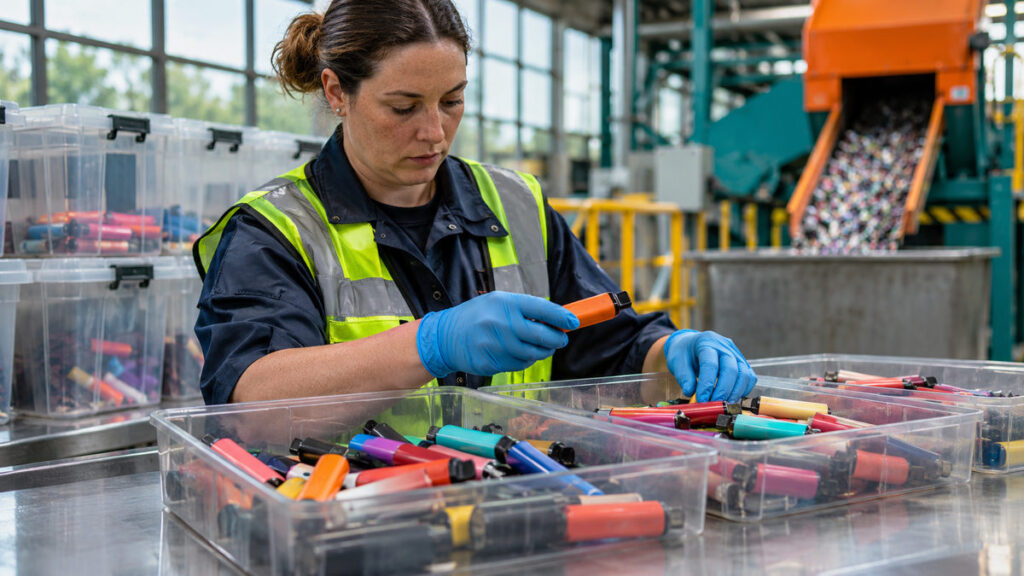
A used rechargeable disposable still contains electronic parts and a built-in battery. It should not go into ordinary household rubbish when local battery recycling is available. Never put it into a fire either. Damaged lithium batteries can ignite during collection or waste processing.
Contact a local household hazardous-waste facility, battery recycling program, or approved electronic-waste collection point. Follow the facility’s directions when transporting damaged devices. Some locations may require separate packaging or covered charging contacts. Since local rules vary, confirm what the facility accepts before you visit.
Responsible disposal helps protect sanitation workers and limit environmental harm. Recycling, however, cannot eliminate every impact linked to disposable products. Before purchasing, adults should consider device lifespan, material use, and access to local recycling. Legal availability and proper disposal deserve as much attention as flavor and capacity.
Conclusion
The BIMO Galaxy 30000 puff figure is best understood as a manufacturer estimate based on defined testing conditions. It does not promise exactly 30,000 satisfying draws for every adult. Real-world longevity depends on daily frequency, draw duration, airflow, power mode, and e-liquid consumption. Battery health, coil condition, storage, and product variation affect the outcome too.
A high rating may be convenient and reduce how often the device needs replacing. It does not automatically deliver better flavor, stronger reliability, suitable nicotine, or greater value. Verified specifications and authentic sourcing are still essential. Safe charging and responsible battery disposal also matter throughout the device’s life.
Track your usual daily puff count over several normal days. Then calculate one lifespan from the advertised maximum and another from a conservative estimate. Check the authentic device specifications before you buy as well. Choose only a legally sold product that suits your habits, nicotine needs, and ability to charge and dispose of it safely.