Could a nicotine-free device still be considered a therapeutic vape? Yes. Nicotine alone does not determine its legal status. Understanding How the TGA Defines a Therapeutic Vaping Device means considering its function, intended use, presentation, and any statutory exclusions. A product might look therapeutic, appear on a notification list, or resemble pharmacy stock without actually having TGA approval.
Consumers and regulated businesses need to distinguish reusable devices from disposables, substances, accessories, packs, kits, and cannabis products. They must also understand the difference between sponsor notification, independent evaluation, and inclusion in the Australian Register of Therapeutic Goods. These distinctions shape the rules for importation, manufacture, advertising, prescribing, pharmacy supply, and patient access.
This guide turns the terminology into practical classification questions and examples. Definitions and regulatory instruments can change, though, and state and territory requirements may differ. Patients should seek clinical guidance, while businesses should obtain qualified regulatory or legal advice.
1. How the TGA Defines a Therapeutic Vaping Device
The basic legal test
Put simply, the category generally covers vaping equipment associated with a permitted therapeutic purpose. The equipment produces or releases aerosol, vapour, or mist for direct inhalation. Electronic operation and a heating element will usually form part of the statutory device concept. Even so, the exact wording of the applicable legislation always determines the classification.
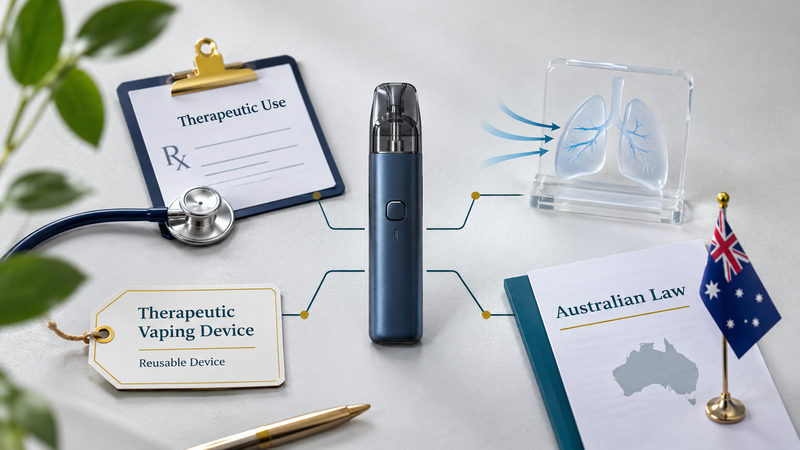
The relevant purpose is generally smoking cessation or the management of nicotine dependence. A reusable electronic device promoted as a way to quit cigarettes may therefore meet the therapeutic-purpose test. Market the same hardware for recreation, and different issues may arise, including prohibitions on non-therapeutic vaping goods. Physical appearance is only part of the picture.
How intended purpose is established
Regulators may examine labels, packaging, advertisements, websites, instructions, and supplier statements. Product design and compatible substances can also reveal the intended purpose. A package that says “helps manage nicotine cravings” provides stronger evidence of therapeutic intent than neutral technical instructions. Simply removing one claim may not be enough if other evidence points to the same intended use.
Context matters too. Pharmacy-only distribution, dosing instructions, clinical claims, and warnings about nicotine dependence may all support a therapeutic classification. Bright, recreational branding, on the other hand, may conflict with the standards for therapeutic presentation. Businesses need to consider the product’s full story, not just one label in isolation.
Why nicotine content does not settle the question
A device may fall within the category even if it is supplied empty. The hardware and the substance placed inside it are classified separately. A reusable device might work with nicotine-containing liquid, nicotine-free liquid, or another compatible substance. Testing the device for nicotine alone cannot establish its legal status.
Take a rechargeable unit sold without a pod. If the instructions link it to nicotine-dependence treatment, the empty unit may still qualify as therapeutic equipment. On the other hand, adding nicotine-related language to an unlawful disposable does not turn it into a reusable therapeutic vaping device. Its physical configuration and statutory category still count.
Express exclusions and legal setting
The specific definition excludes disposable therapeutic vapes and therapeutic cannabis vaping devices. These products belong to separate categories and call for different analysis. Disposable vapes currently face a national ban, rather than an ordinary therapeutic supply route. Cannabis devices remain governed by medicinal cannabis and device controls.
The broader framework includes the Therapeutic Goods Act 1989, regulations, medical device regulations, and delegated instruments. It also covers standards for therapeutic vaping substances, devices, and accessories. Exemptions and special access arrangements may influence lawful supply as well. This overview explains the general principles; it is not a substitute for advice about a particular product.
2. Devices, Disposables, Cannabis Products, and Accessories
Reusable and refillable hardware
A rechargeable device built for repeated use may satisfy the hardware characteristics of a therapeutic vaping device. It could accept refillable tanks, replaceable pods, or compatible cartridges. Reusability alone, however, does not make a device therapeutic. Its intended purpose and presentation must connect it to smoking cessation or the management of nicotine dependence.
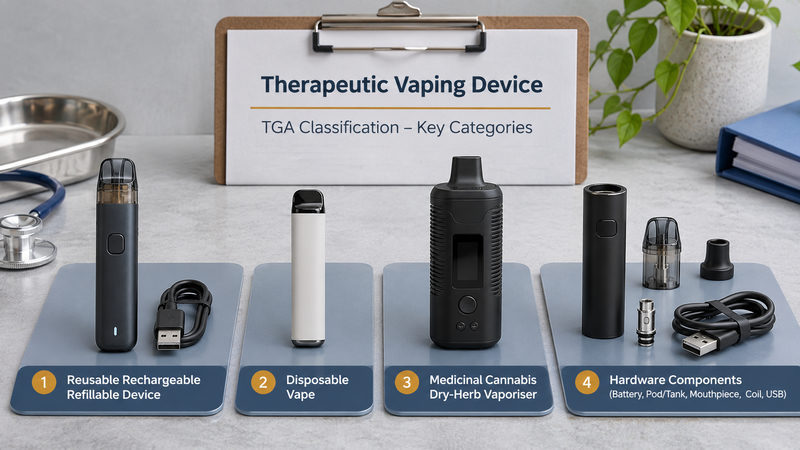
Imagine, for example, a battery unit designed for 300 charging cycles. Its instructions identify compatible therapeutic pods and describe controlled aerosol settings. The packaging also limits its purpose to treating nicotine dependence. Together, those facts support classification as a reusable therapeutic vaping device, provided every other legal requirement is met.
Disposable products and cannabis devices
A disposable usually arrives assembled and prefilled, with no practical way to refill or meaningfully disassemble it. Once its substance or battery is exhausted, the product is typically discarded. Mentioning smoking cessation on the package does not make it a reusable therapeutic device. Current Australian rules ban disposable vapes, including those presented with therapeutic claims.
Therapeutic cannabis vaping devices also fall outside the ordinary therapeutic vaping device definition. They are intended for medicines containing cannabis or synthetic cannabis. A reusable medicinal cannabis vaporiser may need to be assessed under medical device, medicinal cannabis, import, and access rules. Businesses should not assume that documentation for nicotine vapes also covers cannabis equipment.
What counts as a device accessory?
Under the legal terminology, certain supporting items may count as device accessories. An unfilled cartridge, capsule, pod, or similar vessel may qualify if it is designed for a therapeutic device and substance. Whether it is refillable does not always settle the classification. Its design, intended contents, compatibility, and the cannabis exclusions all need to be considered.
This is where everyday language can be misleading. A seller might describe coils, mouthpieces, batteries, or chargers as “accessories,” yet the statutory category may be much narrower. Each article therefore needs to be assessed against the applicable definition. Some components may form part of the device itself, while others may sit outside the specialised accessory category.
Questions that clarify the boundary
- Can the user recharge, refill, disassemble, or reuse the product?
- Are its pods or cartridges replaceable, refillable, prefilled, or permanently fixed?
- What lifespan does the manufacturer specify in the technical documentation?
- Which devices and substances do the instructions identify as compatible?
- Does the presentation describe smoking cessation, nicotine dependence, recreation, or medicinal cannabis administration?
- Does the package contain one article, several components, or a combined regulated product?
These details can place an item in one of several statutory categories. An empty removable pod, for example, differs from a pod that already contains therapeutic liquid. Permanently fixed components may instead point to a disposable configuration. Above all, a commercial label such as “starter kit” cannot override the legal characteristics of what is actually inside.
3. How Substances, Accessories, Packs, and Kits Are Classified
Substances and substance accessories
A therapeutic vaping substance is the liquid or other material used to produce the inhaled aerosol. It is treated separately from the electronic hardware. The substance may contain nicotine, but it can also be nicotine-free. Its intended use with vaping equipment and its therapeutic presentation remain central to the classification.
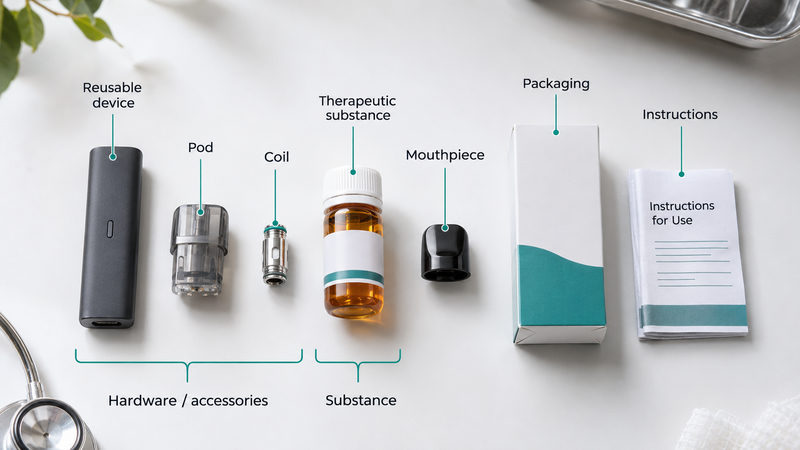
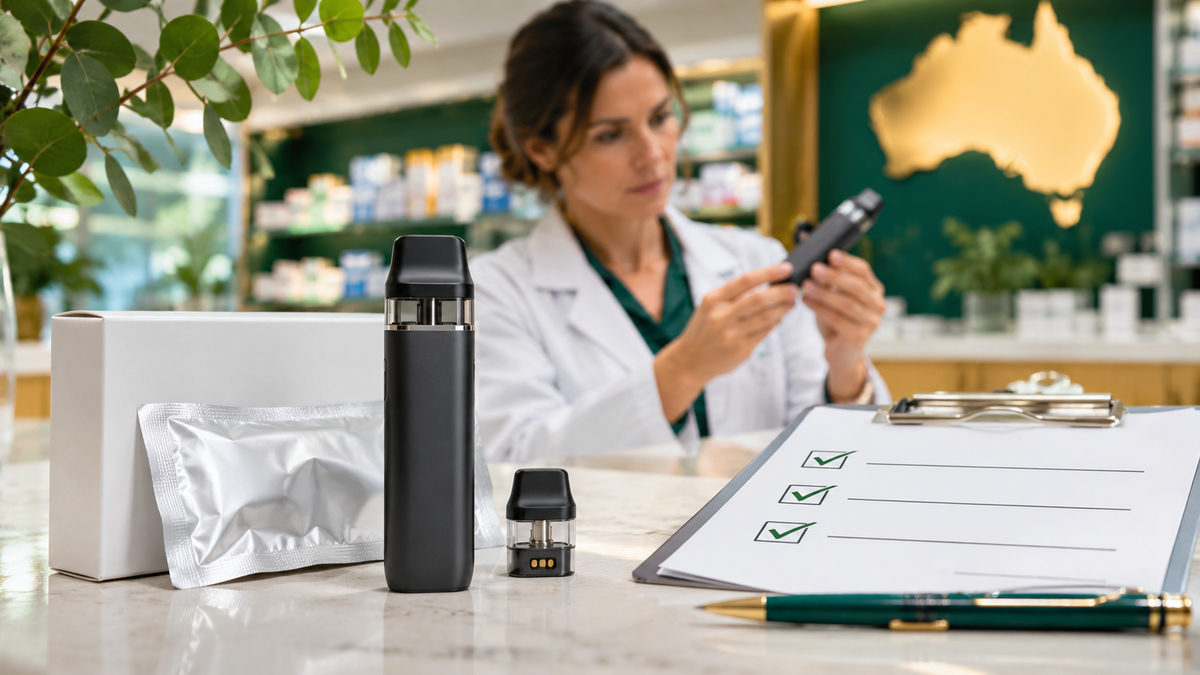
A substance accessory generally contains the therapeutic vaping substance and helps deliver it through a therapeutic device. A filled pod is a straightforward example. An unfilled compatible pod, by contrast, may belong to the device-accessory category. Filling the same vessel can therefore change both the terminology and the compliance analysis.
Other articles might store, measure, transfer, or help administer a substance. That does not automatically bring them within a statutory accessory definition. Businesses need to compare each article’s design and contents with the exact legal wording. They should also record the reasons for the classification they choose.
Packs, kits, and mixed presentations
A therapeutic vaping pack generally combines at least one substance or substance accessory with a device or device accessory. If the statutory definition excludes unrelated therapeutic goods, the pack cannot contain them. A box holding a reusable device and filled therapeutic pods, for example, may qualify as a pack. The answer depends on its exact contents.
A therapeutic vaping kit follows a different statutory structure. Generally, it contains one or more therapeutic vaping substances or substance accessories, with no other goods included. “Pack” and “kit” should not be used as interchangeable terms. Whatever the retailer calls the product, the package contents determine its classification.
Every component still requires its own compliance assessment. A conforming device cannot remedy a non-compliant liquid, just as compliant liquid cannot legalise an excluded disposable or unsuitable accessory. A polished box containing familiar components is no guarantee of lawful supply.
Presentation can create additional risks
Packaging should correctly identify the product, nicotine concentration, ingredients, warnings, and directions. Compatibility instructions should also help users avoid unsafe operation or unsuitable combinations. Required sponsor or supplier details need to be clear and consistent. Any concentration shown on the package should match the testing records and technical specifications.
Therapeutic claims may affect both classification and advertising obligations. “Controls cravings within minutes,” for instance, carries very different implications from neutral operating instructions. Youth-oriented names, decorative graphics, or prohibited flavours may also breach current presentation rules. Businesses should examine the complete package before import, notification, or supply.
- Confirm the legal category of every included article.
- Verify substance ingredients, strength, volume, and flavour restrictions.
- Match device compatibility claims with validated technical evidence.
- Check required warnings, instructions, identifiers, and supplier information.
- Review the finished pack or kit as one commercial presentation.
4. ARTG Inclusion, TGA Notification, and Approval Myths
Unapproved goods and ARTG inclusion
Many therapeutic vaping goods supplied under lawful special arrangements remain unapproved goods. Generally, this means they are not included in the Australian Register of Therapeutic Goods. They have not gone through the usual pre-market evaluation associated with approved therapeutic goods. Still, strict access pathways may allow them to be supplied in certain circumstances.
ARTG inclusion is a separate regulatory pathway. It usually requires supporting evidence and compliance with the rules that apply to the relevant medicine or medical device. Current TGA information states that no therapeutic vapes for nicotine dependence are included in the ARTG. Readers should confirm that this remains the case before relying on it.
Lawful supply does not automatically mean ARTG registration, listing, or inclusion. Nor does professional-looking packaging prove that a product is lawful. Purchasers should identify the exact product, its sponsor, the relevant pathway, and the current supply conditions. Businesses need documents, not assumptions based on branding.
What sponsor notification means
Eligible sponsors must notify the TGA before importing or supplying specified unapproved therapeutic vaping goods. In doing so, the sponsor certifies that the goods meet the applicable requirements. The sponsor must hold evidence supporting that certification and provide it when requested. False or unsupported certification can lead to serious enforcement action.
The notified vape list records products covered by relevant sponsor notices. It can help health professionals and patients identify goods that may enter lawful supply pathways. An entry, however, records a notification—not an independent product endorsement. The TGA does not recommend one listed brand over another.
Crucially, notification does not show that safety, quality, efficacy, or performance has been independently evaluated. Minimum product standards address known risks, but they cannot eliminate every risk. “TGA notified” should never be presented as “TGA approved.” Such wording could mislead patients and commercial partners.
Availability and verification
A listed product may not be available from every pharmacy. Pharmacies decide whether to stock therapeutic vapes and which suitable products they will supply. A single notified entry may also fail to cover every model, flavour, strength, size, or device combination. The exact identifiers need to match the notified details.
Before relying on a product’s status, consult the live TGA notified vape list. Search the ARTG separately, and check current recalls, withdrawals, and safety alerts as well. Businesses should review sponsor notices, certificates, specifications, and supply records. Patients can ask a pharmacist to confirm the product and the lawful access pathway.
- Match the brand, model, variant, strength, flavour, and package size.
- Confirm that the sponsor notice remains current and has not ceased.
- Search separately for any ARTG entry rather than assuming one exists.
- Review recalls, safety alerts, withdrawals, and adverse-event information.
- Ask whether the supplying pharmacy actually stocks the exact product.
5. Safety Standards and Business Compliance Obligations
Standards for devices and substances
Therapeutic vaping goods must comply with the standards relevant to their category. These include the TGO 110 requirements for substances and related goods. The Medical Device Standard Order covers qualifying therapeutic vaping devices and accessories. Sponsors still need to confirm which version, amendments, transitions, exemptions, or Essential Principles currently apply.
Requirements for devices may cover their design, construction, performance, and ability to deliver aerosol reliably. Manufacturers may also need evidence dealing with leakage, overheating, electrical faults, battery hazards, contaminants, and incompatible components. Risk management should address normal use as well as reasonably foreseeable misuse. Testing needs to reflect the finished device, not an ideal prototype.
Compatibility calls for particular care. Too much power, for example, can overheat a substance intended for lower operating settings. The wrong pods may leak or produce inconsistent aerosol. Manufacturers should validate the combinations they specify and clearly flag incompatible components. Every technical claim needs traceable evidence behind it.
Labelling, packaging, and presentation
Labels and instructions may need to show product identifiers, warnings, directions, and sponsor information. Packaging rules can also restrict colours, names, graphics, flavours, and health-related suggestions. Instructions should explain how to charge, fill, clean, store, and dispose of the product safely. English-language instructions must remain legible for the intended shelf life.
The finished package needs to align with notification records and technical documents. Even a small label change can alter the claims or create an unnotified variant. Businesses therefore need formal review and change-control procedures. Before releasing a revised product, they should assess the regulatory consequences.
Responsibilities across the supply chain
Sponsors are responsible for correct classification and selection of the proper market pathway. They must manage notification or ARTG obligations, retain supporting evidence, and monitor post-market performance. They should also investigate complaints, report relevant events, and respond promptly to TGA requests. Supplier assurances on their own are rarely enough.
Manufacturers need sound quality controls, technical documentation, traceability, and accurate specifications. Their controls should cover materials, production changes, software, batteries, and critical suppliers. Importers and wholesalers, meanwhile, should verify sponsor status, import permissions, product identity, and storage conditions. Distribution records must be detailed enough to support targeted recalls.
Commercial importers may also require licences or permits administered outside the TGA. Customs controls, nicotine requirements, and other border rules may apply. A TGA notification therefore does not automatically authorise every import transaction. Businesses should check the requirements of each regulator before goods are shipped.
Pharmacy duties and enforcement
Pharmacists should consider clinical suitability, patient eligibility, and the permitted product selection. They must comply with the relevant access pathways, supply conditions, recordkeeping duties, and local medicines laws. Advertising restrictions and pharmacy-only supply rules also limit ordinary retail promotion. A pharmacist is not obliged to stock or supply a requested vape.
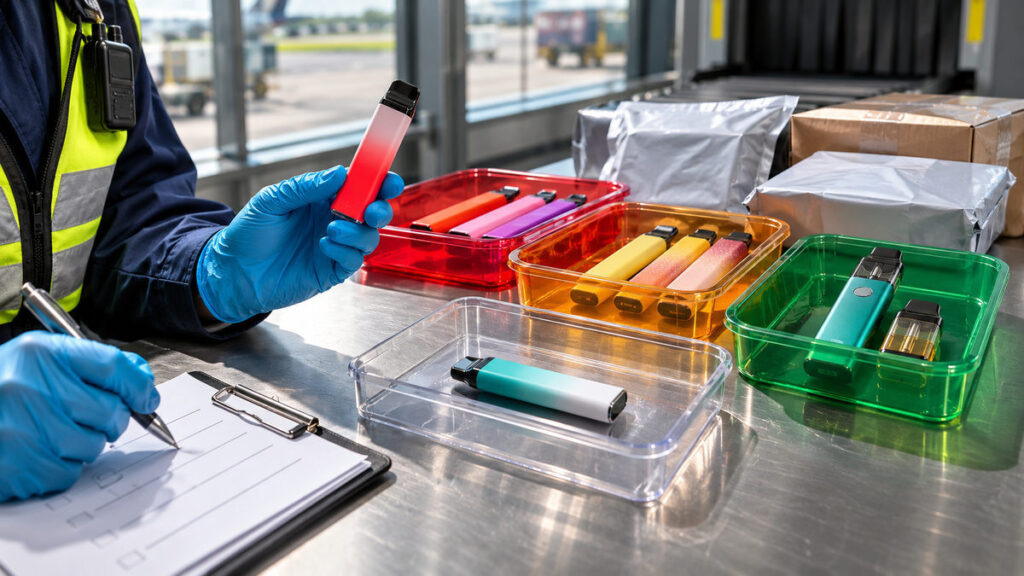
Regulators may act against unlawful importation, manufacture, advertising, possession for sale, or supply. Enforcement options include border seizure, recalls, infringement notices, civil proceedings, and criminal prosecution. False certification can also expose responsible parties to significant consequences. Strong records help show that compliance is genuine and ongoing.
6. Lawful Import, Pharmacy Supply, and Patient Access
Commercial importation and distribution
Before importing or supplying therapeutic vaping goods, a business must identify an authorised pathway. Sponsor notification, evidence of compliance with standards, border permissions, and suitable distribution controls may all be required. Restrictions on advertising and commercial possession also operate throughout the supply chain. A product being legal in the supplier’s country says nothing about its Australian compliance.
Importers should compare invoices, model numbers, strengths, and package configurations with their current documentation. They also need to check whether transition dates or withdrawn notices have changed the product’s supply status. Regular checks remain necessary long after the first shipment. Compliance does not stop at the border.
Personal importation and pharmacy access
Individuals cannot order vaping products from overseas retailers or websites, even if they have a prescription. Vaping goods are excluded from the ordinary Personal Importation Scheme. A limited traveller exemption may apply to accompanied baggage within specified quantities. Before travelling, people should confirm the current rules with the TGA and Australian Border Force.
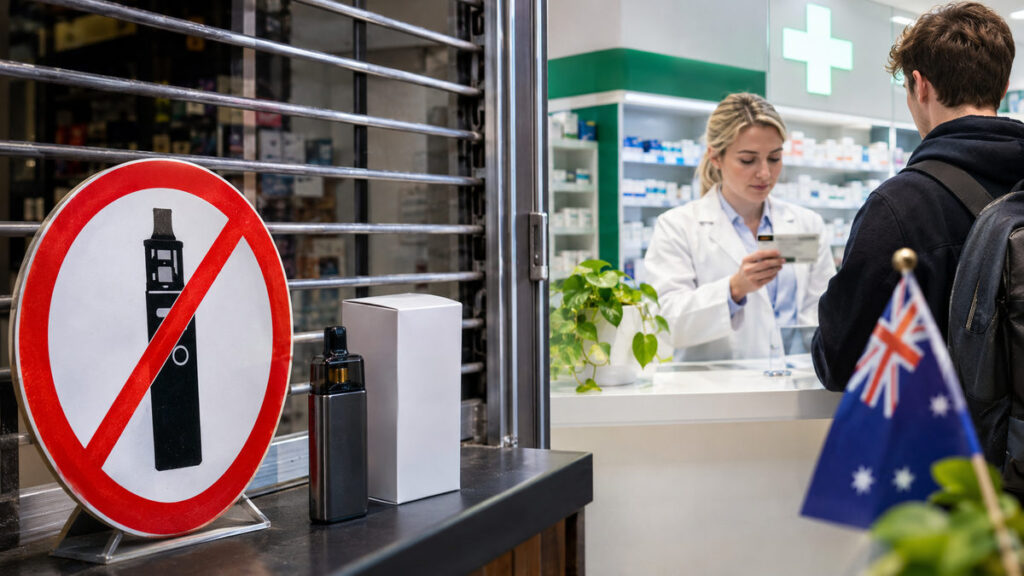
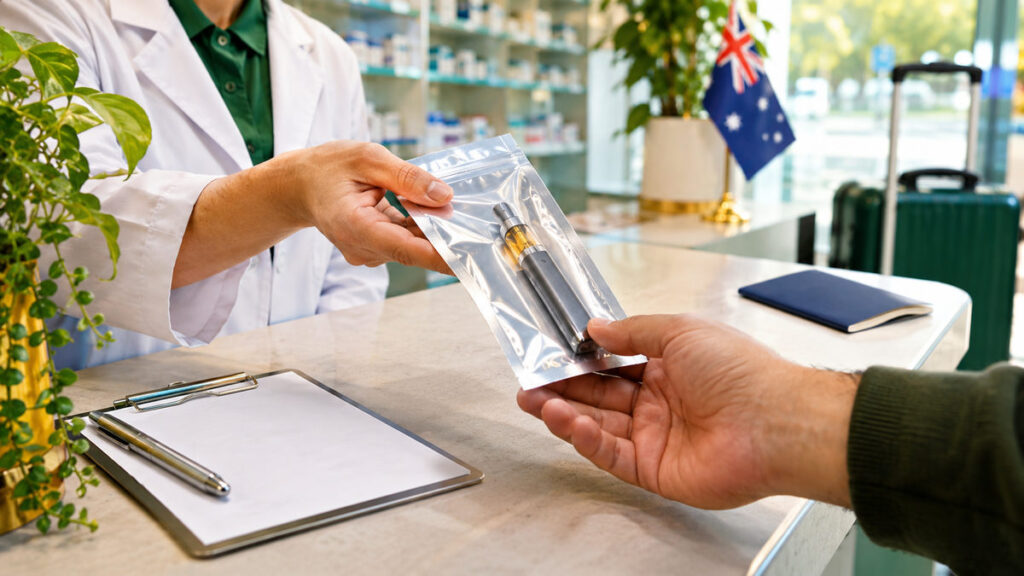
Lawful therapeutic products are generally available through participating Australian pharmacies. Vape shops, tobacconists, convenience stores, and general online retailers cannot sell them. This restriction also applies to nicotine-free vapes. The therapeutic pathway is intended for smoking cessation and the management of nicotine dependence.
Adults may obtain qualifying products containing no more than 20 mg/mL nicotine following a pharmacist consultation. State or territory law may set stricter conditions, however. A prescription is generally required for higher strengths, people under 18, or situations needing additional clinical oversight. Products with more than 50 mg/mL nicotine are not permitted.
The rules for younger patients vary considerably between jurisdictions. Some prohibit supply to people under 18 even if they have prescriptions. Others require prescriptions more broadly than the Commonwealth scheduling settings. Patients and professionals need to check the latest requirements of the relevant health department.
The clinical conversation
Therapeutic vapes are not first-line treatments for smoking cessation or nicotine dependence. A pharmacist may first discuss approved alternatives, such as nicotine patches, gum, lozenges, or other clinically appropriate treatments. Not every requested product will suit every patient.
Patients should talk about pregnancy, cardiovascular conditions, medicines, previous reactions, and their current nicotine use. They should also ask about dose selection, device operation, storage, and follow-up. A clear treatment plan can lower the risk of accidental overuse or prolonged dual use. Any adverse event calls for prompt clinical attention and appropriate reporting.
Non-therapeutic and disposable products
Australia prohibits the commercial importation, manufacture, advertising, and retail supply of non-therapeutic vaping goods. The controls apply whether or not the product contains nicotine. Non-pharmacy retailers cannot create a lawful pathway simply by adding health claims. Unsupported therapeutic wording may create further regulatory problems.
Relabelling a disposable vape does not turn it into a lawful reusable therapeutic device. Its fixed, prefilled, single-use configuration still determines what it is. Current rules also ban disposable vapes, including products claimed to be therapeutic. Businesses should not rely on overseas labels such as “medical disposable” or “cessation vape.”
Verification checklist
- Confirm the exact statutory category for every product and component.
- Identify the Australian sponsor and verify its current documentation.
- Check notification status and search the ARTG separately.
- Confirm the applicable substance, device, labelling, and packaging standards.
- Verify import permissions and lawful wholesale distribution arrangements.
- Check pharmacy supply, scheduling, prescription, and patient-age conditions.
- Review current recalls, withdrawals, safety alerts, and sponsor changes.
- Confirm Commonwealth and relevant state or territory requirements.
Conclusion
A therapeutic vaping device is classified by looking at its function, intended use, presentation, and statutory category. Neither nicotine content nor therapeutic-looking branding can settle the question by itself. Reusable devices, disposables, cannabis vaporisers, substances, accessories, packs, and kits may all follow different rules. Every product requires a careful assessment based on evidence.
Notification, ARTG inclusion, and TGA evaluation are distinct concepts. A notified product has not necessarily undergone an independent assessment of its safety, quality, efficacy, or performance. Notification does not guarantee that a pharmacy will stock it, either. Exact models, variants, strengths, and package details all matter.
Before buying, importing, manufacturing, or supplying a product, check its details against current TGA guidance and the notified vape list. Search the ARTG public register separately, then review current safety notices and the applicable state or territory rules. Patients should speak with a qualified healthcare professional. Businesses should seek specialised regulatory or legal advice.
This content offers general medical and legal information only. It is not personal clinical advice or advice about a specific commercial product.