A therapeutic vape can be stopped at Australia’s border because of one missing notice. So, what is a TGA sponsor notice? It is a formal notification for certain therapeutic vaping goods supplied under specific exemptions from ARTG inclusion.
Submitting the notice, however, does not mean the Therapeutic Goods Administration has approved the product. Sponsors still need to classify the goods correctly and demonstrate compliance. They must also meet every condition covering importation, manufacture, advertising, distribution, and supply.
This guide explains which goods require notification and who can submit it. It also covers the filing process, supporting evidence, ongoing duties, and enforcement risks. Requirements can change, so sponsors should always check the current rules before making commercial decisions.
1. What Is a TGA Sponsor Notice?
A TGA sponsor notice is a formal notice submitted to the Secretary of the Department of Health and Aged Care. It covers eligible therapeutic vaping goods that a sponsor plans to import or supply after manufacture in Australia. The notice operates under exemptions from inclusion in the Australian Register of Therapeutic Goods, commonly known as the ARTG.
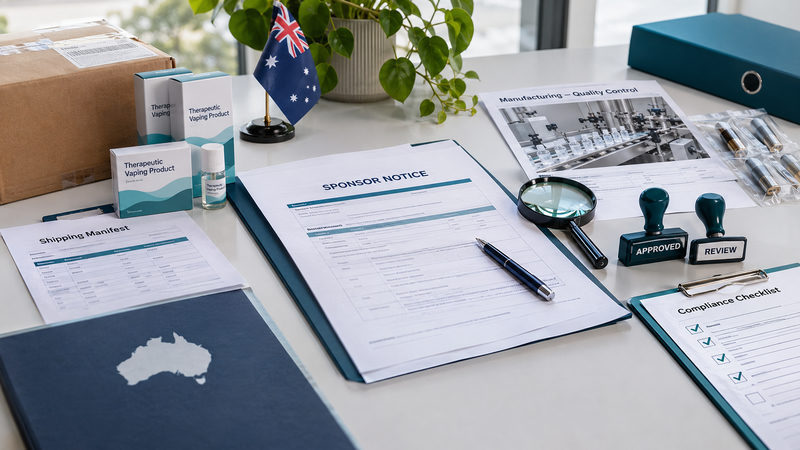
The framework generally applies to unregistered goods intended solely for smoking cessation or the management of nicotine dependence. It can also cover certain ingredients, components, starting materials, devices, accessories, kits, and packaged goods. The precise exemption depends on the product category and the way the goods enter Australia.
Notification is not product approval
A notice records the sponsor’s declarations about specific goods. It is not a full TGA assessment of quality, safety, effectiveness, or device performance. Unless they have a separate ARTG inclusion, notified vaping goods remain unapproved.
For that reason, inclusion on the notified vape list must not be presented as TGA approval. The list simply shows that the TGA received a notice for the named goods. Lawful supply still depends on meeting every relevant exemption condition and supply restriction.
The notice framework allows regulators to identify products, sponsors, manufacturers, and declared compliance arrangements. That information can support border controls, surveillance, inspections, and enforcement. The TGA may also publish details about the sponsor and the notified goods.
The sponsor carries the evidentiary burden
A sponsor must establish compliance before making a declaration. A brief assurance from the manufacturer, for example, is rarely enough to support detailed claims about composition, labelling, or performance. Sponsors should obtain test reports, specifications, certificates, manufacturing records, and evidence relating to the finished product.
That evidence must stay accurate for as long as the notice operates. After submission, the TGA may ask for documents or product samples. Filing a notice without proper support can therefore expose the sponsor to serious civil or criminal consequences.
A valid notice is only one part of a broader compliance system. It cannot fix a non-compliant product or make up for incomplete due diligence. Above all, the sponsor must continue meeting the exemption conditions until the notice ends through withdrawal or a cease-supply determination.
2. Which Therapeutic Vaping Goods Require a Notice?
Whether a notice is required depends on the product, its intended purpose, and its route into the Australian market. Sponsors also need to identify the exemption they intend to rely on. One notice should never be assumed to cover a whole brand or product range.
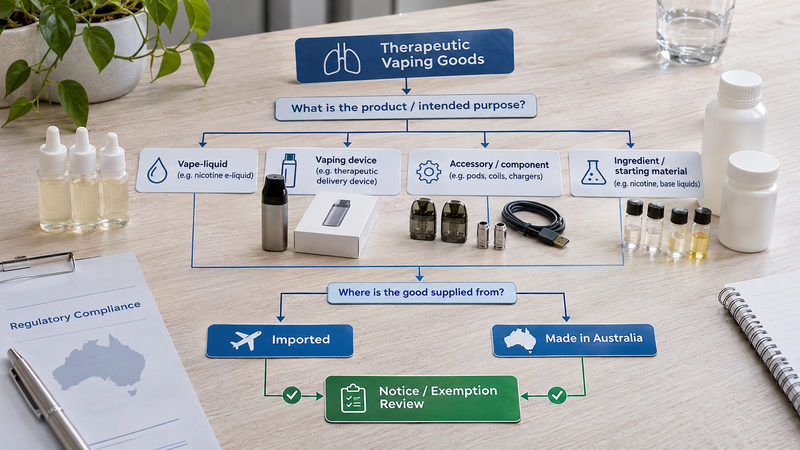
A notice is generally required before an eligible unapproved therapeutic vaping good is imported. For finished goods made in Australia, it is usually needed before the first domestic supply. Imported materials intended for further manufacture in Australia may also require notification before importation.
Goods commonly covered by the framework
Each item should be classified according to its actual composition, presentation, and intended use. Relevant categories can include:
- Therapeutic vaping substances intended for smoking cessation or nicotine-dependence management.
- Filled pods, cartridges, capsules, or other therapeutic vaping substance accessories.
- Ingredients and components used to manufacture substances or filled accessories.
- Nicotine solution imported for manufacturing therapeutic goods.
- Other starting materials or articles intended for Australian vaping-goods manufacture.
- Therapeutic vaping devices and their empty pods, cartridges, capsules, or accessories.
- Components or articles used to manufacture devices or device accessories.
- Therapeutic vaping kits containing substances and substance accessories, without devices.
- Individual goods presented within a therapeutic vaping pack that includes a device.
Finished goods and manufacturing inputs need to be considered separately. A business might, for example, import bulk nicotine solution for local filling and packaging. It may need one notice for the input and another for each finished good before supply begins.
Distinct goods usually need distinct notices
As a general rule, a sponsor completes a separate notice for each distinct type of good. Differences in flavour, nicotine concentration, ingredients, container type, product name, or device characteristics may create separate goods. A range with ten concentrations could therefore require ten notifications, not one filing for the entire brand.
Therapeutic vaping kits are treated differently in some respects. Substances and filled accessories supplied together in a qualifying kit may be included on one form. Even then, the sponsor must provide information about every individual good in the kit.
A therapeutic vaping pack, by contrast, may contain a device or device accessory. Each individual good in that pack generally requires its own form. Sponsors need to distinguish a statutory “kit” from a bundle described that way for ordinary commercial purposes.
Situations where another pathway may apply
A notice is generally not needed if the good is already included in the ARTG. Certain goods imported under a relevant customs licence and permit may also sit outside this notice requirement. Specific medicinal-cannabis vaping products, for example, can be subject to different controls.
Reusable devices intended for medicines containing cannabis may also require a different import notice. The same can apply to an empty vessel used only with such a device. The full purpose of the product matters more than its physical appearance.
Disposable vapes are another major risk area because Australia imposes strict import prohibitions. Vitamins, melatonin products, and heat-not-burn tobacco products may likewise fall outside the permitted therapeutic vaping pathway. A sponsor notice cannot make goods lawful when the governing framework does not allow them.
Classification should happen before stock is ordered, shipped, or supplied. Sponsors should record why each substance, device, component, accessory, kit, ingredient, and starting material belongs in the chosen category. That written reasoning may prove useful in later discussions with customs authorities or the TGA.
3. Who Is the Sponsor and Who May Submit the Notice?
The sponsor is the Australian person or company legally responsible for the therapeutic goods. In broad terms, this is the party that imports, exports, manufactures, or arranges their supply in Australia. The sponsor must also have the necessary relationship with overseas manufacturers and other commercial partners.

An overseas manufacturer does not automatically become the Australian sponsor. Nor does a freight forwarder, customs broker, warehouse operator, wholesaler, or marketing distributor take on that role simply by providing routine services. One of those businesses could still be the sponsor if its activities and legal arrangements meet the definition.
Identify the responsible Australian entity
Take an overseas company that manufactures filled nicotine pods. If an Australian importer buys those pods and supplies them through its own local arrangements, the importer will commonly carry the sponsor responsibilities. The contracts and actual activities still need careful review.
The sponsor needs a TGA client identity and suitable access to TGA Business Services. Only a recognised sponsor can lodge a notice for goods associated with that entity. A consultant cannot use an unrelated client identity simply because they prepared the documents.
Representatives may assist, but responsibility remains
Where the system allows it, a sponsor, manufacturer, or authorised sponsor representative may prepare and submit the form. Regulatory consultants and employees can also organise evidence and manage the drafting process. Their authority and portal access should be documented before anything is submitted.
Outsourcing the administration does not transfer the sponsor’s legal duties. The sponsor remains accountable for the declarations, product compliance, records, and responses to regulators. Contractual indemnities may divide commercial costs, but they do not remove statutory responsibility.
The sponsor should approve the final submission and keep a complete copy. Every manufacturer name, address, product detail, and compliance statement should be checked. Crucially, a senior responsible person should understand the evidence supporting each declaration.
4. How to Submit a Sponsor Notice Through TGA Business Services
The approved sponsor notice is an online form available through TGA Business Services, or TBS. Sponsors should check that they are using the current form, as older downloadable procedures may no longer apply. The official Therapeutic Goods Administration website contains the latest form page and filing guidance.
Step 1: Establish the sponsor’s TGA identity
The Australian sponsor first needs a TGA client identification number. A new organisation must complete the relevant client registration and provide supporting business details. Enough time should be allowed for identity checks and account setup.
The sponsor then needs to arrange user access to its TBS account. Portal permissions control which applications and submissions a user can see or complete. The person lodging the notice must have the right role linked to the correct sponsor.
Businesses should compare the client name with their legal records. Even a small mismatch can cause confusion during product identification or border processing. Sponsors that manage several entities must also choose the one that actually bears the legal responsibility.
Step 2: Assemble the product file
Preparation is best completed before the form is opened. Gathering the information early helps avoid inconsistent answers and abandoned drafts. Sponsors should assemble the following material:
- The sponsor’s legal name, contact details, client number, and authorised-user information.
- The product name, category, presentation, intended indications, and supply configuration.
- Nicotine concentration, flavour, formulation, ingredients, and container details where applicable.
- Device model, characteristics, accessories, components, and intended substance compatibility.
- Manufacturer names, physical addresses, responsibilities, and relevant manufacturing locations.
- Product specifications, labels, package information, instructions, and advertising claims.
- Certificates, test reports, risk documents, and other evidence supporting each declaration.
- Details of any consent covering non-compliance with particular medical-device requirements.
- Manufacturing-input information where materials will undergo further processing in Australia.
For substances, the formula should match the laboratory reports and labels. For devices, model identifiers need to align with certificates and technical documents. The evidence must relate to the version being notified, not merely a similar product sold in another market.
Step 3: Choose the correct notification
Once logged into TBS, the user should go to the Applications area and select the approved online sponsor-notice form for therapeutic vaping goods. Portal wording can change, so navigation should follow the current TGA instructions.
The filer must specify whether the submission is a sponsor notice or a requested restatement. The two have different regulatory purposes. A restatement should only be submitted when the Secretary or a delegate has formally requested one.
Step 4: Complete the product-specific fields
The form requests sponsor details, the category of goods, product information, and manufacturer information. It also includes compliance declarations specific to substances, devices, accessories, or manufacturing inputs. Every answer should be checked against the supporting product file.
Unless the kit rules permit combined reporting, a notice should cover one permissible product type or configuration. Mint liquid containing 20 milligrams of nicotine per millilitre, for instance, is different from a 30-milligram version. A different container or product name may require a separate notice as well.
When imported inputs are used in local manufacture, the sponsor should describe their function accurately. A notice covering unfinished material does not extend to the later finished product. Another notice is generally required before that finished good is first supplied.
Step 5: Review declarations and lodge the form
Before lodging the form, the sponsor should check every field against the source documents. Names, concentrations, model numbers, and manufacturer addresses warrant especially close attention. A second-person review can catch mistakes that might otherwise disrupt customs clearance or lawful supply.
The authorised filer can then complete the declaration and submit the online form. The sponsor should retain the confirmation, submission record, and any notification identifier issued. It should also record the precise product version covered by that identifier.
A receipt or identifier does not correct an inaccurate declaration. Before relying on the notice, the sponsor must wait for any required processing outcome. Importers may also need an Office of Drug Control licence and a shipment-specific permit before bringing the goods into Australia.
Step 6: Build border and supply controls
Import teams should match every purchase order and shipment to the correct notice. Required permits, customs declarations, and product identifiers also need checking. At the same time, supply teams should hold the goods until every exemption and jurisdictional condition has been met.
A warehouse might, for example, quarantine stock while compliance staff verify the notice and import permit. Its release record can show the product, batch, quantity, and approval decision. This straightforward control creates valuable evidence if regulators later inspect the shipment.
5. Product Standards, Essential Principles, and Exemption Conditions
A sponsor notice remains valid only while the supporting legal framework is satisfied. The goods must meet all applicable standards, requirements, and exemption conditions. Sponsors should therefore map their obligations by product category instead of relying on one checklist for every item.
Therapeutic vaping substances
Therapeutic vaping substances must meet the applicable therapeutic-goods standard. Requirements may cover ingredients, nicotine concentration, prohibited substances, flavours, packaging, labelling, and child-resistant features. Sponsors should also hold evidence for the complete finished product, including its shelf life.
Laboratory testing needs suitable methods and representative samples. A certificate of analysis may not prove compliance with every part of the product standard. The sponsor might also need formulation records, toxicological reasoning, container evidence, and stability information.
Permitted indications are equally significant. The goods must be intended for smoking cessation or nicotine-dependence management under the relevant exemption. Lifestyle, wellness, vitamin, energy, sleep, or recreational claims could take the product outside that framework.
Devices and device accessories
Therapeutic vaping devices and accessories are generally subject to medical-device requirements. Unless the Secretary has provided relevant written consent, they must satisfy the Essential Principles. These principles cover safety, performance, design, construction, information, and risk management.
The Medical Device Standard for therapeutic vaping devices may offer a way to demonstrate particular requirements. Supporting evidence can include recognised quality-system certification or specified overseas regulatory material. Sponsors still need to confirm that each certificate is current and covers the correct product and manufacturer.
If a device does not meet a particular Essential Principle, the sponsor cannot deal with the problem simply by disclosing it in the notice. Consent under the Therapeutic Goods Act may be required before filing. Regulators grant this consent only in limited circumstances and may attach risk controls.
Packs, kits, components, and manufacturing inputs
One packaged combination may contain goods subject to different requirements. A device and filled cartridge, for example, can require separate classification and evidence. Every article inside the retail package should be assessed on its own terms.
Components and starting materials need appropriate controls too. Sponsors should confirm their identity, composition, specifications, traceability, transport conditions, and intended manufacturing use. Local manufacturers may also need licences and must follow the applicable manufacturing principles unless an exemption applies.
Exemption conditions extend beyond product design
Compliance does not stop once a product passes its tests. Exemption conditions may govern permitted recipients, record keeping, document production, samples, inspections, and supply reporting. Pharmacy supply and prescription requirements can also be affected by state and territory laws.
Sponsors must cooperate with authorised officers as well. They may be asked to provide documents, arrange testing, facilitate site access, or supply product samples within a specified period. Where another company manufactures the goods, the sponsor should have procedures in place to secure its cooperation.
In practical terms, contracts should allow audit access and require technical records to be delivered promptly. They should address complaint investigations, safety information, change control, recalls, and regulatory requests too. Those arrangements need to work before trouble arises.
6. Ongoing Duties, Restatements, Amendments, and Enforcement
Lodging a notice begins an ongoing set of responsibilities; it does not finish them. Sponsors must keep their evidence current and their records accurate. They should also monitor complaints, product use, adverse events, manufacturing changes, and new safety concerns.
Maintain records and respond promptly
The sponsor should retain the filed notice, declarations, specifications, certificates, test reports, and regulatory correspondence. Distribution records need to support quick batch tracing and product recovery. Adverse-event procedures should also route safety information to trained staff without delay.
The TGA can request information, evidence, documents, or samples. Sponsors must respond accurately and within the specified period. Records held only by an unresponsive overseas supplier are therefore a serious compliance risk.
Changes may require a new notice
A material change may turn a product into a new good rather than a simple administrative update. This can include a change to flavour, formulation, nicotine concentration, product name, container, label, or device characteristics. Proposed changes should be reviewed before updated stock is imported or released.
Manufacturers should not make changes without the sponsor’s approval. A written change-control process can compare the revised product with the current notice and its supporting evidence. It should determine whether the change calls for new testing, consent, permits, or another notice.
Restatements and regulatory intervention
A restatement of compliance is not the same as a voluntary product update. The Secretary or a delegate may formally require a further notice for a particular good. If that happens, the sponsor must follow the approved restatement process and meet the stated deadline.
The TGA can also inspect records or investigate suspected non-compliance. It may publish relevant information about the product and sponsor. A product can be removed from the notified list after withdrawal or a cease-supply decision.
Consequences of non-compliance
Importing or supplying goods without a required notice may breach both therapeutic-goods and customs controls. Unsupported declarations carry similar risks. Regulators may respond by detaining shipments, stopping supply, seizing goods, or ordering corrective action.
Serious cases may result in infringement notices, civil penalties, or criminal prosecution. Providing false or misleading information can add further exposure. A sponsor’s lack of knowledge about the exemption conditions is no defence for failing to comply.
The commercial fallout can include destroyed stock, postponed launches, recalls, cancelled pharmacy arrangements, and reduced insurer confidence. A single incorrect concentration, for example, may affect an entire imported batch. Preventive review usually costs far less than border detention or removal from the market.
Conclusion
A TGA sponsor notice is a formal notification for eligible therapeutic vaping goods supplied under specified exemptions. It is not product approval, ARTG inclusion, or evidence of a TGA assessment. Sponsors must identify each good correctly and support every declaration before they file.
They must also submit the notice at the right time and keep the evidence current. Their continuing duties include record keeping, safety monitoring, change control, reporting, and cooperation with TGA requests. Even after a notice has been filed, breaching an exemption condition can make importation or supply unlawful.
Before importing, manufacturing, or supplying these goods, check the current notice form and requirements on the official TGA website. Carry out a product-specific compliance review that covers every component and finished good. Where classification, evidence, or exemption conditions remain unclear, seek qualified Australian regulatory or legal advice.