A vape battery packs substantial power into a cell small enough to fit in your pocket. But torn insulation, improper charging, or even a loose coin can turn that energy into intense heat. Vape Battery Safety: Essential Information helps you avoid these preventable hazards and spot warning signs before a damaged cell causes an emergency.
Many beginners struggle to recognize unsafe wraps, misleading ratings, or incompatible chargers. Removable-battery devices also demand careful decisions that built-in systems often keep out of sight. The rules below cover how to choose, inspect, charge, carry, store, replace, and recycle lithium-ion cells safely.
1. Vape Battery Safety: Essential Information and Risks
Batteries used in vape devices
Some vape devices use sealed battery packs that cannot be removed by the user. Others take cylindrical lithium-ion cells, most commonly in 18650 or 21700 formats. Size alone, however, does not make a cell suitable for vaping. A battery with the same dimensions may lack the necessary current capability or protective design.
Why lithium-ion cells require careful handling
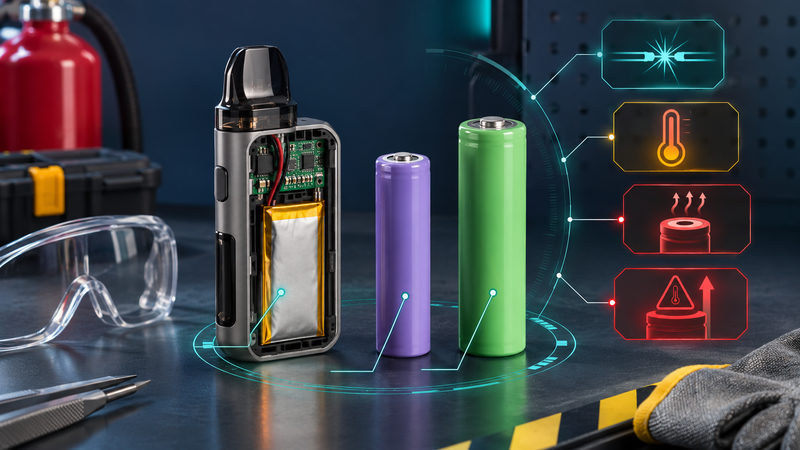
Lithium-ion technology stores a great deal of energy in a compact package, allowing these cells to power demanding devices without excessive bulk. That convenience comes with responsibility. Physical damage, excessive current, incompatible equipment, or manufacturing defects can generate dangerous internal heat. Misuse can also harm the thin separator that keeps the internal components apart.
Short circuits and overheating
A short circuit forms a direct electrical path between the positive and negative terminals. Without the device’s normal resistance, current can rise extremely quickly. The battery may become dangerously hot in seconds. Coins, keys, torn wraps, and faulty equipment can all cause this problem.
Venting and thermal runaway
Venting happens when rising pressure forces hot gas out of a battery. The cell releases this pressure to reduce the chance of a more violent rupture, but the escaping gas may contain flammable material and can ignite. Keep your face and hands well away from any venting cell.
Thermal runaway is an escalating reaction in which the battery generates heat faster than it can release it. As the temperature rises, more internal damage and chemical reactions follow. The cell may vent, burn, or rupture. Nearby cells can overheat as well, allowing the emergency to spread.
Battery explosion prevention
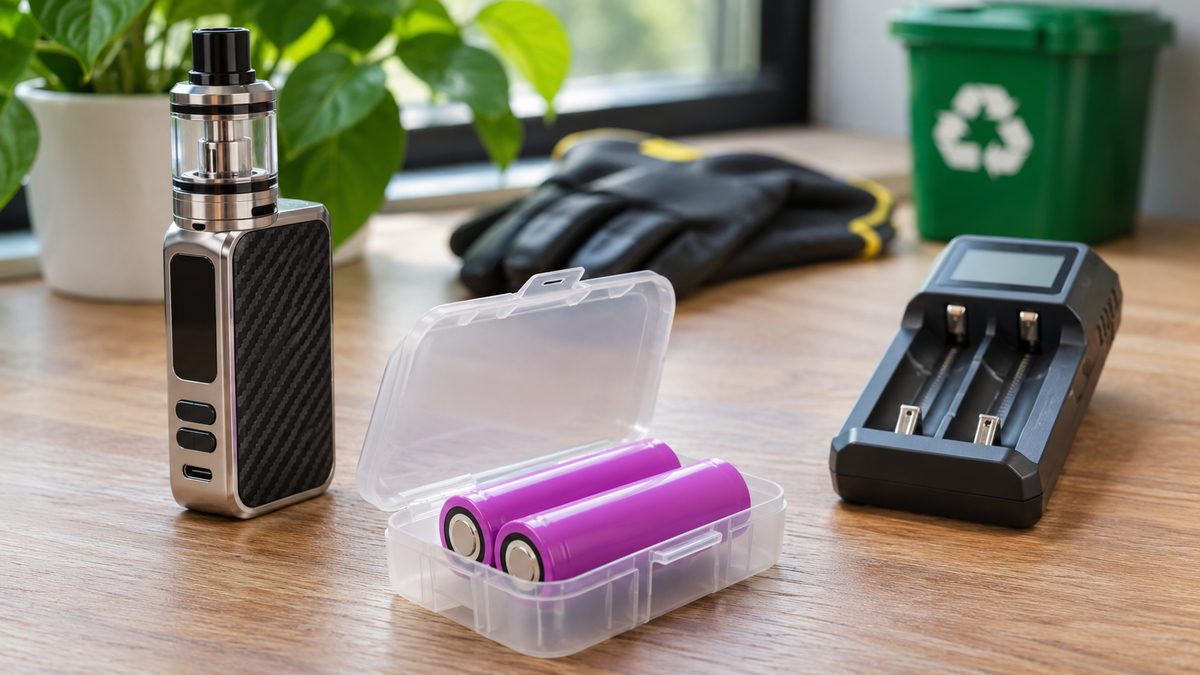
Reduce the risk by buying authentic, compatible cells from reputable sellers. Keep each wrap and insulating ring intact, and always cover exposed terminals during transport. Never exceed a verified continuous current limit. Follow the instructions provided with the device, battery, and charger.
Regulated versus mechanical devices
Regulated mods usually include protection against short circuits, reverse polarity, over-discharge, and charging faults. These safeguards still cannot compensate for every damaged battery, counterfeit component, or unsafe habit. Mechanical devices have few, if any, electronic protections and require advanced technical knowledge. Beginners should use an appropriate regulated device.
2. How to Inspect Battery Wraps and Recognize Damage
Why wraps and insulating rings matter
A removable cell is covered by a thin plastic wrap. Most of the metal can beneath it acts as the negative terminal. At the top, an insulating ring separates that surface from the positive terminal. If the insulation is damaged, parts of the device may bridge the two electrical surfaces.
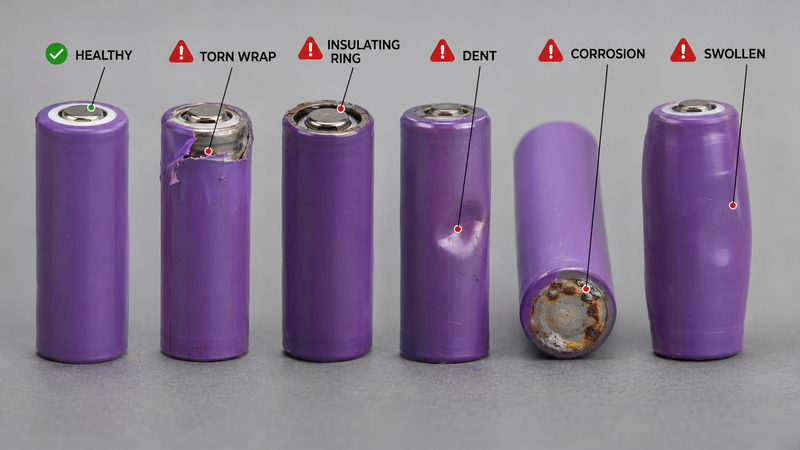
Even a tiny tear near the positive end needs immediate attention. The exposed negative can sits very close to the positive terminal in this area. If a metal contact touches both, it may cause a direct short circuit. Wrap damage is never merely cosmetic.
Step-by-step visual inspection
First, remove the battery exactly as the device manufacturer directs. Work in bright light, with metal objects kept away from the inspection area. Slowly rotate the cell and examine the entire wrap. Check the top, bottom, seams, edges, and any sections that were hidden inside the device.
Then inspect the positive terminal and its insulating ring. The ring should lie flat, remain undamaged, and cover the intended area. Check the negative terminal for dents, residue, or other damage. Finally, examine the cell body for changes in shape or raised sections.
Damage checklist
Stop using the cell and investigate if anything appears wrong. Look specifically for:
- Torn, cut, peeling, or nicked plastic wraps
- Missing, cracked, burned, or shifted insulating rings
- Dents, swelling, crushed areas, or a distorted cell body
- Corrosion, rust, leakage, or unusual residue
- Discoloration, scorch marks, or melted insulation
- Deformed, recessed, or otherwise damaged terminals
- Unusual chemical odors or unexplained heat
When rewrapping may be appropriate
A knowledgeable professional may be able to replace a superficially damaged wrap or insulating ring. The authentic cell underneath must still be correctly identified and free from structural damage, and the replacement materials must fit that exact cell. If you do not have the proper training, replace the battery or consult a qualified specialist.
When immediate replacement is necessary
Retire any cell that has dents, swelling, corrosion, leakage, or deformed terminals. The same applies to cells showing signs of overheating, unknown identity, internal damage, or repeatedly abnormal performance. A new wrap cannot repair a crushed metal can or damaged internals. Never use rewrapping to hide a serious defect.
Warning signs during use
Stop using the device if the battery becomes excessively hot or starts hissing. Other warning signs include swelling, unusual smells, discoloration, and rapid power loss. Unexpected shutdowns or inconsistent charging may also signal trouble. Keep the device out of service until a qualified person identifies the cause.
3. Vape Battery Charging Safety at Home
Safe charging procedure
Choose charging equipment from a reputable manufacturer and make sure it supports your exact battery type. Before each session, inspect the cell, charger, cable, and power connection. Check the polarity before inserting a removable cell into a charging bay. A reversed battery can damage the equipment or trigger a hazardous failure.
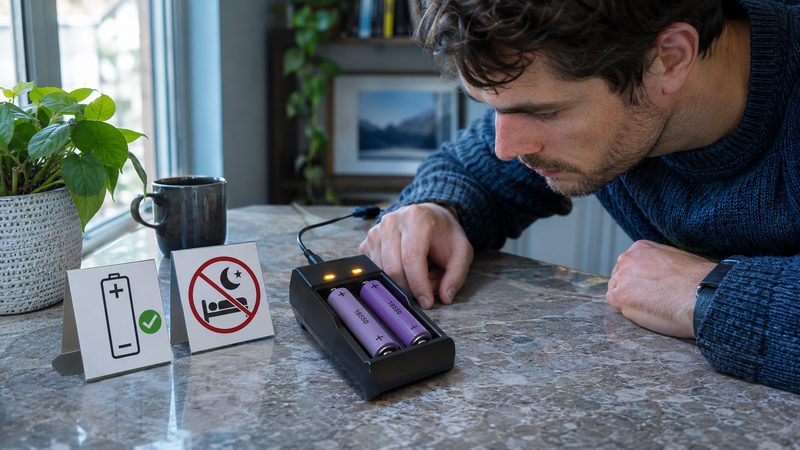
Set the charger on a stable, nonflammable surface with plenty of airflow. Keep it clear of paper, curtains, liquids, and other combustible items. Stay nearby and monitor the battery throughout charging. If you notice heat, odor, noise, swelling, or erratic readings, stop immediately.
Overnight and unattended charging
Never leave a vape charging overnight or while you sleep. Do not charge it while you are away from home, either. A developing fault can quickly escalate if no one sees the early warning signs. Supervision gives you time to disconnect the power safely and leave the area.
External battery chargers
A good external charger can provide useful control when charging removable cells. Independent bays, for example, may monitor and charge each battery separately. Clear status displays can expose voltage differences or unusual charging behavior. Suitable models also protect against reverse polarity, overheating, and excessive charging time.
The charger must still support the cell’s chemistry, size, and charging current. Never force a battery into a bay or rely on damaged sliding contacts. Follow the manufacturer’s directions for bay selection and operating limits. Replace any charger that becomes loose, cracked, or unreliable.
Onboard USB charging
USB charging may be appropriate when the device manufacturer explicitly supports it. Devices with built-in batteries often rely on their internal charging circuits. Use the specified cable, a compatible power source, and the recommended charging method. Do not assume that every cable or high-power adapter is safe to use.
Multi-cell charging considerations
Removable cells from a multi-battery device often benefit from being charged together in a suitable external charger. Doing so makes it easier to compare their progress and keep the set at similar charge levels. Some devices, however, support safe and balanced onboard charging. Use that feature only when the device manufacturer explicitly approves it.
Charging practices to avoid
Several familiar charging habits add needless risk. Avoid:
- Damaged cables, bent plugs, or loose charging ports
- Incompatible adapters and improvised charging equipment
- Chargers with unclear specifications or unknown origins
- Bedding, sofas, carpets, and other heat-trapping surfaces
- Direct sunlight, freezing areas, or extremely hot rooms
- Wet locations and spaces without adequate airflow
Overcharging protection has limits
Electronic protection is a helpful backup, but it can fail. Counterfeit or damaged equipment may not even contain the safety features advertised on its packaging. Faulty cables and charging circuits can behave unpredictably as well. Protective features are never a reason to leave a battery charging unattended.
4. Choosing the Correct Battery and Understanding Ratings
Match the device specifications
Select the cell format, chemistry, nominal voltage, capacity, and current capability required by your device. Above all, follow the device manufacturer’s battery recommendations. A cell may fit the compartment perfectly and still have the wrong electrical characteristics. Never alter a battery compartment to accommodate an unsupported cell.
Continuous discharge rating
The continuous discharge rating, or CDR, shows how much current a battery can provide continuously while remaining within safe temperature limits. This makes CDR the most useful amperage figure when selecting a cell. Rely on a trustworthy, verified rating rather than accepting wrapper claims at face value.
A genuine 20-amp CDR, for example, does not become a 30-amp rating under demanding use. Pushing beyond the limit creates more heat and can accelerate battery damage. Repeated stress may also reduce capacity and shorten the cell’s service life. Choose a battery with a conservative margin above the expected current.
Continuous versus pulse ratings
Pulse, maximum, and burst ratings often look far higher than continuous ratings. The catch? Manufacturers may calculate them using different pulse lengths, temperatures, and recovery periods. Some rewrap brands also print exaggerated figures without explaining the test conditions. Never replace a verified CDR with an unclear pulse rating.
Capacity and current tradeoffs
Battery capacity is usually shown in milliamp-hours, or mAh. More capacity can mean longer runtime under suitable conditions, but it does not automatically mean the cell can safely deliver more current. Battery design often involves a tradeoff between runtime and current capability.
A 5,000 mAh label, for instance, may seem more appealing than 3,000 mAh. Yet that larger number means little if the current rating cannot support the device. Be wary of cells claiming both extreme capacity and extreme amperage. Choose verified performance over an impressive-looking wrapper.
Ohm’s law for vaping
Ohm’s law calculates current by dividing voltage by resistance. As an example, 4.2 volts divided by 0.21 ohms equals 20 amps. This simple calculation shows why lower resistance draws more current from the battery. It matters especially when using unregulated or mechanical devices.
Real systems also involve resistance tolerances, voltage sag, connection losses, and changes in battery condition. Measuring equipment can introduce small errors too. For that reason, never build a setup that runs directly at the battery’s stated limit. Leave a conservative margin and verify the complete setup carefully.
Mechanical mod safety
Mechanical mods do not offer the electronic protections found in regulated devices. The battery responds directly to the coil, contacts, and physical condition of the device. Safe use requires advanced knowledge of Ohm’s law, coil resistance, cell limits, and short-circuit prevention. Every contact and insulating component must also be maintained correctly.
One simple building error can draw more current than the cell can safely provide. A stuck switch or damaged insulator may also cause continuous firing. Mechanical devices are not suitable for beginners. Anyone unsure about the calculations should choose an appropriate regulated device.
Reverse polarity
Battery orientation controls which terminal meets each contact in the device. Always check the positive and negative markings inside the battery compartment. Do not trust memory when swapping cells in a hurry. Installing a battery backward can damage the equipment or cause a hazardous failure.
A regulated device may include reverse-polarity protection, but that feature should never be tested deliberately. Damaged or counterfeit circuitry may not respond as expected. If the compartment markings are worn or unclear, stop. Consult the manufacturer before inserting another battery.
Married battery pairs
Dual-battery and multi-battery devices need closely matched cells. Buy identical authentic batteries together, then charge and use them exclusively as a set. Mark the set without harming the wraps. This keeps each cell on a similar schedule of use, charging, and aging.
Keep married cells at similar charge levels, and rotate their positions if the manufacturer recommends doing so. Never replace one aging member of the set with a new battery. Differences in condition can force one cell to work harder than the other. Replace the entire set if any member is damaged, lost, or unreliable.
Authentic batteries and reputable sellers
Purchase cells from established specialist retailers that offer traceable products and consistent specifications. Packaging should be intact, with labels that look clear and professionally applied. The stated ratings should also be realistic and match dependable technical information. Keep your purchase records in case questions about authenticity arise.
Suspiciously low prices, spelling mistakes, altered wraps, and implausible ratings are all warning signs. Mixed packaging and unverifiable origins deserve caution too. A counterfeit cell may behave nothing like the specifications printed on its exterior. If you cannot confirm authenticity, retire the battery instead of testing its limits.
5. Safe Storage, Transportation, and Emergency Actions
Carry spare batteries in dedicated cases
Keep every removable cell in a rigid, nonconductive battery case. It should fully cover both terminals and prevent the batteries from shifting around. Use a case made for that exact cell size. If the container has cracks, broken hinges, or an unreliable latch, replace it.
Never carry loose cells
Never carry an unprotected cell in a pocket, handbag, backpack, or toolbox. Coins, keys, jewelry, and tools can connect its terminals. A short circuit may then generate severe heat within seconds, potentially igniting clothing or other nearby materials.
Loose cells can also develop wrap damage as they rub against other objects. A single unnoticed nick may expose the negative metal can. A proper case protects the terminals and the wrap at the same time. Thin fabric pouches and plastic bags cannot provide the same protection.
Safe storage conditions
Store batteries in protective cases in a cool, dry, well-ventilated location. Keep them away from direct sunlight, heaters, hot vehicles, freezing temperatures, water, and humidity. Separate them from combustible materials and metal objects as well. The storage area should be secure and out of reach of children and pets.
Storage preparation
For long-term storage, remove the cells if the device manufacturer recommends it. Do not store them fully depleted, since excessive discharge may cause damage. Follow the battery manufacturer’s guidance on storage charge and inspection intervals. Keep the terminals separated, and periodically check each cell for corrosion, leakage, or swelling.
If a battery becomes unusually hot
If unusual heat develops, stop using or charging the device at once. Disconnect the power only if you can do so safely. Never pick up a hot cell with bare hands. Move away, keep others clear, and avoid breathing any fumes.
If conditions allow, move nearby combustible materials without approaching the battery itself. The device is not worth risking personal safety. A hot cell can deteriorate fast, so treat rising heat, hissing, or swelling as an emergency warning.
If a cell vents, smokes, or burns
Do not hold, puncture, crush, or move a venting cell. Never try to reuse a battery after it has released smoke, fire, or gas. Evacuate if necessary and call emergency services when a fire cannot be controlled. Follow local fire-safety instructions without exposing yourself to greater danger.
After an incident
Let professional responders or qualified personnel handle a hazardous cell. Once authorities say the area is safe, ventilate it carefully. Retire any device or charger exposed to heat, smoke, liquid, or physical damage. Damage that is hidden now could cause another failure later.
6. Replacement, Recycling, and Routine Safety Checklist
Battery lifespan and replacement criteria
There is no single replacement schedule that fits every vape battery. Lifespan depends on usage, charging habits, temperature, cell quality, and the demands of the device. Replace a cell when its capacity falls substantially or its runtime becomes unusually short. Increasing heat, inconsistent voltage behavior, visible damage, or manufacturer guidance are also valid reasons to retire it.
Replace uncertain or mismatched cells
Retire any battery with an unknown history, uncertain identity, or questionable authenticity. If one cell in a married set becomes damaged or significantly degraded, replace the whole set. Do the same if one member is lost. Combining old and new cells can create an unsafe performance imbalance.
Responsible battery disposal
Never put lithium-ion cells in household trash or curbside recycling. Instead, insulate the terminals and contain damaged cells individually where local rules allow. Bring retired batteries to an approved lithium-ion collection or recycling facility. For swollen, leaking, burned, or unstable cells, ask local waste authorities for specific instructions.
Daily checklist
- Inspect the device and all visible battery areas.
- Watch for unusual heat, odor, noise, or discoloration.
- Use only compatible batteries, cables, and chargers.
- Confirm correct cell orientation before closing the device.
- Protect every spare cell inside a dedicated case.
- Monitor every charging session from start to finish.
Weekly checklist
- Remove and inspect removable batteries under good lighting.
- Examine every wrap, insulating ring, terminal, and cell body.
- Clean device contacts according to manufacturer instructions.
- Inspect the charger, bays, cable, plug, and charging port.
- Compare paired cells for condition and similar performance.
- Review unexplained declines in runtime, output, or charging behavior.
Final safety rule
Follow the directions provided by every device, battery, and charger manufacturer. If something looks, smells, sounds, or feels unusual, stop. Do not improvise repairs or experiment with questionable equipment. When in doubt, ask a qualified vape battery specialist for help.
Conclusion
Vape battery safety starts with authentic, compatible cells and verified continuous current limits. Intact wraps and insulating rings prevent dangerous contact with the metal cell body. Correct polarity, supervised charging, and suitable equipment reduce the risk further. A protective case also keeps spare batteries safely separated from coins, keys, and other conductive objects.
Take a moment to inspect every removable battery and its case today. Check that the charger and current ratings meet the manufacturers’ requirements. Promptly retire any damaged, degraded, mismatched, or uncertain cell. Then take unsafe and retired batteries to an approved lithium-ion recycling facility.